Manual Metal Arc Welder: Which One to Buy
A manual metal arc welder runs stick rods with no gas cylinder, and this guide compares the 250A, 130A and 125A machines here on input voltage, rod sizes, weight and kit.

On this page
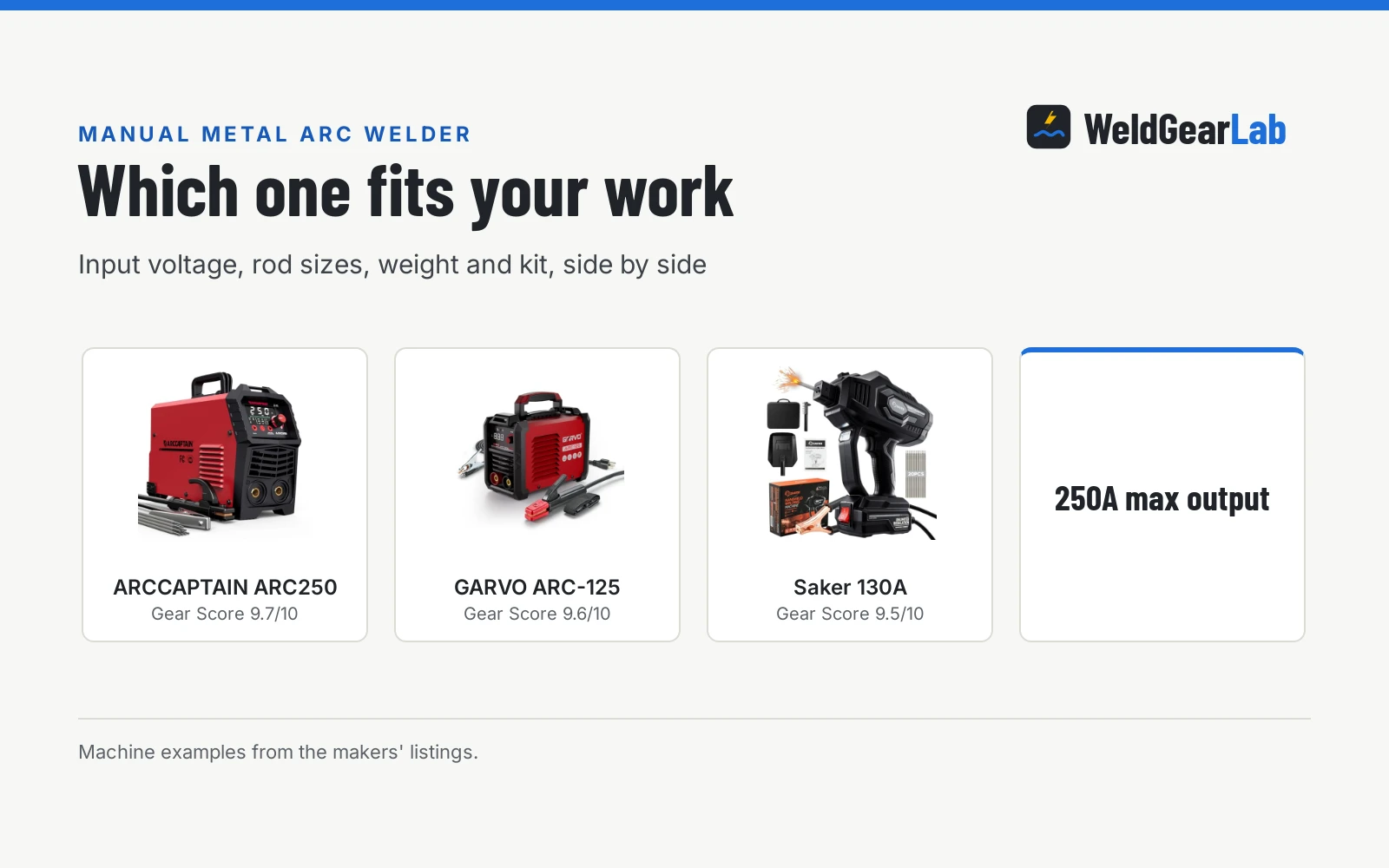
Top picks at a glance
As an Amazon Associate I earn from qualifying purchases.
- 1
 ARCCAPTAIN 250A Stick Welder9.7/10View on Amazon
- 2
 GARVO 110V MMA Welder Machine,125Amp ARC Welder9.6/10View on Amazon
- 3
 Saker 130A Handheld Stick Welder9.5/10View on Amazon
A cracked gate hinge, a broken trailer bracket, a mower deck split along a weld: the repair is a stick weld, laid down with a rod and a machine that runs on household power. A manual metal arc welder is the tool for that job. It strikes an arc between a coated electrode and the work and leaves a bead under a layer of slag, with no gas cylinder and no wire feed to set up. This guide explains what the process needs and which machine here fits each kind of repair.
This guide links to our product roundups, where WeldGearLab gets a commission on purchases made through links on this page, and your price stays the same. Read our affiliate disclosure.
| # | Product | Gear Score | Buy |
|---|---|---|---|
| 1 | ARCCAPTAIN 250A Stick Welder | 9.7/10 | Buy on Amazon |
| 2 | GARVO 110V MMA Welder Machine,125Amp ARC Welder | 9.6/10 | Buy on Amazon |
| 3 | Saker 130A Handheld Stick Welder | 9.5/10 | Buy on Amazon |
ARCCAPTAIN 250A Stick Welder
A 230V stick and lift TIG machine to 250A with synergic control, a 3.2 inch display and a 2-year service term.
Pros
- MMA output to 250A with lift TIG to 220A in the same machine
- Synergic control matches current and voltage to the rod diameter
- 3.2 inch LED display for clear parameter readings
- 10 ft electrode holder and ground clamp plus 10 rods in the box
Cons
- 230V input, so it needs a 230V outlet rather than a standard 110V household outlet
- 11.5 lb, heavier than the 3.9 lb FEIFANKE and the 3.97 lb Saker
- Lift TIG torch sold separately
- At 14.9 in long it takes more bench space than the 8.5 in FEIFANKE
GARVO 110V MMA Welder Machine,125Amp ARC Welder
A 125A stick welder on 110V to 120V household power with hot start, arc force and a complete accessory kit.
Pros
- 125A max output with a 10-125A dial for fine control
- Hot start and arc force built in, with anti-stick
- Runs on 110V-120V household outlets with voltage stabilization
- Complete kit: 10-ft holder, ground clamp, hammer and plug converter
Cons
- 125A max output, below the 250A machines in this guide
- Stick only, with no lift TIG mode
- No warranty term is stated
- 1/8 in is the only electrode size stated, so no smaller rod is named for thin work
Saker 130A Handheld Stick Welder
A 3.97 lb handheld stick welder to 130A on 110V, with a digital display and rod recommendations.
Pros
- 3.97 lb handheld body, built for work at height
- Digital display with real-time amperage and rod recommendations
- 130A output from a standard 110V household outlet
- Overheat, overcurrent and overvoltage protection with fan cooling
Cons
- 130A max, below the 250A machines in this guide
- Stick only, with no lift TIG mode
- No warranty term is stated
- 1/8 in is the largest rod size stated
What a manual metal arc welder is
Manual metal arc welding, usually called stick welding, feeds current through a coated rod. The coating burns as the rod melts, shielding the puddle and leaving slag over the bead. The machines in this guide run on 110V household power or a 230V outlet, and each one lists the rod sizes or types it takes.
Stick suits outdoor work and dirty metal, since wind cannot blow the shielding away the way it can with gas. The trade is slag to chip and more spatter than gas MIG, plus a rod to change as it burns down. See the stick vs MIG welder comparison for the full trade between the processes.
The welders in this guide
Pick the machine by the repair in front of you: the rod size and the current the joint needs decide it, and the cards below give both for each machine.
Side by side
| Machine | Max output | Input | Weight | Processes |
|---|---|---|---|---|
| ARCCAPTAIN ARC250 | 250A | 230V | 11.5 lb | Stick and lift TIG |
| GARVO ARC-125 | 125A | 110V-120V | Not stated | Stick |
| Saker 130A | 130A | 110V | 3.97 lb | Stick |
| FEIFANKE 250A | 250A | 110V | 3.9 lb | Stick |
Input voltage splits the group: the ARCCAPTAIN needs a 230V outlet, while the other machines run on 110V household power. Output splits it again: the ARCCAPTAIN and the FEIFANKE both claim 250A, against 130A for the Saker and 125A for the GARVO. Weight is the last split: the Saker at 3.97 lb and the FEIFANKE at 3.9 lb carry by hand, while the ARCCAPTAIN at 11.5 lb comes with a handle and shoulder strap.
How to tell what a machine supports
The same handful of facts decide whether a machine fits the repair:
- Input voltage. A 110V machine plugs into a standard household outlet; a 230V machine needs a 230V outlet. Check the outlet before ordering.
- Max current and rod size. The Saker and the FEIFANKE take rods from 1/16 in to 1/8 in, and the GARVO is rated for 1/8 in electrodes.
- Hot start, arc force and anti-stick. Hot start eases striking the arc, arc force steadies the puddle, and anti-stick keeps the rod from freezing to the work. The ARCCAPTAIN, GARVO and FEIFANKE list hot start, arc force and anti-stick; the Saker lists none of them, and leans on its display and rod recommendations instead.
- What is in the box. Rods, a holder, a ground clamp, a brush and a hammer vary by machine, so check the kit list first.
For the arc controls in detail, see the hot start vs arc force stick welder guide.
Rods and metal: what these machines weld
The rod types named here are E6010, E6011, E6013, E6014 and E7018, with the ARCCAPTAIN and the FEIFANKE naming E6010, E6011, E6013 and E7018, and the GARVO adding E6014. Rod sizes run from 1/16 in to 1/8 in, or 1.6mm to 3.2mm on the FEIFANKE. Metals named are mild steel, stainless steel, cast iron and carbon steel, with the Saker adding iron for general repair work.
Match the rod to the metal and set the polarity the rod calls for. The best 7018 1/8 welding rod picks cover the low-hydrogen rod most of these machines name.
For more options, see our welders guides.
FAQ for welders
What is a manual metal arc welder?
A manual metal arc welder is a stick welder: it strikes an arc between a coated electrode and the work, and the coating shields the puddle as the rod melts. The machines here run on 110V household power or a 230V outlet, with rod sizes from 1/16 in to 1/8 in. No gas cylinder is needed.
Can a manual metal arc welder run on a standard household outlet?
The Saker, GARVO and FEIFANKE run on 110V household power, while the ARCCAPTAIN needs a 230V outlet. Check the outlet the machine needs before ordering, and make sure the circuit can carry it.
What rods does a manual metal arc welder use?
The rods named here are E6010, E6011, E6013, E6014 and E7018, in sizes from 1/16 in to 1/8 in. The Saker display (on Amazon) gives rod recommendations as the current is set.
Is stick welding good for outdoor repairs?
Yes, for fence repairs, farm maintenance and garage projects, the jobs the Saker names. Wind cannot blow away the shielding the way it can with gas, since the rod coating makes its own shield. Chip the slag before the next pass or before painting.
Is another machine needed for TIG?
Only the ARCCAPTAIN here runs lift TIG, to 220A, and its torch is sold separately. The other machines are stick only. If TIG matters, see the stick welder vs multi-process welder comparison.
Related: stick welder AC vs DC, flux core vs stick for outdoor use, MIG vs stick for rusty metal, and the best portable stick welder roundup.