Flux Core vs Stick for Outdoor Use: Which One Should You Buy?
Self-shielded flux core and stick each weld fine outdoors with no gas to lose; this guide compares the processes on wind, setup, thickness and cleanup, and shows self-shielded wires built for field work.

On this page
Top picks at a glance
As an Amazon Associate I earn from qualifying purchases.
- 1
 ARCCAPTAIN Flux Core Welding Wire E71T-GS .035" 2LB x 39.5/10View on Amazon
- 2
 INETUB BA71TGS Flux Core Welding Wire .035"View on Amazon
- 3
 YixangDD 2 Pack 030 Flux Core Welding WireView on Amazon
- 4
 4-Pack 0.030" Flux Core Welding WireView on Amazon
- 5
 PGN E71T-11 .030" + .035" Gasless Flux Core Welding Wire 2 lbView on Amazon
- 6
 RUBIK 0.030" Flux Core Gasless Mig Wire-E71T-GS 2Pcs 2-PoundView on Amazon
- 7
 ATLASWELDER Flux Core Welding WireView on Amazon
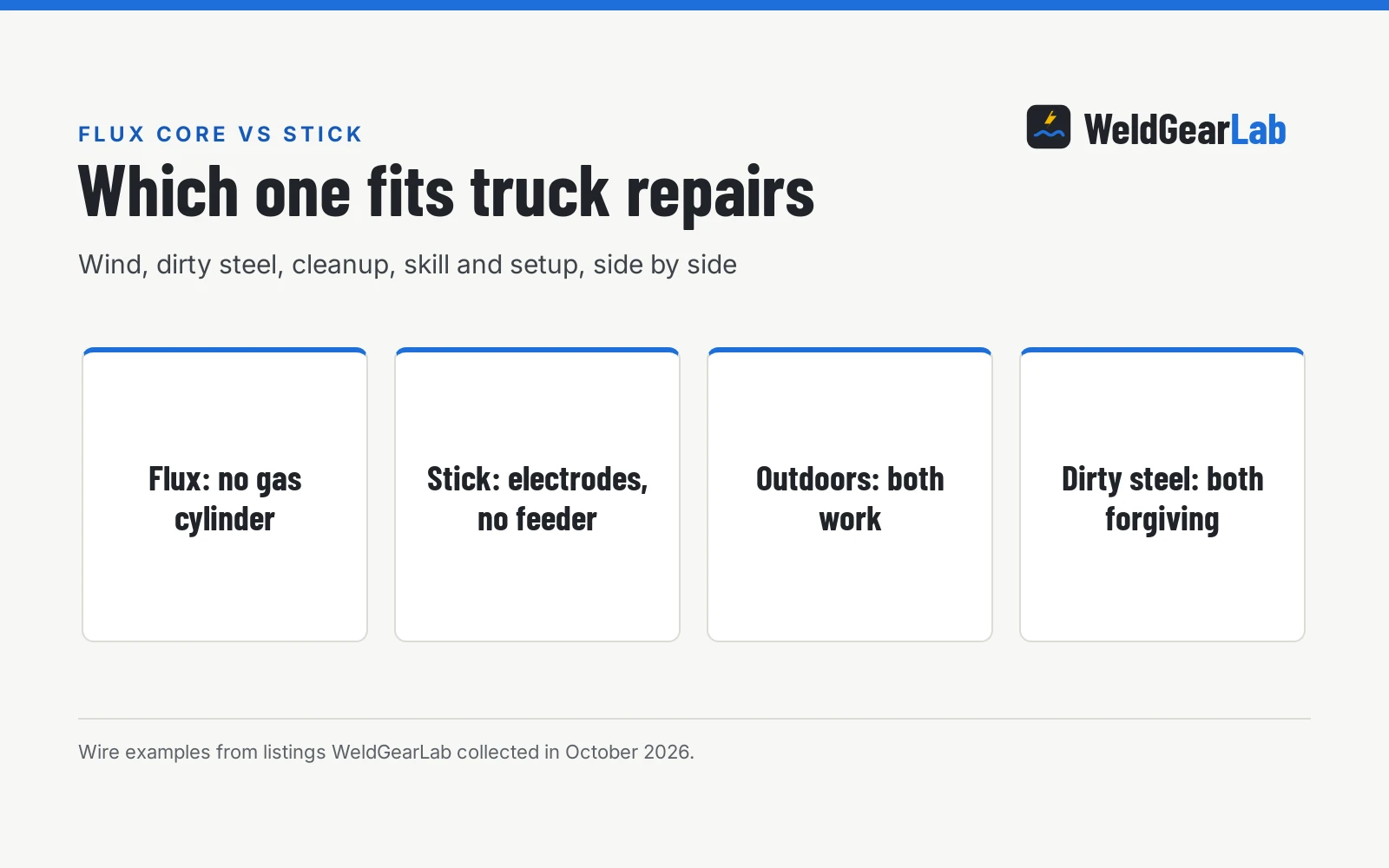
A gate frame that needs mending before the weather turns, a trailer with a cracked bracket sitting out in the yard: that is the kind of job that settles the flux core vs stick for outdoor use question. For outdoor work, each beats gas MIG, and self-shielded flux core is the handier pick for most home and farm welders because the wire feeds continuously and there is no gas to blow away. Stick still earns its place when the steel is thick, dirty or far from an outlet, since a stick machine is simple to drag around and electrodes tolerate poor fit-up. This guide lays out where each process wins, then shows self-shielded wires built for outdoor work.
Other welders and gear to compare
 INETUB BA71TGS Flux Core Welding Wire .035"Check price on Amazon
 YixangDD 2 Pack 030 Flux Core Welding WireCheck price on Amazon
 4-Pack 0.030" Flux Core Welding WireCheck price on Amazon
 PGN E71T-11 .030" + .035" Gasless Flux Core Welding Wire 2 lbCheck price on Amazon
 RUBIK 0.030" Flux Core Gasless Mig Wire-E71T-GS 2Pcs 2-PoundCheck price on Amazon
 ATLASWELDER Flux Core Welding WireCheck price on Amazon
This guide links to our product roundups, where WeldGearLab gets a commission on purchases made through links on this page, and your price stays the same. Read our affiliate disclosure.
Flux Core vs Stick for Outdoor Use: The Short Answer
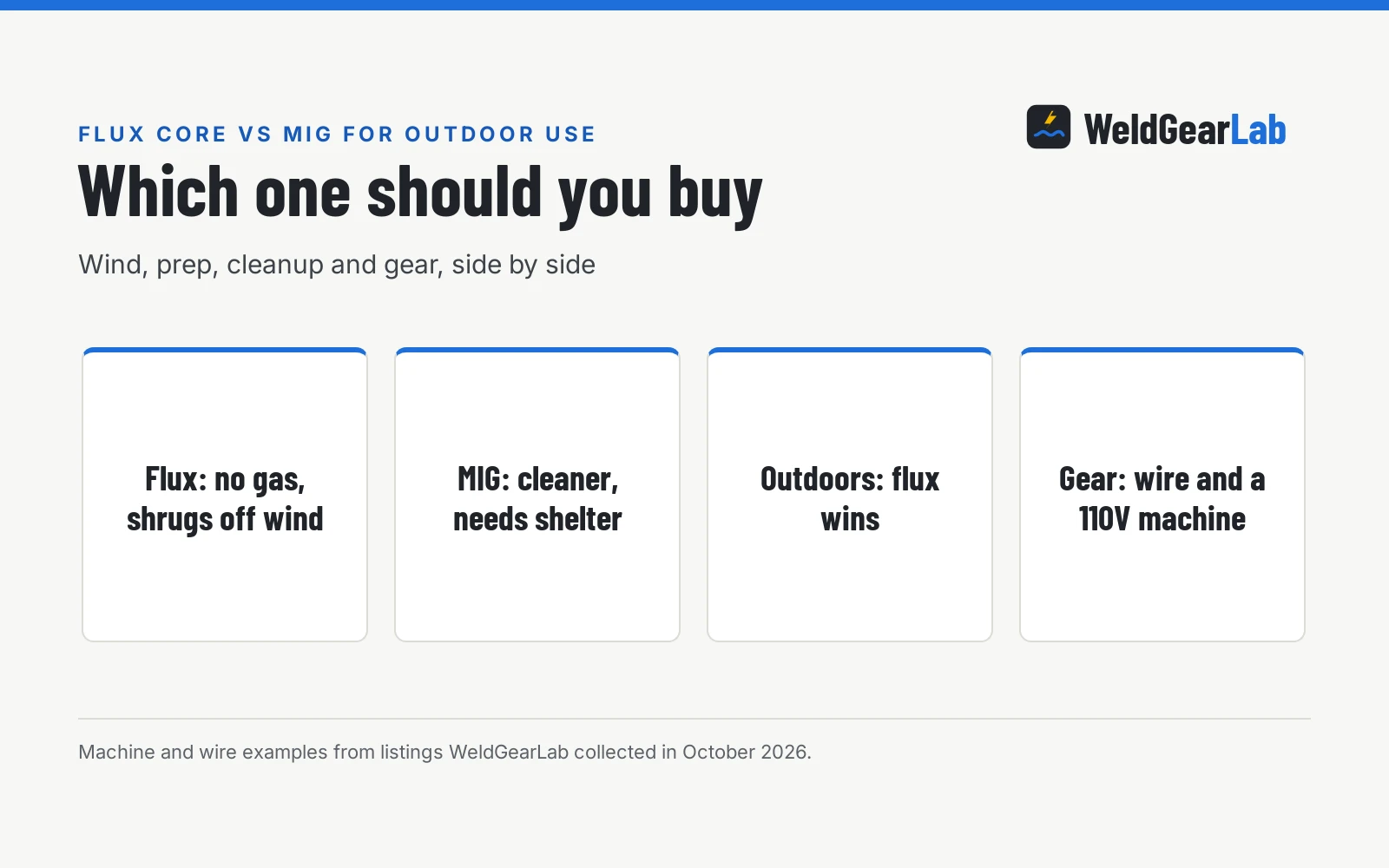
Pick self-shielded flux core when you want to weld outside with a wire feed machine and no cylinder: the flux in the wire makes its own shielding, so wind is a non-issue and long welds run without stopping to change electrodes. Pick stick when the job is thick steel, rusty steel or a long way from the shop, since stick machines are simple and electrodes handle poor fit-up well. If you already own a wire feed welder that runs flux core, a spool of self-shielded wire is the cheapest way to take it outside.
Side by side
| Flux core (self shielded) | Stick (SMAW) | Outdoor edge | |
|---|---|---|---|
| Shielding | Flux in the wire makes its own shield | Flux coating on the electrode shields the weld | Even |
| Wind | No gas to blow away | No gas to blow away | Even |
| Setup | Spool the wire, set the polarity on the label, weld | Clamp an electrode, set the polarity, weld | Stick is simpler |
| Long welds | Continuous wire feed with fewer stops | Stop to change electrodes | Flux core |
| Thick or dirty steel | Single-pass wire; not for multi-pass structural certification | Electrodes handle heavy steel and poor fit-up | Stick |
| Thin sheet | .035 and .030 inch wire runs hot; watch for burn-through | Hard on thin sheet as well | Flux core, with care |
| Cleanup | Slag to chip after welding | Slag to chip after welding | Even |
| Gear to carry | Welder plus gun and a spool of wire | Welder, stinger and a pocket of electrodes | Stick travels lighter |
Polarity follows the wire. The INETUB listing below states DCEN (DC electrode negative) for its wire. Always run the polarity printed on the wire label and in the machine manual, and swap the polarity lead when you change wire types.
When flux core wins outdoors
- No gas to lose. Self-shielded wire carries its shielding in the flux, so a breeze that ruins gas MIG barely matters.
- Long welds without stops. The wire feeds continuously, so fence lines, trailer frames and gates go faster with fewer restarts.
- One machine does the yard and the shop. Many wire feed welders run flux core outside and gas MIG inside, so the wire is the only change.
- Forgiving on used steel. The INETUB listing states its wire works on mild steel with light surface rust or mill scale.
See the best flux core welder guide for gasless machines, and the flux core vs stick for farm repairs comparison for more on repair work.
When stick wins outdoors
- Thick and dirty steel. Stick electrodes dig into heavy, rusty or painted steel where a small wire feed machine runs out of authority.
- Simple gear. A stick machine, a stinger and a pocket of electrodes travel well to the far corner of the property.
- Poor fit-up. Gaps and uneven joints are a normal farm repair, and stick tolerates them better than wire.
- Electrode choice. Different rods suit different jobs, from deep penetration to easy restarts, without changing the machine setup.
For rod choice see the best all-around stick welding rod, and for thick steel the MIG vs stick for thick steel comparison.
Self-shielded flux core wire for outdoor work
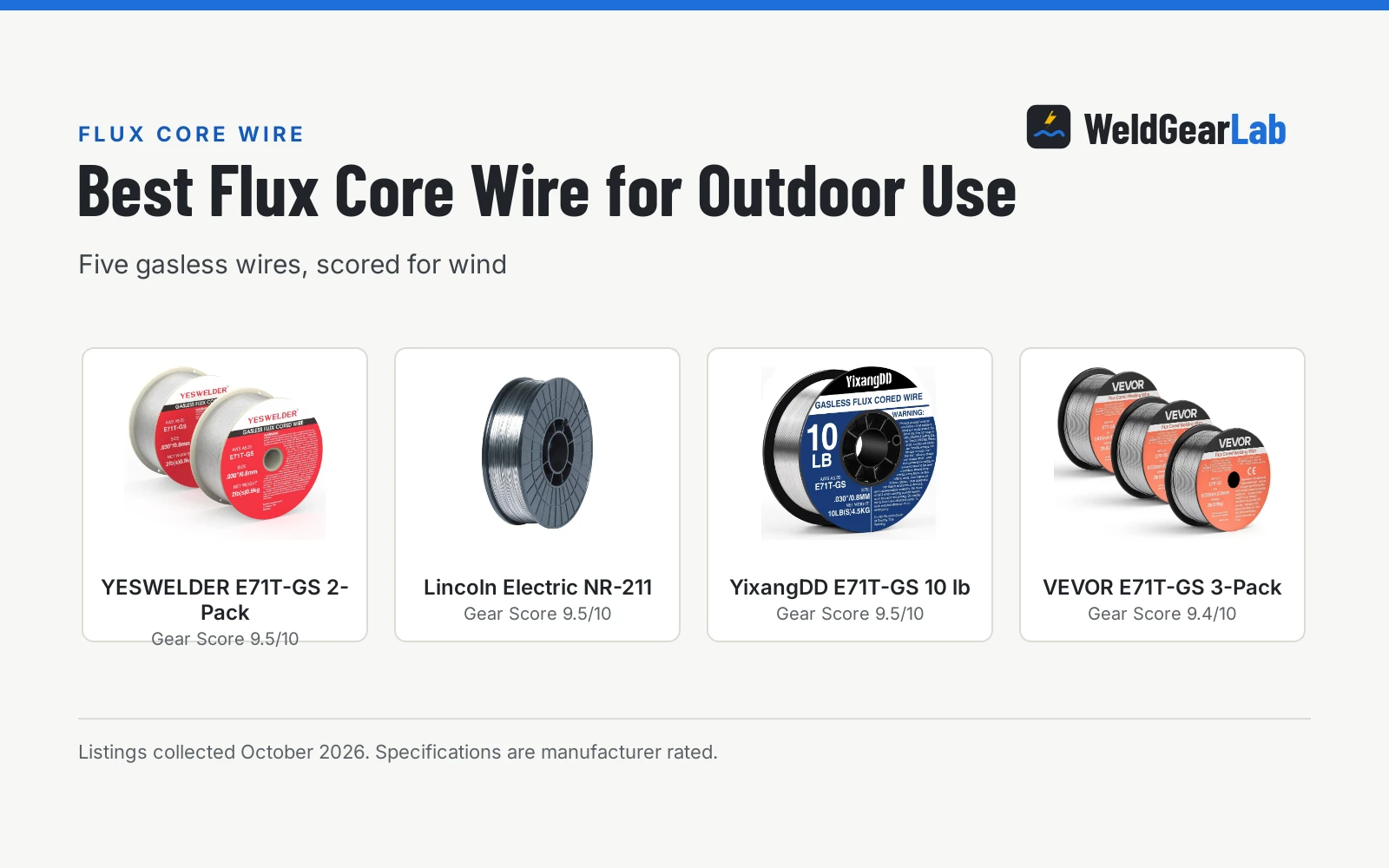
The wires below are self-shielded flux core wire, which is why they suit the outdoor side of the question. They are ordered by their scores, from the stronger listing to the thinner one.
INETUB BA71TGS .035″ Flux Core Wire, 2 lb Spool
The INETUB BA71TGS is a .035 inch self-shielded flux core wire on a 2 lb spool, made in Italy. The listing states no gas is needed, an AWS E71T-GS classification, all-position welding, and a 100 to 130 amp range at 18 to 21 volts on DCEN. It is a single-pass wire for mild carbon and low-alloy steel, and the listing says it is not for multi-pass structural certification.
Pros
- Self-shielded with no gas needed, stated as ideal for outdoor, field and windy conditions.
- AWS E71T-GS classification stated, rated for flat, horizontal, vertical and overhead.
- Stated 100 to 130 amp range at 18 to 21 volts gives a clear starting window.
- Formulated for low spatter and easier slag removal, and tolerates light surface rust or mill scale.
Cons
- Single-pass wire only; the listing says it is not for multi-pass structural certification.
- No warranty term is stated.
- The 2 lb spool is small for big fabrication jobs.
- The spec table lists the installation method as gas-welding, which contradicts the self-shielded, no-gas listing; trust the title and bullets.
Lincoln Electric NR-211 .030″ Flux Core Wire, 1 lb Spool
Lincoln Electric’s NR-211 is a .030 inch inner-shield flux core wire on a 1 lb spool for mild steel. The listing states strong mild steel wire with good bead appearance, and freezing characteristics that accommodate poor fit-up.
Pros
- Inner-shield flux core wire, so no gas cylinder is needed for outdoor work.
- The .030 inch diameter is the smaller of the wires compared here.
- Stated to accommodate poor fit-up, which suits farm and repair welding.
- Item package weight of 1.1 lb keeps the carry light.
Cons
- No warranty term is stated.
- The listing states no voltage or amperage range, so settings come from the machine manual.
- The title says a 1 lb spool, the bullets say 1.1 lb package weight and the spec table says 1.2 pounds; trust the title and bullets.
- The 1 lb spool means more spool changes on long welds than the 2 lb spool above.
What to check before welding outside
Match the wire to the machine: check that the drive rolls and liner suit the wire diameter on the label, and set the polarity the wire calls for. Keep the work and the gun dry, clamp the ground close to the weld, and clear dry grass and anything flammable from the area. If the steel is more than lightly rusty, grind it; flux core is forgiving, not magic.
Flux core smoke and slag. Self-shielded wire makes more smoke than gas MIG, and hot slag can flick off when you chip it. Weld with your head out of the plume, wear safety glasses under the hood when chipping, and keep a fire watch on dry ground. See the OSHA welding overview.
FAQ for welders
Can you weld outside with flux core wire?
Yes. Self-shielded flux core wire makes its own shielding as the flux burns, so wind that ruins gas MIG barely affects it. The INETUB listing states its wire is ideal for outdoor, field and windy conditions. Keep the gun and work dry and clear flammables from the area.
Is stick better than flux core for outdoor welding?
Stick is simpler and handles thick, dirty steel well, and electrodes tolerate poor fit-up. Flux core feeds continuously, so long welds run with fewer stops to change electrodes. For most home and farm outdoor repairs, let the steel thickness and the carry distance decide.
What polarity does self-shielded flux core wire use?
The INETUB BA71TGS listing states DCEN, which is DC electrode negative. Always check the wire label, since some wires call for a different polarity, and set the machine to match.
Can I weld in the wind with a gas MIG welder?
Not well. Wind blows the shielding gas away from the puddle and the weld goes porous. That is why outdoor work points at flux core and stick, which carry their shielding in the wire or in the electrode coating.
Does flux core wire work on rusty steel?
The INETUB listing states its wire works on mild steel with light surface rust or mill scale. Heavy rust still needs grinding first. Flux core is forgiving of less than perfect prep, not a substitute for it.
What does AWS E71T-GS mean on a wire label?
It is the AWS classification the INETUB listing states under AWS A5.20 for this wire. The listing notes it is a single-pass wire, not for multi-pass structural certification. For load-bearing welds, have a certified welder do the work or inspect it.
Related: best flux core welder, flux core vs stick for farm repairs, MIG vs stick for thick steel, and the welders hub.