Flux Core vs Stick for Truck Repairs: Which One Should You Buy?
Flux core and stick compared for truck repairs, with the flux wires in this guide ranked for field work on dirty steel and thick frames.

On this page
Top picks at a glance
As an Amazon Associate I earn from qualifying purchases.
- 1
 ARCCAPTAIN Flux Core Welding Wire E71T-GS .035" 2LB x 39.5/10View on Amazon
- 2
 2 Pack 030 Flux Core Welding WireView on Amazon
- 3
 YESWELDER Gasless Flux Core MIG WireView on Amazon
- 4
 ATLASWELDER Flux Core Welding WireView on Amazon
- 5
 Flux Core Welding Wire .035View on Amazon
- 6
 YESWELDER 135A MIG WelderView on Amazon
- 7
 ARCCAPTAIN 130A Flux Core Welder MIG Welder 110V Gasless MIGView on Amazon
A cracked frame bracket, a rusted bed crossmember, a trailer hitch that needs a patch: the weld has to hold, and it often has to happen outside, on dirty steel, with no shop around. For flux core vs stick for truck repairs, flux core is the easier pick for most field jobs because its wire feeds continuously, while stick is the more practical pick for thick frame sections and very dirty steel when you already weld stick and do not mind stopping to change electrodes. Neither process needs a gas cylinder.
Other welders and gear to compare
 2 Pack 030 Flux Core Welding WireCheck price on Amazon
 YESWELDER Gasless Flux Core MIG WireCheck price on Amazon
 ATLASWELDER Flux Core Welding WireCheck price on Amazon
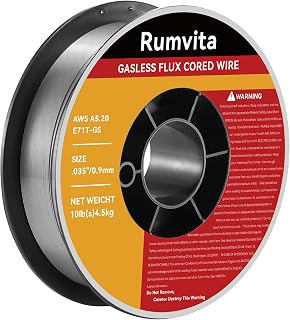 Flux Core Welding Wire .035Check price on Amazon
 YESWELDER 135A MIG WelderCheck price on Amazon
 ARCCAPTAIN 130A Flux Core Welder MIG Welder 110V Gasless MIGCheck price on Amazon
This guide links to our product roundups, where WeldGearLab gets a commission on purchases made through links on this page, and your price stays the same. Read our affiliate disclosure.
The difference in one paragraph
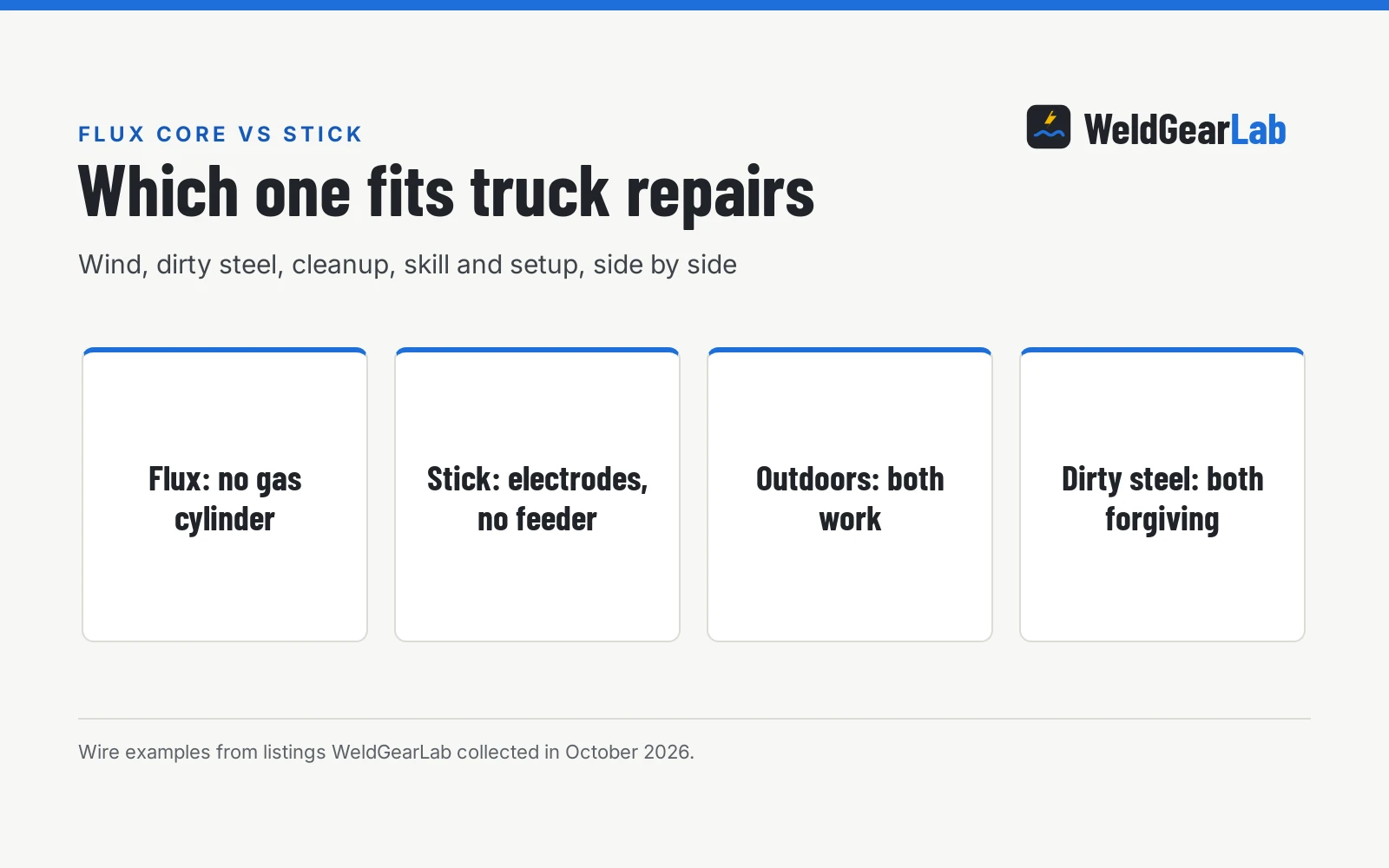
Molten steel reacts with oxygen and nitrogen in the air, which makes a porous, weak weld. Self shielded flux core wire is hollow and filled with flux that burns to make its own shielding gas and leaves a layer of slag on the bead. Stick welding burns a coated electrode: the coating makes shielding gas and slag, and the electrode gets shorter as you weld until you stop and fit another one. No cylinder, no hose, no regulator on either side, which is why both suit work away from the shop.
Side by side
| Flux core (self shielded) | Stick (SMAW) | On a truck job | |
|---|---|---|---|
| Shielding | Flux inside the wire | Flux from the electrode coating | Either works outdoors, no cylinder to haul |
| Wind and outdoor work | Tolerates a breeze | Tolerates a breeze | Field repairs away from the shop |
| Dirty or rusty steel | Tolerates light rust or mill scale, per one wire listing | Tolerates dirty steel well | Stick edges ahead on very dirty steel |
| Thin body panels | Burn through risk on thin sheet | Greater burn through risk on thin sheet | Neither is the easy pick for thin sheet |
| Thick frame sections | Multi-pass wire work | Electrodes suit thick sections | Stick often simpler on heavy frame |
| Cleanup | Slag to chip, spatter to grind | Slag to chip, spatter to grind | Chip slag before paint or the next pass |
| Gear beyond the machine | Wire spool, gun, drive rolls | Electrode holder, electrodes | Flux needs a wire feeder, stick needs none |
| Stops during a weld | Spool feeds continuously | Stop to change electrodes | Flux suits longer runs |
| Fumes and smoke | Smoke, needs ventilation | Smoke, needs ventilation | Ventilation or outdoors, head out of the plume |
Polarity and settings are general practice for common wires and electrodes; always follow the polarity printed on your wire or electrode packaging and in the machine manual. Machines that run both wire and stick may require a polarity lead or setting change when you swap process; follow the manual.
When flux core is the better choice
- Outdoor work. Frame patches, bed repairs, hitches and trailers in a yard or field. A breeze that ruins gas shielding affects self shielded flux core far less.
- Longer runs without stopping. A spool feeds wire continuously, so a long seam or a series of patches can go faster than stopping for fresh electrodes.
- Dirty steel, within limits. One wire in this guide states deoxidizing agents for light rust or mill scale, so flux core handles light surface rust, but stick remains the more forgiving process on very dirty steel.
- No cylinder to haul. You avoid buying or renting a cylinder and regulator, and there is nothing to refill before a field job.
Our best flux core welder guide covers gasless machines for home and field work.
When stick is the better choice
- Thick frame sections. Electrodes suit heavy sections and multi-pass frame work, and changing electrode size is simple.
- Very dirty or rusty steel. Stick is famously forgiving on steel that is far from clean, which is common on old truck frames.
- Simple gear. No wire feeder, no drive rolls, no spool to load. An electrode holder, electrodes and a machine are enough.
- Work far from power and parts. Electrodes pack light, though they need dry storage to stay in good condition, so a small kit covers a roadside or farm repair.
Our best stick welder for farm use guide covers machines built for this kind of work.
The wires in this guide
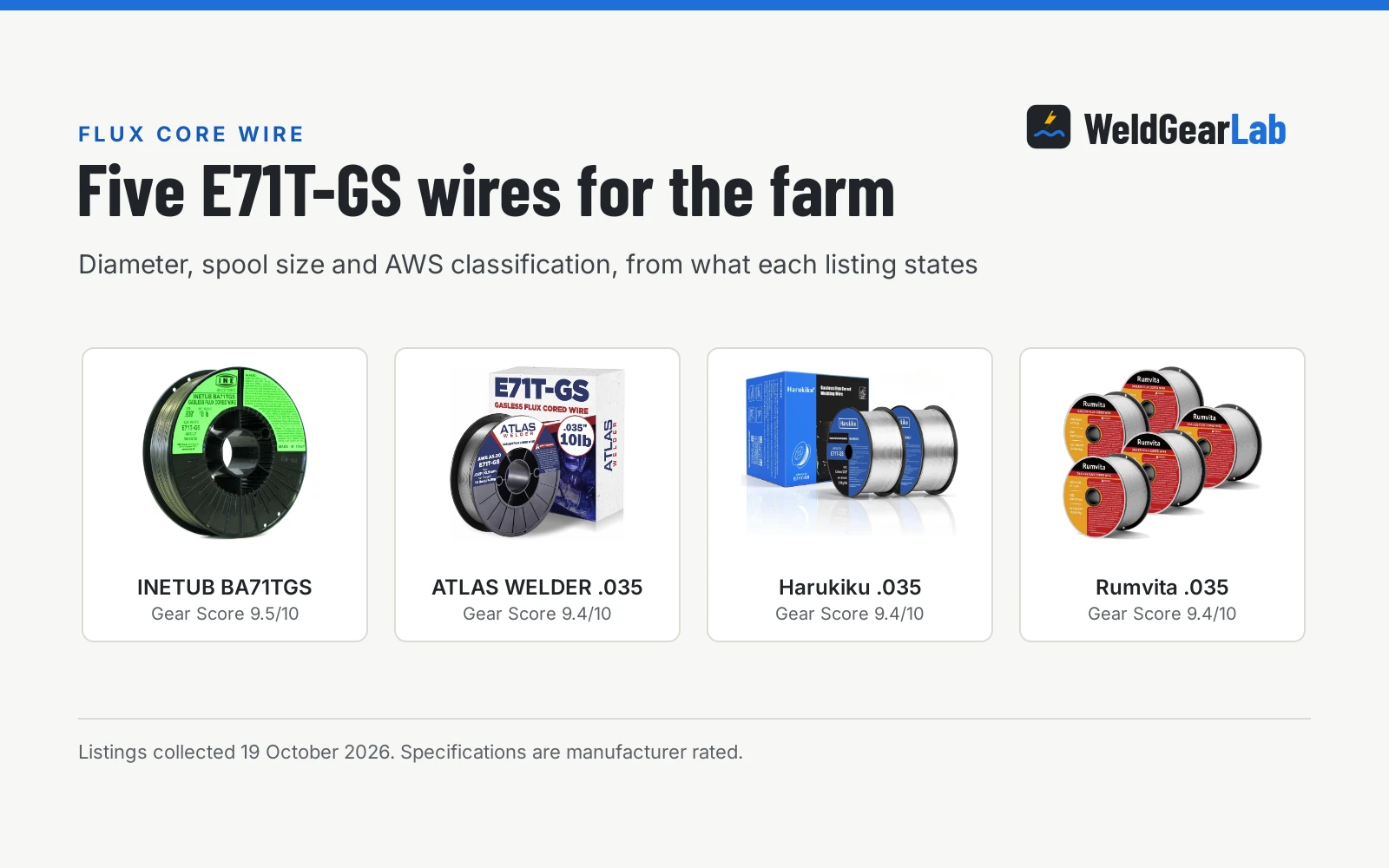
Both listings in this guide are self shielded flux core wires for mild steel, so this section ranks the flux side of the comparison. First is the YESWELDER E71T-GS wire in 0.030 inch: the listing states deoxidizing agents for welding through light rust or mill scale, low spatter, full slag formation with easy removal, and porosity-free deposits, plus all position welding and single and multi-pass applications, with automotive repair among its stated uses. That rust and mill scale tolerance is the closest match to a truck that has lived outside. Second is the ATLASWELDER E71T-11 wire in .035 inch on a 10 lb spool: the listing states all position welding on mild steel, smooth arc stability and minimal spatter, self shielding for outdoor and windy work, and automotive repair, fabrication and maintenance among its stated uses. The larger spool suits a longer job or a series of patches, while the YESWELDER wire suits the dirtier single repair.
Flux core vs stick for truck repairs on a real job
Match the process to the job, not to habit. A bed floor patch or a light bracket outdoors points to flux core: no cylinder, continuous feed, and tolerance for wind and light rust. A thick frame crack or a heavily rusted crossmember points to stick: electrodes handle heavy sections and dirty steel, and the gear stays simple. Thin body panels point away from both, since both run hot and risk burn through on thin sheet; a gas shielded process or a panel patch by another method suits thin panels better. Check what your machine already runs before buying wire or electrodes, and check the steel: heavy rust, paint and oil still need cleaning on either process, and a cracked frame on a road truck deserves a certified welder to do or inspect it.
Can one machine do both?
Yes, and for a truck owner that is often the practical answer: flux core for outdoor patches, stick for frame work, on one machine. Multi-process machines that list both wire feed and stick let you switch without buying a second machine; see the multi-process welders hub. Check the listing for both processes stated, not just a wire feed or stick label, and check the polarity and drive roll requirements for the wire you plan to run.
Flux core and stick smoke and slag. Both processes make smoke and fumes, and hot slag can flick off when you chip it. Weld with good ventilation or outdoors with your head out of the plume, wear safety glasses under the helmet when chipping, and clear dry grass and anything flammable from the area. Chip slag before paint or the next pass, and keep a fire watch after welding near fuel lines, tires and dry debris.
FAQ for welders
Is flux core as strong as stick for truck frames?
Both can make sound welds on mild steel when the wire or electrode, settings and technique suit the joint. Strength depends more on the joint and the welder skill than the process. For structural or load bearing frame work, have a certified welder do or inspect it.
Can I run flux core wire in a MIG welder?
Usually, if the machine lists flux core and you set the polarity the wire calls for. Check whether your machine needs knurled drive rolls for flux wire. Check the machine listing and the wire packaging before you buy.
Can stick weld thin truck body panels?
It is harder than on thick steel, because stick runs hot and thin sheet burns through easily. Flux core can be easier than stick on thin panels with a small wire, but it still runs hot and risks burn through. See can you stick weld thin metal for the limits, and consider a gas shielded process for thin panels.
Which wire suits a rusty truck frame?
The YESWELDER wire in this guide states deoxidizing agents for light rust or mill scale, which suits a frame with light surface rust. Heavy rust still needs cleaning first, and no wire replaces sound prep on a structural joint.
Do I need gas for either process?
No. Self shielded flux core makes its own shielding gas from the flux inside the wire, and stick electrodes make shielding from their coating. That is why both suit field repairs with no cylinder to haul.
Related: flux core vs stick for farm repairs, flux core welding vs stick welding, stick welder vs MIG welder for truck repairs, and the stick welders hub and MIG welders hub.