Stick Welder AC vs DC: Which One Should You Buy?
AC and DC stick welding run on different electrical current paths, shaping arc stability, spatter levels, electrode selection, and equipment design for home and farm metal repair.
 By WeldGearLab Editorial
Updated October 8, 2026
By WeldGearLab Editorial
Updated October 8, 2026
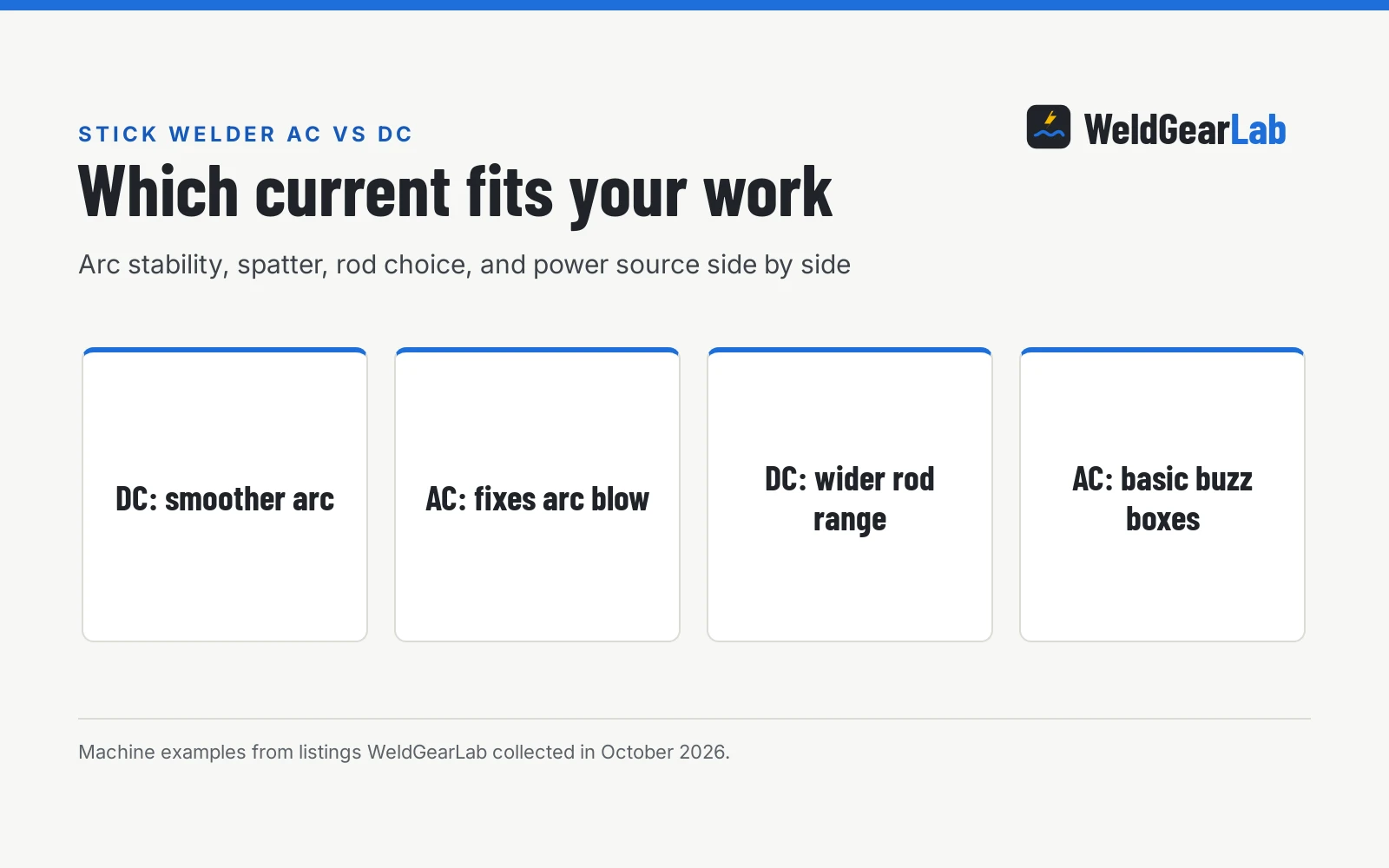
When choosing a stick welder ac vs dc, direct current (DC) is the better choice for almost every home shop, farm repair, and beginner project. DC welding creates a steady arc that strikes cleanly, spatters less, supports a wider variety of electrodes, and gives you tighter control over weld penetration. Alternating current (AC) stick welding remains valuable primarily for eliminating magnetic arc blow and powering simple, heavy transformer buzz boxes. This guide explains how AC and DC stick welding differ, when each current fits your metal repairs, and how to verify what current an electrical machine actually delivers.
As an Amazon Associate I earn from qualifying purchases. This guide links to our product roundups, where WeldGearLab earns a commission when you buy through links, at no extra cost to you. Read our affiliate disclosure.
The difference in one paragraph
Electric current in shielded metal arc welding flows across an arc gap between the coated electrode and the base metal. With direct current, electrons travel steadily in a single direction, producing continuous heat and an unbroken arc column that keeps the molten puddle stable. With alternating current, the electrical flow reverses direction continuously, momentarily collapsing as it switches polarities. That recurring drop causes a harsher arc that extinguishes and reignites constantly, creating more spatter, but the shifting magnetic field prevents arc blow when welding magnetized steel.
Side by side
| AC Stick | DCEP (Reverse Polarity) | DCEN (Straight Polarity) | |
|---|---|---|---|
| Current flow | Alternates direction continuously | Continuous flow, electrode positive | Continuous flow, electrode negative |
| Arc stability | Rougher arc with regular current reversals | Smooth, continuous and stable arc | Smooth, continuous and stable arc |
| Penetration profile | Medium penetration into base metal | Deep penetration into base metal | Shallower penetration into base metal |
| Deposition rate | Medium electrode melt-off rate | Standard melt-off rate | Faster melt-off and deposition rate |
| Magnetic arc blow | Eliminates arc blow on magnetized steel | Susceptible near edges and corners | Susceptible near edges and corners |
| Spatter and cleanup | More spatter to scrape and clean | Low spatter with clean bead ripple | Low spatter with clean bead ripple |
| Electrode selection | AC-rated rods such as E6011 and E6013 | Runs almost all rods including E6010 and E7018 | Rods rated for straight polarity like E6013 |
| Best applications | Magnetized pipe, heavy rust, farm repairs | Structural fabrication, thick steel joints | Sheet metal, surface build-up, thin tubing |
Current behavior dictates how your machine operates; always consult the electrode packaging and machine documentation before striking an arc. Most modern DC welders use separate output terminals that allow you to swap the electrode holder and ground clamp cables to switch polarities.
When AC stick welding is the better choice
- Fixing magnetic arc blow. Arc blow happens when magnetic fields build up in thick steel, joints with tight corners, or workpieces near ground clamps, pulling the arc away from the joint. AC reverses magnetic orientation so rapidly that arc blow cannot stabilize.
- Welding previously magnetized metal. Drill pipe, well casing, and structural scrap often retain residual magnetism that deflects DC arcs completely. AC cuts straight through magnetized steel without pulling the puddle.
- Running legacy transformer buzz boxes. Older workshop welders use straightforward transformers that step down utility power into alternating welding current without solid-state rectifiers, offering durable service with minimal moving parts.
- Budget farm and yard repairs on rusty equipment. Paired with an AC-tolerant rod such as E6011, an alternating current welder can burn through heavy rust, paint, and dirt on fence posts and machinery frames.
If you repair fencing, implement hitches, and tractor attachments outdoors, see our best stick welder for farm use guide for machines designed for heavy yard maintenance.
When DC stick welding is the better choice
- Smoother arc and easier arc striking. DC current flows without interruption, making it far simpler to strike an arc without sticking the rod to the metal. Beginners experience fewer stuck electrodes and less frustration.
- Cleaner welds with less spatter. Because the arc stays continuously lit, metal transfer across the puddle remains consistent. This produces smooth bead ripples and reduces the time you spend chipping slag and grinding away spatter.
- Out of position welding. Controlling molten filler metal when welding vertically uphill or overhead requires a steady puddle. DC gives the puddle freeze control necessary to deposit sound metal out of position without sagging.
- Broad electrode compatibility. Direct current runs almost every coated electrode, including deep-penetrating E6010 cellulose rods and low-hydrogen E7018 rods that run best on a steady DC arc.
- Thin sheet metal and light fabrication. On machines that support polarity switching, running direct current electrode negative (DCEN) directs more arc energy into melting the electrode while reducing heat input into the workpiece. This produces shallower penetration that helps avoid burn through on thinner tubing and light steel.
For newcomers looking for a machine that strikes cleanly and prevents stuck rods right away, check our best welder for beginners guide.
Stick welder ac vs dc: how to tell what a machine supports
Because welder listings frequently mix up input power (such as utility alternating current) with output welding current, identifying whether a machine provides AC, DC, or both requires checking several technical details:
- Stated DC output in specifications. Some listings explicitly clarify their welding output current. The GZ GUOZHI ARC-210LED, for example, lists a 210A output, 110V/220V dual voltage, and states Power Source: DC in its specification table. Similarly, the zinnore engine-driven welder generator lists 2000 watts of DC output with 130A welding capability at 74.8 pounds.
- Polarity instructions and terminal markings. Machines with direct current output feature dedicated positive (+) and negative (-) terminals so the operator can select electrode polarity. In its listing, WRDLOSY provides a polarity guide for its 250A machine (which lists 150A output on 110V for 0.06 to 0.2 inch steel with 1/16 to 1/8 inch rods), instructing users to connect the electrode holder to positive and ground clamp to negative for acidic rods, and reverse them for alkaline rods. The ARCCAPTAIN 220A unit, weighing 9.5 lbs with a 20-220A range for metal from 0.04-0.47 inches thick, also uses separate terminals for its leads.
- Electrode compatibility callouts. Listings often name specific rod classifications to indicate what arc the unit maintains. TECWELD lists its 200A machine for E6013, E6011, E6010, and E7018 rods on steel up to 1/4 inch thick with a 60% duty cycle at 5 lbs. However, rod support varies by machine design, so always confirm whether a particular model lists the specific rod you intend to burn.
- Portability and power design. Inverter-based designs listed with compact dimensions often achieve low machine weight, such as the Siasky mini stick welder listed at 3.3 pounds with 250A rating, and the Cobowo handheld unit listed at 3.96 lb for 3/32 to 1/8 inch rods. Always check the machine manual to confirm output current characteristics rather than assuming current type from weight alone.
Developing good arc control is just as critical as choosing current type; explore our how to learn welding at home guide for structured practice drills on striking and running beads.
Which polarity for DC stick welding
When running a direct current machine, you must select the polarity by connecting your electrode lead and ground clamp to the proper terminals. DC welding provides distinct configurations that alter heat distribution:
- Direct Current Electrode Positive (DCEP / Reverse Polarity). In this setup, the electrode holder connects to the positive (+) stud and the work clamp connects to the negative (-) stud. In stick welding, DCEP creates a digging arc that drives heat deep into the workpiece, producing deep penetration and excellent arc stability. DCEP is the standard configuration for structural welds and runs low-hydrogen E7018 and cellulose E6010 electrodes effectively.
- Direct Current Electrode Negative (DCEN / Straight Polarity). In this setup, the electrode holder attaches to the negative (-) stud and the work clamp connects to the positive (+) stud. In stick welding, DCEN accelerates the melting rate of the electrode while delivering shallower penetration into the base steel. This makes DCEN useful for welding thin sheet metal where burn through must be avoided, as well as building up worn metal surfaces.
Duty cycle limits also determine how long you can weld continuously at higher amperage settings; read our breakdown on welding duty cycle explained before starting extensive repair projects.
Can one machine do both?
Yes, AC/DC combination stick welders offer both current outputs in a single unit. These machines let you toggle between alternating current to eliminate arc blow on magnetized joints and direct current for everyday smooth, low-spatter welding on clean steel. For home workshops that handle diverse maintenance tasks, a dual-current machine provides complete versatility across different metal conditions and electrode types.
While combination units historically consisted of heavy transformer-rectifier cabinets, modern fabrication shops also use multi-process units that combine DC stick welding with wire feed and TIG processes. Browse our overview of the best multi-process welder options to evaluate versatile multi-mode machines.
Electrical safety and hot slag protection. Stick welding generates intense ultraviolet radiation, airborne sparks, hot flying slag, and electrical hazard risks. Always inspect your welding cables for worn insulation or exposed copper before powering up the unit, and ensure your ground clamp establishes clean, bare-metal contact. Wear dry leather welding gloves, protective clothing, and a full-coverage helmet with appropriate filter shading, and keep safety glasses on when chipping slag off the bead. Maintain adequate ventilation across your work area to draw welding fumes away from your breathing zone, and position fire extinguishers near your workstation. Explore our welding safety gear resources to equip your shop responsibly.
Frequently Asked Questions
Which is better, AC or DC stick welding?
Direct current (DC) is generally better for most welding applications because it provides a smoother, more stable arc with less spatter and easier arc striking. DC also supports a wider selection of electrode types and allows better puddle control in vertical and overhead positions. Alternating current (AC) remains superior specifically when tackling magnetized metal or avoiding arc blow in deep joints.
Do you stick weld on AC or DC?
Most welders stick weld on direct current electrode positive (DCEP) for standard fabrication and equipment repair. You switch to AC primarily when joint geometry or residual magnetism causes severe arc wander that disrupts your weld puddle. You should always verify that the electrode you choose is rated for the current type set on your machine.
Are most stick welders AC or DC?
Stick welders on the market include both AC and DC designs. Many compact inverter models provide DC output, while traditional shop welders built around heavy transformers operate on AC. Versatile commercial machines and select shop units provide both AC and DC output with a front-panel selection switch.
Why does DC stick welding produce less spatter than AC?
DC current flows continuously in one direction, maintaining uniform electrical resistance and steady molten metal transfer across the arc gap. AC current alternates direction continuously, collapsing and re-establishing the arc at every cycle reversal. This repeated reignition creates arc turbulence and molten droplet agitation that throws excess spatter around the joint.
How do you set up an AC/DC stick welder?
To set up an AC/DC stick welder, select your desired current mode on the front panel switch based on your metal condition and electrode rating. For DC welding, insert your electrode holder and ground clamp leads into the corresponding positive or negative terminals to match your rod’s polarity requirement. Clamp your work lead securely to clean metal, set your welding amperage, and strike your arc.
Related: best stick welder for farm use, best welder for beginners, best multi-process welder, and the stick welders hub. Also see our overview of all welders. Also see our best portable stick welder. Also see our stick welder vs wire welder. Also see our how to use stick welder. Also see our best stick welder under 300. Also see our stick welder vs mig welder for farm repairs. Also see our welding rod amperage chart. Also see our what amperage for 1/8 7018 rod. Also see our why does my welding rod keep sticking. Also see our how to strike an arc with a stick welder. Also see our how to store 7018 rods without a rod oven. Also see our how to stick weld rusty metal. Also see our how to weld cast iron with a stick welder. Also see our can you stick weld thin metal. Also see our lincoln ac225 vs inverter stick welder. Also see our dc vs ac stick welding. Also see our what does 7018 mean on a welding rod. Also see our 6011 vs 7018 welding rod. Also see our 6013 vs 7018 welding rod.
About the author
WeldGearLab Editorial is the editorial team behind WeldGearLab. We research product listings, specifications, safety listings and warranty terms, score every pick with the published Gear Score method, and correct errors when readers report them. We do not run our own shop trials; see How We Pick for exactly how picks are made.