What Amperage for 1/8 7018 Rod?
Learn how to dial in the right heat for a 1/8 7018 stick electrode, how welding position shifts your amperage, and how to maintain smooth puddle control on carbon steel.
 By WeldGearLab Editorial
Updated October 9, 2026
By WeldGearLab Editorial
Updated October 9, 2026
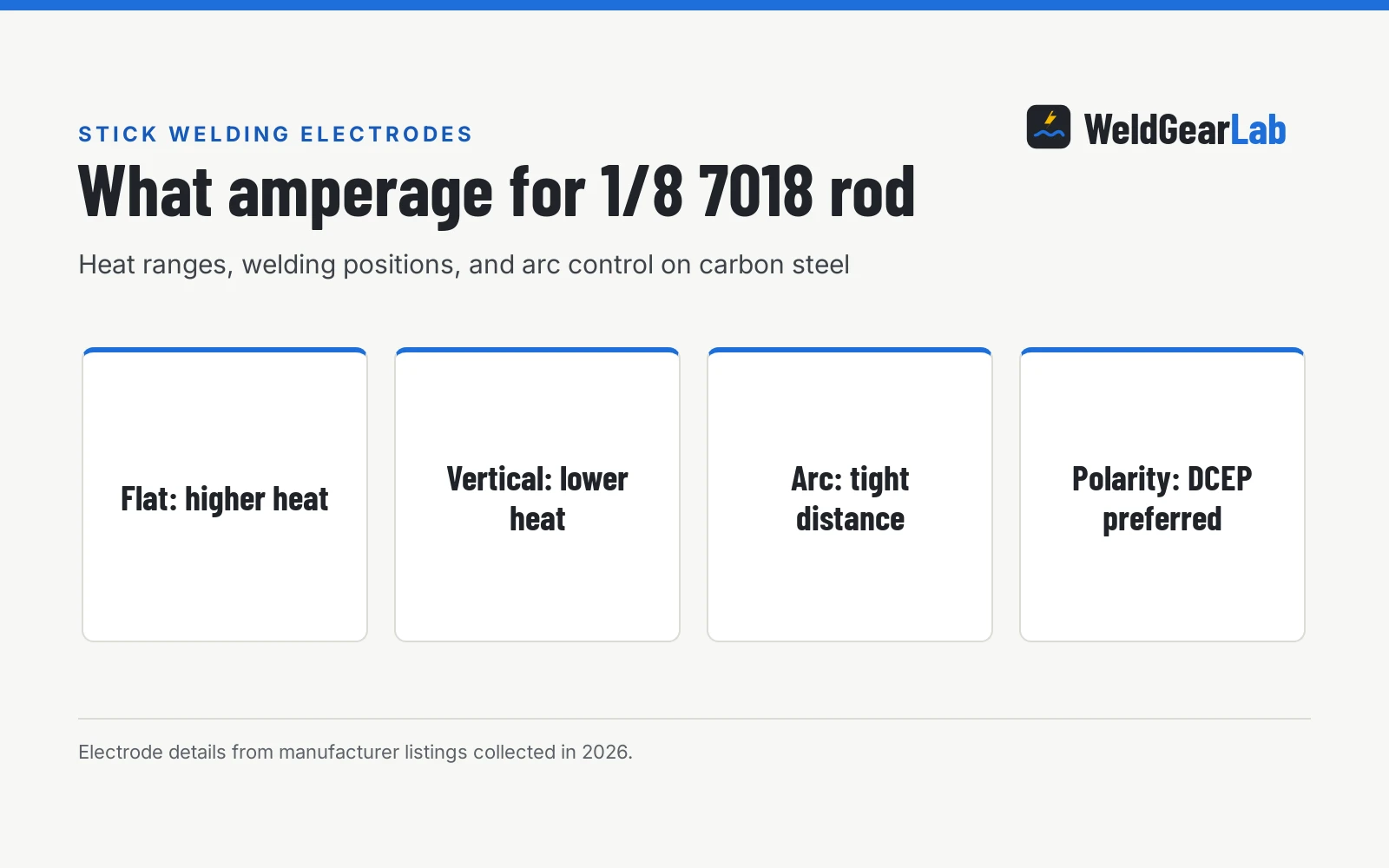
When asking what amperage for 1/8 7018 rod stick welding requires, the correct heat setting depends on your welding position, joint design, and base metal thickness rather than a single fixed setting. No single amperage setting suits every pass because the arc must balance heat input against puddle control. A 1/8-inch diameter core carries noticeably more current than smaller 3/32-inch electrodes, allowing deep fusion on structural carbon steel, but running too hot causes spatter and undercut while running too cold causes the rod to freeze to the work. To establish your starting heat, begin at the middle of your machine’s door chart for 1/8-inch rod, observe how the puddle wets into the joint edges, and adjust up for flat butt welds or down when welding out of position.
As an Amazon Associate I earn from qualifying purchases. This guide links to our product roundups, where WeldGearLab earns a commission when you buy through links, at no extra cost to you. Read our affiliate disclosure.
What amperage for 1/8 7018 rod
Finding the sweet spot on your amperage dial requires understanding how low-hydrogen flux operates. A 7018 electrode uses an iron powder coating that produces a smooth, quiet arc, low spatter, and a heavy protective slag covering. When setting 7018 1/8 amps on your welder, you need enough thermal energy to break down the heavy flux coating and establish a fluid puddle without overheating the steel core wire. If your amperage dial delivers too little current, the arc stumbles, spatter clumps around the joint, and the rod sticks firmly to the steel plate. When the dial delivers excessive current, the core wire overheats before you reach the end of the electrode, causing flux breakdown, heavy undercut along the bead toes, and excessive spatter.
Because actual amperage output varies between transformer power sources and modern digital inverters, published door charts provide a starting point rather than an absolute rule. Check our welding rod amperage chart for general shop benchmarks across different electrode diameters, and use scrap material of matching thickness to dial in your arc before welding finished assemblies.
Side by side
| Factor | Flat Groove | Horizontal Fillet | Vertical Up |
|---|---|---|---|
| Heat setting | Highest heat for full base penetration | Moderate heat for clean sidewall wetting | Reduced heat to control molten pool sag |
| Puddle control | Gravity holds molten pool in root | Lower plate ledge supports puddle | Relies on quick freezing weld metal shelf |
| Travel technique | Steady straight drag angle | Straight stringer with consistent tilt | Stepping weave upward across shelf |
| Arc length | Tight arc held near puddle | Tight arc to avoid rollover | Extremely tight arc to prevent drips |
| Slag behavior | Slag floats evenly behind puddle | Slag blankets lower toe evenly | Slag trails behind solidifying metal |
| Current polarity | DCEP preferred | DCEP preferred | DCEP preferred |
Operating characteristics shift significantly between flat shop positions and vertical out-of-position joints. Always refer to your welder’s faceplate guide and adjust your heat to support puddle freeze when fighting gravity.
When flat welding calls for more heat
Flat groove joints allow you to run the highest heat setting for a 1/8-inch electrode, while horizontal fillet joints require moderate heat to prevent top-edge undercut. In the flat position, gravity works with you by keeping the molten puddle settled securely inside the joint root. This allows you to carry plenty of heat, achieve complete side-wall fusion, and maintain a steady drag angle across heavy plate.
- Thick structural plate. Heavy sections absorb heat rapidly through thermal conduction, requiring higher current to achieve proper puddle wetting and prevent cold lap along the edges.
- Long continuous passes. Stable flat joints benefit from higher travel speeds and greater deposition rates without the danger of the puddle sagging or spilling out.
- Fillet weld penetration. T-joints and lap joints present a larger heat sink than open butt joints, demanding sufficient amperage to penetrate cleanly into the root vertex.
For heavy fabrication on trailers, farm implements, and equipment frames, our guide to the best stick welder for farm use highlights machines capable of delivering steady output on thick structural steel.
When vertical and overhead joints call for lower heat
Welding out of position reverses how gravity affects your puddle. On vertical up and overhead joints, excessive current causes the molten puddle to sag, drip, or roll over cold metal, creating severe undercut and irregular beads. To maintain control, dial back your amperage setting until the puddle freezes quickly behind your arc.
- Building a puddle shelf. Vertical up progression requires freezing a small shelf of weld metal that supports each successive weave step as you climb the joint.
- Overhead crown control. Lower heat keeps the molten pool small and manageable, allowing surface tension and arc force to hold the bead flat against the overhead plate.
- Short arc technique. Out-of-position joints require holding an extremely tight arc gap to concentrate heat and prevent the heavy flux coating from dropping into the pool.
If you are developing your out-of-position stick technique, review our breakdown on how to use a stick welder for detailed pointers on electrode angles and arc manipulation.
How manufacturer listings report electrode specs
Examining manufacturer specifications across rod sizes illustrates how electrode dimensions correspond to current capacity:
- Smaller diameter benchmarks. For its 3/32-inch E7018 electrode, TOOLIOM lists recommended amperages of 70A-100A, demonstrating the baseline heat needed for smaller core wire.
- Amperage capacities on 3/32-inch rods. Forney publishes an amperage capacity of 105 A for its 30701 electrode and 110 A for its 30681 and 30680 E7018 AC rods.
- Larger diameter thresholds. At the heavier end, Forney lists an amperage capacity of 210 A for its 30910 5/32-inch E7018 electrode.
- Tensile strength ratings. Hobart rates its 1/16-inch H119916-R01 and 3/32-inch 770482 electrodes for 70,000 PSI tensile strength, matching the AWS classification standard. Metal Marlin reports tensile strength of 70,000 to 84,000 psi and yield strength above 58,000 psi for its E7018 H4R electrodes.
Because a 1/8-inch electrode features a core wire thicker than 3/32-inch, it demands more current than the 70A-100A or 110 A capacity stated for 3/32-inch rods, while staying well below the 210 A capacity listed for 5/32-inch wire. Retail spec sheets occasionally contain confusing errors. For example, Forney listings 30681 and 30701 include mismatched spec tables showing an E6010 diameter of 1/8 inch with 35-125 amperage and 80,000 PSI tensile strength, despite the title and description clearly identifying the product as E7018 with 70,000 tensile strength. Always verify numbers on the physical manufacturer packaging rather than relying on unverified online tables.
Which polarity to run on 7018 electrodes
Current polarity directly impacts arc stability, heat distribution, and spatter production when burning 7018 electrodes. Most standard low-hydrogen electrodes perform best on direct current electrode positive, known as DCEP or reverse polarity. Running on DCEP produces a stable arc, minimal spatter, and deep joint penetration while smoothly consuming the electrode coating.
Certain formulations labeled E7018 AC are engineered with potassium compounds in the flux coating to maintain arc stabilization as alternating current reverses direction. However, running standard 7018 rods on entry-level AC machines often produces arc flutter and frequent sticking. Compare machine configurations in our guide to stick welder AC vs DC to determine which current type matches your shop power source.
Choosing a machine to run 1/8 electrodes
Running a 1/8-inch 7018 rod requires a power source with sufficient amperage capacity and a suitable open circuit voltage to strike and sustain the arc. Compact welders operating at low output settings may struggle to re-strike low-hydrogen rods once the flux forms a non-conductive glass crust over the tip. If you need portable capability for field jobs, see our guide to the best portable stick welder for models that maintain steady arc force without tripping breakers.
Stick welding safety and fume precautions. Electric arc welding generates intense ultraviolet radiation, sparks, and airborne fumes. Always wear a shaded helmet meeting ANSI standards, flame-resistant leather gloves, and durable clothing covering all exposed skin; see our welding safety gear checklist for beginners for essential shop protection. Low-hydrogen flux coatings produce smoke and particulates that require proper ventilation or an approved respirator for welding fumes when working in confined spaces. Chipping solidified slag from finished beads presents a flying particle hazard; keep safety glasses on under your hood during post-weld cleanup. Clear all dry grass, sawdust, and combustible solvents from your work perimeter before striking an arc.
Frequently Asked Questions
What happens if the amperage is set too low on a 1/8 7018 rod?
Setting your amperage too low prevents the arc from generating enough heat to melt the heavy flux coating and steel core wire evenly. The electrode frequently freezes to the base metal upon striking, creating frustration and rough arc marks. Even when the arc remains lit, insufficient heat leads to poor fusion, crowned bead profiles, and slag inclusions trapped beneath the weld deposit.
What signs indicate the amperage is set too high?
Excessive amperage produces a harsh, loud arc accompanied by heavy spatter flying across the workpiece. The intense heat erodes grooves along the edges of the bead, leaving deep undercut that weakens the joint. High current also overheats the core wire toward the end of the rod, causing the protective flux coating to crack and crumble prematurely.
Can you run a 1/8 7018 rod on an AC stick welder?
Standard E7018 electrodes run best on direct current electrode positive and perform poorly on basic alternating current machines. Hobart explicitly notes on its packaging that standard 7018 electrodes are not recommended for low-voltage AC welders due to arc instability. If you weld with an AC power source, choose electrodes specifically marked E7018 AC, which include arc stabilizers in the flux to keep the arc lit through current reversals.
Why does vertical up welding require lower amperage than flat welding?
When welding vertically upward, gravity constantly pulls molten filler metal downward toward the floor. Reducing your heat input allows the weld puddle to freeze more rapidly, creating a solid ledge that supports each subsequent weave. Running flat-position amperage on a vertical joint causes the molten metal to overheat and spill out of the joint groove.
How does rod storage affect 7018 amperage performance?
Low-hydrogen coatings are formulated to prevent hydrogen embrittlement in high-strength carbon steels, but they readily absorb atmospheric moisture if left exposed. Moisture in the flux destabilizes the arc, produces violent spatter, and introduces porosity regardless of your machine settings. Manufacturers such as Metal Marlin package rods in vacuum-sealed containers to preserve low-hydrogen integrity until you are ready to weld.
Related: the stick welders hub, our best small inverter stick welders guide, and our stick welder vs wire welder comparison.
About the author
WeldGearLab Editorial is the editorial team behind WeldGearLab. We research product listings, specifications, safety listings and warranty terms, score every pick with the published Gear Score method, and correct errors when readers report them. We do not run our own shop trials; see How We Pick for exactly how picks are made.