DC vs AC Stick Welding: Which One Fits Your Work
DC and AC stick welding differ in arc stability, penetration, electrode choice, and arc blow, shaping which current fits your repairs and fabrication projects.
 By WeldGearLab Editorial
Updated October 9, 2026
By WeldGearLab Editorial
Updated October 9, 2026
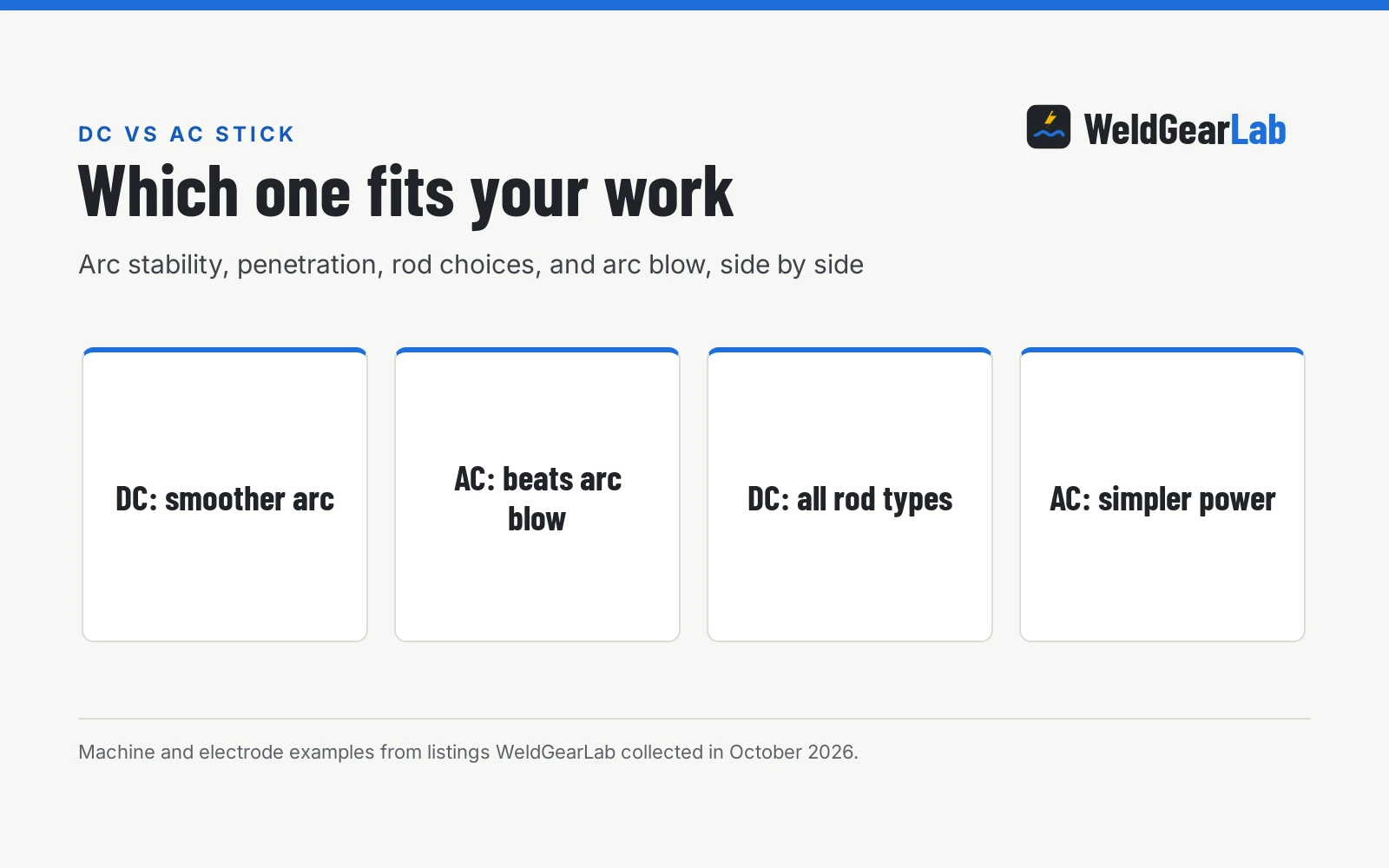
When comparing DC vs AC stick welding, DC (direct current) is the standard choice for most home, farm, and shop welding because it creates a smoother, more stable arc, generates less spatter, and supports a wider range of electrodes. AC (alternating current) stick welding is mainly used when welding with traditional transformer buzz boxes or when severe magnetic arc blow makes DC welding difficult. This guide compares both currents for repair and fabrication, explains how polarity affects your weld puddle, and helps you choose the right setup for your projects.
As an Amazon Associate I earn from qualifying purchases. This guide links to our product roundups, where WeldGearLab earns a commission when you buy through links, at no extra cost to you. Read our affiliate disclosure.
The difference in one paragraph
The core difference between DC and AC stick welding comes down to current direction. Direct current flows in a constant direction through the electrode and workpiece, providing continuous arc energy, stable puddle control, and effortless arc starts. Alternating current reverses its flow direction continuously, cycling positive and negative. That constant reversal causes the arc to extinguish and reignite with every cycle, creating a slightly harsher arc with more spatter. However, that same alternating flow prevents directional magnetic fields from building up in the base metal, which stops magnetic arc blow in its tracks.
Side by side
| DC+ (DCEP) | DC- (DCEN) | AC (Alternating) | |
|---|---|---|---|
| Current flow | Electrode positive, work clamp negative | Electrode negative, work clamp positive | Reverses direction continuously back and forth |
| Penetration depth | Deep penetration into base metal | Shallow penetration with faster melt-off | Medium penetration between DCEP and DCEN |
| Arc stability | Smooth and steady arc with easy restrikes | Smooth and steady arc with easy restrikes | Can feel harsher with polarity reversals |
| Arc blow susceptibility | Subject to magnetic arc blow | Subject to magnetic arc blow | Naturally resists magnetic arc blow |
| Electrode compatibility | Runs DCEP rods including E7018, E6010, E6011, and E6013 | Runs DCEN-compatible rods including E6013 and sheet metal electrodes | Requires AC-rated rods like E6011, E6013, AC E7018 |
| Spatter and cleanup | Low spatter with clean bead profile | Low spatter with clean bead profile | Moderate to high spatter with rougher bead |
| Best shop use | Structural steel, heavy repair, thick plate | Thin sheet metal, buildup passes, overlays | Preventing arc blow, magnetized parts, buzz boxes |
| Equipment type | Modern DC inverter or transformer-rectifier | Modern DC inverter or transformer-rectifier | Traditional transformer buzz box or AC/DC unit |
Polarity in DC stick welding depends on whether your electrode holder connects to the positive terminal (DCEP) or negative terminal (DCEN). AC has no fixed polarity because the current alternates continuously. Always check the electrode box or maker specification to confirm whether your rod requires DCEP, DCEN, or runs on AC.
When DC is the better choice
- Smoother arc and easier starts. Constant current flow maintains a stable arc column, making it easier to strike the arc and maintain a tight puddle without the rod sticking.
- Less spatter and cleaner cleanup. A steady arc produces less spatter across the joint, resulting in cleaner bead profiles and slag that chips away cleanly.
- Broader electrode compatibility. DC supports a wider range of electrode classifications than AC, including standard low-hydrogen E7018 rods, cellulose electrodes, and specialty stainless alloys like E309L. Running cellulose E6010, however, requires a welder with sufficient open-circuit voltage.
- Flexible penetration control. Switching between electrode positive and electrode negative lets you tailor penetration depth to fit either thick joints or thinner sheet metal.
For outdoor repair and heavy equipment maintenance, our best stick welder for farm use guide highlights machines that handle rough work in the field.
When AC is the better choice
- Overcoming magnetic arc blow. When welding heavy plate, inside deep corners, or on steel with residual magnetism, magnetic fields can pull or deflect a DC arc uncontrollably. The alternating current in AC prevents directional magnetic field buildup, keeping the arc centered.
- Running legacy transformer equipment. Traditional transformer buzz boxes operate directly on alternating current without rectifiers. These durable machines provide dependable power for farm and maintenance shops without complex electronics.
- Magnetized pipe and field repairs. Structural components or drill pipe that have developed magnetic fields from inspection or handling can be difficult to join with DC, making AC the practical solution.
- Cost-effective utility welding. When combined with AC-compatible electrodes such as E6011 or E6013, AC provides solid utility welds on rusted or painted scrap steel.
DC vs AC stick welding: electrode compatibility
Electrode selection is one of the biggest practical differences between DC and AC stick welding. The flux coating on each electrode classification determines whether it requires direct current, alternating current, or operates on both.
Common utility electrodes like E6011 and E6013 frequently run on both currents. Rutile-coated E6013 electrodes provide shallow to medium penetration with easy arc starts on sheet metal, while cellulose E6011 rods deliver aggressive penetration on rusted or dirty joints. For example, TingMos lists its 3/32 Inch E6013 carbon steel electrodes for AC or DC operation across a recommended range of 45-90 amps, while GOORY lists a 3/32” E6013 electrode with recommended amperages of 70A-100A for AC and DC reverse polarity. PUWU notes that its 110V stick machine supports E6010, E6011, and E6013 rods in sizes from 1/16″-1/8″ for welding steel thicknesses from 0.06-0.2 inch. While E6011 features potassium in its flux to stabilize the arc across AC current reversals, standard E6010 requires direct current electrode positive and will not run on an AC output.
Low-hydrogen electrodes require close attention to current specifications. Standard E7018 rods produce code-quality, crack-resistant welds on structural assemblies, but standard versions need DCEP. Manufacturers also produce AC-modified E7018 formulations that incorporate potassium compounds into the iron powder coating to stabilize the arc on alternating current. TOOLIOM specifies its 1/8″ E7018 low-hydrogen electrodes for AC/DC operation across 115A-165A, and LIIJII lists 1/8″ E7018 rods compatible with both AC and DCEP welders. ARCCAPTAIN also lists 1/8″ E7018 electrodes suitable for AC or DC reverse polarity. For stainless steel repairs on dissimilar metals, Flutesan lists 3/32″ E309L-16 rods for AC/DC welding, while ALGESBPO provides 1/8″ E4043 aluminum stick electrodes operating at 80-120A on AC/DC+.
Understanding polarity: DCEP vs DCEN
When running a DC stick machine, you must choose between distinct polarity configurations:
- DCEP (Direct Current Electrode Positive). Often called reverse polarity, DCEP connects the electrode holder to the positive terminal and the work clamp to the negative terminal. This configuration produces deep penetration, a stable arc, and smooth metal transfer. DCEP is the standard setup for most structural welding, general repairs, and rods like E7018 and E6010.
- DCEN (Direct Current Electrode Negative). Often called straight polarity, DCEN connects the electrode holder to the negative terminal and the work clamp to the positive terminal. This configuration increases the electrode melt-off rate while delivering shallower penetration into the base metal. This setup is useful when welding thin gauge sheet to avoid burn-through, or when building up worn surfaces with overlay passes.
- AC (Alternating Current). Because current alternates direction continuously, heat distributes between the electrode and the base metal. This produces medium penetration between DCEP and DCEN, but does not provide the specialized penetration control of dedicated DC polarities.
Can one machine do both?
Yes. Some welding machines provide both AC and DC welding current, allowing operators to switch between them as the joint requires. Many compact inverters are dedicated DC machines designed for portable stick welding. In RUBIK’s listing for its 20A-160A mini inverter, the maker notes that DC delivers a smoother arc with less spatter than an AC buzz box. For lightweight portability, MROACE lists a 110V machine delivering 135A that weighs 4 lbs. If you need AC output to combat severe arc blow or prefer heavy-duty transformer reliability, traditional AC buzz boxes and AC/DC transformer-rectifiers remain common choices in home and farm shops. Check our guide on stick welder AC vs DC for a detailed look at choosing between transformer buzz boxes and modern portable inverters.
Electrical safety and arc flash protection. Stick welding generates high open-circuit voltage, intense ultraviolet radiation, and airborne metal fumes. Always wear a shade-appropriate welding helmet, flame-resistant leather gloves, and protective clothing to shield your skin and eyes from arc flash and hot slag. Because electrode flux generates smoke during breakdown, always weld in well-ventilated areas or position a shop exhaust system away from your breathing zone. Keep electrical leads intact, inspect cables for cracked insulation, and avoid welding in damp or wet conditions where shock hazards increase.
Frequently Asked Questions
Can you run 7018 on an AC welder?
Standard E7018 electrodes are engineered primarily for direct current electrode positive operation and often struggle to maintain an arc on AC machines. However, manufacturers make specialized AC-compatible E7018 rods with potassium added to the flux coating to stabilize the arc across current cycles. Always check the electrode packaging to confirm that AC is listed before attempting to run 7018 on an alternating current welder.
Why does stick welding arc blow happen on DC?
Arc blow occurs when the steady direct current flowing through the joint generates magnetic fields that concentrate unevenly in the steel. These magnetic forces pull or push the molten arc column away from the joint, causing spatter and poor puddle control. Switching to AC stops arc blow because the rapid reversal of current direction prevents magnetic fields from accumulating in the base metal.
Is DC stick welding stronger than AC?
Weld strength depends on proper joint preparation, electrode selection, and operator technique rather than current type alone. A sound weld made with an AC-compatible electrode on alternating current will meet structural requirements just as well as a DC bead. DC is preferred for critical work primarily because its smooth arc and deeper DCEP penetration make defect-free welds easier to achieve consistently.
What polarity is best for general stick welding?
Direct Current Electrode Positive, or DCEP, is the standard polarity choice for general fabrication and repair work. It delivers deep penetration, steady arc control, and smooth bead rippling. You should switch to DCEN only when working with thin sheet steel where burn-through is a concern, or when an electrode specifically calls for straight polarity.
Which is easier for a beginner to learn?
DC stick welding is significantly easier for a beginner to learn because the arc strikes quickly and burns steadily without flutter. The continuous current flow reduces the tendency of the rod to stick to the workpiece during ignition and restrikes. AC stick welding requires more precise arc length control to avoid extinguishing the arc or producing excessive spatter.
Related: best portable stick welder, best welding rods for AC welder, why a welding rod keeps sticking, and the stick welders hub. Also see our practical guide on how to strike an arc with a stick welder.
About the author
WeldGearLab Editorial is the editorial team behind WeldGearLab. We research product listings, specifications, safety listings and warranty terms, score every pick with the published Gear Score method, and correct errors when readers report them. We do not run our own shop trials; see How We Pick for exactly how picks are made.