What Does 7018 Mean on a Welding Rod?
A 7018 welding rod designation indicates minimum tensile strength, all-position welding capability, and a low-hydrogen iron powder flux coating.
 By WeldGearLab Editorial
Updated October 9, 2026
By WeldGearLab Editorial
Updated October 9, 2026
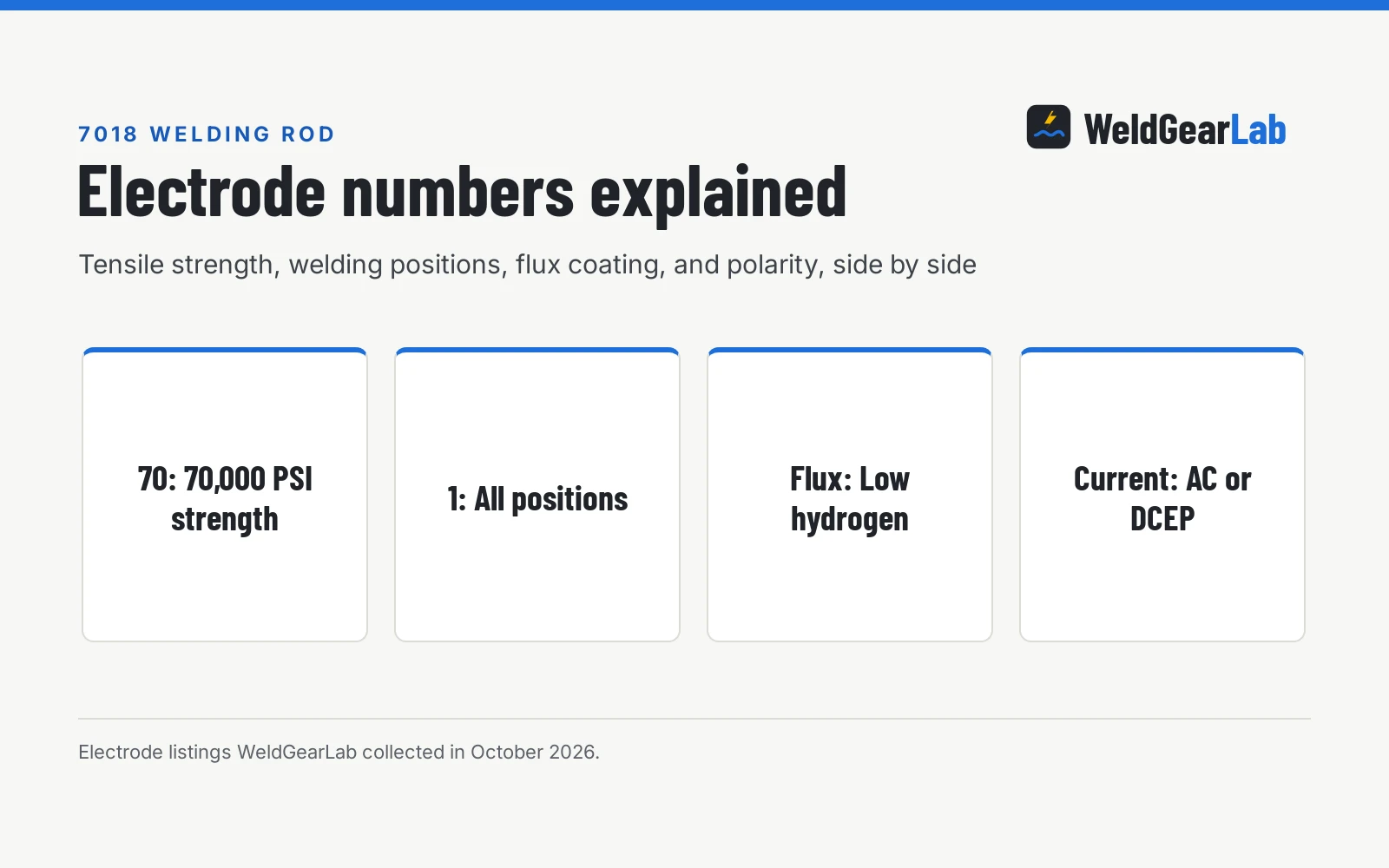
If you want to know what does 7018 mean on a welding rod, the designation identifies its minimum tensile strength, welding position capability, and flux coating chemistry under the American Welding Society classification system. Specifically, the digits 70 indicate a minimum tensile strength of 70,000 PSI, the digit 1 means the electrode operates in all positions, and the ending digit in 7018 specifies a low-hydrogen iron powder coating running on AC or DCEP current. This electrode produces ductile, crack-resistant joints on carbon steel for farm machinery, structural framing, and general fabrication repairs.
As an Amazon Associate I earn from qualifying purchases. This guide links to our product roundups, where WeldGearLab earns a commission when you buy through links, at no extra cost to you. Read our affiliate disclosure.
What does 7018 mean on a welding rod
Stick welding electrodes carry standardized alphanumeric codes indicating their mechanical properties and operational limits. On a 7018 stick electrode, each part represents a specific performance characteristic:
- Prefix letter E. The letter E indicates an arc welding electrode for shielded metal arc welding (SMAW), consisting of a metal core wire covered with flux coating.
- Digits 70: Tensile strength. The digits 70 represent a minimum tensile strength of 70,000 PSI in the deposited weld metal. For example, Hobart lists 70,000 PSI tensile strength for its 7018 stick electrode, while Metal Marlin lists tensile strength between 70,000 and 84,000 psi alongside yield strength exceeding 58,000 psi.
- Digit 1: Welding positions. The digit 1 indicates an all-position electrode suitable for flat, horizontal, vertical, and overhead welding, as listed by Tooliom and Metal Marlin.
- Final digit in 7018: Coating type and operating current. The final digit in 7018 identifies a low-hydrogen flux coating with iron powder. Tooliom lists a low-hydrogen potassium iron powder flux, and Hobart specifies operation on AC or DCEP (reverse polarity). The iron powder increases deposition rates while low-hydrogen chemistry prevents cracking.
- Suffix designations such as H4R. Some manufacturers add suffix codes for moisture resistance. Metal Marlin packages an E7018 H4R electrode conforming to AWS A5.1 and ASME SFA-5.1 specifications, vacuum sealed to maintain low-hydrogen status without pre-baking.
Side by side
| 1/16-Inch 7018 | 3/32-Inch 7018 | 1/8-Inch 7018 | |
|---|---|---|---|
| Minimum tensile strength | 70,000 PSI | 70,000 PSI | 70,000 PSI |
| Welding positions | All positions | All positions | All positions |
| Coating classification | Low-hydrogen iron powder | Low-hydrogen iron powder | Low-hydrogen iron powder |
| Operating polarity | AC or DCEP | AC or DCEP | AC or DCEP |
| Length in listings | Not stated in listing | 14 inches | 14 inches |
| Amperage in listings | Not stated in listing | 70A to 100A (TOOLIOM) | Not stated in listing |
| Pack sizes in listings | 1 lb | 2 lb, 3 lb, 4.4 lb, 5 lb, 10 lb | 5 lb, 10 lb, 60 lb |
| Listing brands | Hobart | TOOLIOM, Metal Marlin, Taskzoom, Buelkmag, TECWELD, ATLAS WELDER | HYW Products, Metal Marlin, findmall, ATLAS WELDER |
| Typical steel thickness | Light structural joints | Medium plate and equipment repairs | Thick structural steel and heavy assemblies |
Polarity and amperage settings reflect standard shop practice for carbon steel stick welding across different rod diameters; always follow the recommended parameters printed on your electrode container and in the welder’s manual. Most modern inverter stick welders run both AC and DC, while traditional transformer machines may provide AC output only.
When 7018 is the better choice
- Structural fabrications. When joining steel plates, I-beams, or channels where joint failure is unacceptable, 7018 provides strong tensile resistance. Buelkmag specifies its 7018 rods for load-bearing structures and heavy-duty repairs.
- Restrained joints prone to cracking. High-carbon and low-alloy steels are susceptible to cracking from diffusible hydrogen. Tooliom and HYW Products list applications on carbon steels and steels containing sulfur or selenium, where low-hydrogen chemistry prevents cracking.
- Heavy equipment and farm repairs. For cracked tractor hitches, loader buckets, and implements subjected to shock loads, ductile 7018 deposits resist impact. Our guide to the best stick welder for farm use covers capable machines for these repairs.
- Smooth bead appearance and radiographic quality. Iron powder in the flux creates a stable arc with minimal spatter. Tooliom notes low spatter and outstanding X-ray quality, producing clean beads that require minimal grinding.
When another stick rod is the better choice
- Dirty or rusted steel without prep. While listings like TECWELD mention welding on uncleaned surfaces, low-hydrogen rods work best on clean metal. When you cannot grind rust or mill scale to bare steel, fast-freeze cellulose rods penetrate contamination more reliably. Read our guide on how to stick weld rusty metal for prep advice.
- Thin sheet metal fabrications. Heavy puddle dynamics and iron powder deposition deliver heat that easily burns through light-gauge steel panels. Fast-freezing electrodes or small general-purpose rods are easier to control on sheet metal.
- Shops without dry storage. Once opened, standard 7018 electrodes absorb humidity, which introduces hydrogen into the weld puddle. If you do not own a rod oven or airtight container, see our guide on how to store 7018 rods without a rod oven.
- Budget AC buzz box welders. Standard 7018 rods can be difficult to run on basic transformer welders with low open-circuit voltage. Hobart explicitly warns that its 7018 electrode is not recommended for low-voltage AC welders.
How to tell what a machine supports
Not every stick welder runs 7018 electrodes with equal ease. Check these machine specifications before buying rods:
- Direct current capability (DCEP). Running 7018 on DCEP produces a stable arc, minimal spatter, and reliable penetration. Verify whether your machine provides DC output. Our dedicated stick welders hub reviews machines across both categories.
- Amperage output for rod diameter. Match electrode diameter to available welder amperage. TOOLIOM lists a recommended range of 70A to 100A for a 3/32-inch rod. Hobart offers a 1/16-inch 7018 electrode in a 1-pound package, while ATLAS WELDER and Metal Marlin supply 3/32-inch and 1/8-inch diameters in 5 lb and 10 lb packages. HYW Products and findmall list 1/8-inch rods in 60 lb quantities.
- Open-circuit voltage ratings. Striking 7018 requires sufficient voltage. Transformer welders with low open-circuit voltage often stick the rod. Modern inverter stick welders typically include hot start features that boost current to help ignite low-hydrogen rods smoothly.
Consult our welding rod amperage chart to compare operating ranges across electrode diameters.
Which polarity for 7018 on steel
Electrode polarity affects arc stability and heat distribution:
- DCEP (Reverse polarity). DCEP connects the electrode holder to positive and the work clamp to negative. Hobart specifies DCEP (reverse) polarity as a primary setting. DCEP delivers smooth metal transfer, moderate penetration, minimal spatter, and good puddle control in all positions.
- AC (Alternating current). Tooliom, Taskzoom, and Metal Marlin confirm their 7018 electrodes run on AC power. Current alternates direction, distributing heat evenly and eliminating arc blow on thick steel. However, maintaining the arc requires adequate voltage. Read our guide comparing DC vs AC stick welding for shop details.
Always verify polarity markings on your electrode packaging before welding.
Can a small welder run 7018?
Yes, provided you choose an electrode diameter matched to machine capacity:
- 1/16-inch electrodes. Hobart produces a 1/16-inch 7018 stick electrode in a 1-pound container. This diameter allows low-output welders to deposit low-hydrogen weld metal on small brackets and light structural joints without overloading the power source.
- 3/32-inch electrodes. Manufacturers including TOOLIOM, Buelkmag, TECWELD, Taskzoom, and ATLAS WELDER supply 3/32-inch rods. With TOOLIOM specifying 70A to 100A, a compact welder capable of 100 amps can run this diameter across all positions. Check our guide to the best small inverter stick welders for compact options.
- 1/8-inch electrodes. Rods measuring 1/8 inch require higher current suited for dedicated workshop circuits. HYW Products, findmall, and Metal Marlin supply 1/8-inch electrodes for heavier structural assemblies.
Fume management and safety. Burning 7018 produces mineral fumes from flux, requiring good ventilation or an outdoor setup with your head away from the plume. Hot slag forms a crust that can pop off as it cools; keep safety glasses on under your hood and wear leather welding gloves.
Frequently Asked Questions
What does 7018 mean on a welding rod?
The numbers identify mechanical properties and flux formulation under AWS standards. The digits 70 signify 70,000 PSI minimum tensile strength, the digit 1 confirms all-position capability, and the ending digit in 7018 designates a low-hydrogen iron powder coating for AC or DCEP current. Together, these deliver ductile, crack-resistant welds on carbon steel.
Can you run 7018 welding rods on an AC welder?
Yes, manufacturers including Tooliom, Taskzoom, and Metal Marlin formulate 7018 electrodes for AC and DC operation. However, running 7018 on AC requires sufficient open-circuit voltage. Hobart notes on its packaging that standard 7018 is not recommended for low-voltage AC welders, where rods tend to stick.
What amperage is needed for a 3/32 7018 welding rod?
Amperage depends on formulation and joint position. For example, TOOLIOM lists an operating range of 70A to 100A for its 3/32-inch diameter E7018 electrode. Lower settings help control the puddle on vertical joints, while higher settings provide smooth deposition on flat plate.
What does the H4R designation mean on a 7018 rod?
The H4R suffix indicates an electrode engineered for low diffusible hydrogen and moisture resistance. Metal Marlin supplies E7018 H4R electrodes in vacuum-sealed packaging designed to block ambient humidity. This keeps rods dry out of the box, reducing cracking risks without pre-baking.
Why must 7018 welding rods stay dry?
Mineral flux coatings absorb moisture from surrounding air once package seals are broken. In the welding arc, moisture decomposes into hydrogen that diffuses into molten steel, causing cracking as joints cool. Storing rods in airtight containers or heated ovens preserves coating integrity.
Related: how to store 7018 rods without a rod oven, how to stick weld rusty metal, welding rod amperage chart, DC vs AC stick welding, and our guide on why a welding rod keeps sticking.
About the author
WeldGearLab Editorial is the editorial team behind WeldGearLab. We research product listings, specifications, safety listings and warranty terms, score every pick with the published Gear Score method, and correct errors when readers report them. We do not run our own shop trials; see How We Pick for exactly how picks are made.