6011 vs 7018 Welding Rod: Which One Should You Buy?
6011 and 7018 run on stick welders but suit different jobs. How they differ on rust, penetration, storage, weld strength and setup, and how to choose the right rod.
 By WeldGearLab Editorial
Updated October 9, 2026
By WeldGearLab Editorial
Updated October 9, 2026
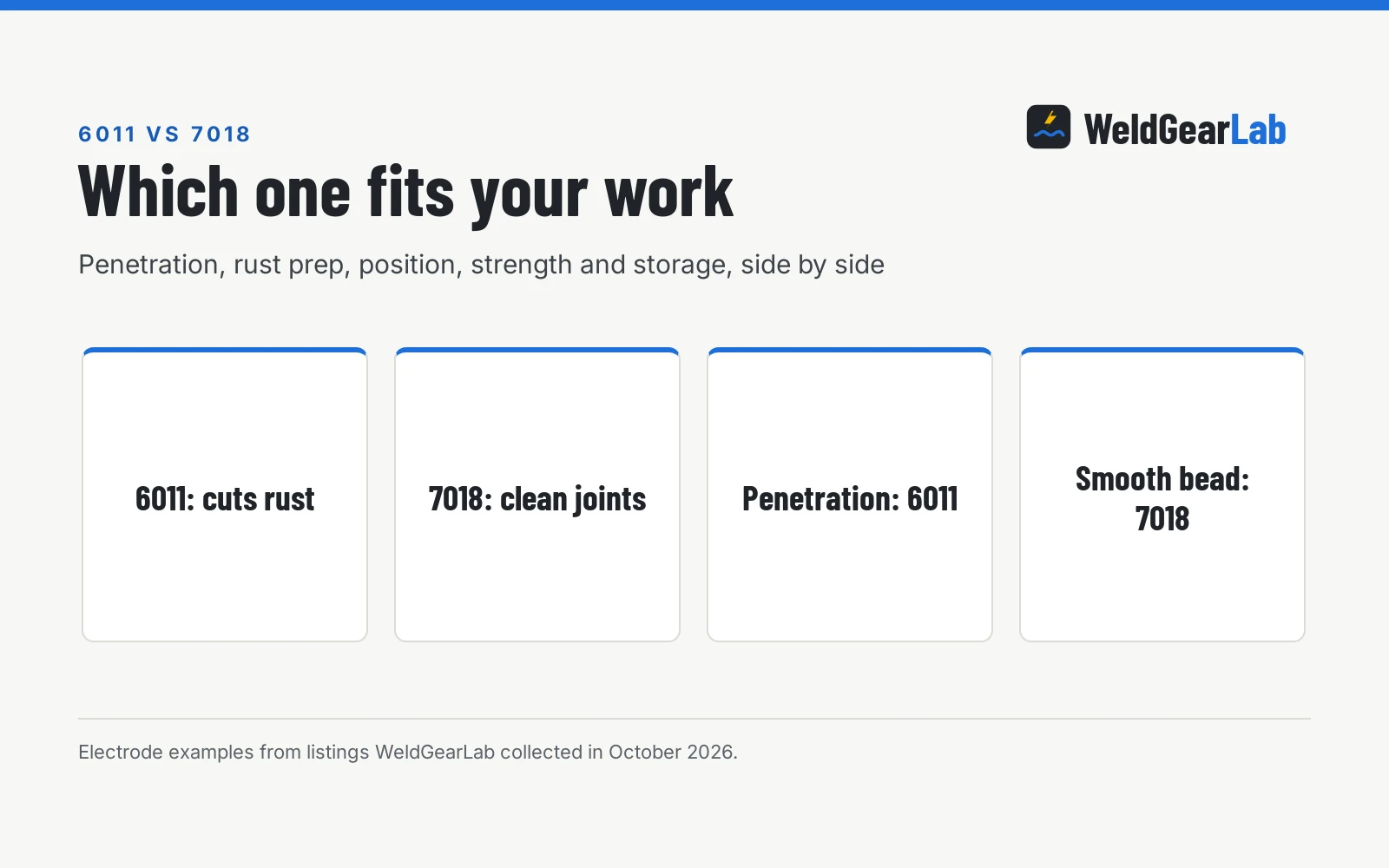
When choosing between a 6011 vs 7018 welding rod, use 6011 for dirty, rusted, or painted steel and outdoor farm repairs where deep penetration is needed, and choose 7018 for clean structural joints where high strength, ductile metal, and smooth bead appearance matter. Both are common stick welding electrodes, but their flux coatings create very different arcs and mechanical properties. This guide compares their penetration, joint preparation, storage needs, and equipment compatibility so you can pick the right rod for your shop or field work.
As an Amazon Associate I earn from qualifying purchases. This guide links to our product roundups, where WeldGearLab earns a commission when you buy through links, at no extra cost to you. Read our affiliate disclosure.
6011 vs 7018 welding rod: the difference in one paragraph
The difference between these electrodes comes down to their flux coatings and arc action. The 6011 electrode uses an organic cellulose potassium coating that produces a forceful, digging arc capable of burning through rust, oil, mill scale, and paint. Its puddle freezes rapidly, leaving a thin slag layer that chips easily. In contrast, the 7018 electrode uses a low-hydrogen flux coating packed with iron powder that produces a calmer, stable arc, filling joints with ductile, crack-resistant metal beneath a heavy slag blanket. One is built for rough maintenance on contaminated steel, while the other is engineered for clean, code-quality structural fabrication.
Side by side
| Feature | 6011 welding rod | 7018 welding rod | Practical takeaway |
|---|---|---|---|
| Flux coating | Cellulose potassium | Low hydrogen iron powder | Cellulose cuts rust; low hydrogen resists cracking |
| Arc characteristics | Forceful, deep digging arc | Calm, smooth, medium penetration | 6011 penetrates deeper; 7018 runs smoother |
| Joint cleanliness | Burns through rust, dirt, and paint | Requires clean steel, free of oil and rust | 6011 excels on unprepared farm metal |
| Slag and cleanup | Thin, brittle slag with moderate spatter | Heavy, easily chipped slag with low spatter | 7018 leaves a cleaner cosmetic finish |
| Storage requirements | Tolerates shop humidity, no oven needed | Moisture sensitive, needs heated oven once opened | 6011 requires no special storage equipment |
| Puddle freeze | Fast freezing puddle for all positions | Fluid puddle requiring close arc control | 6011 controls vertical and overhead easier |
| Current compatibility | Runs on AC or DCEP reverse polarity | Runs on DCEP, or AC with AC-specific rods | 6011 works on all basic AC transformer welders |
| Primary application | Farm repairs, rusty equipment, outdoor pipe | Structural steel, trailer frames, shop fab | Match rod to base metal prep and joint demands |
Current settings and polarity follow the manufacturer recommendations printed on the packaging or your machine door chart. While 6011 runs reliably on alternating current or DCEP, 7018 rods produce optimal results on DCEP, though specific AC-rated variants can run on transformer equipment.
When 6011 is the better choice
- Dirty, rusty, or painted steel. The aggressive cellulose arc digs through surface contaminants, rust, and paint where other rods would produce porosity and slag inclusions.
- Outdoor repairs and farm maintenance. Excellent for pasture fence repair, livestock gates, and farm machinery that cannot be easily brought into a clean shop for grinding.
- Out of position welding. The fast freezing puddle solidifies rapidly, making vertical and overhead passes easier to control without sagging.
- Basic alternating current machines. Runs smoothly on entry level transformer machines that lack direct current output.
- No special storage required. The cellulose coating tolerates ambient garage humidity without degrading, requiring no heated rod oven.
For field maintenance, see our comparison of a stick welder vs MIG welder for farm repairs, or explore our guide to the best stick welder for farm use for equipment that handles fence and machinery fixes. Hobart and Forney state a 60,000 PSI tensile rating on their 6011 electrodes, providing dependable strength for general maintenance. On joint thickness, 1/8-inch electrodes are widely available in 5-pound and 10-pound packs from Hobart, TOOLIOM, and YESWELDER, with 1-pound packs from Forney for quick repairs.
When 7018 is the better choice
- Structural and load-bearing welds. The deposited weld metal provides higher tensile strength and ductility with superior resistance to cracking under mechanical stress.
- Smooth bead appearance. Produces clean, uniform ripple patterns with minimal spatter, reducing grinding time on finished projects.
- Easy slag removal. The heavy slag blanket solidifies smoothly and often curls off or chips away with minimal hammer effort.
- Critical fabrication on clean steel. Ideal for trailers, structural framing, pressure piping, and shop fabrication where metal can be ground clean before welding.
If you need clean appearance and high joint ductility, 7018 is the standard filler metal in commercial fabrication shops and structural job sites. To understand the electrode naming system, see our guide on what 7018 means on a welding rod.
How to tell what your stick welder supports
Not every stick machine runs both rods equally well. Before buying electrodes, check your power supply specifications:
- Current type and polarity. Basic AC transformer machines run 6011 easily, but standard 7018 requires DC positive output. If your machine only provides alternating current, verify whether it supports standard rods or requires AC-formulated rods.
- Cellulose rod capability. Some compact inverter stick welders struggle with the forceful arc voltage that cellulose coatings demand. Listings that support cellulose electrodes often state 6010 or 6011 compatibility directly in the specifications.
- Amperage output. Smaller machines may only support 3/32-inch electrodes. Forney states an amperage capacity of 90A for 3/32-inch 6011 and 130A for 1/8-inch 6011, while TOOLIOM and YESWELDER list recommended operating ranges of 75A to 125A for 1/8-inch diameter.
Our hub for stick welders covers machine classes from portable inverters to heavy shop units.
Storage requirements for 7018 rods
The primary operational challenge with 7018 electrodes is moisture absorption. The low-hydrogen coating contains minerals designed to keep hydrogen out of the weld puddle, preventing underbead cracking in high-strength steel. However, once a factory sealed package is opened, the flux absorbs ambient humidity from the atmosphere. In commercial code fabrication, opened 7018 rods must be stored in a heated rod oven to remain compliant. For home shops without an oven, hermetically sealed storage containers offer temporary protection, or you can choose 6011 for general repairs since cellulose flux requires no oven storage.
For home shop setups, see our guide on how to store 7018 rods without a rod oven.
Can you combine both on the same project?
Yes, combining both electrodes on a single joint is standard practice in pipe welding and heavy structural fabrication. Welders regularly deposit a 6011 root pass to penetrate deeply and bridge fit-up gaps, then fill and cap the joint with 7018 to achieve high strength, ductile weld metal, and a smooth cosmetic finish.
Arc safety and slag hazards. Stick welding produces intense ultraviolet radiation, sparks, and hot slag. Chipping slag requires safety glasses worn beneath your welding helmet to protect against flying fragments. Because 6011 generates a forceful arc with significant spatter, ensure your work area is clear of combustible materials. When welding on galvanized, oily, or painted steel, the plume releases harmful fumes; always work in a well-ventilated space or outdoors, keeping your head out of the rising plume. See our welding safety gear checklist for beginners and our guide on how to weld galvanized steel safely.
Frequently Asked Questions
Can I run 7018 on an AC stick welder?
Standard 7018 electrodes are formulated for direct current electrode positive operation and frequently extinguish or stick on alternating current machines. If your machine only provides alternating current, look for electrodes specifically labeled 7018 AC, which include arc stabilizers in the coating. Always check the current compatibility printed on the packaging before striking an arc.
Why is 6011 better for rusty steel than 7018?
The cellulose coating on 6011 produces an aggressive, digging arc that burns through surface rust, paint, and mill scale. In contrast, 7018 requires clean base metal because surface rust and moisture contaminate the puddle, resulting in porosity and trapped slag. For contaminated equipment repairs where grinding is impractical, 6011 provides superior penetration.
Do I need a rod oven for 6011 electrodes?
No, 6011 electrodes do not require heated storage because their cellulose flux naturally contains moisture essential for proper arc shielding. Storing 6011 in a rod oven can dry out the coating and ruin its performance. A dry shelf or standard plastic container in your garage is sufficient for 6011.
Which rod is easier for a beginner to strike and run?
For striking an initial arc on clean steel, 7018 is generally smoother and spatters less once burning. However, re-striking an opened 7018 can be frustrating because the heavy slag covers the rod tip, requiring you to chip the tip clean. Many beginners find 6011 easier to re-strike, though its digging arc demands steady travel speed to avoid burn-through.
Can you put a 7018 cap over a 6011 root pass?
Yes, this combination is a standard procedure in pipe welding and heavy structural fabrication. The 6011 root pass penetrates deeply and bridges fit-up gaps, while subsequent 7018 fill and cap passes deposit high-strength, ductile metal with a smooth surface. You must thoroughly chip and wire brush all slag from the 6011 pass before depositing 7018.
Related: how to stick weld rusty metal, best welding rods for AC welder, how to store 7018 rods without a rod oven, and the stick welders hub. Also see our guide on why a welding rod keeps sticking.
About the author
WeldGearLab Editorial is the editorial team behind WeldGearLab. We research product listings, specifications, safety listings and warranty terms, score every pick with the published Gear Score method, and correct errors when readers report them. We do not run our own shop trials; see How We Pick for exactly how picks are made.