How to Weld Galvanized Steel Safely: Ventilation, PPE, and Prep
Learn how to weld galvanized steel safely by grinding off the zinc coating, setting up cross ventilation, and wearing proper respiratory protection against toxic fumes.
 By WeldGearLab Editorial
Updated October 9, 2026
By WeldGearLab Editorial
Updated October 9, 2026
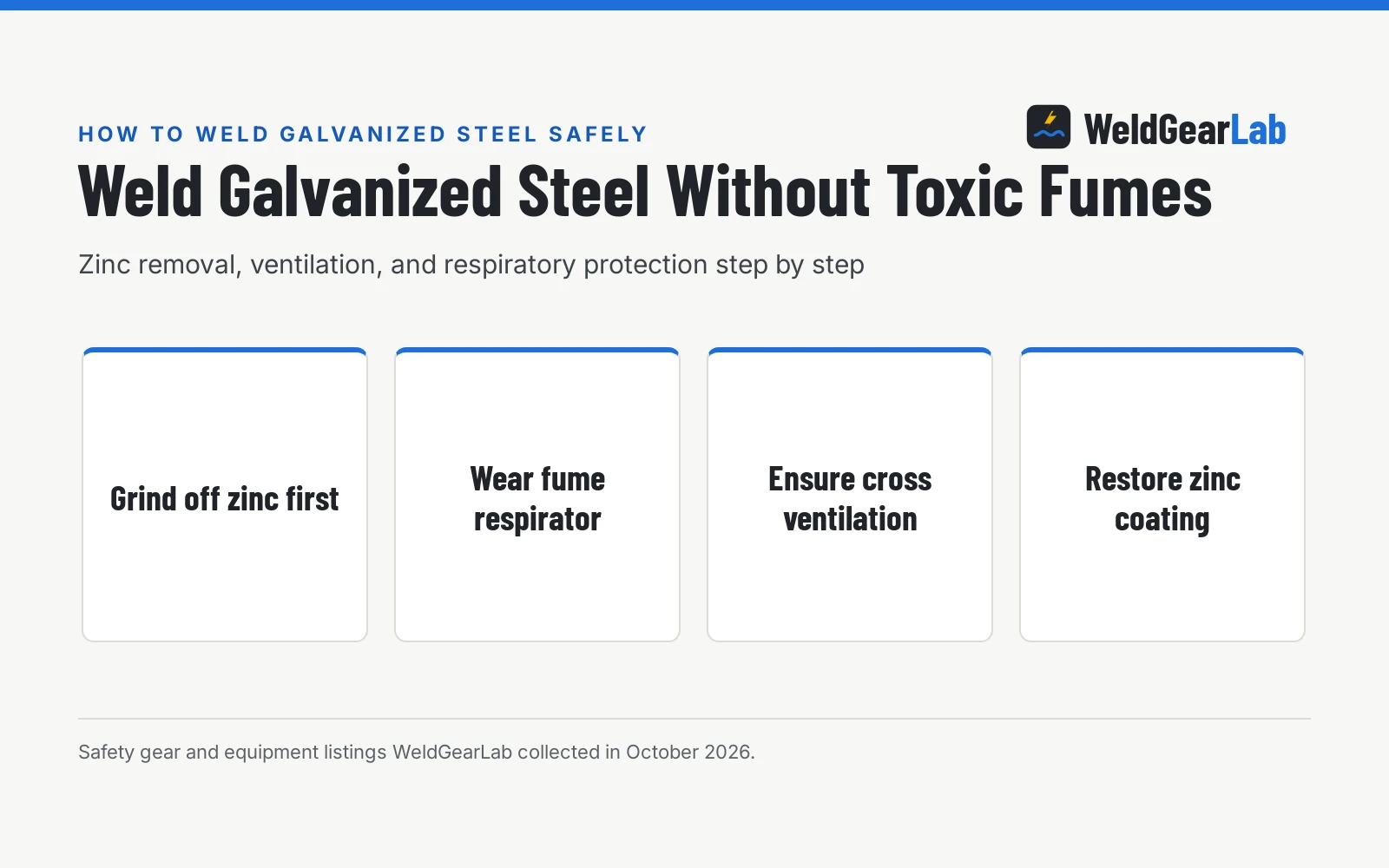
To learn how to weld galvanized steel safely, a welder must remove the zinc coating from the joint, establish active ventilation to move fumes away from the breathing zone, and wear a respirator approved for metal fumes. Welding through galvanized zinc vaporizes the coating, creating dense zinc oxide smoke that can cause metal fume fever and leave porous, weak weld seams. Proper mechanical preparation and personal protective equipment ensure clean welds while shielding the welder from hazardous airborne contaminants.
As an Amazon Associate I earn from qualifying purchases. This guide links to our product roundups, where WeldGearLab earns a commission when you buy through links, at no extra cost to you. Read our affiliate disclosure.
The zinc hazard in brief
Galvanized steel is carbon steel coated with a layer of zinc to prevent rust and corrosion. While zinc provides outstanding galvanic protection against weather, it creates severe hazards during welding. Steel melts at a high temperature, but zinc vaporizes at a much lower temperature. When an electric arc strikes galvanized steel, the zinc boils instantly into a thick white plume of zinc oxide smoke. Inhaling these fumes causes an acute occupational condition known as metal fume fever, characterized by flu-like chills, fever, nausea, joint aches, and fatigue.
In commercial product listings, Eagle specifies hot dipped 24-gauge galvanized steel for its 5 gallon safety storage cans. Whether fabricating thin 24-gauge sheet metal or heavier galvanized pipe and angle iron, the surface zinc must be removed from the weld zone before striking an arc. Beyond the health risks, vaporizing zinc disrupts the arc pool, causing severe puddle turbulence, violent spatter, and deep porosity that ruins joint strength. OSHA workplace safety guidelines emphasize that controlling exposure to airborne zinc oxide fumes requires a combination of engineering controls, such as mechanical ventilation, and personal protective equipment, including respirators approved for metal fumes.
Side by side
| MIG (Solid Wire + Gas) | Flux-Cored (Gasless) | Stick (SMAW Electrodes) | |
|---|---|---|---|
| Zinc removal requirement | Must grind to bare steel; zero zinc tolerance | Must grind to bare steel for clean welds | Must grind to bare steel for sound joints |
| Wind and outdoor tolerance | Shielding gas blows away in breezes | Tolerates outdoor wind and breezes | Tolerates outdoor wind and breezes |
| Thin sheet and small parts | Excellent control with minimal burn-through | Higher heat input; risk of burn-through | Difficult on thin sheet; high burn-through |
| Spatter and post-weld cleanup | Low spatter on clean steel; no slag | Moderate spatter; slag must be chipped | Heavy spatter; slag must be chipped |
| Fume generation on bare steel | Low smoke volume once zinc is ground away | Moderate smoke from wire core flux | Heavy smoke from electrode flux coating |
| Respiratory protection needed | Metal fume respirator under helmet | Metal fume respirator under helmet | Metal fume respirator under helmet |
| Best application on galvanized | Indoor shop projects on stripped sheet | Outdoor repairs on fences and gates | Field repairs on heavy structural steel |
Each welding process behaves differently when working on galvanized materials, but all processes require grinding off the zinc coating before striking an arc. While wire and stick processes offer distinct advantages for shop fabrication or outdoor field repairs, none can overcome the porosity, spatter, and toxic fumes caused by welding directly through unstripped zinc.
When MIG welding is the better choice
MIG welding with solid wire and shielding gas is the preferred process for indoor shop fabrication and sheet metal projects once the zinc coating has been ground away. The continuous wire feed and shielding gas envelope produce smooth, visually clean beads with minimal spatter, reducing the need for post-weld cleanup on furniture, brackets, and automotive assemblies.
However, MIG welding requires absolute cleanliness at the joint. Any residual zinc left along the seam will vaporize into the gas stream, causing porosity and nozzle fouling. In addition, MIG welding cannot be used outdoors or in drafty areas because breezes blow away the shielding gas, resulting in severe weld contamination. When selecting tools to prepare joints for MIG welding, our review of the best angle grinder for welding prep covers dedicated grinders for removing coatings. Comparing a flap disc vs wire wheel shows that a coarse flap disc strips galvanized zinc down to bright base steel far more effectively than a wire wheel, which tends to burnish the soft coating rather than remove it.
When flux core or stick is the better choice
For outdoor repairs on farm gates, fences, trailers, and agricultural equipment, self-shielded flux-cored arc welding and stick welding are the practical choices. Neither process requires an external gas cylinder, and both tolerate wind and outdoor breezes that make gas MIG impossible in the field.
Flux-cored wire and stick electrodes provide deep penetration and produce their own internal shielding from burning flux compounds. Even so, welders must never rely on electrode flux to burn through galvanized coatings. Stripping the zinc down to bare base metal remains mandatory to prevent toxic smoke plumes and weak, slag-filled joints. Both flux core and stick leave a layer of slag on the bead that must be chipped away and brushed clean before painting or inspection.
How to weld galvanized steel safely
Achieving sound welds without risking your respiratory health requires a methodical approach to joint preparation, environmental setup, and technique. Follow these essential practices whenever working with galvanized materials:
- Strip the zinc from the weld zone. Use an angle grinder equipped with a coarse flap disc to remove the galvanization along the joint line. Grind back until bright, bare carbon steel is visible on both sides of the seam, across both the front and back surfaces of the workpiece.
- Establish active ventilation. Set up fans or local exhaust systems to move fumes away from your workspace. Position air movers so that fresh air sweeps across your work area and carries the welding plume away from your breathing zone without disrupting any necessary shielding gas.
- Wear a dedicated fume respirator. Put on a clean half-mask respirator fitted with particulate filters rated for metal fumes under your welding helmet. Ensure the facepiece seals firmly against clean-shaven skin to prevent fume bypass.
- Maintain a steady welding technique. Keep your travel speed and arc length consistent. Watch the molten puddle for any signs of residual zinc contamination, such as green flame tinges, white powder around the bead, or sudden popping.
- Clean and restore the corrosion barrier. After the joint cools, chip away slag and brush off surface spatter. Because the welding heat destroys the zinc coating in the heat-affected zone, apply a zinc-rich cold galvanizing compound over the bare metal to restore rust resistance.
Protective gear and respiratory equipment
Personal protective equipment serves as your vital defense against heat, ultraviolet radiation, and toxic airborne particles. Standard paper dust masks do not provide adequate protection against submicron zinc oxide fumes. Selecting the best respirator for welding fumes ensures particulate protection against airborne metal oxides while fitting comfortably beneath a welding hood.
Protecting your hands from molten spatter, sharp galvanized edges, and conductive heat is equally critical. Wearing the best welding gloves for MIG provides heat shielding and spark resistance when handling hot steel assemblies. An auto darkening welding helmet with appropriate filter shading shields your eyes from intense arc radiation while allowing clear visibility during grinder setup. Reviewing our comprehensive welding safety gear guide provides an overview of complete shop protective standards.
Can you weld galvanized steel in a home workshop?
Welding galvanized steel inside an enclosed residential garage or hobby basement workshop presents serious safety challenges. Zinc oxide fumes disperse slowly in confined areas and can settle on surfaces, tools, and clothing. Natural garage door openings alone do not provide sufficient air exchange to keep fume levels within safe limits.
If you must weld galvanized components in a home shop, perform the grinding and welding operations outdoors whenever possible. Working outside in a steady breeze provides natural dilution ventilation that rapidly carries away stray fumes. When indoor work is unavoidable, set up mechanical exhaust fans near the weld table to vent air directly outside, keep overhead doors fully open, and never allow bystanders or pets in the area during welding or grinding.
Frequently Asked Questions
What happens if you weld galvanized steel without removing the zinc?
Welding directly through zinc causes the coating to vaporize into thick white zinc oxide fumes that can cause acute metal fume fever. The boiling zinc also introduces severe porosity and cracking into the molten puddle, resulting in a weak and brittle joint. In addition, the arc spatters violently, fouling the welder nozzle and contact tip.
Does drinking milk prevent metal fume fever?
Drinking milk before or after welding galvanized metal is an old shop myth that provides no medical protection against toxic zinc oxide fumes. Inhaled zinc fumes enter the lungs and bloodstream directly, bypassing the digestive system entirely. The only reliable prevention is removing the zinc coating before striking an arc, providing strong ventilation, and wearing an approved fume respirator.
How far back should you grind galvanized steel before welding?
You should grind the zinc coating off the steel far enough back from the weld line so the heat of the arc does not vaporize remaining zinc. A clean band of bare, shiny steel along both sides of the joint ensures that the puddle stays clean and free of contaminants. Be sure to strip both the front face and the back face of the metal if heat penetrates through the joint.
Can you MIG weld galvanized steel?
Yes, you can MIG weld galvanized steel provided you mechanically grind away the zinc coating down to bare steel along the joint before welding. Once the steel is stripped clean, standard solid wire with shielding gas creates strong, clean beads with minimal spatter. If you attempt to MIG weld through unstripped zinc, vaporizing gas blows holes in the puddle and spatters heavily.
How do you restore rust resistance after welding galvanized steel?
Welding heat burns away the protective zinc layer around the joint, leaving bare carbon steel vulnerable to corrosion. After the weld cools and you remove any spatter or slag with a wire brush, apply a zinc-rich cold galvanizing compound or paint over the joint. This restores cathodic rust protection to the heat-affected area and keeps the project weather-resistant.
Related: welding safety gear checklist for beginners, best welding respirator for under a helmet, what shade for MIG welding, and best flap disc for metal.
About the author
WeldGearLab Editorial is the editorial team behind WeldGearLab. We research product listings, specifications, safety listings and warranty terms, score every pick with the published Gear Score method, and correct errors when readers report them. We do not run our own shop trials; see How We Pick for exactly how picks are made.