How to Weld in a Cold Garage in Winter
Learn how to weld in a cold garage in winter safely by preheating steel, protecting shielding gas regulators, stopping moisture buildup, and ventilating shop fumes.
 By WeldGearLab Editorial
Updated October 9, 2026
By WeldGearLab Editorial
Updated October 9, 2026
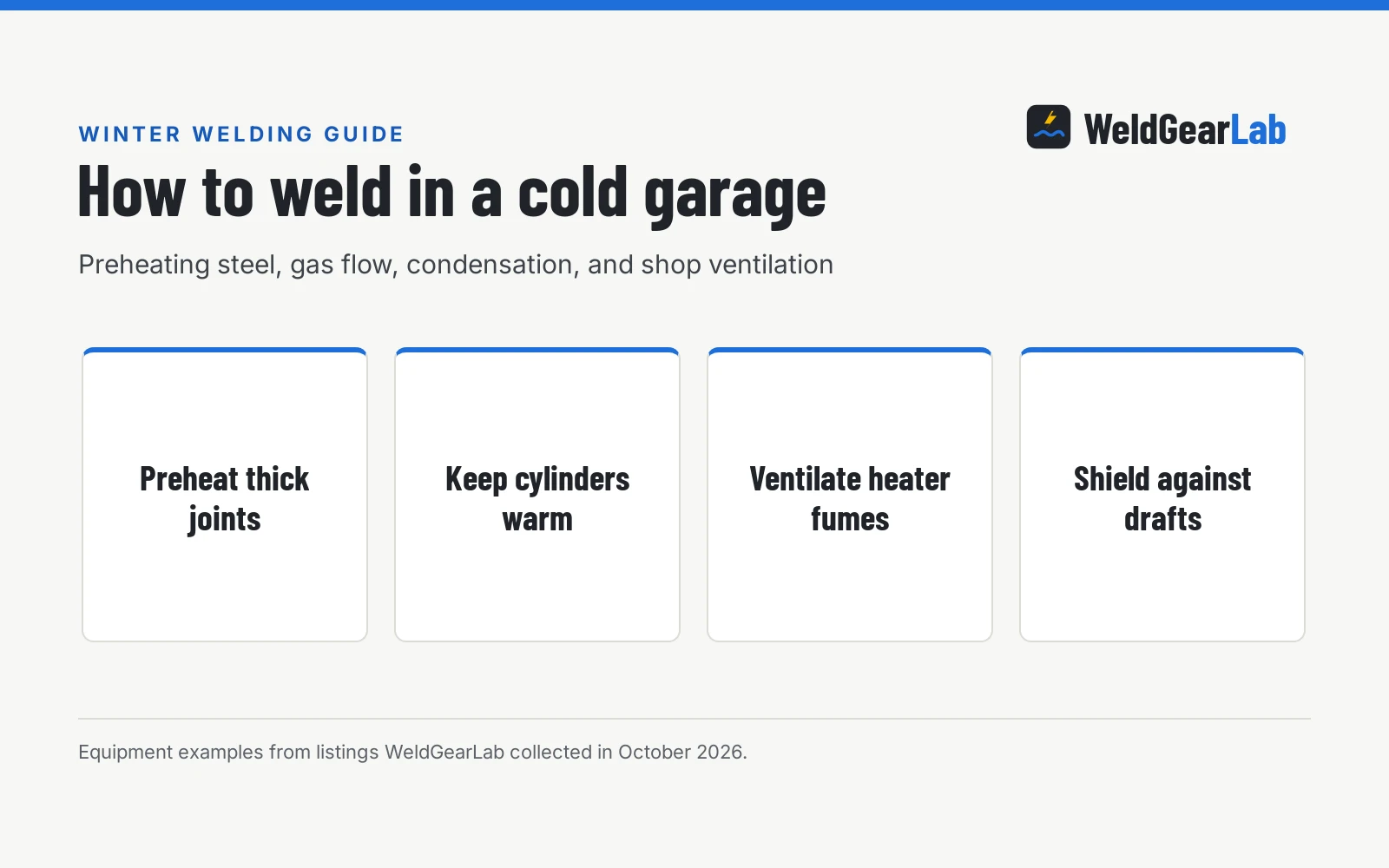
Knowing how to weld in a cold garage in winter comes down to warming your base metal, keeping moisture off equipment, maintaining steady shielding gas flow, and ventilating heater exhaust safely. Cold steel siphons heat away from the welding arc, which leads to lack of fusion, brittle joints, and cracking along the bead. Working in an unheated garage also introduces moisture that condenses on cold tools, wire rolls, and machine circuits as soon as the space begins to warm up. By warming cold metal, storing consumables in dry conditions, and managing heating equipment properly, you can make sound, clean welds through the coldest months of the year.
As an Amazon Associate I earn from qualifying purchases. This guide links to our product roundups, where WeldGearLab earns a commission when you buy through links, at no extra cost to you. Read our affiliate disclosure.
Winter garage welding in one paragraph
Cold temperatures change how molten steel solidifies and how shop tools behave. Steel acts as a heat sink in freezing weather, rapidly chilling the weld puddle and trapping hydrogen, which causes cold cracking. At the same time, cold shielding gas lines and regulators can freeze up as expanding gas cools, while moisture settles on frosty metal surfaces to cause porosity. Safe winter welding requires preheating cold workpieces, keeping your equipment dry, and running fresh air ventilation while heating the garage space.
Side by side
| Factor | Cold garage issue | Winter solution | Shop practice |
|---|---|---|---|
| Base metal temperature | Cold steel rapidly pulls heat from the arc | Preheat joints warm to the touch | Reduces thermal shock and cracking |
| Condensation on tools | Warm air creates moisture on frosty steel | Acclimate equipment before powering on | Protects inverter circuits from moisture |
| Shielding gas delivery | Regulators frost over as gas expands | Store cylinders in tempered space | Maintains steady flow and prevents freezing |
| Wire and consumables | Bare wire rusts in humid unheated air | Store spools in airtight containers | Prevents wire feeding friction and porosity |
| Garage ventilation | Closed doors trap fumes and gases | Run dedicated exhaust and intake vents | Removes welding fumes and combustion gas |
| Protective clothing | Bulky synthetic coats ignite from sparks | Wear flame resistant cotton and leather | Shields against radiant heat and burns |
| Weld cooling rate | Freezing concrete causes rapid chilling | Cover hot welds with thermal blankets | Slows cooling rate for ductile joints |
Warming the metal and controlling moisture prevents cold cracking and porosity before you strike an arc. Always check your welder manual for minimum operating temperatures before turning on power in an unheated shop.
How to weld in a cold garage in winter
- Acclimate and inspect the welder. Inverter welders contain sensitive circuit boards. When cold machines meet warm garage air, condensation forms on the internal components. Bring machines above freezing or allow garage air to warm gradually before turning the main power switch on.
- Preheat the base metal. Never strike an arc on frost covered or ice cold steel. Use a propane torch or radiant heat to remove chill and drive off surface moisture until the steel is warm to the touch.
- Clean surface scale and moisture. Wipe away any water, frost, grease, or oil before grinding the joint down to bright, clean metal. Moisture introduces hydrogen into the puddle, causing porosity and internal weld flaws.
- Protect shielding gas delivery. Expanding gas chills the regulator orifice, which can cause frost buildup on the regulator body and restrict gas flow during cold weather. Keep cylinders in an insulated area or warm room until you are ready to weld.
- Insulate the completed joint for slow cooling. Do not set hot welded parts on freezing concrete floors or expose them to cold drafts. Cover finished joints with an insulating thermal blanket so the metal cools slowly and retains its ductility.
Managing metal temperature and preheating
Cold steel draws thermal energy away from the welding arc far faster than warm steel. When molten filler metal contacts freezing steel, the puddle freezes almost instantly, preventing full penetration into the root of the joint. This rapid quench effect hardens the heat affected zone, leaving brittle microstructures that crack under load.
Preheating steel sections reduces the thermal gradient between the weld puddle and the base metal. Warming the joint allows the puddle to wet out smoothly into the edges and gives dissolved gases time to escape before the bead freezes. To protect work areas around high heat sources, a basalt thermal barrier like DEGEOBERLIN states a continuous operating temperature of 1800 degrees and intermittent heat protection to 2500 degrees, reducing up to 90% of radiant heat. After welding, wrapping cooling parts in high-temperature insulation prevents sudden chilling from garage drafts.
Shielding gas and moisture control
Moisture and freezing gas lines create persistent problems for MIG and TIG welding in unheated garages. Expanding compressed gas naturally cools as it passes through the regulator orifice. When ambient air is already near freezing, moisture in the air freezes onto the regulator body, causing erratic gas flow or complete regulator freeze up. Our guide to choosing a gas regulator for welder setups covers durable regulators designed for stable gas delivery.
Condensation is equally damaging to welding wire. Leaving a spool of solid MIG wire on the machine in an unheated space exposes bare wire to humidity swings, producing surface rust that causes feeding friction and severe weld porosity. For a deeper breakdown of gas issues and contamination, see our guide on what causes porosity in MIG welds. Store spools in airtight plastic containers with desiccant packs when the shop is not in use.
Heating and ventilating a cold garage safely
Heating a garage workspace introduces serious safety considerations regarding open flames, sparks, and toxic exhaust fumes. Unvented propane or kerosene space heaters release large amounts of moisture vapor along with hazardous carbon monoxide into the shop atmosphere.
For safe heating, ceiling mounted forced air furnaces direct combustion gases outside through dedicated venting. A dedicated heater such as the Reznor UDXC-30 provides 30,000 BTU with an 82% thermal efficiency rating, circulating between 456 and 1537 CFM of heated air on 115 volts across spaces from 600 to 1000 sq.ft. For heating exhaust through a metal garage roof, high temperature flashing is required. Fasteners Plus lists a silicone roof flashing boot for pipe outside diameters from 5-1/2 to 11-1/2 inches, rated for continuous temperatures up to 437°F and intermittent heat up to 500°F. For cooler shop penetrations like air intake pipes or electrical conduit, Fasteners Plus rates an EPDM flashing boot for pipe diameters from 1/4 to 2-1/2 inches with continuous heat limits to 212°F.
Ventilation is essential because welding fumes accumulate rapidly in a closed winter garage. To maintain airflow, Cuchiilo lists 4 Inch flexible ducting with R4 fiberglass insulation over a 25 foot run to reduce condensation in unconditioned spaces. Moving exhaust air out of the shop requires reliable air movement, such as a Dayton high-temperature blower rated at 310 CFM running on 115 volts. For a complete walkthrough on positioning tools and exhaust systems, review our guide on how to set up a welding area in a home garage.
Protective gear and cold weather welding tips
Welding in winter tempts operators to bundle up in synthetic winter coats or heavy fleece, but synthetic materials melt and ignite easily when hit by spatter. Dress in flame resistant cotton or heavy wool under a leather welding jacket to stay warm without risking fire hazards. Our overview of welding safety gear covers essential protective layers for home shops.
Cold hands reduce torch control and trigger dexterity, making smooth bead travel difficult. Stiff winter gloves cause poor gun angles and erratic travel speeds. Selecting a pair from our review of the best welding gloves for MIG provides supple leather that preserves fingertip feel while shielding hands from radiant arc heat and chilly shop tools. Additionally, inspect electrical connections carefully, as cold stiffens power cables and increases the risk of cracked insulation. Our review of the best extension cord for portable welder models highlights flexible, heavy gauge cords suitable for cold garage outlets.
Frequently Asked Questions
Can cold weather crack a weld?
Yes, cold steel rapidly pulls heat away from the molten weld pool, creating a rapid quench that forms hard, brittle microstructure in the metal. Trapped hydrogen combined with high residual cooling stress frequently leads to cold cracking along the weld bead. Preheating the workpiece and allowing it to cool slowly under an insulating blanket prevents rapid quenching and minimizes the risk of cracking.
Can I leave my welding machine in an unheated garage?
Storing a welder in a cold garage is generally acceptable, but running the machine while it is freezing cold can cause problems. Bringing cold electronics into a suddenly heated shop creates internal condensation on sensitive circuit boards, which can cause short circuits when powered up. Allow the welder to acclimate gradually to room temperature before switching on the power.
Why does my MIG shielding gas regulator freeze up?
Compressed gas drops in temperature rapidly as it expands across the regulator valve orifice. When ambient garage air is already near freezing, this chilling effect causes external frost to build up on the regulator body and can choke internal gas flow. Storing cylinders in a tempered room or using an inline gas heater prevents regulator freeze up.
What is the safest way to heat a garage while welding?
The safest garage heating option is an indirect fired or vented forced air furnace that exhausts combustion fumes outside the building. Open flame space heaters create an ignition hazard near welding sparks and release moisture that causes rust and weld porosity. Radiant overhead heaters or vented gas furnaces provide warmth without blowing air currents directly across your shielding gas puddle.
Do I need to increase my welder voltage settings in winter?
No. Do not increase your welder voltage or change wire feed speed to compensate for a cold garage. Cranking up voltage without preheating creates an erratic arc and does not stop cold steel from rapidly chilling the puddle. Preheat the steel until it is warm to the touch, then use the standard voltage and wire feed settings recommended on your welder door chart.
Related: how to set up a welding area in a home garage, what causes porosity in MIG welds, best welder for beginners, and the welders hub. Also see our guide on the best welding respirator for under a helmet.
About the author
WeldGearLab Editorial is the editorial team behind WeldGearLab. We research product listings, specifications, safety listings and warranty terms, score every pick with the published Gear Score method, and correct errors when readers report them. We do not run our own shop trials; see How We Pick for exactly how picks are made.