How to Set Up a Welding Area in a Home Garage
How to set up a safe, organized welding space in a home garage, covering concrete floor prep, electrical supply, spark containment, ventilation, and fire safety.
 By WeldGearLab Editorial
Updated October 9, 2026
By WeldGearLab Editorial
Updated October 9, 2026
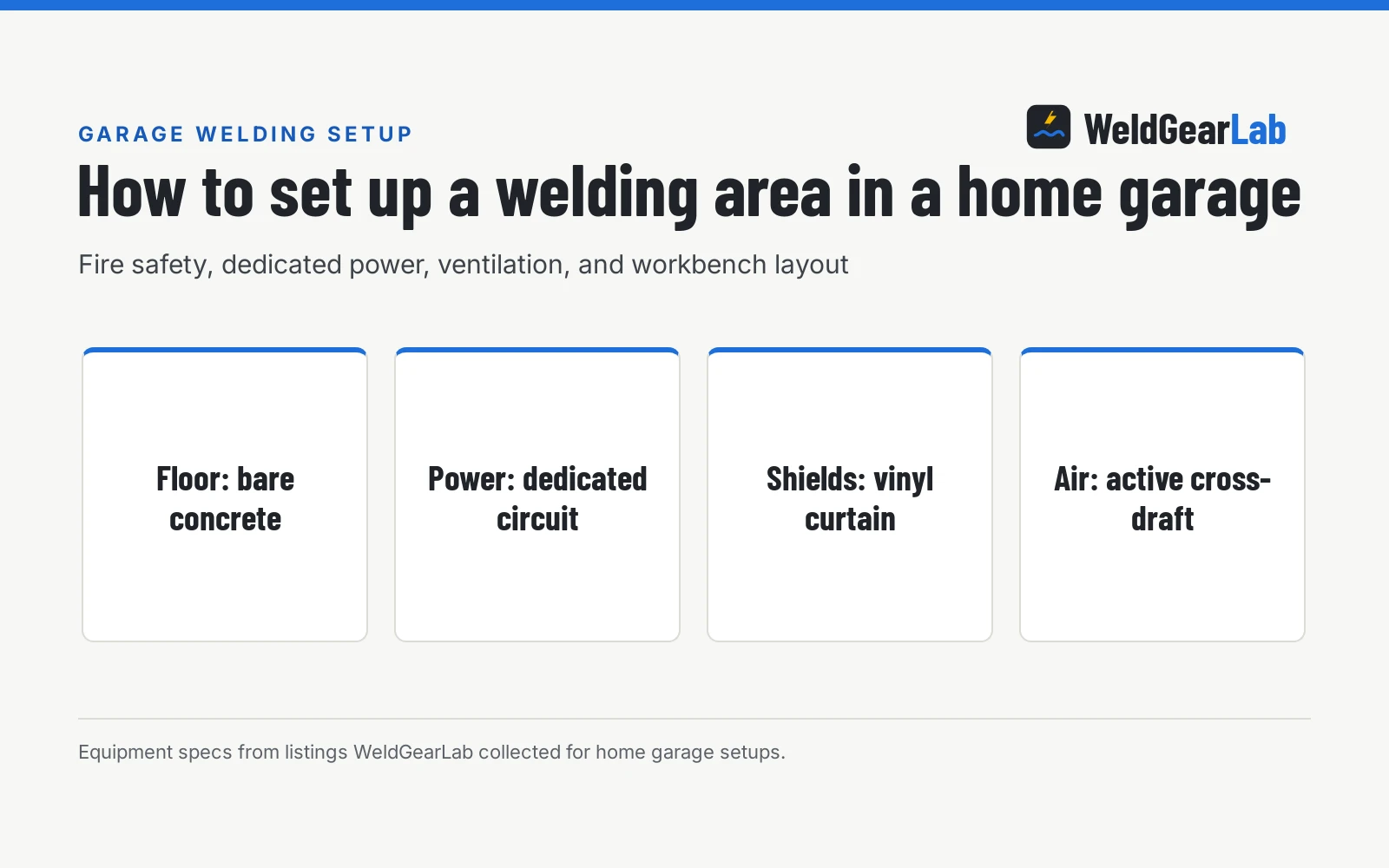
To set up a welding area in a home garage, clear a dedicated perimeter on bare concrete, remove all combustible storage, run a dedicated power feed, set up flame-resistant spark screens, and arrange cross-ventilation to exhaust fumes. Learning how to set up a welding area in a home garage safely comes down to separating hot sparks from flammable materials while providing reliable electricity and breathable air. A sturdy steel workbench, grounded work lead, secure cylinder storage, and nearby fire extinguisher complete the workstation.
As an Amazon Associate I earn from qualifying purchases. This guide links to our product roundups, where WeldGearLab earns a commission when you buy through links, at no extra cost to you. Read our affiliate disclosure.
How to set up a welding area in a home garage
Setting up a garage workspace requires balancing hot metal fabrication with ordinary residential storage. Garages often house dry lumber, gasoline cans, cardboard boxes, and family vehicles, all of which present fire hazards during welding and grinding. An effective layout isolates the welding zone from flammable items, provides a stable metal surface to hold workpieces, and ensures clean breathing air without trapping fumes under the roof.
Whether you weld artistic projects, automotive patches, or farm equipment repairs, your work area must accommodate core fundamentals: a clear floor space that withstands dropped spatter, an electrical circuit that delivers stable welding current without tripping household breakers, and a continuous exhaust path that pulls fumes away from your breathing zone.
Side by side: comparing garage welding setups
| Dedicated Bay | Mobile Garage Setup | Outdoor Apron | |
|---|---|---|---|
| Primary layout | Permanent corner or dedicated shop stall | Roll-away station that folds away for parking | Wheel-out equipment for open-air work |
| Work surface | Heavy steel workbench or lockable rolling bench | Foldable carbon steel table with casters | Portable folding table or metal sawhorses |
| Spark containment | Fixed hanging curtains or partition walls | Portable vinyl screen on swivel casters and blankets | Clear open perimeter away from dry grass |
| Machine mobility | Fixed shelf or dedicated bench stand | Rolling multi-tier cart with tool brackets | Wheeled cart or portable handle |
| Shielding gas storage | Wall-anchored cylinder bracket with chain | Upright cart slots with safety chains | Secured to rolling cart during transport |
| Ventilation method | Dedicated wall exhaust or ducted fan | Open door cross-draft with portable blower | Natural open-air dispersion |
| Fire safety routine | Permanent clear perimeter and fire watch | Post-weld sweep, stow away, and fire watch | Water hose ready and perimeter scan |
Choosing among a dedicated bay, a mobile roll-away setup, or an outdoor apron depends on available floor space and whether vehicles share the garage. A mobile configuration lets you stow equipment along a wall after the metal cools, a dedicated stall keeps heavy tools and spark shields in place, and moving outside to an apron provides open ventilation for smoky jobs.
Garage welding fire safety and floor prep
Sound garage welding fire safety starts with treating every spark, spatter droplet, and hot slag bead as an ignition source. Bare concrete is the standard floor surface for garage welding. Sweep the concrete thoroughly before striking an arc to remove sawdust, dry leaves, and dirt that can ignite. If your garage floor has an epoxy coating, oil stains, or rubber floor mats, protect them: dropped spatter burns pit marks into epoxy and easily ignites rubber or plastic.
Clear all combustible storage away from the welding zone. Cardboard packing boxes, paper towels, spray paint cans, solvents, and fuel containers must be removed from the area or stored inside closed, fire-resistant metal cabinets. For fixed wooden workbenches or nearby shelving that cannot be moved, drape flame-retardant barriers over the wood. Gihunk lists a 60 by 40 inch fiberglass welding blanket with heat resistance up to 1400°F to drape over nearby surfaces and catch stray sparks.
Keep a certified fire extinguisher mounted within immediate reach of your welding stall, along with a bucket of clean water and a metal dustpan. After finishing a welding session, establish a fire watch: remain in the garage, inspecting the floor, wall seams, and nearby surfaces for lingering embers, rising smoke, or smoldering debris before closing the garage door.
Electrical power supply and circuit requirements
Welding machines draw substantial current, especially during arc strikes. Never plug a welder into an overloaded household convenience circuit shared with refrigerators, power tools, or garage door openers. A dedicated branch circuit wired directly from the main service panel provides stable current and prevents nuisance breaker trips while laying beads.
Selecting your welding machine depends on your home electrical service. Compact machines demonstrate this flexibility: Confote lists a dual-voltage stick machine operating on 110V and 220V with a 5 KW rating and up to 160A output, showing how home welders can select equipment matched to available residential power outlets. When plugging into household voltage, ensure the breaker and receptacle match the machine maker’s stated input requirements. Keep power cords routed away from the work area so hot metal and heavy rolling wheels never damage cord insulation.
Ventilation and shop airflow
Welding produces metal fumes, ozone, and shielding gas displacement that must not accumulate in an enclosed space. In a residential garage, passive air volume is insufficient to protect your lungs during extended welding or grinding sessions. Always arrange active cross-ventilation to direct the plume outside.
Open the main garage overhead door along with a rear service door or window to establish a continuous exhaust path. Position a portable fan to draw fumes away from your breathing zone and guide smoke toward the open doorway, taking care not to direct high-velocity air across your weld puddle where drafts can blow shielding gas away. When welding galvanized coatings, oily steel, or flux-cored wire, wear respiratory protection under your hood. Check our guide to the welding respirator for under a helmet for low-profile filtration masks that fit comfortably beneath a welding hood.
Welding tables, rolling carts, and spark containment
A solid, level steel welding table acts as the center of your work zone, providing a flat surface for clamping workpieces and attaching your ground clamp. Wooden workbenches present fire hazards during welding because flying spatter, hot slag, and sparks can ignite dry wood, sawdust, or cracks in timber.
For welders needing substantial weight capacity, a heavy steel bench provides a rigid, level foundation. WORKPRO lists a 36 by 18 inch nitriding steel welding workbench with a 1200 pound total weight capacity, supporting 794 pounds on the tabletop and 406 pounds on the tool tray, equipped with 4 casters with brakes to lock the bench securely in place while welding. For shared garages where vehicles park, folding workbenches allow rapid teardown. YESWELDER lists a foldable carbon steel table with a 20 by 30 inch top, four adjustable height positions from 30 to 37 inches, and a 400 pound load capacity, folding down to 7.5 inches thick for compact storage. Similarly, VEVOR lists a foldable carbon steel workbench offering a 44 by 21 inch tabletop, a 500 pound capacity, 6 tool slots, and 0.63-inch fixture holes for clamping. For more options across styles, explore our roundup of the best welding table for a home shop.
To shield family members, pets, and shop equipment from arc flash and grinding debris, surround your workstation with freestanding curtains. VEVOR lists a 6 by 8 foot flame-retardant vinyl welding screen on 4 swivel wheels with 2 lockable brakes to isolate the arc and capture spatter. Our overview on what is a welding curtain details how tinted vinyl absorbs ultraviolet radiation while allowing visible light through.
Shielding gas cylinder storage and handling
Compressed shielding gas cylinders such as argon, helium, and carbon dioxide mixes contain high pressures and require careful handling. An unsecured cylinder that tips over and snaps its valve can become an uncontrolled projectile.
Always store and operate shielding gas cylinders in an upright position. In a fixed welding bay, secure cylinders to a wall stud using heavy steel brackets and retaining chains. In a mobile garage setup, mount the bottle directly onto a purpose-built welder cart. VEVOR lists a 3-tier steel cart with a 400 pound static load capacity featuring 2 cylinder slots and 2 safety chains to keep shielding gas cylinders upright and secure during work. When moving machines around the garage, review our picks for the best welding cart with drawers to organize consumables, nozzles, and chipping hammers in a rolling station.
Personal protective equipment and fire response
Setting up your workspace also requires organizing personal protective equipment so safety gear is ready before striking an arc. Hang your auto-darkening helmet, leather jacket, and ear protection on hooks near the welding table so you never weld without complete coverage.
Protect your hands against spatter and heat with heavy split cowhide or goatskin gloves; our guide to the best welding gloves for MIG covers durable options with reinforced palms. Wear leather work boots and flame-resistant cotton clothing without cuffs that could trap falling embers. Keep our comprehensive welding safety gear checklist for beginners posted on your garage wall as a pre-weld inspection reminder, and consult the broader welding safety gear section for apparel standards.
Frequently Asked Questions
Can you weld on a standard garage concrete floor?
Yes, bare concrete is the standard floor surface for garage welding because it will not ignite from falling sparks or spatter. However, clean the slab thoroughly to remove accumulated sawdust, oil deposits, and dry trash before beginning. If your garage floor has an epoxy coating or decorative paint, cover the immediate work zone with a welding blanket to prevent spatter from scorching or peeling the finish.
Do you need a dedicated 220V circuit to weld in a garage?
A dedicated 220V outlet is ideal for welding thicker steel, but many entry-level machines run effectively on standard 110V household outlets for light hobby projects. Beginners can start on 110V circuits by selecting versatile dual-voltage machines, such as those covered in our best welder for beginners guide. Ensure the outlet you use is a dedicated circuit that does not share power with other garage appliances.
How do you prevent garage welding sparks from starting a fire?
Preventing fires requires establishing a clean perimeter around your welding table, clearing all cardboard boxes, solvents, and fuel cans from the area. Hang flame-retardant welding screens around your work zone to stop sparks from reaching wall studs or stored household goods. Always keep a working fire extinguisher beside your workstation and conduct a fire watch after extinguishing the arc.
Is opening the garage door enough for welding ventilation?
Opening the main garage overhead door provides fresh air, but passive airflow alone often fails to clear concentrated smoke from under the garage ceiling. Position a portable fan to draw fumes toward the open door without directing high-velocity air across your weld puddle. For prolonged welding sessions or flux-cored wire, wear an approved welding respirator under your helmet.
Can you store gas cylinders inside a home garage?
Yes, shielding gas cylinders can be stored inside a garage provided they are chained upright to a wall stud or secured in dedicated cart slots. Keep cylinders away from direct heat sources, radiators, and sparks produced by welding or grinding. Whenever a cylinder is not connected to a regulator, thread the protective steel valve cap firmly in place.
Related: welding safety gear checklist for beginners, best welding table for a home shop, what is a welding curtain, and the welding safety gear hub. Also explore our welding tables and carts section.
About the author
WeldGearLab Editorial is the editorial team behind WeldGearLab. We research product listings, specifications, safety listings and warranty terms, score every pick with the published Gear Score method, and correct errors when readers report them. We do not run our own shop trials; see How We Pick for exactly how picks are made.