What Is a Welding Curtain? Materials, Safety, and Setup
A welding curtain is a flame-resistant, semi-transparent safety screen that encloses welding stations to protect shop workers from optical radiation, sparks, and spatter.
 By WeldGearLab Editorial
Updated October 9, 2026
By WeldGearLab Editorial
Updated October 9, 2026
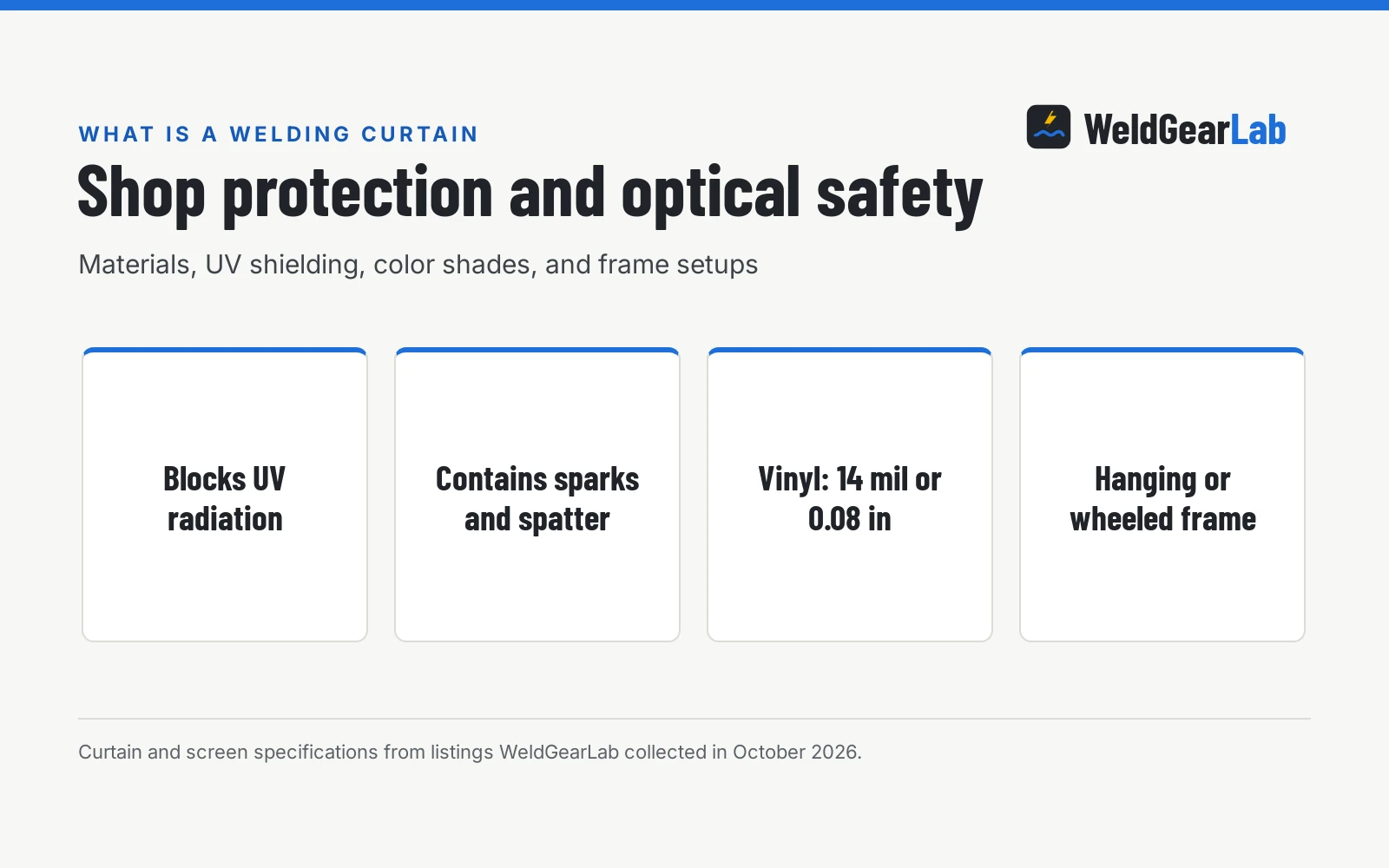
A welding curtain is a flame-resistant, semi-transparent safety screen designed to enclose a welding area, shielding nearby workers and passersby from hazardous optical radiation, sparks, and spatter. Anyone setting up a fabrication shop or garage workspace quickly asks: what is a welding curtain, and why is it necessary? Electric arcs emit severe ultraviolet and blue light that can injure unprotected eyes, while hot flying sparks and molten spatter pose an immediate fire hazard. A proper welding curtain creates an optical barrier that filters arc glare, contains hot particles, and establishes a dedicated boundary for fume extraction while permitting visual supervision from outside the stall.
As an Amazon Associate I earn from qualifying purchases. This guide links to our product roundups, where WeldGearLab earns a commission when you buy through links, at no extra cost to you. Read our affiliate disclosure.
What is a welding curtain in one paragraph
An electric arc produces intense optical radiation across ultraviolet, visible, and infrared wavelengths, alongside flying molten spatter. A welding curtain uses specially formulated vinyl to absorb harmful ultraviolet radiation and reduce blinding arc glare while remaining translucent enough for shop monitoring. It encloses the welding station so bystanders can walk past without eye injury, contains sparks to prevent workshop fires, and provides a physical containment barrier that helps exhaust systems capture fumes and vapor.
Side by side
| Hanging Vinyl Curtain | Framed Rolling Screen | PVC Strip Curtain Door | |
|---|---|---|---|
| Mounting method | Built-in grommets (framing not included) | Metal frame with swivel casters and ties | Rod pocket or custom-cut strips |
| Mobility | Stationary hanging partition | Mobile on 360-degree swivel wheels | Stationary walk-through opening |
| Stated thickness | 14 mil | Not stated | 0.08 inches |
| Stated flame standard | NFPA 701, ANSI/FM 4960, California Fire Marshall | Flame-retardant vinyl (standard not stated) | Not stated |
| Stated sizes in listings | 6′ x 6′ | 6′ x 6′ and 6′ x 8′ (1 or 3 panels) | 8 inch wide on 150-foot roll |
| Environmental role | Fume containment and noise reduction | Sparks, spatter, and flash isolation | Temperature separation and draft barrier |
Specifications reflect published manufacturer data for common shop configurations. Hanging curtains use built-in grommets for suspension from overhead frames or track mounts, mobile screens mount to wheeled metal frames, and strip curtains hang across doorways where materials and personnel pass through.
When hanging vinyl curtains are the better choice
- Permanent welding booths. Dedicated fabrication bays and maintenance stalls benefit from fixed curtain perimeters that stay in place during routine work.
- Ceiling track and pipe mounting. Built-in grommets allow hanging from overhead tubing or roller tracks so curtains can slide open when moving large steel stock. Jackson lists a 14 mil PVC vinyl curtain measuring 6′ x 6′ with grommets spaced 8 inches apart along one width side and 16 inches apart along both height sides.
- Containment for fume extraction. Hanging partitions restrict cross-drafts that disturb shielding gas and help overhead hoods extract welding fumes more efficiently.
- Floor clearance. Because hanging curtains suspend from above, the shop floor remains free of wheel assemblies and frame legs.
When outfitting a permanent stall, pair room shielding with individual gear; browse our welding safety gear overview and consider a dedicated respirator for welding fumes.
When framed mobile screens are the better choice
- Repositioning around large workpieces. When welding assemblies, equipment frames, or trailers that do not fit into a booth, rolling screens move directly to the work.
- Mobility on shop floors. Portable screens feature metal tubing frames mounted on caster wheels. VEVOR specifies 6′ x 6′ and 6′ x 8′ framed screens with 4 swivel wheels, including 2 lockable caster brakes for quick-stop stability.
- Multi-panel enclosure. For wrapping around open areas, multi-panel units connect multiple sections. VEVOR lists 3-panel configurations measuring 6′ x 6′ or 6′ x 8′ per panel, supported by 12 swivel wheels with 6 lockable brakes and secured with 24 or 72 cable ties.
- Flexible garage space. In a home shop where welding shares room with woodworking or vehicle parking, mobile screens roll against a wall when not in use.
If your layout relies on mobile fabrication equipment, framed screens pair well with a portable work surface from our best welding table for a home shop guide.
How to tell what protection a curtain provides
Not every vinyl divider is suitable for welding operations. Standard warehouse plastic lacks flame retardants and UV-absorbing compounds. Look for these checkable details in manufacturer specifications:
- Stated flame resistance. Welding curtains should self-extinguish when hit by hot spatter. Some manufacturers document compliance with recognized standards: Jackson lists compliance with NFPA 701, ANSI/FM 4960, and California Fire Marshall standards for flame resistance, whereas other makers specify flame-retardant vinyl formulations without citing a standard number.
- Material thickness. Listings that state thickness provide a baseline for durability under hot sparks. Jackson lists 14 mil PVC vinyl, while Strivide lists smooth PVC strips at 0.08 inches thick for doorway pass-throughs. Many framed screen listings do not state a mil thickness.
- Optical radiation filtering. The listing should explicitly state ultraviolet and blue light protection. VEVOR specifies 6-level UV protection on flame-retardant vinyl to shield skin and vision from arc flash.
- Grommet reinforcement. Heavy curtains pull against their mounting points. Look for reinforced corners and machine-pressed edges to prevent tearing, along with documented grommet spacing.
When selecting protective gear, verify that specifications explicitly state arc welding compliance rather than general dust separation.
Which curtain color for your welding process
Welding curtains are available in transparent and semi-transparent shades, including green, dark green, orange, yellow, red, blue, and amber. The choice of tint balances optical glare reduction against interior booth illumination:
- Green and dark green. Jackson transparent green and VEVOR dark green decrease total light transmission. Jackson specifically notes that its transparent green curtain decreases total light from the arc and suits situations where light reduction is necessary, such as high-glare MIG, Arc, and plasma operations.
- Orange, yellow, red, and blue. Lighter tints absorb hazardous ultraviolet radiation while allowing higher visible light transmission. Jackson notes that its transparent orange curtain puts light back into the welding area to help worker productivity, making it useful in shops that need bright interior visibility.
- Amber strip rolls. Strivide lists amber welding vinyl in 8-inch wide strips for doorway dividers, providing optical protection while allowing equipment and personnel to move through openings.
Select darker tints when arc glare is distracting to neighboring work stations, and choose lighter tints when the operator needs maximum ambient illumination inside the enclosure.
Can a welding curtain replace a welding helmet?
A welding curtain cannot replace personal protective equipment. As Jackson explicitly notes in its specifications, curtains are not intended for use in lieu of visors, goggles, eyewear, or welding helmets. A curtain protects bystanders outside the booth from stray flash; it does not protect the operator holding the torch.
An operator striking an arc directly faces intense radiant energy, high-velocity molten spatter, and infrared emissions. Anyone operating MIG, TIG, or stick equipment must wear an approved auto-darkening hood, safety eyewear, and flame-resistant leather gloves. Browse our recommendations for the best auto darkening welding helmet and pair your setup with heavy-duty hand protection from our best welding gloves for MIG guide.
Frequently Asked Questions
Can you look directly at an arc through a welding curtain?
You should not stare directly at an electric arc through a welding curtain for extended periods. While the flame-resistant vinyl filters hazardous ultraviolet radiation and cuts glare, direct observation can still cause visual fatigue. Curtains are designed to protect passersby and shop workers from accidental arc flash, not to serve as a viewing window for active welding.
What is the difference between a welding curtain and a welding blanket?
A welding curtain is a semi-transparent vinyl screen designed to hang vertically or mount to a frame to block optical radiation, sparks, and drafts. A welding blanket is an opaque thermal barrier designed to drape directly over equipment, machinery, or vehicle panels. Blankets protect surfaces from hot slag and heat during nearby work, whereas curtains define safe workspace perimeters.
Does a welding curtain reduce noise and fumes?
A welding curtain acts as a physical boundary that dampens sound transmission and encloses welding fumes. Jackson lists noise minimization and vapor containment among its curtain benefits. By restricting cross-drafts, the curtain helps local exhaust ventilation and fume extractors capture welding smoke before it disperses into the wider shop.
What size welding curtain do I need for a small shop?
Manufacturer listings commonly specify screens in 6′ x 6′ and 6′ x 8′ dimensions. For an individual welding table or bench, a 6′ x 6′ screen encloses the immediate work zone. For broader fabrication areas, multi-panel configurations such as a 3-panel frame provide expanded perimeter coverage.
How do you mount a welding curtain without a rolling frame?
Curtains equipped with perimeter grommets can be suspended from overhead steel conduit, threaded pipe, or tensioned aircraft cable. S-hooks, shower curtain rings, or cable ties run through the grommets to allow smooth sliding along the track. Jackson specifies grommets spaced 8 inches apart on one width side and 16 inches apart along height edges for hanging versatility.
Related: welding safety gear hub, best respirator for welding fumes, best auto darkening welding helmet, and best welding table for a home shop.
About the author
WeldGearLab Editorial is the editorial team behind WeldGearLab. We research product listings, specifications, safety listings and warranty terms, score every pick with the published Gear Score method, and correct errors when readers report them. We do not run our own shop trials; see How We Pick for exactly how picks are made.