What Shade for MIG Welding: How to Choose the Right Lens
Learn what shade for MIG welding protects your eyes across different welding currents, how fixed and auto-darkening lenses differ, and how to set your hood safely.
 By WeldGearLab Editorial
Updated October 9, 2026
By WeldGearLab Editorial
Updated October 9, 2026
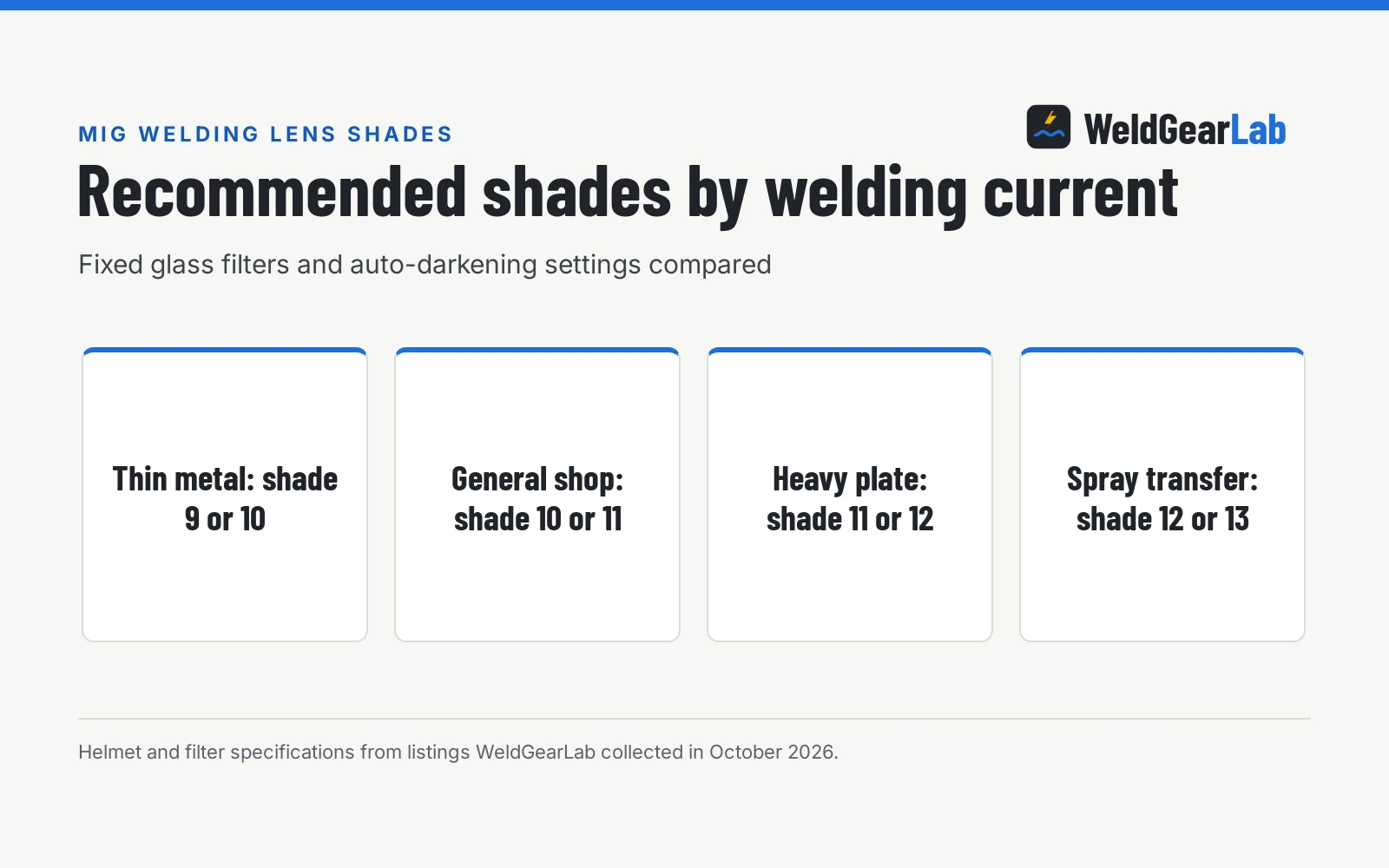
When deciding what shade for MIG welding you need, shade 10 to shade 12 is the standard range for almost all home, farm, and auto shop work. Lower welding current on thin sheet metal requires shade 9 or shade 10 to keep the weld puddle clearly visible, while higher welding current on thicker plate requires shade 11 or shade 12 to filter out intense arc glare. If you run heavy production spray transfer, you may need shade 13. This guide breaks down the correct lens shade for your welding current, compares fixed shade glass plates with variable auto-darkening hoods, and explains how to set your helmet safely.
As an Amazon Associate I earn from qualifying purchases. This guide links to our product roundups, where WeldGearLab earns a commission when you buy through links, at no extra cost to you. Read our affiliate disclosure.
What shade for MIG welding in one paragraph
In MIG welding, the electric arc generates intense visible light, harmful ultraviolet radiation, and infrared energy. A welding lens protects your eyes by blocking harmful ultraviolet and infrared radiation while filtering visible light down to a comfortable viewing level. Certified welding lenses provide continuous ultraviolet and infrared filtration regardless of their shade setting; for example, NDUUN lists ultraviolet and infrared protection up to DIN 16 on its auto-darkening hoods. The shade number refers specifically to visible light darkness. A shade number that is too low lets excessive brightness through, causing arc eye and eye strain. A shade number that is too high makes the weld puddle and the joint seam pitch black, forcing you to strain your neck or wander off the joint. Choosing the right shade balances arc glare reduction with clear puddle visibility.
Side by side
| Welding Current and Task | Recommended Shade | Typical Metal Work | Arc and View Condition |
|---|---|---|---|
| Low welding current | Shade 9 to 10 | Thin sheet steel and auto body panels | Moderate arc glare, clear joint visibility |
| Medium welding current | Shade 10 to 11 | General shop tubing, brackets, and frames | Bright arc glare, balanced puddle contrast |
| High welding current | Shade 11 to 12 | Thick steel plate and multi-pass joints | Intense arc brightness, heavy glare reduction |
| Heavy spray arc transfer | Shade 12 to 13 | Heavy structural steel and production welds | Extremely bright arc, maximum light filtering |
| Grind mode and joint prep | DIN 4 | Slag cleaning, weld prep, and surface grinding | Non-welding clear state, full optical view |
Recommended shades reflect standard eye comfort ranges for gas metal arc welding. Always confirm that your filter plate or auto-darkening cartridge carries an ANSI Z87.1 certification mark for optical safety and impact resistance before striking an arc. If your eyes feel fatigued or you see afterimages after a bead, move up to a darker shade number immediately.
When fixed shade lenses are the right choice
- Consistent optical clarity. High-grade hardened glass filter plates offer crisp puddle definition without optical distortion. For instance, TRQWH lists a hardened glass shade 10 filter plate sized 2 inches by 4.25 inches that fits standard 2 inch by 4 1/4 inch viewing windows.
- Immune to sensor obstruction. In tight corners, under vehicle chassis, or around complex tubular frames, physical obstacles can block optical sensors on an auto-darkening hood, causing the lens to flicker. A fixed glass plate never flickers because it relies on passive optical density.
- Zero battery dependence. Fixed glass plates require no lithium batteries, solar charging cells, or electronic circuitry. They never turn off or fail to switch because of dead battery cells or cold workshop temperatures.
- Lower replacement cost. Replacement filter plates and clear polycarbonate cover lenses cost very little to replace when pitted by spatter.
Our best fixed welding lens guide covers durable filter plates and drop-in cartridges for standard hood shells.
When auto-darkening hoods are the right choice
- Accurate gun positioning. You can position your MIG gun nozzle, wire stick out, and joint seam with your hood down in a clear resting state, such as the DIN 4 setting on NDUUN and TRQWH models, before pulling the trigger, preventing accidental arc strikes on clean workpieces.
- Seamless shade adjustment across different currents. Instead of changing glass plates, you turn an internal or external dial to adapt your view. Models like NDUUN and TRQWH offer an adjustable shade range from DIN 9 to 13, while VORITO provides a wide shade range from DIN 4 and shade 5 to 13.
- Fast electronic arc switching. High-speed liquid crystal filters darken almost instantaneously. Listings in our data show rapid switching speeds, such as 1/20000 second on TRQWH hoods, alongside responsive 4 arc sensor configurations on VORITO.
- Integrated grinding modes. Many auto-darkening hoods allow switching directly into a grind mode, such as the DIN 4 setting on TRQWH, without removing your headgear, protecting your face during metal preparation and weld cleanup.
How to choose your MIG welding shade
Finding your ideal shade setting depends on arc brightness, ambient shop lighting, and individual eye sensitivity. Look for these factors when dialing in your hood:
- Start with a darker shade and adjust downward. Safety guidance recommends striking an arc with a darker shade, such as shade 11 or shade 12, then adjusting down to shade 10 or shade 9 until the puddle and joint seam are clearly visible without strain. Starting with a darker setting prevents accidental glare exposure when the arc first strikes.
- Match shade to welding current and wire transfer mode. Lower heat short-circuit MIG on thin auto body panels produces modest arc glare that works well at shade 9 or shade 10. Higher current on thick plate and high-heat spray transfer creates an intensely luminous arc requiring shade 11, shade 12, or shade 13.
- Check optical clarity ratings. Look for clear optical ratings on the cartridge. Auto-darkening hoods like NDUUN list a 1/1/1/2 optical clarity, while VORITO lists a top 1/1/1/1 clarity rating that minimizes blurriness, distortion, and uneven shade darkness across the viewing area.
- Adjust sensitivity and delay controls. If ambient lighting or overhead shop lamps cause your hood to darken before you strike an arc, turn down the sensitivity knob. Adjust the delay setting, which ranges from 0.1s to 0.8s on NDUUN or 0.2s to 1.0s on TRQWH, to keep the lens dark while the glowing orange bead cools.
See our how to use auto darkening welding helmet guide for dialing in sensitivity and delay settings.
MIG welding lens shade by amperage and steel thickness
When selecting your MIG welding lens shade by amperage, arc current is the primary factor that dictates how much light the puddle emits. Here is how lens shades align with different fabrication tasks:
- Low current on thin steel and sheet metal. When welding thin gauge steel panels, automotive sheet, or small brackets, lower current creates a smaller weld puddle and lower arc brightness. A shade 9 or shade 10 setting provides the proper balance of glare reduction and joint visibility. Using a darker shade like shade 12 at low amperage can hide the joint line, making it hard to follow the seam.
- Medium current on general fabrication. For typical home, farm, and shop welding on steel tubing, angle iron, and frame brackets, shade 10 is the universal baseline. Depending on ambient shop lighting, welders alternate between shade 10 and shade 11. A fixed shade 10 hardened glass plate, such as the 2 inch by 4.25 inch lens from TRQWH, provides reliable, distortion-free viewing for this work.
- High current on thick plate. As welding current increases for heavy plate fabrication, multi-pass fillet welds, and bevel joints, arc glare intensifies significantly. Switch your variable hood or fixed plate to shade 11 or shade 12 to filter out heavy radiation and prevent eye fatigue.
- Spray arc transfer on production steel. High-voltage, high-current spray transfer produces a brilliant, continuous flame-like arc with massive light radiation. For spray arc operations, select shade 12 or shade 13 to maintain proper eye comfort.
Can one shade cover all MIG welding?
For welders who work almost exclusively on light to medium steel projects in a home or farm shop, a single shade 10 lens often covers most daily tasks. That is why shade 10 has long been the standard factory-installed plate in traditional welding hoods. However, relying on a single shade limits your flexibility. If you switch between low-current sheet metal and heavy plate fabrication, a single shade will either be too dark to see your joint on thin metal or too light to prevent eye fatigue on thick plate.
An adjustable auto-darkening helmet solves this problem by giving you a variable shade range, such as DIN 9 to 13 on NDUUN, in a single piece of gear. For our top helmet recommendations across different budgets, explore our best welding helmet for MIG welding, best auto darkening welding helmet, and best hobby welding helmet guides.
Arc radiation and eye safety. Electric arc welding generates harmful ultraviolet and infrared radiation that can cause painful cornea burns known as arc flash or photokeratitis within seconds of unprotected exposure. Always wear a helmet shell that protects your face, ears, and neck from direct and reflected radiation, not just goggles or safety glasses. Inspect your filter lenses regularly for pitting, cracks, or deep scratches that could compromise optical density. Wear flame-resistant welding gloves and proper shop clothing to shield bare skin from radiation burns. For broader eye and head protection options, consult our welding helmets category hub.
Frequently Asked Questions
Is shade 10 dark enough for MIG welding?
Shade 10 is the standard shade for most light to medium MIG welding on mild steel. It provides comfortable eye protection across typical home and garage fabrication while keeping the molten puddle clearly defined. For heavier plate welding at high currents, you should increase the darkness to shade 11 or shade 12 to prevent eye fatigue.
Can you use shade 9 for MIG welding?
Yes, shade 9 is appropriate for lower welding current on thin sheet metal, such as automotive body repair. At low currents, arc brightness is lower, and a darker shade like shade 11 or 12 can make the joint seam difficult to see. If you notice any eye discomfort or glare after welding, immediately switch up to shade 10.
What happens if your welding shade is too dark?
A lens that is too dark blocks your view of the weld puddle and the joint line ahead of your gun nozzle. This forces you to squint, lean excessively close to the hot arc, or wander off the joint path, leading to uneven beads and poor penetration. If you cannot see the edge of the puddle or where the joint goes, turn your shade dial down to a lighter setting.
Do auto-darkening helmets protect your eyes when turned off?
Yes, certified auto-darkening helmets provide constant protection against ultraviolet and infrared radiation whether they are powered on or off. The passive optical coatings in the filter block harmful radiation even in a clear resting state, with listings like NDUUN rated up to DIN 16 protection. However, the light state does not filter intense visible glare, so you must ensure the lens darkens properly before striking an arc.
How do 2-sensor and 4-sensor welding helmets differ?
Helmets with 2 arc sensors, such as basic NDUUN models, work reliably for open bench welding where the line of sight between the arc and the hood remains clear. Helmets with 4 arc sensors, such as VORITO models, provide greater reliability when welding out of position or in tight spaces where your hands or workpieces might obstruct one or two sensors. Four sensors ensure the lens darkens reliably from multiple angles.
Related: welding helmet solar vs battery, welding helmet with built in light, cheater lens for welding hood, how to choose a MIG welder, and best welding gloves for MIG.
About the author
WeldGearLab Editorial is the editorial team behind WeldGearLab. We research product listings, specifications, safety listings and warranty terms, score every pick with the published Gear Score method, and correct errors when readers report them. We do not run our own shop trials; see How We Pick for exactly how picks are made.