Best Welding Helmet for MIG Welding: 5 Hoods Scored (2026)
Five welding helmets for MIG welding, compared on shade range, optical clarity, arc sensors, viewing area, shell material, and the warranty each listing states.
 By WeldGearLab Editorial
Updated October 9, 2026
By WeldGearLab Editorial
Updated October 9, 2026
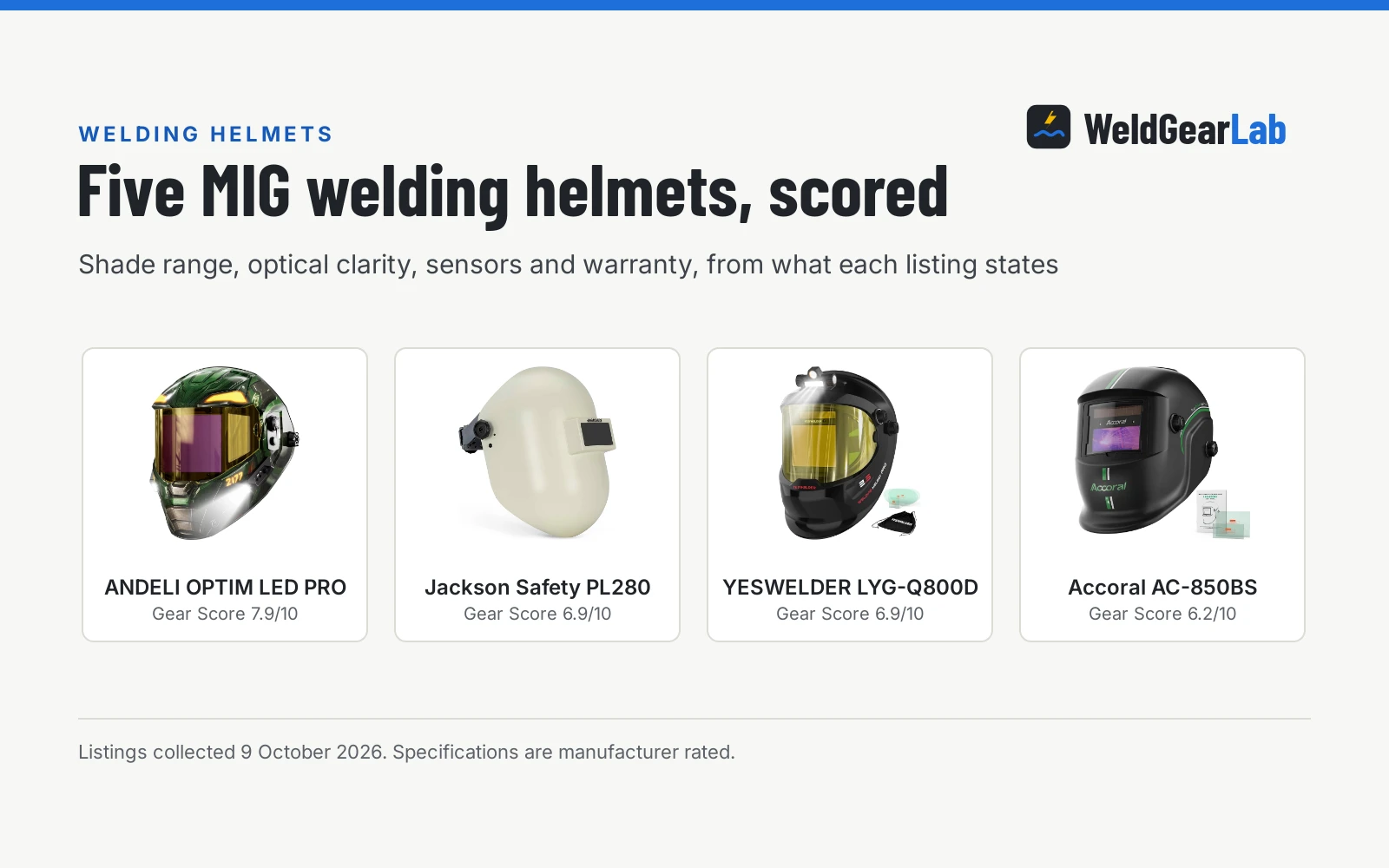
Choosing the best welding helmet for mig welding means balancing clear visibility of the weld puddle with dependable eye protection against intense arc radiation and spatter. MIG welding generates continuous arc light and molten spatter, making shade range, optical clarity, sensor reaction speed, and headgear comfort critical. This guide compares five welding helmets for home and shop MIG welding across what each listing states: viewing area, shade settings, arc sensors, shell materials, and stated manufacturer warranties.
As an Amazon Associate I earn from qualifying purchases. WeldGearLab earns a commission when you buy through links on this page, at no extra cost to you. Read our affiliate disclosure.
Quick picks
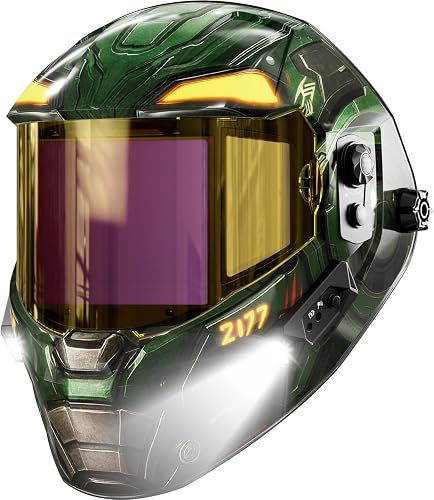
- Best Overall ANDELI OPTIM LED PRO: A panoramic 7.2 x 3.2 inch view, 6 arc sensors, rechargeable 1000mAh battery with gesture LED lights, nylon shell, and a stated 1 year warranty. Check price on Amazon
- Best Safety Certified Jackson Safety PL280: Stated ANSI Z87.1+ and CSA Z94.3 standards, a heat-resistant fiberglass shell, drop-in shade 10 filter, and a stated 1 year warranty. Check price on Amazon
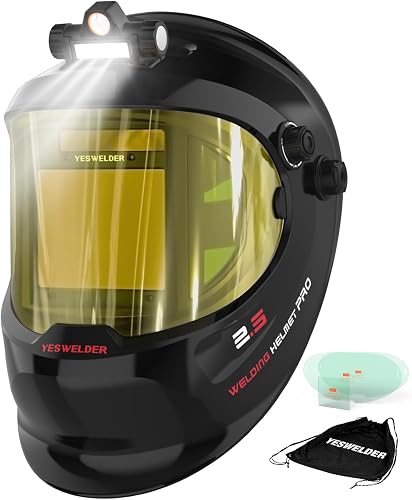
- Best Side View YESWELDER LYG-Q800D: A 3.94 x 3.23 inch main view with DIN 5 side windows, 4 arc sensors, 1/1/1/1 optical clarity, and 3 replacement lenses. Check price on Amazon
- Best External Controls Accoral AC-850BS: External side panel buttons for quick shade adjustment, 1/1/1/1 optical clarity, and a stated 1/25000-second response time. Check price on Amazon
Compare the picks
| Model | Gear Score | Viewing area | Shade range | Arc sensors | Optical clarity | Shell material | Warranty |
|---|---|---|---|---|---|---|---|
| ANDELI OPTIM LED PRO | 7.9/10 | 7.2 x 3.2 in (panoramic) | DIN 3, 5-9, 9-13 | 6 | 1/1/1/1 | Nylon, PA | 1 year |
| Jackson Safety PL280 | 6.9/10 | 2 x 4.25 in | Fixed shade 10 | None (passive) | Not stated | Fiberglass | 1 year |
| YESWELDER LYG-Q800D | 6.9/10 | 3.94 x 3.23 in (+ side view) | DIN 3, 5-9, 9-13 | 4 | 1/1/1/1 | ABS and PP | Not stated |
| Accoral AC-850BS | 6.2/10 | 3.64 x 1.67 in | DIN 4, 9-13 | 2 | 1/1/1/1 | PP | Not stated |
| Omolith OM-860CS | 5.8/10 | 3.64 x 1.67 in | DIN 4, 9-13 | 2 | 1/1/1/1 | PP | Not stated |
Specifications are manufacturer rated, as published on each listing and collected 9 October 2026.
The picks
| Award | Product | Gear Score About the Gear ScoreThe Gear Score runs from 0 to 10 and weighs performance (35%), build (25%), value (25%), safety (10%, where it applies) and warranty (5%), using only what the manufacturer and the listing publish. How we pick › | |
|---|---|---|---|
 ANDELI Auto Darkening Welding Helmet with 2 Sensor
|
7.9/10 | Check price on Amazon | |
 Jackson Safety PL280 Pipeline Welding Helmet
|
6.9/10 | Check price on Amazon | |
 YESWELDER Auto Darkening Welding Helmet with LED
|
6.9/10 | Check price on Amazon | |
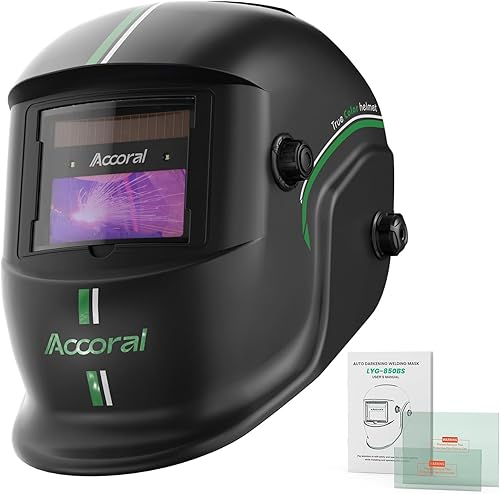 Auto-Darkening Welding Helmet, True Color
|
6.2/10 | Check price on Amazon | |
 Auto-Darkening Welding Helmet, True Color
|
5.8/10 | Check price on Amazon |
ANDELI Auto Darkening Welding Helmet with 2 Sensor
A panoramic auto-darkening helmet with a 7.2 x 3.2 inch view, 6 arc sensors, dual rechargeable batteries, and a 1 year warranty.
Pros
- Large panoramic 7.2 x 3.2 inch total viewing area with 1/1/1/1 optical clarity
- Six arc sensors for reliable detection during MIG welding
- Dual LED lights with gesture sensor control and rechargeable 1000mAh battery
- One year warranty stated by the manufacturer
Cons
- No ANSI Z87.1 or CSA Z94.3 safety certification stated in the listing
- Weighs 0.6 kg, heavier than basic fixed helmets
- Rechargeable internal battery requires Type-C cable charging rather than standard coin cells alone
- Contradiction between title mentioning 2 sensor lights and bullets stating 6 arc sensors
Jackson Safety PL280 Pipeline Welding Helmet
A fiberglass bucket-style pipeline hood with a 2 x 4.25 inch drop-in shade 10 filter, stated ANSI Z87.1+ and CSA Z94.3 standards, and a 1 year warranty.
Pros
- Meets stated ANSI Z87.1+ and CSA Z94.3 safety standards
- Heat-resistant self-extinguishing fiberglass shell deflects sparks and spatter
- Patented 370 Speed Dial ratcheting headgear
- One year manufacturer warranty stated in the listing
Cons
- Fixed shade 10 filter lacks auto-darkening adjustability for varying MIG amperages
- Small 2 x 4.25 inch viewing window compared to panoramic auto-darkening hoods
- Spec table states it cannot be worn with a hard hat
- No grinding shade mode, requiring removal of the hood to clean welds
YESWELDER Auto Darkening Welding Helmet with LED
A large-view auto-darkening hood with a 3.94 x 3.23 inch main lens, DIN 5 side windows, 4 arc sensors, and 1/1/1/1 optical clarity.
Pros
- Large 3.94 x 3.23 inch main viewing area plus DIN 5 side view windows
- Four arc sensors with a stated 1/30000-second switching response
- Wide shade adjustment from DIN 3, 5 to 9, and 9 to 13 for welding, cutting, and grinding
- Includes 3 replacement lenses, storage bag, and replacement lithium battery
Cons
- No warranty term is stated in the listing
- No ANSI Z87.1 or CSA safety standards stated in the listing
- Contradiction between bullets claiming reinforced PP and spec table listing ABS and PP
- Side windows are fixed DIN 5 and do not auto-darken
Auto-Darkening Welding Helmet, True Color
A lightweight auto-darkening helmet with external shade controls, a 3.64 x 1.67 inch viewing screen, and 1/1/1/1 optical clarity.
Pros
- External side panel buttons for easy shade, sensitivity, and delay adjustments
- Stated 1/1/1/1 optical clarity with True Color viewing
- Stated 1/25000-second auto-darkening switching speed
- Pivoting headgear designed for adjustable fit around head and neck
Cons
- No warranty term is stated in the listing
- Only 2 arc sensors, which may be blocked during out-of-position MIG welding
- Smaller 3.64 x 1.67 inch viewing screen than panoramic competitors
- Title truncates abruptly with dela and listing lacks stated safety certifications
Auto-Darkening Welding Helmet, True Color
A budget auto-darkening hood with DIN 4/9-13 shade control, cheater lens compatibility, and 1/1/1/1 optical clarity.
Pros
- Stated 1/1/1/1 optical clarity with DIN 16 UV and IR protection
- Cheater magnifying lens compatible for detailed MIG joint work
- Replaceable CR2450 lithium battery paired with solar cell power
- Includes grinding mode alongside TIG, MIG, MMA, and plasma applications
Cons
- No warranty term is stated in the listing
- No third-party safety certifications stated in the listing
- Contradictions between Part Number LY600A and Style OM-860CS plus placeholder 1 x 1 x 1 inch dimensions
- Weighs 1.99 pounds with only 2 arc sensors
How we scored them
Each helmet is scored out of 100 on performance, build, value, safety listing and warranty, with the weights published on our How We Pick page. Helmets earn safety points only when the listing states an official standard such as ANSI Z87.1 or CSA Z94.3, and warranty points only when a specific duration is stated.
| Product | Gear Score | Perf. /35 | Build /25 | Value /25 | Safety /10 | Warranty /5 |
|---|---|---|---|---|---|---|
| ANDELI OPTIM LED PRO | 7.9 | 33 | 22 | 21 | 0 | 3 |
| Jackson Safety PL280 | 6.9 | 19 | 21 | 18 | 9 | 3 |
| YESWELDER LYG-Q800D | 6.9 | 30 | 20 | 21 | 0 | 0 |
| Accoral AC-850BS | 6.2 | 23 | 19 | 20 | 0 | 0 |
| Omolith OM-860CS | 5.8 | 22 | 18 | 19 | 0 | 0 |
Buying guide: choosing the best welding helmet for mig welding
Shade range and MIG welding processes
MIG welding produces continuous arc radiation that requires sufficient filter darkness to prevent ocular fatigue. The auto-darkening hoods in this guide offer variable shade ranges spanning DIN 3 or DIN 4 in the light state up to DIN 9 through 13 in the dark state. A lighter shade allows you to align the MIG gun nozzle precisely before pulling the trigger, while shades from DIN 9 to 13 provide shielding across various welding amperages. Fixed-shade options, such as the Jackson PL280 with its drop-in Shade 10 filter, provide constant protection without electronic controls.
Optical clarity and viewing size
A clear view of the molten weld puddle allows a MIG welder to monitor wire stickout, puddle fluid dynamics, and joint edges. Four auto-darkening models reviewed here publish a 1/1/1/1 optical clarity rating, ensuring minimal distortion and uniform dark shading across the lens. Viewing area sizes vary substantially across the group: compact windows measure 3.64 x 1.67 inches on the Accoral and Omolith, while the YESWELDER provides a 3.94 x 3.23 inch main screen with side windows. The ANDELI provides the largest total coverage with a 7.2 x 3.2 inch panoramic viewing area.
Arc sensors and switching response
Arc sensors detect the flash of an electric arc and signal the liquid crystal layers to transition to dark state. Helmets with 2 arc sensors, such as the Accoral AC-850BS and Omolith OM-860CS, handle flat benchtop welding well but risk sensor blockage during out-of-position joints. Increasing to 4 arc sensors on the YESWELDER LYG-Q800D or 6 arc sensors on the ANDELI OPTIM LED PRO provides superior coverage from obstructed angles. Switching speeds published among these listings range from 1/25000 second to 1/30000 second.
Shell materials and spatter deflection
MIG welding produces airborne sparks and molten metal droplets, making shell durability essential. The listings reviewed feature three distinct shell materials: polypropylene (PP) on the Accoral and Omolith, combined ABS and PP on the YESWELDER, drop-resistant nylon and PA on the ANDELI, and heat-resistant fiberglass on the Jackson PL280. Molded fiberglass provides exceptional resistance against heat and spatter burn-through, while lightweight nylon and PP shells reduce neck fatigue during lengthy shop sessions. Stated helmet weights range from 0.6 kg on the ANDELI up to 1.99 pounds on the Omolith, with others listing 1.45 pounds, 1.8 pounds, and 1.9 pounds.
Power sources and battery design
Auto-darkening filters require electrical power to operate their sensor circuits and liquid crystal displays. The hoods evaluated rely on solar assistance coupled with lithium batteries. The YESWELDER and Omolith use replaceable CR2450 coin cells, allowing quick replacements when depleted. The ANDELI uses a 1000mAh rechargeable lithium battery that recharges via Type-C USB in 2.5 to 3 hours, offering up to 1300 hours of runtime without auxiliary lights. Passive fiberglass hoods like the Jackson eliminate electronic power requirements entirely.
Use as directed. Inspect helmet shells, filter lenses, and retention frames before striking an arc. Never weld with a cracked lens, missing spatter cover plate, or unfastened headgear. Ensure your helmet shade provides adequate protection against ultraviolet and infrared radiation for your welding process. See the OSHA welding overview and our Safety Disclaimer.
Frequently Asked Questions
What shade is best for MIG welding?
MIG welding produces intense arc radiation, so selecting the proper filter shade is necessary to prevent eye strain and arc flash. The helmets in this guide provide variable dark states spanning DIN 9 to 13, alongside fixed Shade 10 protection on passive models. Lighter shades within the DIN 9 to 10 range suit lower current work, while darker settings up to DIN 13 provide shielding for higher current arcs. Consult your welding machine manual or wire door chart for manufacturer recommended shade settings for your specific wire diameter and voltage.
How does an auto darkening welding helmet work?
An auto darkening welding helmet uses arc sensors mounted on the front shell to detect the infrared and ultraviolet light emitted when an electric arc ignites. Detection circuitry signals liquid crystal display layers inside the cartridge to align and darken within fractions of a second, such as 1/25000 or 1/30000 second on models reviewed here. When the arc stops, adjustable delay controls hold the dark state momentarily until the weld pool cools, then return the lens to a clear light state such as DIN 3 or DIN 4.
How do solar powered welding helmets work?
Solar powered welding helmets integrate photovoltaic cells on the front of the hood to capture light energy from both ambient shop illumination and the welding arc itself. This solar assist supports internal battery systems, which in our comparison include replaceable CR2450 coin cells, lithium ion packs, or rechargeable 1000mAh cells. Solar charging extends operational battery runtime, reducing the frequency of battery replacements during extended welding sessions.
How to adjust an auto darkening welding helmet?
Adjusting an auto darkening welding helmet involves setting sensitivity, shade level, and delay controls either via internal digital dials or external shell buttons. Set sensitivity high enough to detect your arc reliably without being triggered by shop lighting, and dial the shade between DIN 9 and 13 to keep the weld puddle visible without glare. Finally, adjust the headgear ratchet knob and pivot points so the hood balances securely on your head without slipping when nodding down.
What is a welding helmet called?
Welders commonly refer to a welding helmet as a welding hood, lid, or shield. Pipeline welders frequently refer to compact, fixed-shade fiberglass models like the Jackson PL280 as bucket hoods or pancake hoods depending on shell contour. While names vary across regional shops, all designs serve the primary objective of protecting the welder’s eyes and face from intense arc radiation, sparks, and hot spatter.
Can you use a pipeline helmet for MIG welding?
Yes, a pipeline helmet such as the Jackson PL280 can be used for MIG welding if fitted with a filter shade appropriate for your arc amperage. Traditional pipeline hoods use passive drop-in filters, such as Shade 10, housed in heat-resistant fiberglass shells that deflect heavy spatter. However, because they lack variable auto-darkening and grind modes, you must nod or flip the hood up to inspect your joint or grind spatter between passes.
Related: best welding helmet for outdoors, how to use auto darkening welding helmet, best welding gloves for MIG, and the welding helmets hub. Also see our cheater lens for welding hood. Also see our best fixed welding lens.
About the author
WeldGearLab Editorial is the editorial team behind WeldGearLab. We research product listings, specifications, safety listings and warranty terms, score every pick with the published Gear Score method, and correct errors when readers report them. We do not run our own shop trials; see How We Pick for exactly how picks are made.