Lincoln Viking 3350 vs Miller Digital Infinity: Which One Should You Buy?
Lincoln Viking 3350 and Miller Digital Infinity compared on optical clarity, viewing size, headgear comfort, grind mode and warranty coverage for shop welders.
 By WeldGearLab Editorial
Updated October 9, 2026
By WeldGearLab Editorial
Updated October 9, 2026
When comparing the Lincoln Viking 3350 vs Miller Digital Infinity, the Lincoln Viking 3350 stands out for welders who prioritize certified optical clarity, a lightweight helmet, and an industry-leading 5-year warranty. The Miller Digital Infinity appeals to operators seeking an expansive viewing window and internal digital push-button controls, while the Viking 3350 delivers a well-balanced profile during extended fabrication shifts. This guide breaks down how both premium hoods compare across optics, viewing size, headgear comfort, controls, and replacement parts to help you decide which one belongs in your shop.
As an Amazon Associate I earn from qualifying purchases. This guide links to our product roundups, where WeldGearLab earns a commission when you buy through links, at no extra cost to you. Read our affiliate disclosure.
The difference in one paragraph
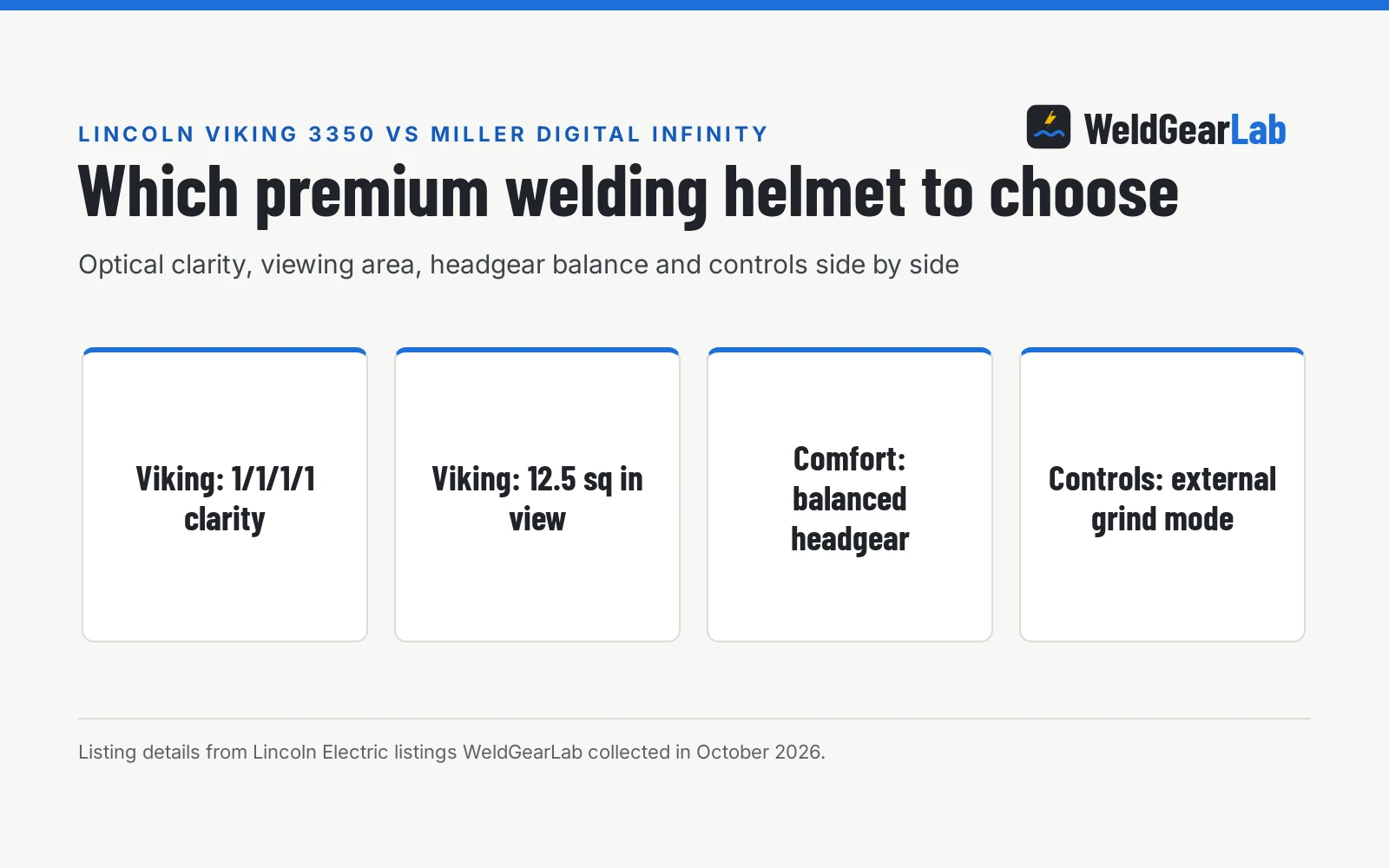
Both hoods are flagship auto-darkening welding helmets built for professional fabrication and serious home shops, but they prioritize different operator needs. The Lincoln Electric Viking 3350 centers on optical precision with 4C lens technology, an optical clarity rating of 1/1/1/1, a stated viewing area of 12.5 sq. inches, an external low-profile grind control, and a listed item weight starting at 1.4 pounds backed by a 5-year manufacturer warranty. In contrast, the Miller Digital Infinity emphasizes a massive viewing area and internal digital push-button controls for setting sensitivity and delay. The right choice depends on whether you value the Viking’s lighter listed weight, documented optical rating, and extended warranty coverage or the Digital Infinity’s expansive viewing window and digital interface.
Side by side
| Lincoln Viking 3350 | Miller Digital Infinity | Takeaway | |
|---|---|---|---|
| Optical clarity rating | 1/1/1/1 | Not stated | Viking documents certified 1/1/1/1 rating |
| Lens technology | 4C Lens Technology | ClearLight lens technology | Both provide true color viewing |
| Viewing area | 12.5 sq. inches (11.8 on ADV) | Extra-large viewing window | Both offer wide viewing coverage |
| Grind mode control | External low profile button | Internal digital controls | Viking allows switching from helmet exterior |
| Headgear system | X6 Headgear with multi-point pivot | Multi-point ergonomic headgear | Both distribute weight to reduce pressure |
| Stated helmet weight | 1.4 pounds (2 pounds on ADV) | Not stated | Standard Viking graphic models list 1.4 pounds |
| Stated warranty term | 5 year manufacturer warranty | Not stated | Viking documents 5-year coverage |
| Safety specification | ANSI Z87.1, EN Z89.1 | Not stated | Viking 3350 ADV lists ANSI and EN standards |
Specifications reflect published manufacturer listings and technical data. Stated weights and viewing areas vary slightly by production series; for example, the Viking 3350 ADV variant lists an 11.8 square inch viewing area and an item weight of 2 pounds with ANSI Z87.1 and EN Z89.1 specifications. Always verify replacement cover lens dimensions before ordering spares for your shop.
When Lincoln Viking 3350 is the better choice
- Optical clarity and true color. The Viking 3350 features Lincoln Electric 4C Lens Technology with a certified 1/1/1/1 optical clarity rating, reducing eye fatigue and giving a clear view of the weld puddle.
- All-day comfort and neck fatigue. Standard graphic editions list an item weight of 1.4 pounds, paired with the X6 headgear that distributes pressure across multiple contact points to reduce neck fatigue during long production runs.
- External grind mode access. A dedicated low-profile external grind button allows you to switch between welding and grinding modes from the helmet exterior.
- Long-term warranty protection. Lincoln Electric backs the Viking 3350 with a stated 5-year hassle-free manufacturer warranty on the auto-darkening filter.
Our best auto darkening welding helmet roundup covers premium hoods scored for clarity, response, and shop durability.
When Miller Digital Infinity is the better choice
- Expansive field of view. Welders working on large weldments and broad assemblies benefit from the expansive viewing area offered by the Digital Infinity lens geometry.
- Digital internal controls. Push-button digital controls make setting sensitivity, shade levels, and delay straightforward without guessing dial positions.
- Specialized sensor modes. Operators working in environments with obstructed sensors or outdoor sunlight appreciate specialized sensing modes designed to prevent flickering under varied lighting conditions.
- Integrated headgear adjustment. The headgear provides extensive tilt and forward-backward adjustments to accommodate prescription cheater lenses and respirators comfortably.
For operators running wire feed equipment, matching your helmet setup to the right lens darkness is critical; check our guide on what shade for MIG welding for proper eye protection across various amperage ranges.
Lincoln Viking 3350 vs Miller Digital Infinity
When evaluating the Lincoln Viking 3350 vs Miller Digital Infinity, the primary mechanical difference begins with helmet balance and weight distribution. Standard Viking 3350 graphic models like the Code Red, Motorhead, and Zombie editions list an item weight of 1.4 pounds with a lightweight nylon shell. This lower mass places less leverage on neck muscles during active welding and when the hood is raised between passes. The Miller Digital Infinity features a robust shell designed to house its larger lens cartridge and digital control module, giving it a slightly more substantial presence on the head.
Headgear ergonomics play a major role in how heavy a hood feels over a full shift. Lincoln Electric equips the Viking 3350 with its X6 headgear, which incorporates adjustable supports to distribute weight evenly across the top and back of the head. This design helps reduce localized pressure hotspots across the forehead and temples. Miller equips the Digital Infinity with an ergonomic headgear that offers fine tilt adjustments and custom sizing bands. Both headgear systems provide reliable retention, but the Viking’s lower listed weight provides an advantage for welders prone to neck strain. For detailed setup steps, consult our guide on how to adjust welding helmet headgear.
Grind mode integration represents another functional distinction between the two models. The Viking 3350 features a low-profile external grind button positioned on the left side of the helmet shell. Pressing this button toggles the auto-darkening filter into a fixed light state, allowing the operator to grind, inspect, or chip spatter without removing the helmet. The Miller Digital Infinity uses internal digital push-buttons located directly on the lens cassette. While internal placement protects controls from grinding dust, sparks, and accidental bumps, adjusting settings requires the welder to lift the hood up to reach the internal panel.
Lens technology and optical clarity
Optical performance determines how clearly you can see the molten puddle, base metal, and joint boundaries. The Lincoln Viking 3350 incorporates proprietary 4C Lens Technology, which enhances the visible color spectrum to reduce eye strain. This filter reduces the traditional lime-green hue common in older auto-darkening filters, creating a natural view of the arc in both light and dark states. Furthermore, Lincoln Electric publishes a certified 1/1/1/1 optical clarity rating across all optical criteria: optical class, diffusion of light, luminous transmittance variation, and angular dependence. Learn more about these standards in our welding helmet optical clarity rating explained guide.
Miller uses its ClearLight lens technology on the Digital Infinity to achieve a natural color spectrum with high contrast. Both helmet lines deliver sharp visibility of the puddle and base metal. Lincoln Electric explicitly documents its optical performance through the published 1/1/1/1 rating, where the fourth digit confirms uniform shading when viewing the weld puddle from off-axis angles, such as during pipe welding or restricted joint fabrication.
Lens protection and consumable maintenance are essential for keeping high-end optics performing properly. For the Viking 3350, reference listings include the Lincoln Electric KP2898-1 outside clear cover lens, which measures 4.5 x 5.25 x 0.04 inches and notes thermal protection blocking 60% of radiation heat to protect the auto-darkening filter from heat distortion. Inside clear cover lenses listed for the series include dimensions of 3.73 x 3.53 x 0.04 inches. Replacing scratched or spatter-pitted lenses promptly prevents optical distortion and protects the main cartridge. Check our tutorial on how to clean a welding helmet lens to extend consumable life.
Which helmet should you buy?
Choosing between the Lincoln Viking 3350 and the Miller Digital Infinity depends on your daily shop tasks, welding processes, and personal comfort priorities. If you weld for long stretches and prioritize reduced neck fatigue, documented 1/1/1/1 optical clarity, external grind switching, and a stated 5-year manufacturer warranty, the Lincoln Viking 3350 is a dependable investment for precision fabrication and general manufacturing.
The Miller Digital Infinity is suited for welders who prioritize an expansive viewing window above other factors. If you work on large assemblies where broad peripheral visibility is helpful, or if you prefer internal digital push-button controls, the Digital Infinity’s large viewing cassette delivers strong utility. However, standard Viking models offer a lighter 1.4-pound listed weight, an external grind switch, and a documented 5-year warranty term.
Regardless of which premium hood you choose, eye and respiratory protection must remain your primary shop safety focus. Both helmets are designed to protect against intense arc radiation, ultraviolet rays, and flying debris when fitted with proper cover lenses. In reference listings, the Viking 3350 ADV documents compliance with ANSI Z87.1 and EN Z89.1 standards. Always ensure your lens shade matches your welding process and amperage. For more hood options and reviews across all price points, explore our welding helmets category and our guide to the best welding helmet for MIG welding.
Frequently Asked Questions
Which helmet has better optical clarity?
The Lincoln Viking 3350 features a published 1/1/1/1 optical clarity rating and 4C lens technology designed to reduce distortion and eliminate artificial green tint. Both helmets offer true color viewing, but Lincoln Electric documents the 1/1/1/1 optical class standard directly on its listings. This clarity helps welders distinguish the molten puddle from the base metal, joint root, and surrounding puddle edges during precise passes.
How do the viewing areas compare between the two hoods?
Lincoln Electric lists a 12.5 sq. inch viewing area for standard Viking 3350 models, with the 3350 ADV edition stating an 11.8 square inch window. The Miller Digital Infinity also features an expansive viewing screen designed for wide peripheral visibility. While both provide generous viewing windows, the Viking 3350 delivers ample coverage without adding unnecessary front-heavy bulk.
Is an external grind button better than internal controls?
An external control button allows you to switch into grind mode from the outside of the helmet shell. The Viking 3350 provides an external low-profile grind control on the shell exterior for fast mode changes between passes. Internal digital controls keep the helmet exterior smooth but require lifting the hood up to reach the controls inside the cassette.
What warranty coverage do these welding helmets offer?
Lincoln Electric provides a documented 5-year hassle-free manufacturer warranty on the Viking 3350 auto-darkening filter. Manufacturer warranty terms vary across brands and price tiers, but a stated 5-year term provides long-term coverage when investing in an auto-darkening hood for daily shop work.
Which helmet is more comfortable for all-day welding?
Comfort depends largely on overall helmet weight and headgear adjustability. Lincoln Electric lists standard Viking 3350 graphic models at an item weight of 1.4 pounds and pairs them with the X6 headgear, which uses adjustable supports to distribute weight evenly across the head. Proper headgear adjustment helps minimize pressure points and reduces neck fatigue over extended fabrication shifts.
Related: best auto darkening welding helmet, best welding helmet for MIG welding, best lightweight welding helmet, and the welding helmets category. Also see our guide on welding helmet optical clarity rating explained.
About the author
WeldGearLab Editorial is the editorial team behind WeldGearLab. We research product listings, specifications, safety listings and warranty terms, score every pick with the published Gear Score method, and correct errors when readers report them. We do not run our own shop trials; see How We Pick for exactly how picks are made.