Manual Sheet Metal Brake Guide for Home Shops
A manual sheet metal brake folds sheet into brackets, panels and boxes, and this guide covers capacity, fingers, bending angle and bench space.

On this page
Top picks at a glance
As an Amazon Associate I earn from qualifying purchases.
- 1
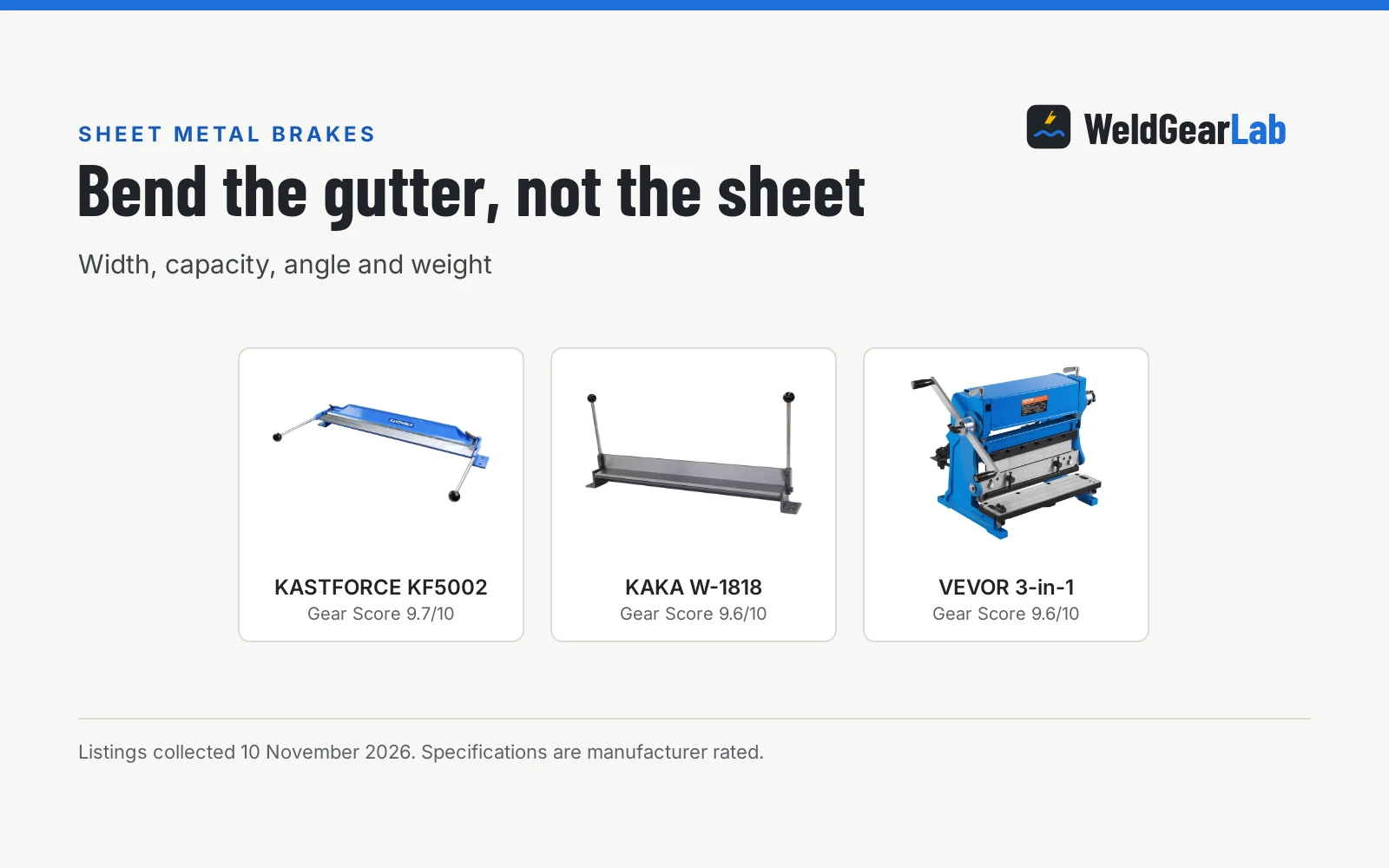
 KF5002 Sheet Metal Brake Steel Bending Brake Sheet Metal9.7/10View on Amazon
- 2
 VEVOR Box and Pan Brake9.6/10View on Amazon
- 3
 VEVOR Box and Pan Brake9.6/10View on Amazon
A bracket for a shelf, a patch panel for a fender, a cover for an electrical box. Each of those jobs ends the same way, with a flat sheet that needs a clean, straight fold, and that fold is what a manual sheet metal brake is for. A lever-style manual sheet metal brake clamps the sheet, holds it flat, and folds it along a straight line with leverage from a handle, and it needs no power.
This guide links to our product roundups, where WeldGearLab gets a commission on purchases made through links on this page, and your price stays the same. Read our affiliate disclosure.
What a manual sheet metal brake is
A lever-style manual sheet metal brake has a flat bed, a clamping bar that holds the sheet, and a hinged leaf that folds the free edge up to the angle wanted. The clamping handle locks the sheet in place, and the bending lever does the work, so the fold stays straight across the full width. The magnetic brake in these listings clamps the sheet with a magnet instead of a bar, and it needs a power supply, covered below. Listings here run from a 12 in compact brake to a 52 in 3-in-1 machine, with 18 in, 24 in and 48 in brakes between them. The brake bends mild steel, stainless steel, aluminum and copper, and the gauge rating is stated for mild steel: the Baileigh 48 in listing rates its brake at 16-gauge mild steel and 20-gauge stainless steel.
Straight brake vs box and pan brake
| Straight brake | Box and pan brake | 3-in-1 shear, brake and roll | |
|---|---|---|---|
| What it bends | Straight bends across the full width | Straight bends, boxes, pans, channels and flanges | Cuts, bends and rolls sheet |
| Fingers | Full-width clamp bar | Sets of removable fingers | Segment fingers |
| Capacity, mild steel | 16 or 18 gauge | 16 gauge or 20 gauge | 16 gauge |
| Width | 18 in, 24 in or 48 in | 12 in, 24 in or 48 in | 52 in |
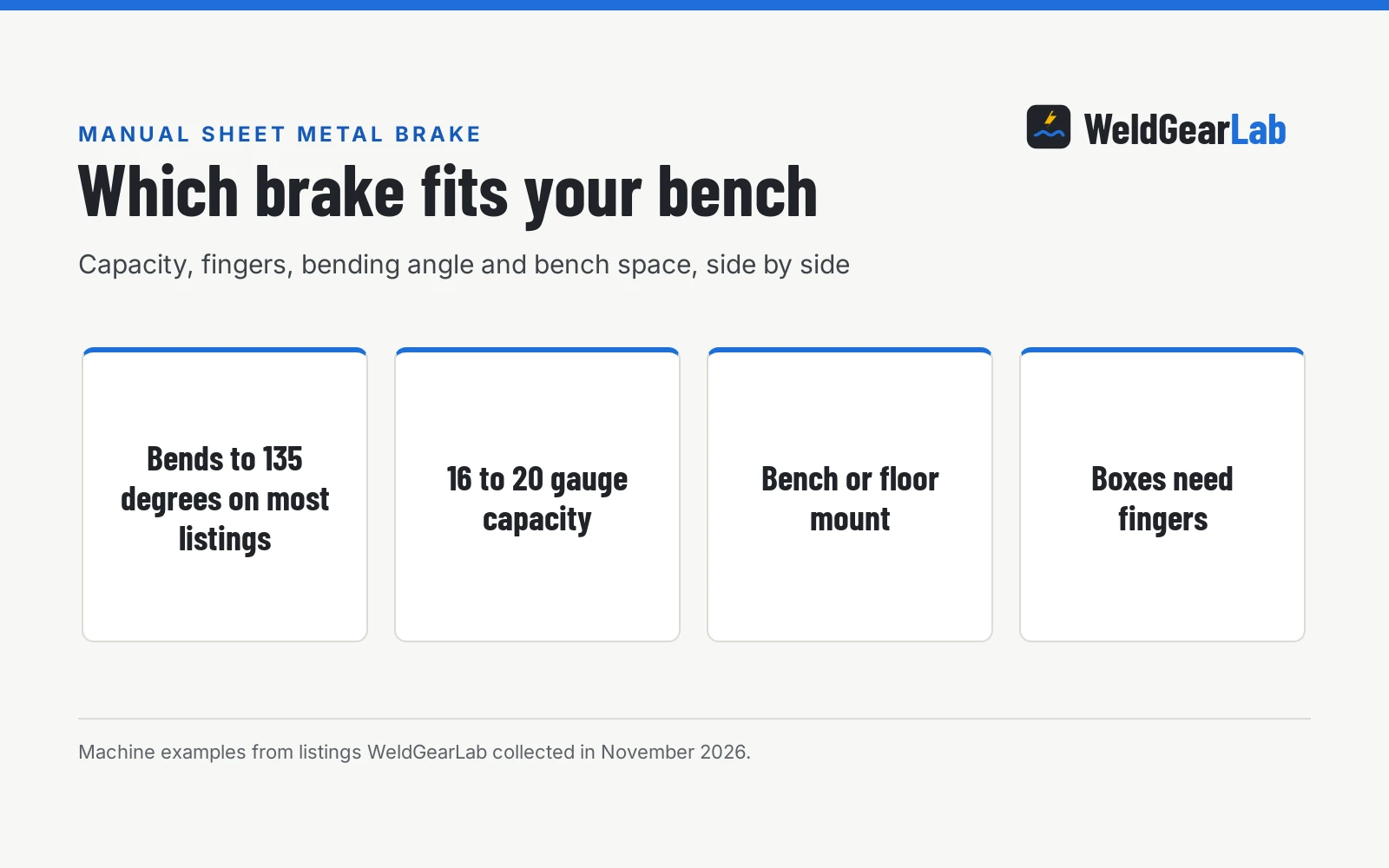
| Bending angle | 0 to 135 degrees | 0 to 135 degrees; 0 to 125 degrees on the KAKA 24 in | Angle not listed; V-groove brake not for 1.0 mm sheet |
| Box depth | Not made for boxes | 1.6 in on the KASTFORCE, 3.35 in on the KAKA | Segment fingers for boxes and pans |
| Mounting | Bench mount, or floor stand on the 48 in Baileigh | Bench mount with screws, or floor stand | Floor standing, 1036.0 pounds |
| Also does | Bending only | Bending only | Shears and rolls as well as bending |
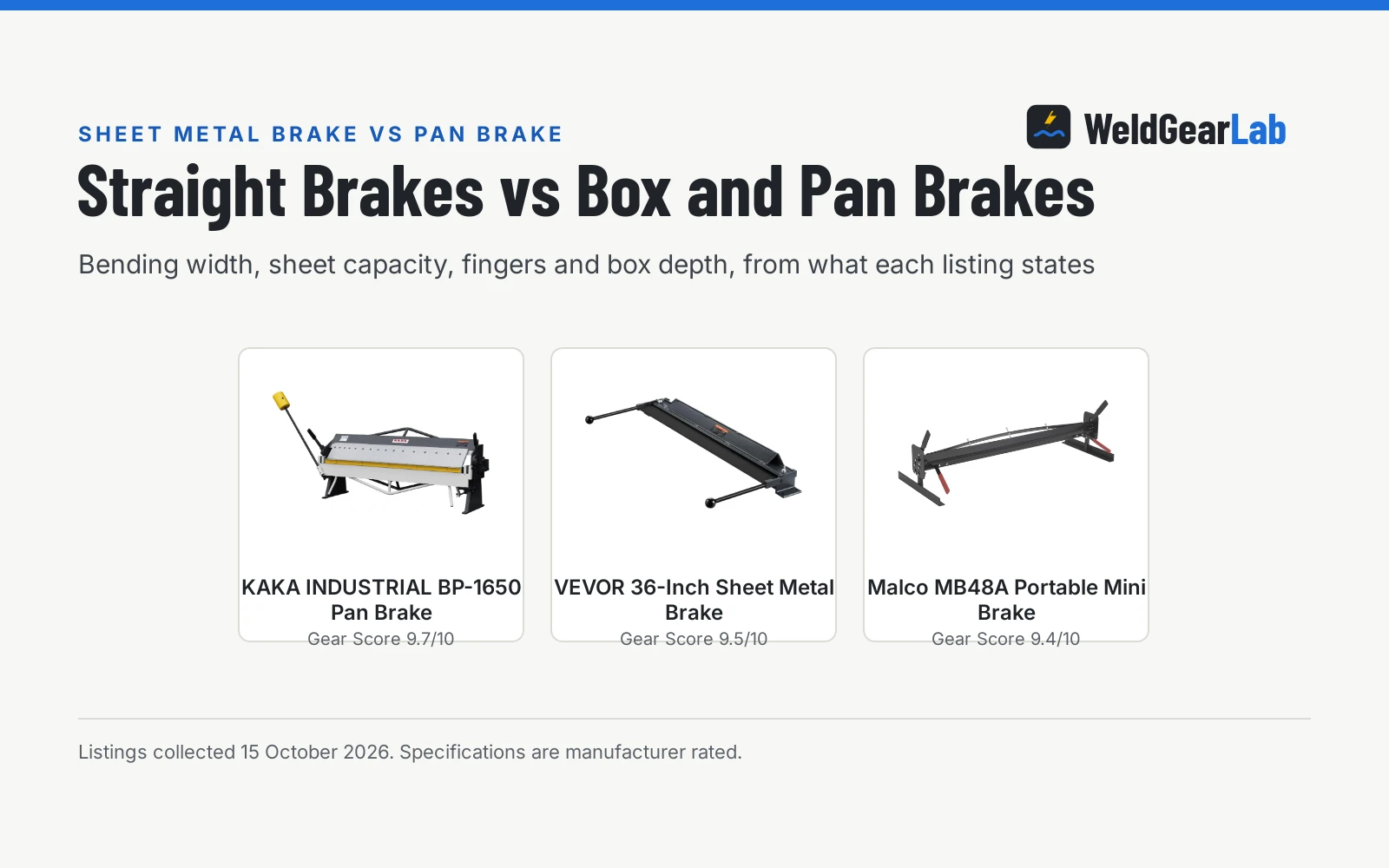
The straight brake is the simpler tool: a full-width clamp and leaf for straight bends and hems across the whole sheet. A box and pan brake splits the clamp and the leaf into removable fingers, so the sides of a box can stand clear of the fingers while the next bend is made. Flat parts and hems suit the straight brake, while boxes, pans, channels and flanges need fingers.
How to read the capacity rating
Capacity is given as a gauge of mild steel and a width in inches. The compact brakes list 20-gauge mild steel at 12 in and 24 in widths, the 18 in brake lists 18-gauge mild steel, and the 24 in and 48 in brakes list 16-gauge mild steel. The KAKA 24 in listing states its 16 gauge rating as 1.5 mm, and the KASTFORCE 24 in listing states its 20 gauge rating as 1.0 mm, so the same thickness may be stated in gauge or in millimetres. Bending angle is listed as a range, most often 0 to 135 degrees, with the KAKA 24 in listing stating 0 to 125 degrees.
Read the fine print on combination machines: the KAKA 52 in 3-in-1 listing states a 16 gauge capacity for the machine, then warns that 1.0 mm sheet can be sheared and rolled but that the V-groove brake design is not suitable for bending 1.0 mm sheet. Match the thickness to the function doing the work.
How to make a bend, step by step
Clamp the brake to the bench or floor so it cannot shift, then lift the clamping handle, slide the sheet under the clamp to the bend line, and lower the handle to lock the sheet flat. Raise the bending leaf slowly to the angle wanted, then release the clamp and lift the part out. The VEVOR listings describe exactly that sequence, and add that angle adjustments are manual. Wear eye protection and keep hands clear of the clamping bar and the leaf while they move.
Allow for springback: the VEVOR listings state that all metal bending will experience springback, and give the example that for a 90 degree bend, the angle should be set to 92 degrees. Bend a scrap piece of the same sheet first, and adjust the setting before bending the good part. Use the stops and gaps the brake provides: the Baileigh 48 in listing describes a stop rod for repeatable bends and an adjustable blade gap, and the KAKA 24 in listing describes a rear stop that adjusts up to 17.5 in for repeat positioning.
What to check in the listing before you buy
Listings disagree with themselves more often than buyers expect, so read the title, the bullets and the spec table against each other. The 18 in Americangaslogs listing titles its bending angle 0 to 90 degrees, then its bullets state 0 to 135 degrees. The VEVOR 24 in listing titles its aluminum capacity 14 gauge, then its bullets state 16-gauge aluminum. The KAKA 24 in bench brake listing states 53 lb net weight in its bullets and 57.0 pounds in its spec table. Where the listing disagrees with itself, treat the figure as unconfirmed and ask the seller before ordering.
Check weight and mounting against the shop. The KAKA 24 in listing states the brake should be securely clamped in place or mounted before use. A bench brake of that size suits a workbench, while the Baileigh 48 in brake lists 506.0 pounds and comes with a modular stand that secures to the floor, and the KAKA 52 in 3-in-1 lists 1036.0 pounds and notes liftgate service for delivery. Check the power supply on magnetic brakes: the Baileigh magnetic 48 in listing states a 220V single-phase supply, so it needs a matching circuit, while the plain lever brakes need no power at all.
Which size fits a home shop
Match the width to the widest sheet the shop bends. A 12 in brake suits small jobs such as side panels and flanges, and the VEVOR 12 in listing calls it out for small-scale DIY jobs. A 24 in brake suits channels, brackets and covers at 16, 18 or 20 gauge, and the VEVOR 24 in listing describes it for home shops and personal use. A 48 in brake suits full-width panels and ductwork. Boxes and pans need removable fingers, with a maximum box depth of 1.6 in on the KASTFORCE listing and 3.35 in on the KAKA listing.
Pair the brake with cutting tools: tin snips and a nibbler cut the sheet to size before it goes on the brake, and a bead roller adds stiffness to flat panels after bending. See the best tin snips for sheet metal and best power bead roller guides.
FAQ for welders
What gauge steel can a manual sheet metal brake bend?
It depends on the brake. The listings here state 20-gauge mild steel for the compact 12 in and 24 in brakes, 18-gauge mild steel for the 18 in and 24 in brakes, and 16-gauge mild steel for the 24 in and 48 in brakes. The Baileigh 48 in listing rates its brake at 16-gauge mild steel and 20-gauge stainless steel, so check the stainless rating on its own rather than assuming the mild-steel rating carries over.
What is the difference between a straight brake and a box and pan brake?
A straight brake has a full-width clamp and leaf for straight bends and hems, while a box and pan brake splits the clamp and leaf into removable fingers, so the sides of a box can stand clear while the next bend is made. Boxes, pans, channels and flanges need fingers; flat parts and hems do not.
How wide a sheet can a manual brake bend?
Listings here state widths of 12 in, 18 in, 24 in, 48 in and 52 in, so the brake should be at least as wide as the widest sheet the shop bends. A 24 in brake suits many home shops, and the VEVOR 24 in listing describes it for home shops and personal use, while 48 in and 52 in brakes suit full-width panels.
Why does my bend come out under 90 degrees?
Sheet springs back after the leaf is released, so the bend ends under the angle set. The VEVOR listings give the example that for a 90 degree bend, the angle should be set to 92 degrees, and bending a scrap piece first shows how much springback the sheet has.
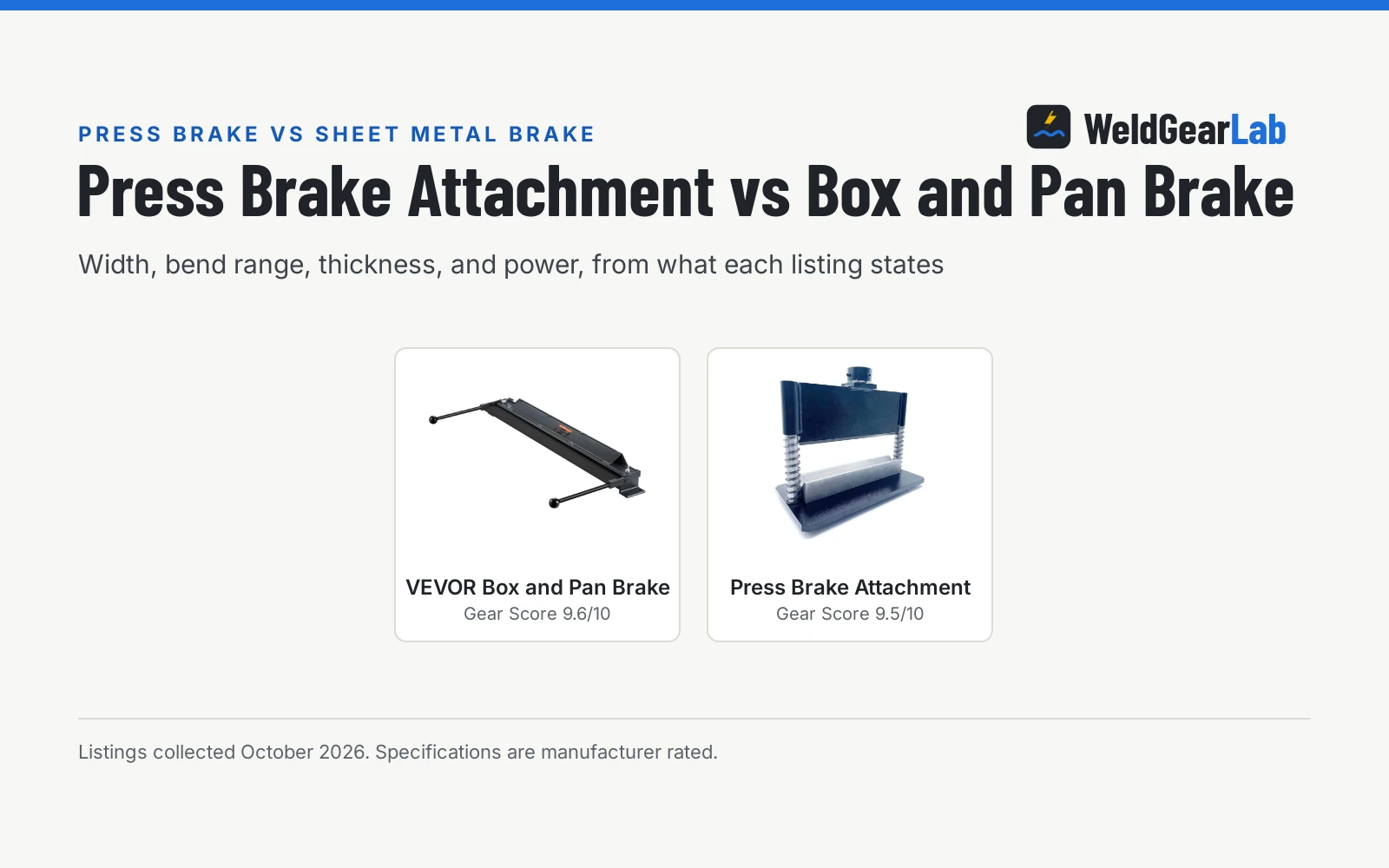
Related: metal fab tools, auto body hammer and dolly set, press brake vs sheet metal brake, and how to use a sheet metal bender.