Best Welder for Auto Body (2026): 4 Stud Welders for Dent Repair
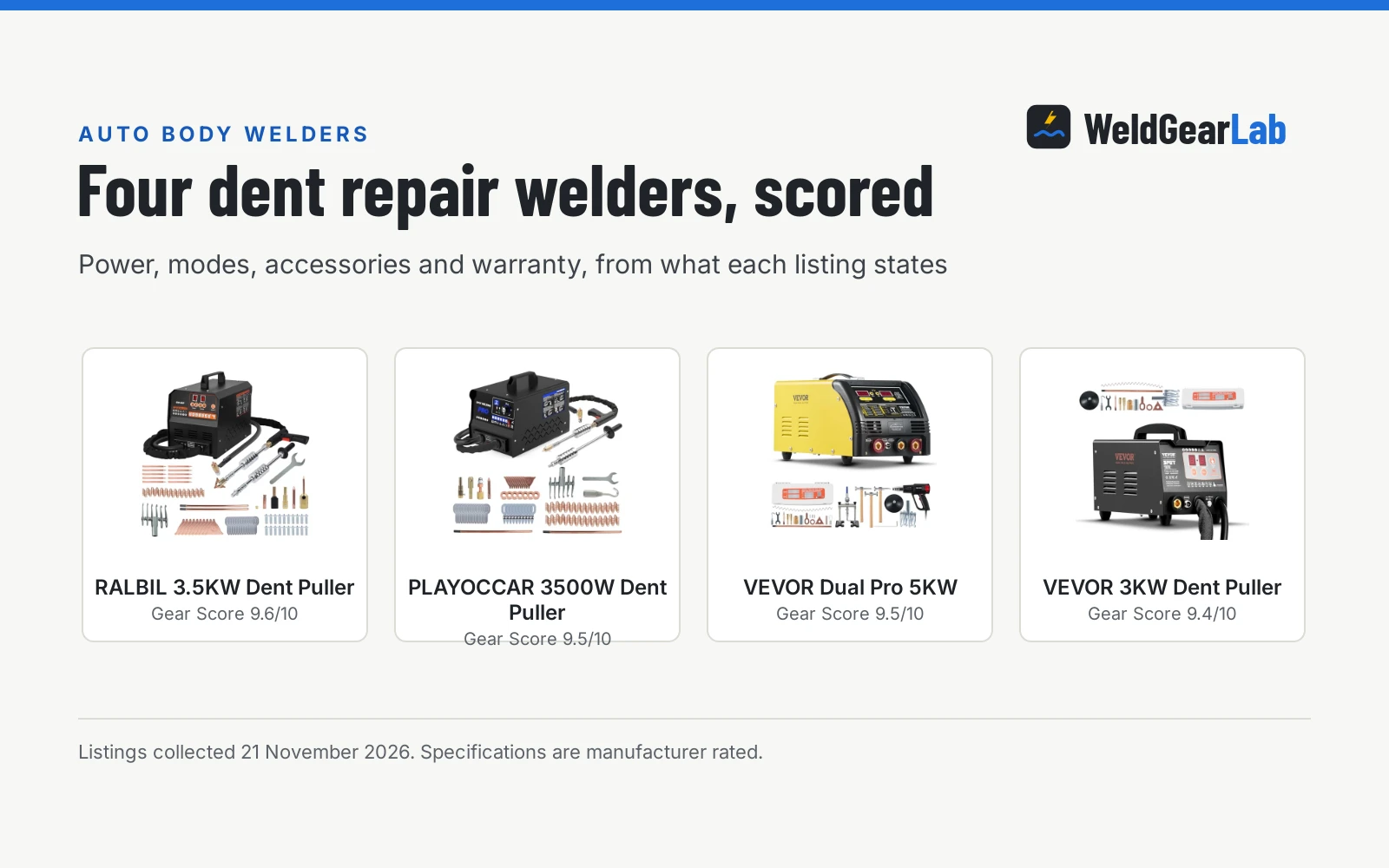
Four stud welders for auto body dent repair, compared on power, welding modes, accessories, weight and warranty, ranked by Gear Score.

On this page
Top picks at a glance
As an Amazon Associate I earn from qualifying purchases.
- 1
 Best OverallRALBIL 3.5KW Dent Puller9.6/10View on Amazon
- 2
 Best Kit ContentsPLAYOCCAR 3500W Dent Puller9.5/10View on Amazon
- 3
 Best for Steel and AluminumVEVOR Dual Pro 5KW9.5/10View on Amazon
- 4
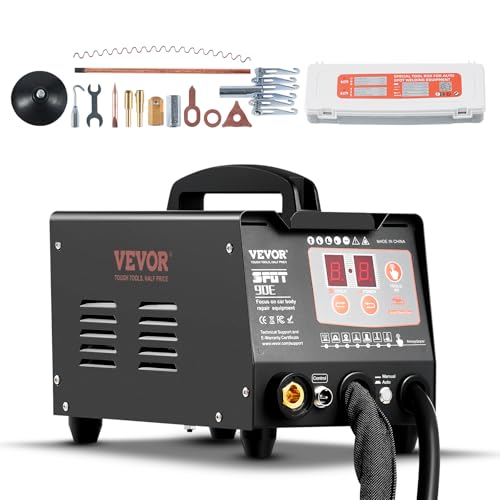 Best Dual-Gun PickVEVOR 3KW Dent Puller9.4/10View on Amazon
A dented door or fender leaves the panel stretched and the paint cracked, and the fix starts with pulling the metal back before filler and paint. A stud welder tacks small studs to the panel so a slide hammer can pull the dent out, and the best welder for auto body work is the one whose power, modes and accessories match the dents you face. This guide compares four stud welders on what each listing states.
WeldGearLab gets a commission on purchases made through links on this page, and your price stays the same. Read our affiliate disclosure.
Quick picks
- Best Overall RALBIL 3.5KW Dent Puller: A stated 4200A output, 7 modes with 11 current levels each, 17 accessory types, overheat protection and a 3 year service term. Check price on Amazon
- Best Kit Contents PLAYOCCAR 3500W Dent Puller: A 3500W kit with 5 core modes, 20 current levels per mode, a temperature cutoff at 70°C and a 1 year warranty. Check price on Amazon
- Best for Steel and Aluminum VEVOR Dual Pro 5KW: The only pick here that works on both steel and aluminum panels, with 10 modes, dual grounds and guns, and 5KW power. Check price on Amazon
- Best Dual-Gun Pick VEVOR 3KW Dent Puller: Two welding guns for two studs at once, 7 modes, auto and manual welding and a toolbox of accessories. Check price on Amazon
The machines
Stud Welder Dent Puller, 3.5KW Spot Welder Dent
A 3.5KW stud welder with a 4200A output, 7 modes, 11 current levels per mode and 17 accessory types, backed by a 3 year service term.
Pros
- 4200A max output at 3500W for strong stud welds
- 7 modes with 11 current levels each, 77 modules in all
- 17 accessory types cover dents of many sizes and shapes
- Overheat protection sounds an alarm and stops the machine at 194°F
Cons
- Built for iron only, not for galvanized sheet or aluminum
- A 0.6 to 1.6 mm weld thickness suits thin panels, not thick sections
- No weight is stated, so portability is hard to judge before ordering
- No toolbox or case is listed for the 17 accessory types
PLAYOCCAR Stud Welder Dent Puller Kit 3500W 110V
A 3500W stud welder kit with 5 core modes, 20 current levels per mode, a 4200A output and a full accessory kit, measuring 10.0 x 7.5 x 12.0 inches.
Pros
- 4200A max output at 3500W for heavy-duty pulling
- 5 core modes with 20 adjustable current levels each
- Temperature display with a buzzer and automatic stop at 70°C
- Kit includes a hook hammer, 2 carbon rods, 10 triangle pull tabs and a user manual
Cons
- Needs a 20A minimum Type C/D ground fault circuit interrupter
- Panel materials are not stated, so steel or aluminum use is unclear
- No weight is stated, so moving it between bays is hard to plan
- The 70°C cutoff stops welding until the unit cools, pausing a long repair
VEVOR Dual Pro Stud Welder Deluxe AL/Fe Dent
A 5KW dual-system stud welder for steel and aluminum panels, with 10 modes, separate grounds and guns, and overheat protection that cuts out above 203°F.
Pros
- The only pick here for both steel and aluminum panels
- 5KW power with a transformer for steel and capacitive discharge for aluminum
- 10 welding modes plus auto and manual spot welding modes
- Overheat protection shuts the machine off above 203°F
Cons
- At 70.11 lb it is the heaviest machine here
- No warranty term is stated
- 18.11 x 9.84 x 10.63 inches takes more bench space than the smaller picks
- Two separate grounds and guns add setup steps
VEVOR Spot Welder Dent Puller
A 3KW stud welder with 2 welding guns for two studs at once, 7 modes, auto and manual welding, and a toolbox of accessories.
Pros
- 2 welding guns weld two different studs at the same time
- 7 default welding modes adapt to different welding studs
- Auto mode welds with a simple contact to the panel, manual mode tunes each spot
- Accessories store in a toolbox, and a handle makes it portable
Cons
- 3KW is the lowest power here
- No warranty term is stated
- No overheat protection is stated
- Built for steel car body panels, with no aluminum work stated
Other welders and gear to compare
 YESWELDER 135A MIG WelderCheck price on Amazon
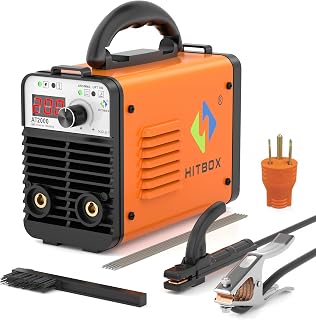 HITBOX 200Amp Stick WelderCheck price on Amazon
 SSimder 140A MIG Welder 3 in 1Check price on Amazon
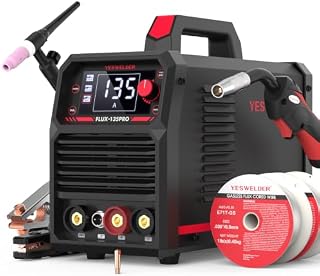 YESWELDER FLUX-135PRO Flux Core MIG Welder with Lift TIG TorchCheck price on Amazon
 FEIFANKE 135A Flux Core MIG Welder 3 in 1 Portable WeldingCheck price on Amazon
 Welding Glasses Auto Darkening Welder Glasses with 2 SensorsCheck price on Amazon
Spec sheet comparison
| Model | Gear Score | Power | Max output | Welding modes | Materials | Weight | Warranty |
|---|---|---|---|---|---|---|---|
| RALBIL 3.5KW Dent Puller | 9.6/10 | 3.5KW | 4200A | 7 | Iron | Not stated | 3 years |
| PLAYOCCAR 3500W Dent Puller | 9.5/10 | 3500W | 4200A | 5 | Not stated | Not stated | 1 year |
| VEVOR Dual Pro 5KW | 9.5/10 | 5KW | Not stated | 10 | Steel and aluminum | 70.11 lb | None stated |
| VEVOR 3KW Dent Puller | 9.4/10 | 3KW | Not stated | 7 | Steel | 47.3 lb | None stated |
All specs here repeat what the maker rates and the listing prints, copied down 20 November 2026.
Buying guide: choosing the best welder for auto body work
Power and output
Power here runs from 3KW to 5KW, and two picks state a 4200A max output. The VEVOR Dual Pro is rated at 5KW, the RALBIL and the PLAYOCCAR at 3500W, and the VEVOR 3KW at 3KW. Higher output suits heavier pulls, while a lower output machine still handles light dents. Check the output figure before you buy.
Welding modes
Modes here run from 5 to 10. The Dual Pro lists 10 welding modes, the RALBIL and the VEVOR 3KW list 7 each, and the PLAYOCCAR lists 5 core modes. Every machine here offers auto and manual welding: manual mode gives precise control for complex dents, and auto mode welds with a simple contact to the panel for large dents. More modes give more choices, but the count matters less than having the mode your dent needs.
Steel or aluminum
Only the Dual Pro here works on both steel and aluminum panels, with a transformer for steel and a capacitive discharge system for aluminum. The RALBIL is built for iron and the maker says it is not suitable for galvanized sheet or aluminum. The VEVOR 3KW is built for steel car body panels. If your work covers aluminum panels, the Dual Pro is the only pick here that states it. For bead welding rather than dent pulling, see the MIG welders hub.
Accessories in the box
A dent puller is only as useful as its accessories. The RALBIL ships with 17 accessory types, including welding guns and pullers. The Dual Pro includes studs, washers, pullers, slide hammers, aluminum hammers and heat guns. The PLAYOCCAR kit lists a hook hammer, carbon rods, triangle pull tabs and a user manual. The VEVOR 3KW stores its accessories in a toolbox. Count the accessories against the dents you face before you buy.
Use as directed. Keep the area around the panel clear of anything that can burn. Wear eye protection and gloves rated for welding, keep the ground clamp on clean bare metal, and never weld on a fuel tank or a panel with fuel lines behind it. Check the manual for the circuit the machine needs, and see the OSHA welding overview.
Before You Strike an Arc
- Check that the outlet and circuit match the 110V supply each listing states, and fit the 20A minimum Type C/D ground fault circuit interrupter the PLAYOCCAR listing calls for.
- Fit the right stud or accessory for the dent before you weld, and set the ground on clean bare metal.
- Check the accessories on arrival against the kit list, including the hook hammer and triangle pull tabs in the PLAYOCCAR kit.
- Let the machine cool if the temperature alarm sounds: the RALBIL stops at 194°F, the PLAYOCCAR at 70°C.
- Work on iron panels with the RALBIL and on steel or aluminum only with the Dual Pro, since the RALBIL listing says it is not for galvanized sheet or aluminum.
FAQ for welders
Will a stud welder work on aluminum panels?
Only the Dual Pro here states aluminum work. The RALBIL states it is not suitable for aluminum, and the other two picks state steel panels or no material at all. Check the listing for the panel material before you buy.
Do I need a MIG welder as well for auto body work?
A stud welder pulls dents, while a MIG welder joins panels and patches holes, so the two tools cover different jobs. If your work includes cutting out rust and welding in patch panels, read how to choose a MIG welder before you buy.
What power supply does a stud welder need?
All four machines here list a 110V supply. The PLAYOCCAR also calls for a 20A minimum Type C/D ground fault circuit interrupter, so check your shop circuit and the listing before you order.
How do auto and manual modes differ?
In manual mode you tune each weld spot for precise work on complex dents. In auto mode the machine welds with a simple contact to the panel for large dents. All four picks here offer both modes.
Related: best spot welder for auto body, stud welder dent repair kit, best flux core welder for auto body repair, best welding magnets for auto body and MIG welder for auto body repair.
Scoring, line by line
Each machine is scored on performance, build, value, safety and warranty, with the weights published on the How We Pick page. No listing here states an electrical safety listing, so every machine here scores zero on that criterion; the ranking comes from the other four.
| Product | Gear Score | Perf. /35 | Build /25 | Value /25 | Safety /10 | Warranty /5 |
|---|---|---|---|---|---|---|
| RALBIL 3.5KW Dent Puller | 9.6 | 30 | 21 | 21 | 0 | 4 |
| PLAYOCCAR 3500W Dent Puller | 9.5 | 29 | 20 | 21 | 0 | 3 |
| VEVOR Dual Pro 5KW | 9.5 | 33 | 21 | 21 | 0 | 0 |
| VEVOR 3KW Dent Puller | 9.4 | 28 | 20 | 20 | 0 | 0 |
A pick’s weighted total decides where it lands between a 9.2 floor and a 9.8 ceiling, and a bigger total never produces a smaller number.