Stud Welder Dent Repair Kit: How It Works
A stud welder dent repair kit welds studs to a dented panel so a slide hammer or bridge puller can draw the metal back to shape, and steel and aluminum panels need different welding setups.

On this page
Top picks at a glance
As an Amazon Associate I earn from qualifying purchases.
- 1
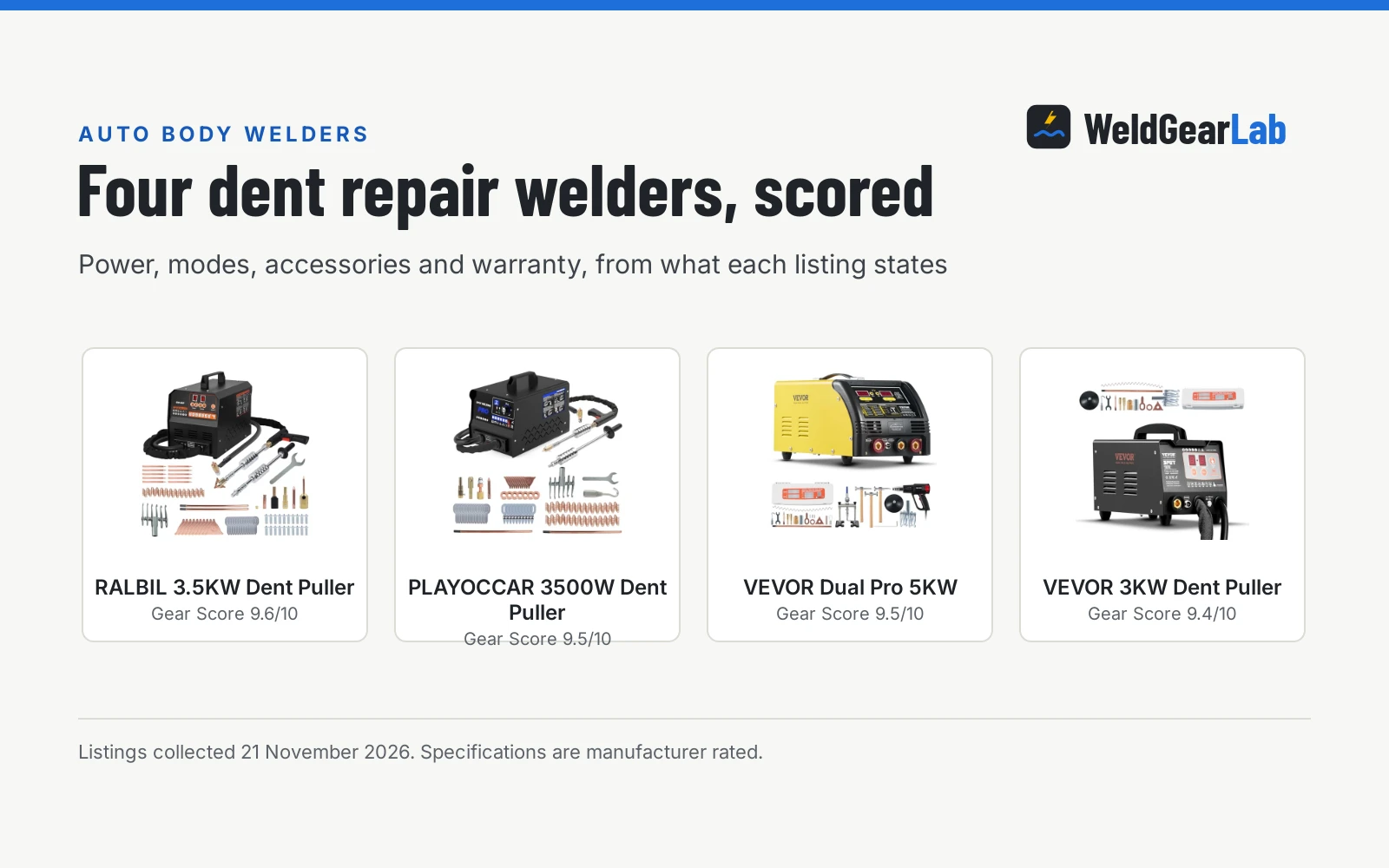
 VEVOR Stud Welder Dent Repair Kit9.4/10View on Amazon
- 2
 VEVOR 90E Stud Welder Dent Repair Kit Professional Dent9.3/10View on Amazon
- 3
 VEVOR Stud Welder Kit9.3/10View on Amazon
- 4
 Flieeya 800VA Stud Welder & Dent Puller Kit with Slide HammerView on Amazon
- 5
 VEVOR Stud Welder Dent Repair Kit & Welding CartView on Amazon
- 6
 PLAYOCCAR Stud Welder Dent Puller Kit 3500W 110VView on Amazon
- 7
 Plastic Welder KitView on Amazon
- 8
 Allturn Plastic Welding Kit with Hot Cutting TipView on Amazon
A dent in a door skin or fender can be pulled back out without filler if a stud can be welded to the panel and pulled. A stud welder dent repair kit welds small studs to the steel or aluminum, then a slide hammer or bridge puller draws the metal back to shape. This guide explains how the kit works, how steel and aluminum kits differ, and what to check on a listing before buying.
Other welders and gear to compare
 Flieeya 800VA Stud Welder & Dent Puller Kit with Slide HammerCheck price on Amazon
 VEVOR Stud Welder Dent Repair Kit & Welding CartCheck price on Amazon
 VEVOR 90E Stud Welder Dent Repair Kit Professional DentCheck price on Amazon
 PLAYOCCAR Stud Welder Dent Puller Kit 3500W 110VCheck price on Amazon
 Plastic Welder KitCheck price on Amazon
 Allturn Plastic Welding Kit with Hot Cutting TipCheck price on Amazon
This guide links to our product roundups, where WeldGearLab gets a commission on purchases made through links on this page, and your price stays the same. Read our affiliate disclosure.
Stud welder dent repair kit: how it works
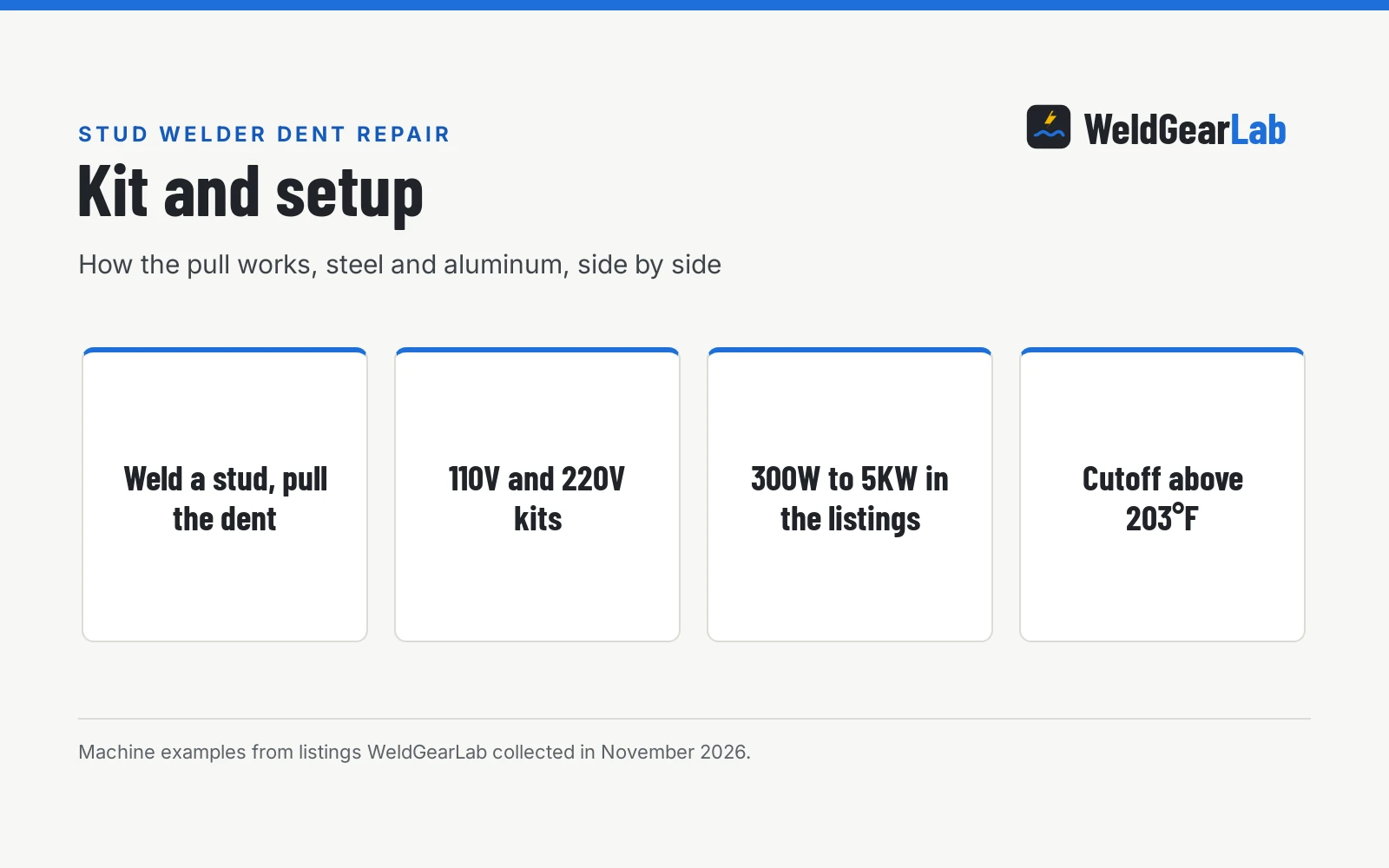
The kit welds a small metal stud to the dented panel, then you pull on the stud to draw the dent out. The stud gives the slide hammer or bridge puller something to grip, so the panel moves without drilling a hole or using filler. Once the panel sits flat, the stud is cut or ground off and the spot is finished. See our what a stud welder is guide for the tool itself.
The weld is a spot weld: the gun touches the panel, current flows for a moment, and the stud sticks. The puller then draws the dent out a little at a time, working the panel back toward flat.
Side by side
| Steel panels | Aluminum panels | ||
|---|---|---|---|
| How the stud sticks | A transformer welds the stud to the panel | A capacitor discharges to weld the stud, then heat and a bridge puller shape the panel | |
| Power in the listings | 110V and 220V, 800VA to 5KW | 110V, 300W to 5KW | |
| Welding modes | 6 to 10 modes, auto and manual | Auto and manual modes | |
| Peak output | 1600A to 3900A | Not stated | |
| Panel thickness | 0.02 to 0.05 inch steel | Not stated | |
| Heat cutoff | Shuts down above 203°F | Shuts down above 203°F | |
| Weight in the listings | 18.0 to 79.37 lb | 33.95 to 70.11 lb |
Power and modes vary by listing, so read the listing for the kit you are looking at. A kit that states auto and manual modes lets you switch between a single contact weld and a controlled weld on a complex dent.
How a dent pull works, step by step
- Clean the panel. Bare metal takes the weld, so clean the paint and coating off the dent before you start.
- Weld a stud. Touch the gun to the panel and weld a stud to the low spot, using manual mode for a complex dent and auto mode for a large dent.
- Pull the dent. Hook the slide hammer or bridge puller to the stud and pull steadily until the panel sits flat.
- Work across the dent. Move from the edge of the dent toward the middle, welding and pulling a stud at a time.
- Remove the studs and finish. Cut or grind the studs off, then finish the panel.
Work slowly. A dent that is pulled too far leaves a high spot that needs tapping back down, and a stud welded to thin metal can burn through if the setting is too high. If the panel starts to stretch, stop and reassess before pulling again.
Steel panels and aluminum panels need different setups
Steel and aluminum do not take the same setup. The VEVOR Dual Pro listing states a transformer for steel repairs and a capacitive discharge system for aluminum, with separate grounds and welding guns in one machine. A capacitor discharge kit for aluminum, like the VEVOR 300W (on Amazon) listing, completes its energy storage in 0.3 seconds, and pairs a heat gun with a bridge puller to shape the panel. The 300W listing states the kit suits aluminum car body panels, while the 3KW VEVOR listing states steel car body panels. Aluminum is more delicate than steel, per the 300W listing, which states the panel has lower tensile strength. See our stud welder for aluminum picks for kits made for aluminum panels.
What comes in the kit
A kit is more than the welder. The listings state studs, washers, pullers, slide hammers, aluminum hammers and heat guns in the box, with the parts stored in a toolbox or on a cart. One listing states 5 different types of studs for various dent sizes, and the Dual Pro listing states studs, washers, pullers, slide hammers, aluminum hammers and heat guns. Check the parts list on the listing, because a kit with the puller you need saves a second order.
What to check before you buy
- Voltage and power. Listings here state 110V and 220V, with power from 300W to 5KW. Match the kit to the outlet you have.
- Modes. The listings state 6 to 10 welding modes with auto and manual settings. More modes give more control over the weld. See our stud welder sizes guide for pin, stud and sheet metal sizes.
- Thermal protection. Several listings state a cutoff that shuts the machine down when the temperature exceeds 203°F. Check the listing for it before a long session.
- Weight and size. The listings state 18.0 to 79.37 lb, and the heaviest kit in the listings rides on a cart. A lighter kit moves to the car; a cart kit stays in the shop.
- Studs and accessories. One listing states 5 different types of studs, and several listings state a full set of accessories in a toolbox. Check what comes in the box before you order.
Heat, sparks and hot metal. Welding studs throws sparks and leaves hot metal on the panel, so wear a welding helmet, gloves and long sleeves, and keep flammable material clear of the work. Work with ventilation or outdoors with your head out of the plume.
FAQ for welders
Can a stud welder fix a dent without filler?
Yes, when the dent can be pulled back to shape. The stud gives the puller a grip on the panel, so the metal moves without drilling a hole. Deep creases or torn metal may still need filler or a panel repair.
Does a stud welder work on aluminum?
It can, but only with a kit made for aluminum. The VEVOR Dual Pro listing states a capacitive discharge system for aluminum, and the VEVOR 300W listing states a kit for aluminum panels with a heat gun and bridge puller. A steel-only kit will not weld studs to aluminum.
What power does a stud welder need?
The listings here state 110V and 220V, with power from 300W to 5KW. Check the listing for the voltage and match it to the outlet you have.
How hot does a stud welder get?
Several listings state a thermal cutoff that shuts the machine down when the temperature exceeds 203°F. The ABS body listings state the shell withstands 93 to 118 degrees Celsius, so let the machine cool if the cutoff trips.
Do I need a slide hammer or a bridge puller?
Both pull the panel, and the listings state both. A slide hammer suits a quick pull on a small dent, while a bridge puller gives controlled force on a wider dent. Check which puller the kit includes.
Related: best spot welder for auto body, MIG vs stick for auto body, spot welder vs MIG welder, and the welders hub.