Stud Welder Sizes: Pin, Stud, and Sheet Metal Guide
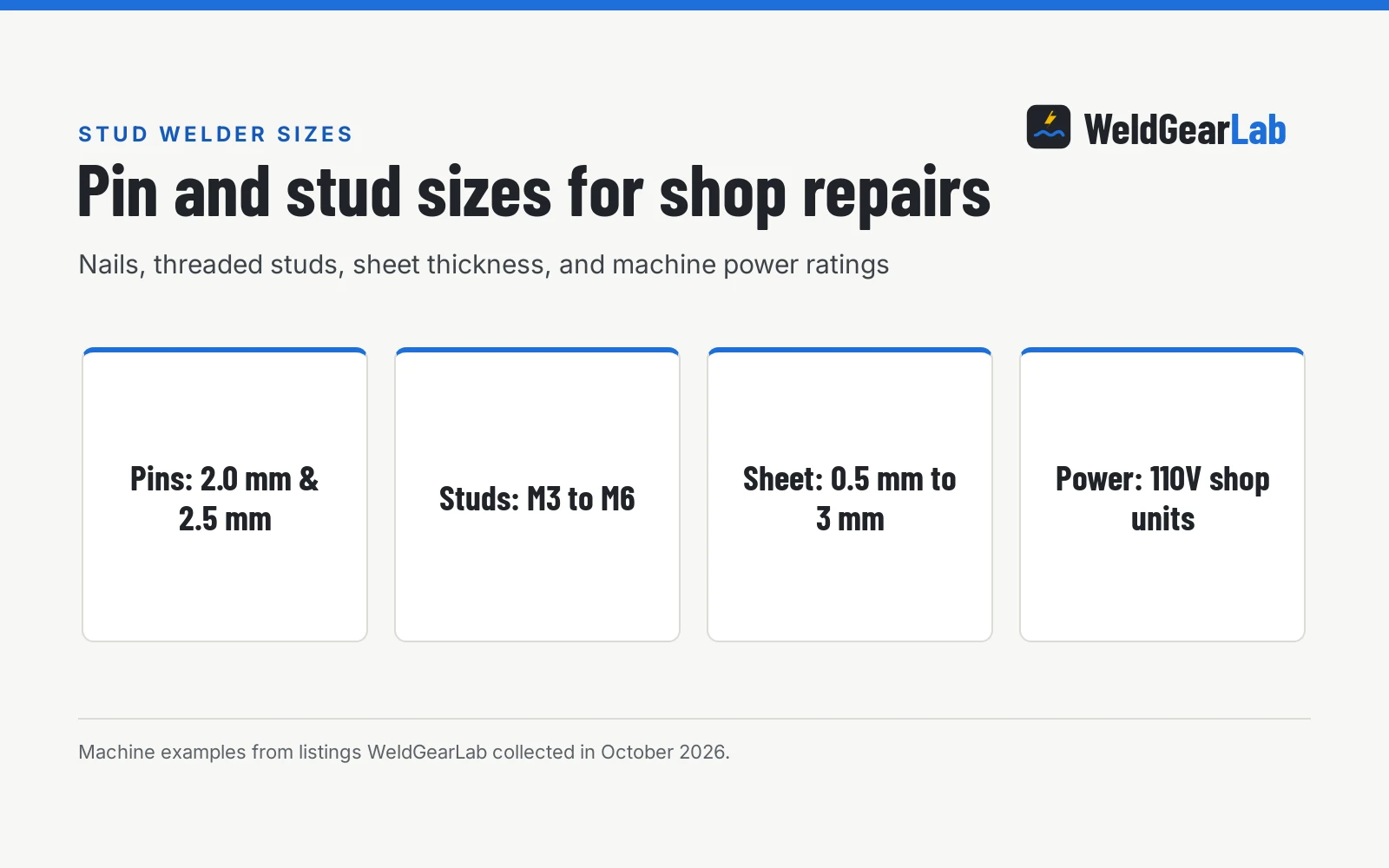
Stud welder sizes range from 2.0 mm and 2.5 mm dent pulling pins to M3 through M6 threaded studs, matching sheet thickness and shop repair jobs.

On this page
Top picks at a glance
As an Amazon Associate I earn from qualifying purchases.
- 1
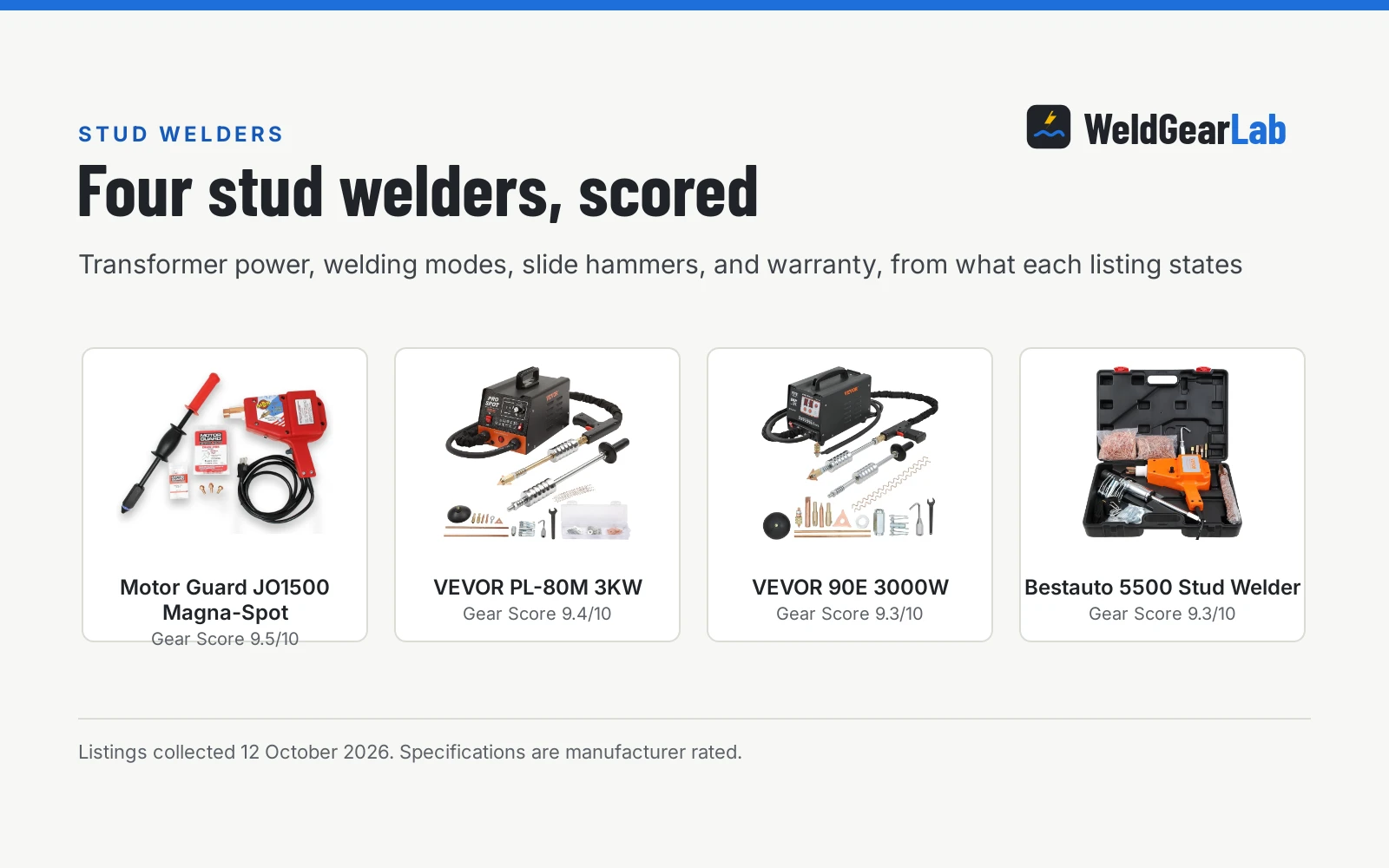
 VEVOR Stud Welder Dent Repair Kit9.4/10View on Amazon
- 2
 VEVOR 90E Stud Welder Dent Repair Kit Professional Dent9.3/10View on Amazon
- 3
 VEVOR Stud Welder Kit9.3/10View on Amazon
When you clamp a slide hammer to pull a crease out of a car door or secure a mounting fastener to sheet metal without drilling holes, choosing the right stud welder sizes decides whether your repair holds or ruins the workpiece. In collision repair and metal fabrication, stud welder sizes refer primarily to distinct groups: temporary dent pulling pins measuring 2.0 mm and 2.5 mm in diameter, and permanent threaded fasteners ranging from M3 to M6 thread sizes. For sheet metal body panels, 2.0 mm pins handle thin steel skins with minimal heat distortion, while 2.5 mm pins deliver higher tensile hold for sharp body lines and heavier metal. For industrial fabrication and electrical cabinets, capacitor discharge studs between M3 and M6 provide solid threaded studs welded in 3 to 6 milliseconds without damaging reverse coatings.
This guide links to our product roundups, where WeldGearLab gets a commission on purchases made through links on this page, and your price stays the same. Read our affiliate disclosure.
Stud welder sizes in one paragraph
Stud welder sizes dictate the mechanical grip of your pulling tools and the electrical current required from your machine. Auto body dent repair systems rely on copper-coated steel pins measuring 2.0 mm and 2.5 mm that fit standard slide hammer collets. The 2.0 mm pin uses a smaller contact footprint with lower overall heat input to lift shallow dings on thin panels, while the 2.5 mm pin provides greater shaft strength to resist shearing under heavy slide hammer pulls on stiff creases. In contrast, capacitor discharge units weld flanged studs from M3 up to M6 onto sheet metal enclosures, fusing the fastener base in a brief pulse without burning through painted or coated backsides.
Side by side
| Handheld Pin Guns | Multi-Mode Dent Pullers | Capacitor Discharge Welders | |
|---|---|---|---|
| Fastener types & sizes | 2.0 mm and 2.5 mm pins | Pins, triangle tabs, OT gaskets, wave wire | M3 to M6 threaded studs |
| Compatible sheet metal | Thin steel body panels | 0.6 mm to 1.5 mm iron plates | 0.5 mm to 3 mm plates |
| Attachment & pull tools | Slide hammer with pin collet | Slide hammer, multi-claw hook, suction cup | Permanent threaded mount (no pulling) |
| Weld cycle duration | Manual contact pulse | Manual contact or automatic mode | 3 to 6 milliseconds |
| Electrical power rating | 800VA transformer on 110V | 1.8KW to 5KW on 110V (up to 4200A) | 72000uF capacitor storage on 110V |
| Machine unit weight | 18 to 22.3 pounds | 42.5 to 70.1 pounds | 54.9 pounds |
| Primary shop use | Spot dent pulling on outer panels | Crease, line, and broad panel repair | Threaded studs on sheet and enclosures |
| Post-weld step | Snip pin and grind flush | Snip or detach hardware and grind flush | Fastener remains on workpiece |
Machine settings and weld duration differ sharply between temporary body pins and structural threaded studs. Always verify that your gun chuck matches your pin diameter before pulling the trigger.
When dent puller pins are the better choice
For collision repair and sheet metal smoothing, temporary dent pins serve as sacrificial anchor points that you weld directly across a dent pattern and pull with a manual slide hammer or multi-hook lever bar.
- Thin outer body panels. The 2.0 mm pin minimizes the heat-affected zone, preventing burn-through and panel warping on lightweight steel door skins and fenders.
- Deep body lines and rocker panels. The 2.5 mm pin provides the tensile strength needed to pull stiff ridges and reinforced metal without snapping the pin shaft.
- Crease lines and large damage areas. When pulling broad dents, repair kits supplement individual pins with wave line wire, OT gaskets, and straight pull triangles that distribute pulling load across multiple points.
- Clean surface finishing. Because pins are temporary, you snip them flush and grind the surface flat, leaving the original sheet metal intact with no drilled holes to plug.
If you repair aluminum body panels rather than steel, steel pins will not bond; see our guide to the stud welder for aluminum for dedicated capacitor discharge systems.
When threaded studs are the better choice
Threaded studs replace drilling, tapping, and through-bolting when you need a permanent fastener mounted to sheet metal. Instead of pulling metal back into shape, threaded studs create secure mounting studs on frames, electrical enclosures, and fabricated panels.
- Enclosures and sheet metal boxes. Capacitor discharge studs from M3 to M6 weld directly onto thin metal without burning through or marring the finished exterior face.
- No access to the backside. When mounting components inside sealed tanks, ductwork, or hollow structural tubing, threaded studs eliminate the need for backup nuts or backside wrenches.
- Ground studs and mounting tabs. Threaded studs provide clean grounding studs for electrical panels and secure mounting points for wiring looms, tubing clamps, and fluid lines.
- Structural sheet fabrication. The flanged base of an M6 stud creates a full-face fusion joint that supports brackets and hardware without weakening the underlying parent metal.
How to tell what a machine supports
Not every stud welder handles both pins and threaded fasteners. Most garage machines are dedicated transformer dent pullers, while industrial units use capacitor discharge circuits. When reviewing machine specifications, look for these key details:
- Included chucks and collets. A dent puller listing should state collet sizes for 2.0 mm and 2.5 mm pins. The GRAUTOSPOT kit (on Amazon), for instance, includes dedicated electrodes and standard pins in both 2.0 mm and 2.5 mm sizes.
- Fastener diameter range. Capacitor discharge welders state specific thread sizes. The Huanyu RSR-1600 (on Amazon) lists a welding range of M3 to M6 for low carbon steel, stainless, and aluminum studs.
- Specialty pulling attachments. Transformer dent pullers often include accessories for non-pin shapes. The YUANRI dent puller (on Amazon) includes chucks for OT gaskets, round washers, triangle straight pull sheets, and wave lines.
- Stated power and transformer ratings. Handheld spot guns like the VEVOR 1600A deliver 800VA transformer power on 110V, which suits standard pins. Heavier units like the PLAYOCCAR 3500W (on Amazon) deliver up to 4200A output for heavy-duty pulling tabs.
For shops fabricating replacement patches, see our guide on how to MIG weld thin sheet metal without burning through and our review of the best MIG wire for auto body.
Matching pin diameter to sheet thickness
Selecting the right pin or stud size depends directly on the thickness of the metal on your bench. Using a pin that is too large on thin sheet requires more weld energy and risks burning through or warping the panel, while an undersized pin can tear away under heavy slide hammer force.
For automotive sheet metal, listings indicate specific working ranges. The YUANRI dent puller rates dent stretching repairs on 0.6 mm to 1.5 mm cold-rolled iron plates. Across thin sheet within this range, such as lightweight outer panels, lower power settings and smaller 2.0 mm pins help keep weld heat localized. When working stiffer panels or deeper creases up to 1.5 mm, heavier pulling attachments like 2.5 mm pins, OT gaskets, or triangle straight pull sheets distribute pulling tension and resist tearing out under heavy slide hammer force.
Capacitor discharge studs operate on a wider thickness spectrum. The Huanyu stud welder specifies plate thicknesses from 0.5 mm to 3 mm across its M3 to M6 welding range. Because capacitor discharge releases stored energy in just 3 to 6 milliseconds, smaller studs can fuse to thin 0.5 mm sheet without damaging paint or protective coatings on the reverse side. For thicker plates up to 3 mm, larger studs like M6 provide substantial mechanical strength and full fusion across the weld base.
Can one machine do both?
Most transformer dent pullers are built specifically for temporary pulling pins, while capacitor discharge welders are dedicated to threaded fasteners. Compact handheld units weighing 18 pounds, such as the H & S Auto Shot 4550 (on Amazon), or 21 pounds for the VEVOR 1600A, operate dedicated collets for standard dent pulling pins on 110V power.
Benchtop dent pullers add versatility through mode controls. The VEVOR 1.8KW unit, weighing 43.2 pounds, features 7 default welding modes to accommodate 5 different types of studs and pulling attachments. For shops working across both metals, dual-system machines bridge that gap. The VEVOR Dual Pro Deluxe AL/Fe unit weighs 70.1 pounds and combines a 5KW transformer system for steel with a capacitive discharge system for aluminum, offering 10 welding modes.
Industrial capacitor discharge units like the 54.9-pound Huanyu RSR-1600 utilize a 72000uF capacitor bank to deliver rapid pulses, achieving welding speeds of 15 to 50 pieces per minute across M3 to M6 fasteners. For general garage setups, check our guide to the best welder for beginners.
Shop electrical and safety precautions. High-amperage stud welding demands proper power infrastructure and personal protection. The PLAYOCCAR 3500W unit requires a 20A minimum circuit breaker or ground fault circuit interrupter. Units generate internal heat during rapid duty cycles, triggering thermal cutoffs at 70°C on the PLAYOCCAR or 95°C (203°F) on VEVOR and GRAUTOSPOT machines. Always grind metal completely bare to ensure direct electrical ground contact, as poor grounding causes excessive arcing. Wear shaded eye protection and welding gloves to guard against hot spatter, and maintain active shop ventilation to exhaust fumes from burning primer and anti-corrosion coatings.
FAQ for welders
What size pins do auto body stud welders use?
Most auto body stud welders use 2.0 mm and 2.5 mm copper-coated steel pins. The 2.0 mm pin fits light outer sheet metal where excessive heat could distort the panel. The 2.5 mm pin provides greater tensile hold for deep creases and heavier metal sections.
What is the difference between stud welder pins and threaded studs?
Stud welder pins are temporary pulling points welded onto auto body panels and cut off after dent removal. Threaded studs, such as M3 to M6 fasteners used with capacitor discharge equipment, remain permanently attached to act as mounting bolts. Pins grip a slide hammer chuck, while threaded studs accept nuts to mount brackets and hardware.
Can a stud welder burn through thin sheet metal?
A stud welder can burn through thin sheet metal if current or dwell time is set too high for the panel thickness. Units like the YUANRI dent puller operate on 0.6 mm to 1.5 mm cold-rolled iron plates, requiring lower power settings on thinner sections. Ensuring bare metal contact and selecting the proper pin diameter prevents blow-through.
Do I need 110V or 220V power for a shop stud welder?
Most portable dent pullers and stud welders run on a standard 110V line, drawing between 800VA and 1800 watts during brief welding pulses. High-output units like the PLAYOCCAR 3500W also operate on 110V but require a 20A minimum circuit breaker to prevent tripping. Some high-wattage listings show conflicting voltage figures between 110V in titles and 220 volts in spec tables, so check plug configuration before wiring your shop.
How do you remove welded pins after pulling a dent?
Once the slide hammer brings the low spot level with the panel, twist the pin off with side-cutting pliers or snip the shaft flush with the surface. Grind the remaining weld nub flat using a grinding disc or flap wheel on an angle grinder. Keep grinding light to avoid thinning the base sheet metal before body filler application.
Related: stud welder for aluminum, best MIG wire for auto body, how to MIG weld thin sheet metal without burning through, and the welders hub.