What Is a Stud Welder? How It Works and Shop Guide
A stud welder joins threaded studs, pins, or pull tabs directly to sheet metal or plate without drilling, tapping, or through-holes.

On this page
Top picks at a glance
As an Amazon Associate I earn from qualifying purchases.
- 1
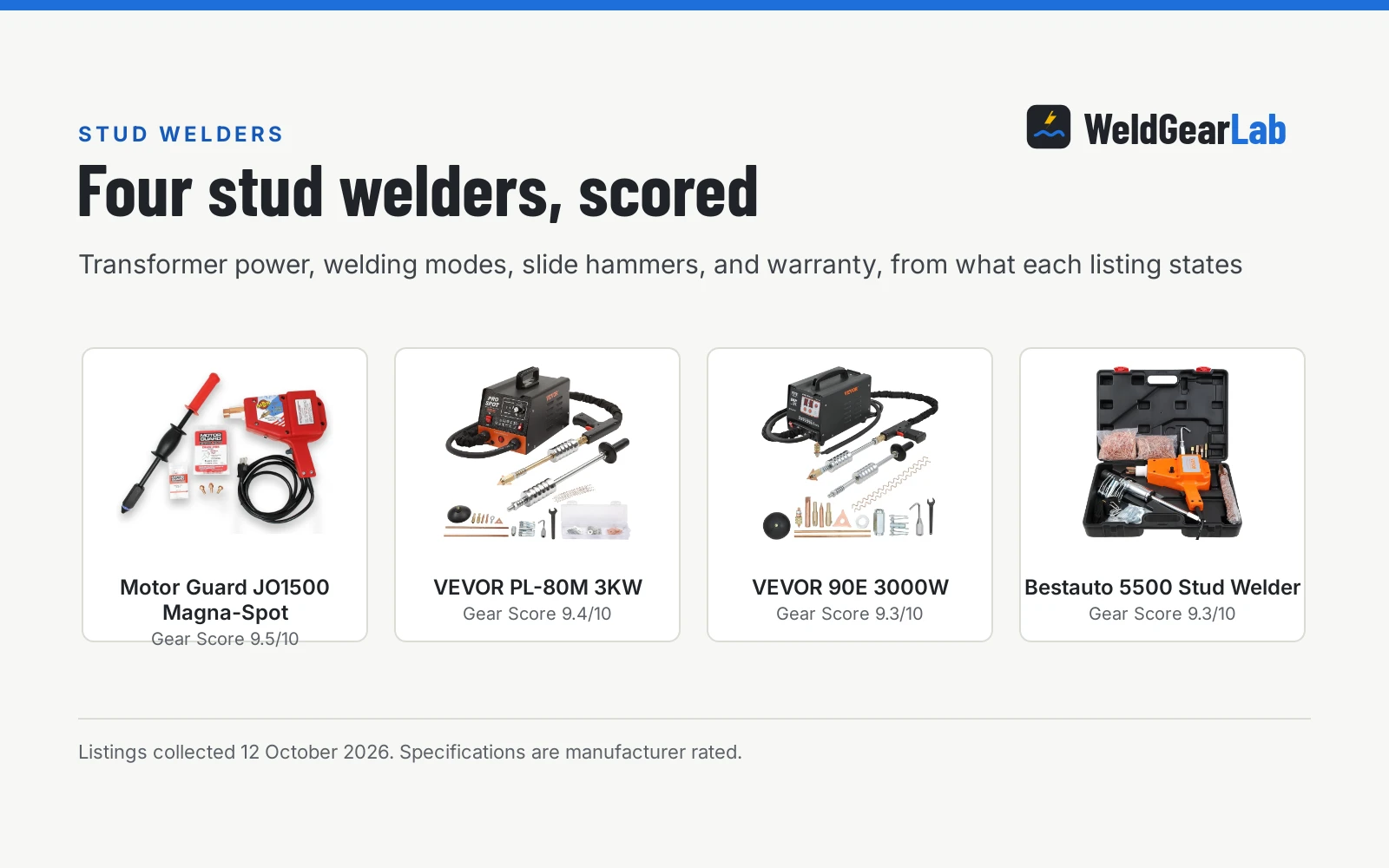
 VEVOR Stud Welder Dent Repair Kit9.4/10View on Amazon
- 2
 VEVOR 90E Stud Welder Dent Repair Kit Professional Dent9.3/10View on Amazon
- 3
 VEVOR Stud Welder Kit9.3/10View on Amazon
When you have a crushed rocker panel on a truck or need to attach a threaded grounding stud inside a sealed steel cabinet without drilling through the face, standard welding torches leave you stuck. Drilling weakens sheet metal and creates rust traps, while through-bolts need access to both sides. What is a stud welder? A stud welder is a dedicated welding machine that fastens threaded studs, unthreaded pins, or dent pulling tabs directly onto a metal surface without drilling, tapping, or through-holes. Using an intense, controlled surge of current through a handheld gun, the machine creates a solid forged weld in an instant. The kits most readers find listed for home and garage use are dent-repair stud welders for auto body work. Industrial capacitor discharge and drawn arc machines do the fastener work, and both are covered below. For the wider picture of machine families, see our welding machine types guide.
This guide links to our product roundups, where WeldGearLab gets a commission on purchases made through links on this page, and your price stays the same. Read our affiliate disclosure.
What is a stud welder and how does it work?
Stud welding differs from wire feed or stick welding because it uses no filler metal. The fastener itself serves as the electrode. When the operator contacts clean metal and triggers the cycle, electrical current arcs or passes through the base of the stud into the workpiece, melting the contact surfaces. In arc stud welding processes, an internal spring or lift mechanism plunges the fastener into the molten puddle, while resistance spot dent pullers fuse the pin directly to the panel under hand pressure.
The weld cycle takes place in an instant. Thin sheet processes like capacitor discharge and resistance dent pulling use a short heat cycle, while heavy drawn arc processes focus concentrated energy into deep penetration on thick plate. Because the process requires access to only a single side of the workpiece, stud welders turn up in auto collision repair, sheet metal fabrication, and structural steel erection.
Side by side comparison of stud welding processes
| Capacitor Discharge (CD) | Drawn Arc | Auto Body Dent Puller | |
|---|---|---|---|
| Primary application | Thin sheet enclosures and electrical cabinets | Structural steel, bridge beams, and heavy plate | Automotive sheet metal panels and dent pulling |
| Power source type | Capacitor bank storage | Heavy DC transformer-rectifier or inverter | Step-down transformer or resistance pulse |
| Weld cycle speed | 3-6 milliseconds (one maker listing) | Fractions of a second | Brief contact pulse |
| Sheet metal thickness | 0.5mm-3mm plates (one maker listing) | Heavy plate and structural sections | 0.6mm-1.5mm cold-rolled iron plates (one maker listing) |
| Fastener types | M3-M6 threaded studs and insulation pins | Heavy weld studs, threaded rods, and shear connectors | Welding pins, wavy wire, and rings |
| Shielding or puddle containment | None needed per maker listing | Ceramic ferrule or shielding gas | None needed |
| Backside metal damage | Maker listing claims no burn-through, discoloration, or paint damage | Heavy heat penetration through plate | Maker listing claims no damage to backside coating |
| Common workshop voltage | Not stated | High-voltage shop power or generator supply | 110V listed on dent puller kits |
Different fab jobs call for different electrical characteristics. Thin electrical boxes need minimal heat to keep marks off the front face, heavy bridge girders demand deep penetration into structural beams, and automotive body panels need fast surface attachments that pull metal back into shape without tearing sheet steel. Choosing the right machine depends on matching the electrical process to your metal thickness and power supply. For pin, stud and sheet thickness pairings, see our stud welder sizes guide.
Capacitor discharge stud welding for thin sheet metal
Capacitor discharge stud welding, commonly abbreviated as CD stud welding, is built for thin sheet metal fabrications. Instead of drawing high continuous amperage straight from the electrical panel, a CD machine charges an internal bank of capacitors. When the operator triggers the gun, stored energy discharges through a small ignition tip on the base of the stud in a rapid burst.
One CD listing states a welding time of 3-6 milliseconds, studs of M3-M6, and plates 0.5mm-3mm thick. The maker claims no deformation, discoloration, or burn-through to the backside paint, and says no flux or shielding gas is needed. Those are the maker’s claims, so check any listing for the metals and stud sizes it actually states.
Drawn arc stud welding for heavy structural plate
When fasteners exceed thin sheet capacities and plate thicknesses increase, shops turn to drawn arc stud welding. Drawn arc welding uses a heavy-duty transformer-rectifier or industrial inverter capable of sustained direct current. The drawn arc gun holds the stud against the workpiece, strikes a pilot arc, and lifts the stud slightly to draw an intense welding arc that creates a deep molten puddle on the plate.
To keep molten steel from oxidizing and splashing out of the joint, drawn arc systems place a disposable ceramic ferrule around the base of the stud. The ceramic ferrule contains the liquid metal puddle, shapes the fillet around the fastener, and shields the weld pool from surrounding air. Once the arc timing concludes, an internal solenoid drives the stud forward into the puddle, and the operator chips away the brittle ceramic ring. Drawn arc welding is standard for welding shear connectors onto bridge beams and securing heavy equipment mounts.
Auto body dent repair stud welders and dent pullers
These are the stud welders most readers will meet first: spot welding dent pullers. In collision repair, restoring a crushed fender, door skin, or rocker panel traditionally required cutting inner structure panels to hammer metal from behind, or drilling holes for mechanical pull hooks. A dent repair stud welder avoids panel destruction by tacking temporary steel pins, pull rings, or wavy wire directly onto the paint-stripped exterior of the panel.
Once welded to the low spot, the technician attaches a slide hammer or lever puller to draw the crease flush, then cuts or twists off the temporary pins. Listings for these kits state a sheet range and an output rating, for example 0.6mm-1.5mm cold-rolled iron plates on one. Compare that range against the panel gauge you plan to pull.
Key equipment features to check for your workshop
Before selecting a stud welder, check the electrical supply, duty cycle, and thermal protection. Dent pulling machines designed for garage use are commonly listed for 110V, though high-amperage current draws can trip breakers during extended pulls. One listing carries a note about the ground fault circuit interrupter to use with it, so read the supply notes in the listing or manual before you plug in.
Thermal management matters on compact transformer units. Resistance spot welding generates rapid heat in the transformer, so look for automatic overload cutoff, and note that the stated cutoff differs by machine. For heavier garage fabrication, browse our welders hub or check our guide on best MIG wire for auto body work.
Shop safety and metal preparation for stud welding
A sound stud weld requires meticulous surface prep. Current must pass from the gun through the fastener and workpiece to the ground clamp without fighting coatings. One maker notes it is necessary to remove insulating coatings around the ground connection and ensure direct contact with clean metal. Paint, primer, rust, and zinc coatings should be mechanically removed with a grinding disc or wire wheel prior to welding. Residual coatings cause high electrical resistance, leading to weak adhesion, arcing spatter, and pin failure.
Operator safety demands protective gear matched to the process. For drawn arc and capacitor discharge units where an electric arc is struck, the flash generates ultraviolet radiation requiring a shaded welding helmet or face shield. For resistance spot dent pullers, impact-resistant safety glasses protect against flying spatter. Wear heavy leather welding gloves to handle hot studs and slide hammers, along with flame-retardant clothing. Grinding creates airborne particulates, and burning coatings release noxious fumes; always work in well-ventilated shop bays. For formal workplace safety guidelines, consult the OSHA welding overview and our Safety Disclaimer.
FAQ for welders
How strong is a stud weld compared to a drilled bolt?
For permanent fasteners welded with drawn arc or capacitor discharge machines, a proper full-fusion stud weld is typically stronger than the fastener itself. Because the entire cross section of the stud fuses into the plate, excessive tensile load shears the threaded shank before failing the weld nugget. In contrast, automotive dent puller pins are temporary surface tack welds designed to hold straight pulling tension and then break or twist away cleanly without tearing the sheet metal.
Can a stud welder weld to painted or rusty metal?
No. Stud welding requires clean, bare metal to establish an electrical circuit. Rust, automotive primer, paint, and mill scale act as electrical insulators that block current flow and prevent proper arc initiation. Technicians must grind or sand the surface to bare steel at the weld location and at the ground clamp attachment point to achieve solid fusion.
Can you use a stud welder on aluminum body panels?
Steel resistance dent pullers cannot weld aluminum studs. Aluminum panels call for a different setup, and one dual-system dent repair listing pairs a capacitive discharge system for aluminum panels with a transformer system for steel, with separate grounds and guns. See our stud welder for aluminum guide for kits.
What is the difference between capacitor discharge and drawn arc?
Capacitor discharge uses stored electrical energy released in rapid milliseconds to weld smaller fasteners to thin sheet metal. Drawn arc welding uses a continuous arc power source with a lift mechanism and ceramic ferrules to weld larger structural studs into heavy steel plate with deeper penetration.
Why does a dent puller pin break off during pulling?
Dent puller pins pull away from sheet metal when the surface was insufficiently cleaned of paint or when heat settings were too low for the metal gauge. If the weld does not achieve full fusion across the base of the pin, lateral force from the slide hammer peels the pin off the panel. Applying direct perpendicular tension and ensuring bare metal contact prevents premature failure.
Related: stud welder for aluminum, stud welder sizes, best MIG wire for auto body, and the welders hub.