Best Leather Welding Gloves (2026): 3 Pairs Scored
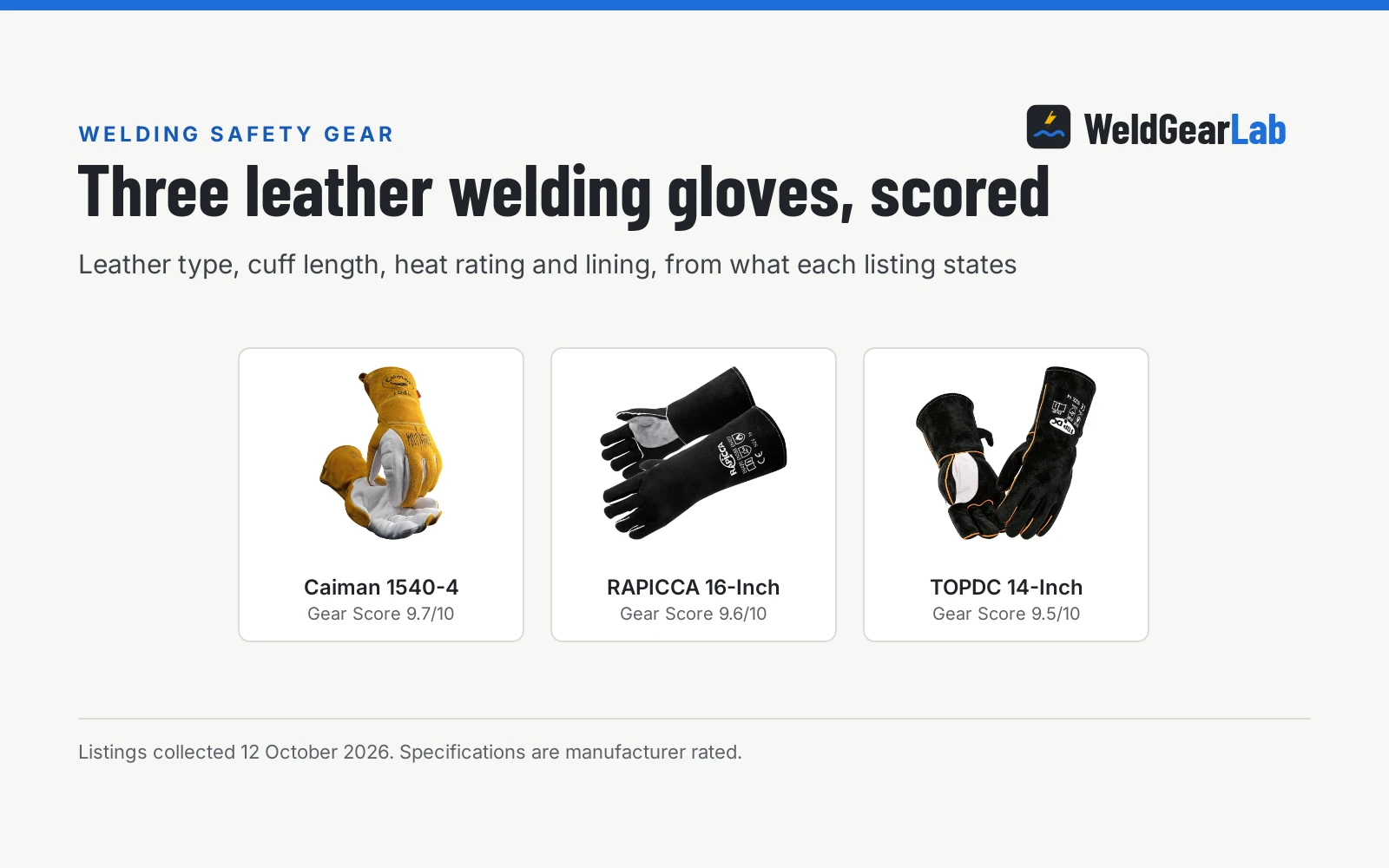
Three pairs of leather welding gloves compared on hide type, cuff length, heat ratings, lining materials, and stated manufacturer warranties.

On this page
Top picks at a glance
As an Amazon Associate I earn from qualifying purchases.
- 1
 Best Overall TIGCaiman 1540-49.7/10View on Amazon
- 2
 Best for High HeatRAPICCA 16-Inch9.6/10View on Amazon
- 3
 Best Value MIG GauntletTOPDC 14-Inch9.5/10View on Amazon
When you are sitting at the fab table running an out-of-position root pass or feeding fine filler rod into a stainless joint, the heat and flying spatter quickly show whether your hand protection is up to the job. Finding the best leather welding gloves means matching the hide and cuff length to your specific welding process, balancing tactile dexterity against radiant heat shielding. This guide compares three leather pairs across split cowhide and goatskin builds to evaluate cuff coverage, heat ratings, linings, and stated manufacturer warranties.
WeldGearLab gets a commission on purchases made through links on this page, and your price stays the same. Read our affiliate disclosure.
Quick picks
- Best Overall TIG Caiman 1540-4: Supple goat grain palm, unlined fingers for rod control, 4-inch extended cuff, and the only stated warranty here at 30 days. Check price on Amazon
- Best for High Heat RAPICCA 16-Inch: Stated 662°F heat resistance, 16-inch length with 7.5-inch sleeves, layered build with aluminum foil, and Kevlar stitching. Check price on Amazon
- Best Value MIG Gauntlet TOPDC 14-Inch: A 14-inch split cowhide gauntlet rated to 482°F with cotton lining, keystone thumb, and double-stitched reinforcements. Check price on Amazon
The machines

Caiman Premium Goat Grain TIG/Multi-Task Welding
A dedicated TIG and multi-task glove combining a goatskin palm, split cowhide back, unlined interior, and a 30-day limited warranty.
Pros
- Top grain goatskin palm gives close feel for feeding TIG wire
- Unlined construction avoids bulky seams in the fingers
- 4-inch extended cowhide cuff shields the wrist and lower arm
- Stated 30-day limited manufacturer warranty
Cons
- Unlined palm offers less thermal barrier against hot heavy spatter
- Only rated to ANSI heat level 2
- Spec table claims waterproof while leather is only water resistant
- Not built for heavy stick welding or prolonged high-amperage MIG

RAPICCA MIG Welding Gloves for Men
A 16-inch heavy-duty leather welding glove insulated with aluminum foil and cotton, rated for temperatures up to 662°F.
Pros
- Stated heat resistance up to 662°F (350°C)
- 16-inch length with 7.5-inch sleeves protects the forearms
- Layered build includes leather, aluminum foil, and cotton
- Double leather reinforcement on the wing thumb and stress points
Cons
- No concrete warranty term is stated in the listing
- Thick layered insulation limits finger dexterity for TIG work
- Weighs 13.76 ounces, making it comparatively heavy on the hand

TOPDC 14Inch Welding Gloves 482°F Heat Resistant
A 14-inch split cowhide gauntlet glove lined with cotton, rated to 482°F for MIG and stick welding.
Pros
- Split cowhide construction rated for heat up to 482°F
- 14-inch overall length shields the wrist and lower forearm
- Stated ANSI heat level 3 and ANSI abrasion level 4
- Built-in hanging loop on the cuff for shop storage
Cons
- Cotton lining reduces feel for fine filler wire manipulation
- Warranty description in the specification table reads NO
Other welders and gear to compare
 Tillman 1338 Top Grain Goatskin TIG Welding Gloves with 4"Check price on Amazon
 Caiman Premium Goat Grain TIG/Multi-Task Welding GlovesCheck price on Amazon
 Welding Gloves -Long Sleeve Fireproof and Heat Resistant 15INCheck price on Amazon
 TIG Welding GlovesCheck price on Amazon
 vclpower 14-Inch Welding GlovesCheck price on Amazon
 ARCCAPTAIN 16-Inch Leather Welding Gloves for Men & WomenCheck price on Amazon
Spec sheet comparison
| Model | Gear Score | Primary Leather | Length | Lining | Heat Rating | Stitching | Warranty |
|---|---|---|---|---|---|---|---|
| Caiman 1540-4 | 9.7/10 | Goatskin palm, cowhide back | 12 in (4 in cuff) | Unlined | ANSI Heat Level 2 | Kevlar | 30 days |
| RAPICCA 16-Inch | 9.6/10 | 70% split cowhide | 16 in (7.5 in sleeve) | Cotton and aluminum foil | 662°F | Kevlar | None stated |
| TOPDC 14-Inch | 9.5/10 | 100% split cowhide | 14 in | 100% cotton | 482°F (ANSI Heat Level 3) | Double stitched | None stated |
All specs here repeat what the maker rates and the listing prints, copied down 11 October 2026.
Buying guide: how to choose the best leather welding gloves
Leather types: goatskin versus split cowhide
The type of leather determines how much heat the glove can endure and how freely your fingers can move. Top grain goatskin, featured on the Caiman 1540-4 palm, offers high tensile strength in a thin cross section, allowing precise manipulation of lightweight torches and filler wire. In contrast, split cowhide leather, used across the RAPICCA and TOPDC models, is thicker and rougher. Split cowhide provides dependable resistance against abrasive metal stock, slag, and heavy radiant heat, making it the practical choice for MIG and stick welding.
Cuff length and forearm coverage
Sleeve length dictates how well your wrists and lower forearms stay shielded from ultraviolet arc burn and spatter. The gloves in this comparison range from the 12-inch Caiman up to the 16-inch RAPICCA. The 14-inch TOPDC and 16-inch RAPICCA provide traditional gauntlet coverage that fits over standard welding jacket cuffs.
Linings and thermal insulation
Lining materials balance comfort, sweat absorption, and thermal protection against torch feel. Unlined designs, such as the Caiman 1540-4, eliminate internal seams for maximum tactile sensitivity during precision TIG work, but they transfer heat quickly when resting on warm metal. Cotton linings, found in the TOPDC, cushion the hand and absorb perspiration during long welding sessions. For extreme heat, multi-layer designs like the RAPICCA incorporate cotton together with an insulating aluminum foil barrier to achieve a stated 662°F heat ceiling.
Seams and reinforcement patches
Welding gloves encounter sharp plate edges, abrasive mill scale, and flying sparks that degrade standard thread. Look for listings that specify Kevlar stitching, which resists burning and seam failure far better than untreated cotton or polyester thread. Strategic reinforcement patches on the palm heel, thumb crotch, and finger backs prolong glove life during heavy clamping, torch holding, and material handling.
Use as directed. Always match your gloves to the welding process, metal thickness, and amperage. Regularly inspect the leather for stiffness, cracking, thinning, or seam separation, and replace compromised gloves before handling hot workpieces. For complete shop safety recommendations, consult our welding safety gear overview.
Before You Strike an Arc
- Inspect the Kevlar and reinforced stitching along the thumb crotch, palm patches, and finger seams for loose loops or missed stitches before exposing the leather to sparks.
- Try the gloves on with clean hands to check finger fit and mobility, confirming the seams do not pinch or bind when gripping your torch or electrode holder.
- Verify that the gauntlet cuff flares wide enough to slide smoothly over your welding jacket or leather sleeves, preventing falling spatter from lodging inside the wrist.
- Keep your gloves free of shop oil, solvent, and water, as saturated leather conducts electrical current more easily and stiffens after drying.
FAQ for welders
Do welding gloves protect against electricity?
Dry leather offers limited electrical resistance against secondary open-circuit voltage from an electrode holder or torch. However, welding gloves are not certified electrical insulating safety equipment. Wet or sweat-soaked leather conducts electrical current readily, increasing shock hazards. Always keep your hands and gear dry, maintain insulated cable connections, and avoid holding bare metal while grounded.
Can you use TIG welding gloves for stick?
You should avoid using light TIG gloves for stick welding. Stick welding generates intense radiant heat, heavy slag, and large molten spatter that will rapidly burn through thin goatskin leather. Stick welding calls for heavy split cowhide gauntlets with thick cotton linings to insulate your hands from prolonged heat exposure.
Can you use TIG welding gloves for flux-core?
TIG gloves do not provide sufficient thermal insulation or abrasion resistance for flux-core arc welding. Flux-core welding produces aggressive spatter showers and substantial radiant heat that quickly char lightweight leather and ruin unlined seams. Lined split cowhide gauntlets are needed to withstand flux-core spatter.
Can you wash TIG welding gloves?
You should avoid washing leather welding gloves with water or standard laundry detergent unless the manufacturer care instructions specifically allow it. Water strips natural oils from tanned hide, causing the leather to shrink, harden, and crack when exposed to shop heat. Use a stiff dry brush or specialized leather cleaner to clear away surface soot and grinding dust.
Does TIG welding need gas?
Yes, standard TIG welding requires an external shielding gas, typically pure argon, to protect the tungsten electrode and molten weld puddle from atmospheric oxygen and nitrogen. Unlike stick electrodes or flux-core wire, bare TIG filler rod contains no flux compounds. Attempting to strike an arc without shielding gas results in instant tungsten oxidation and porous welds.
Related: welding safety gear, best welding gloves for MIG, best welding gloves for dexterity, best welding gloves for high heat, and best material for welding gloves. Also see our best welding gloves for women. Also see our welding aprons for men. Also see our best lightweight welding jacket for summer. Also see our best boots for welding. Also see our best welding blanket for home garage. Also see our welding safety gear checklist for beginners.
Scoring, line by line
Each pair of gloves is scored on performance, build, value, safety listing, and warranty, using the criteria published on our How We Pick page. Welding gloves have no safety standard listing stated in their specifications, so every glove here scores zero on that criterion; the overall ranking reflects the remaining four categories.
| Product | Gear Score | Perf. /35 | Build /25 | Value /25 | Safety /10 | Warranty /5 |
|---|---|---|---|---|---|---|
| Caiman 1540-4 | 9.7 | 30 | 22 | 21 | n/a | 2 |
| RAPICCA 16-Inch | 9.6 | 29 | 21 | 21 | n/a | 0 |
| TOPDC 14-Inch | 9.5 | 26 | 19 | 20 | n/a | 0 |
A pick’s weighted total decides where it lands between a 9.2 floor and a 9.8 ceiling, and a bigger total never produces a smaller number. Unpowered items with no stated safety features skip the safety line, and their score comes from the 90 points that are left.