Best Welding Gloves for Dexterity: 5 Pairs Scored (2026)
Five goatskin and cowhide welding gloves, compared on leather suppleness, cuff length, seam construction, heat ratings, and the warranty each listing states.
 By WeldGearLab Editorial
Updated October 9, 2026
By WeldGearLab Editorial
Updated October 9, 2026
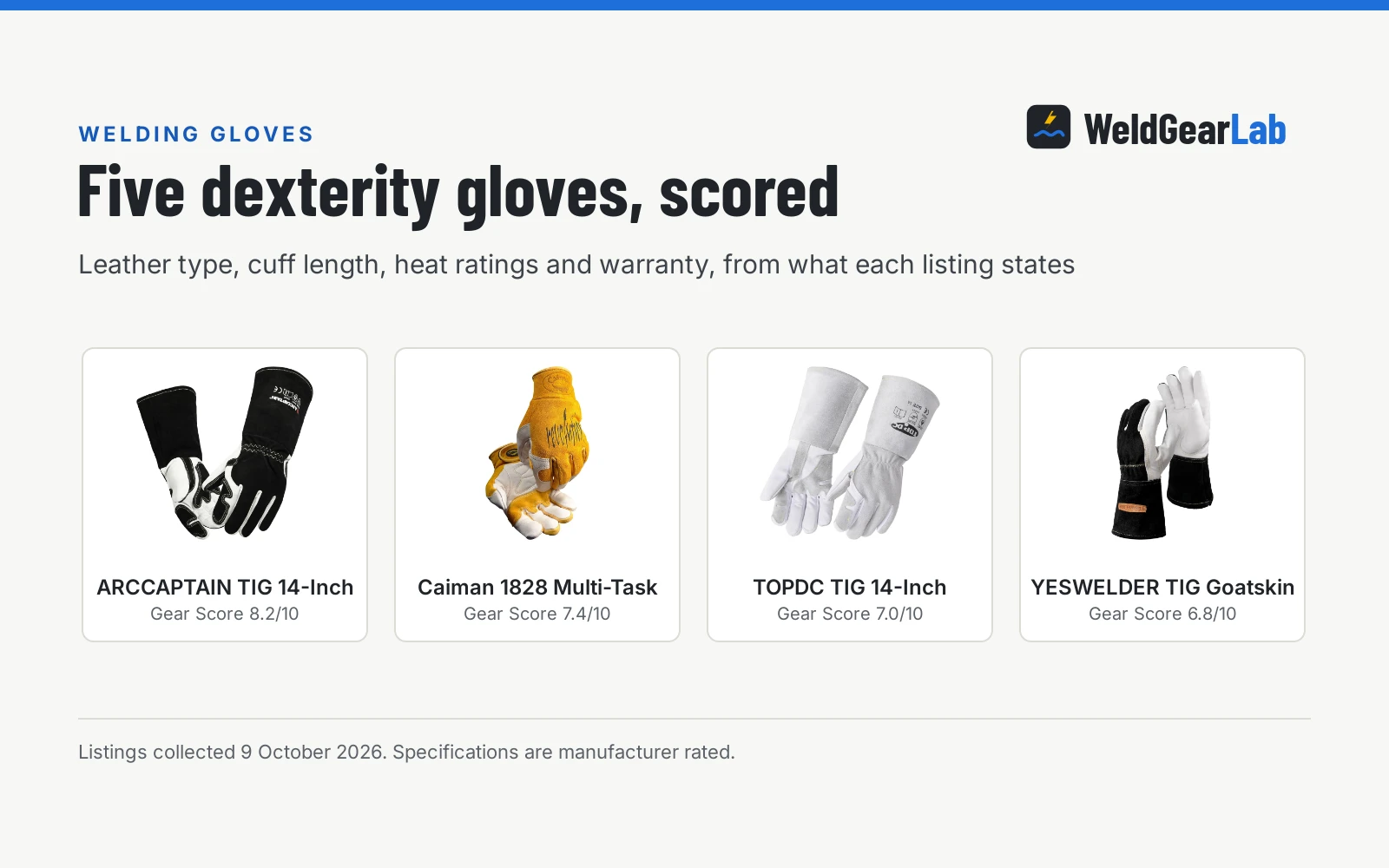
Finding the best welding gloves for dexterity requires balancing fine tactile feedback with heat protection and durable leather construction. For precise TIG torch manipulation and smooth wire feeding, thin and supple goatskin offers superior fingertip control compared to heavy cowhide, while reinforced palms and Kevlar stitching protect against burns. This guide compares five welding gloves on leather type, cuff length, heat ratings, stitching durability, and the warranty each listing states.
As an Amazon Associate I earn from qualifying purchases. WeldGearLab earns a commission when you buy through links on this page, at no extra cost to you. Read our affiliate disclosure.
Quick picks
- Best Overall ARCCAPTAIN TIG 14-Inch: Grain goatskin leather, a 14-inch gauntlet cuff, an ANSI/ISEA Heat Level 5 rating, and a 90-day warranty. Check price on Amazon
- Best Multi-Task Caiman 1828 Multi-Task: Cow grain leather with Kevlar stitching, unlined palm, hook-and-loop wrist, ANSI/ISEA Heat Level 2, and a 30-day warranty. Check price on Amazon
- Best Gauntlet Value TOPDC TIG 14-Inch: A 14-inch cuff with goatskin palm, split cowhide back, drag patches, and seamless index finger. Check price on Amazon
- Best Pack Value SAFEGEAR 65402 Cowhide: A 3-pack of top-grain cowhide driver gloves with keystone thumbs for general shop utility. Check price on Amazon
Compare the picks
| Model | Gear Score | Material | Glove length | Cuff / closure | Stitching | Heat rating | Warranty |
|---|---|---|---|---|---|---|---|
| ARCCAPTAIN TIG 14-Inch | 8.2/10 | Goatskin grain leather | 14 in | Elastic slip-on gauntlet | Reinforced | ANSI/ISEA Heat Level 5 | 90 days |
| Caiman 1828 Multi-Task | 7.4/10 | Cow grain leather | 10 in | Hook and loop | Kevlar | ANSI/ISEA Heat Level 2 | 30 days limited |
| TOPDC TIG 14-Inch | 7.0/10 | Goatskin palm, split cowhide back | 14 in | Elastic gauntlet | Double stitched / Kevlar welted | Not stated | None stated |
| YESWELDER TIG Goatskin | 6.8/10 | Top grain goatskin | Not stated | Pull on | Kevlar | Not stated | None stated |
| SAFEGEAR 65402 Cowhide | 5.8/10 | Top-grain cowhide | 9.75 in | Pull on driver | Reinforced | Not stated | None stated |
Specifications are manufacturer rated, as published on each listing and collected 9 October 2026.
The picks
| Award | Product | Gear Score About the Gear ScoreThe Gear Score runs from 0 to 10 and weighs performance (35%), build (25%), value (25%), safety (10%, where it applies) and warranty (5%), using only what the manufacturer and the listing publish. How we pick › | |
|---|---|---|---|
 ARCCAPTAIN Tig Welding Gloves
|
8.2/10 | Check price on Amazon | |
 Caiman Kevlar-Seamed Multi-Task Welding Gloves
|
7.4/10 | Check price on Amazon | |
 TOPDC TIG Welding Gloves 14In
|
7.0/10 | Check price on Amazon | |
 YESWELDER Premium Goatskin TIG Welding Gloves Top
|
6.8/10 | Check price on Amazon | |
 SAFEGEAR Cowhide Leather Work Gloves with Keystone
|
5.8/10 | Check price on Amazon |
ARCCAPTAIN Tig Welding Gloves
A 14-inch goatskin TIG glove featuring lightweight grain leather, an ANSI/ISEA Heat Level 5 rating, and a stated 90-day warranty.
Pros
- Grain goatskin leather provides thin, pliable fingertip feel for wire feeding
- 14-inch glove length provides extended forearm coverage against spatter
- Listing publishes an ANSI/ISEA Heat Level 5 rating
- Carries a stated 90-day manufacturer warranty
Cons
- Listing shows a contradiction between Medium size and One Size fit type
- Specification table lists reinforced stitching rather than Kevlar thread
- Title includes a typo in durable work protection
- Single pair pack without spare backups included
Caiman Kevlar-Seamed Multi-Task Welding Gloves
A cow grain multi-task glove featuring Kevlar stitching, an unlined palm for tactile control, and an ANSI/ISEA Heat Level 2 rating.
Pros
- Kevlar stitching adds seam resistance along high-wear zones
- Unlined palm design provides direct tactile contact with torch and tools
- Hook and loop closure creates an adjustable, secure wrist fit
- Stated 30-day limited warranty and ANSI/ISEA Heat Level 2 rating
Cons
- Heavyweight cow grain leather is thicker and less pliable than goatskin
- 10-inch length provides less forearm coverage than 14-inch gauntlets
- Short 30-day warranty window
- Straight thumb pattern offers less natural articulation than a keystone thumb
TOPDC TIG Welding Gloves 14In
A 14-inch TIG glove pairing a goatskin palm with split cowhide backing, drag patch reinforcements, and a seamless index finger.
Pros
- Goatskin palm and seamless index finger assist fine TIG filler rod handling
- 14-inch gauntlet cuff shields the wrist and lower forearm from sparks
- Reinforced palm, thumb, drag patch, and rest patch on high-wear zones
- Soft cotton lining absorbs perspiration during shop work
Cons
- Warranty description is listed as NO in the specification table
- No ANSI or EN thermal safety certification is published
- Contradiction between bullet stating Kevlar welted seams and spec table stating double stitched
- Spec table lists sleeve description as sleeveless despite the 14-inch cuff
YESWELDER Premium Goatskin TIG Welding Gloves Top
A top-grain goatskin TIG glove featuring Kevlar stitching, a keystone thumb, and seamless index finger for delicate torch work.
Pros
- Top-grain goatskin leather offers soft, natural finger flexibility
- Kevlar stitching across seams resists heat and seam blowout
- Keystone thumb and seamless index finger promote precise torch control
- Reinforced fingertips and palm strengthen critical wear zones
Cons
- No warranty term is stated in the listing
- No safety standards or ANSI heat level ratings are published
- Contradiction between bullet stating unlined palm and spec table stating cotton liner
- Overall glove length and cuff dimensions are omitted from the specification table
SAFEGEAR Cowhide Leather Work Gloves with Keystone
A 3-pack of top-grain cowhide driver safety gloves with keystone thumbs, suitable for utility work and general shop handling.
Pros
- Three-pair pack provides multiple replacement gloves for the shop
- Top-grain cowhide leather delivers durable abrasion resistance
- Keystone thumb design permits natural hand motion and tool grip
- Listing publishes verified dimensions of 9.75 x 5.25 x 1 inches and 4.32 ounces
Cons
- Short 9.75-inch driver profile lacks an extended gauntlet cuff for forearm protection
- Listing states no concrete warranty term, showing only a link
- No welding-specific safety certifications or heat level ratings published
- Specification table states information was not found for liner material
How we scored them
Each pair of gloves is scored out of 100 on performance, build, value, safety listing and warranty, with the weights published on our How We Pick method. For protective equipment, safety scores require a published standard rating such as an ANSI heat level, while warranty points require a concrete term; the ranking reflects all five criteria.
| Product | Gear Score | Perf. /35 | Build /25 | Value /25 | Safety /10 | Warranty /5 |
|---|---|---|---|---|---|---|
| ARCCAPTAIN TIG 14-Inch | 8.2 | 30 | 21 | 21 | 7 | 3 |
| Caiman 1828 Multi-Task | 7.4 | 27 | 21 | 20 | 4 | 2 |
| TOPDC TIG 14-Inch | 7.0 | 29 | 20 | 21 | 0 | 0 |
| YESWELDER TIG Goatskin | 6.8 | 28 | 20 | 20 | 0 | 0 |
| SAFEGEAR 65402 Cowhide | 5.8 | 21 | 18 | 20 | 0 | 0 |
Buying guide: best welding gloves for dexterity
Leather selection: goatskin vs cowhide
Dexterity in welding starts with the leather. Goatskin grain leather is the standard choice for precision TIG welding because its high tensile strength allows tanners to slice it thinner while retaining durability. The resulting suppleness gives your fingers the tactile feedback needed to feed thin filler wire and roll a torch smoothly. Cowhide, by contrast, is heavier and stiffer. While top-grain cowhide provides greater abrasion resistance and stands up better to heavier spatter in MIG and stick welding, the thicker hide restricts fine finger articulation.
Cuff style and forearm protection
A glove must balance hand mobility with heat shielding. Extended 14-inch gauntlet cuffs flare over your jacket sleeves to deflect sparks, molten spatter, and radiant arc energy away from the wrist. Shorter driver-style gloves measuring around 9.75 to 10 inches offer a lighter feel and simpler slip-on convenience for quick bench tasks, but they leave wrists and forearms exposed to ultraviolet radiation and spatter whenever you weld out of position.
Seam placement and stitching durability
Seam design directly affects both comfort and longevity. A seamless index finger removes inner thread ridges along the side of the finger, allowing smooth, uninhibited contact against filler rod. Stitching material is equally critical: thread spun from Kevlar resists high temperatures and will not burn through as easily when dragging along hot metal. Reinforced palm patches and thumb saddles further distribute wear across high-friction contact points.
Lining and thermal ratings
Liners impact both comfort and feel. Unlined palms provide maximum tactile sensitivity, making it easier to manipulate small parts and torch switches. Cotton linings absorb sweat during extended shop sessions and add a layer of insulation against heat buildup. When evaluating thermal performance, look for formal standards such as ANSI/ISEA Heat Level ratings, which define conductive heat resistance under controlled conditions rather than vague marketing terms.
Why should welding gloves be kept dry?
Welding gloves must be kept dry for two vital safety reasons: electrical resistance and burn prevention. Moisture and perspiration significantly lower the electrical resistance of leather, dramatically increasing the hazard of electric shock from your welding circuit. Furthermore, when damp leather contacts hot metal, the trapped water instantly turns to steam, causing severe steam burns inside the glove. Keeping gloves dry also prevents the leather from stiffening and cracking over time.
Use as directed. Inspect your gloves before every welding session for torn seams, thinned leather, or embedded metal shavings. Never handle red-hot metal directly with dexterity gloves, as thin goatskin quickly transfers heat. For high-amperage MIG or stick welding, switch to heavy-duty insulated gloves with extended cuffs. Follow workplace safety standards and review our welding safety gear section for complete protective gear advice.
Frequently Asked Questions
Why is it important to wear welding gloves?
Wearing dedicated welding gloves protects hands against intense ultraviolet radiation, molten spatter, and thermal burns generated by the welding arc. Quality gloves also provide insulation against electric shock and shield skin from sharp metal edges during fabrication. Standard work gloves lack the heat-resistant seams and leather coverage needed to protect against welding hazards.
What gloves are best for welding dexterity?
The best welding gloves for dexterity are made from thin, pliable goatskin leather with a seamless index finger and an ergonomic keystone thumb. These features allow fine fingertip control for feeding thin TIG filler rod while maintaining adequate protection against heat and arc flash. Heavier cowhide gloves work well for MIG and stick welding but sacrifice fine touch.
What are TIG welding gloves?
TIG welding gloves are specialized, lightweight gloves crafted from soft grain leather such as goatskin or kidskin. Because TIG welding generates almost no spatter, these gloves prioritize fingertip feel and wrist flexibility over thick thermal padding. They typically feature unlined or lightweight cotton palms to maximize tactile feedback.
Can dexterity welding gloves be used for MIG welding?
Dexterity gloves can be used for low-current MIG tacking and light gauge sheet metal work where precise wire placement is necessary. However, continuous MIG welding produces higher radiant heat and heavier spatter that will rapidly degrade thin goatskin. For higher-amperage MIG work, heavier cowhide or split leather gloves provide safer insulation.
How do you clean and maintain leather welding gloves?
Clean leather welding gloves by gently wiping off surface grime with a dry rag or soft brush, and hand wash only if the manufacturer care instructions permit. Never soak welding gloves in water or expose them to direct high heat to dry, as this stiffens and shrinks the leather. Store gloves in a clean, dry shop environment away from humidity and direct sunlight.
Related: best welding gloves for MIG, best welding gloves for high heat, best welding gloves for women, and the welding safety gear hub. Also see our best TIG torch.
About the author
WeldGearLab Editorial is the editorial team behind WeldGearLab. We research product listings, specifications, safety listings and warranty terms, score every pick with the published Gear Score method, and correct errors when readers report them. We do not run our own shop trials; see How We Pick for exactly how picks are made.