Full Grain vs Split Leather Welding Gloves: Which One Should You Buy?
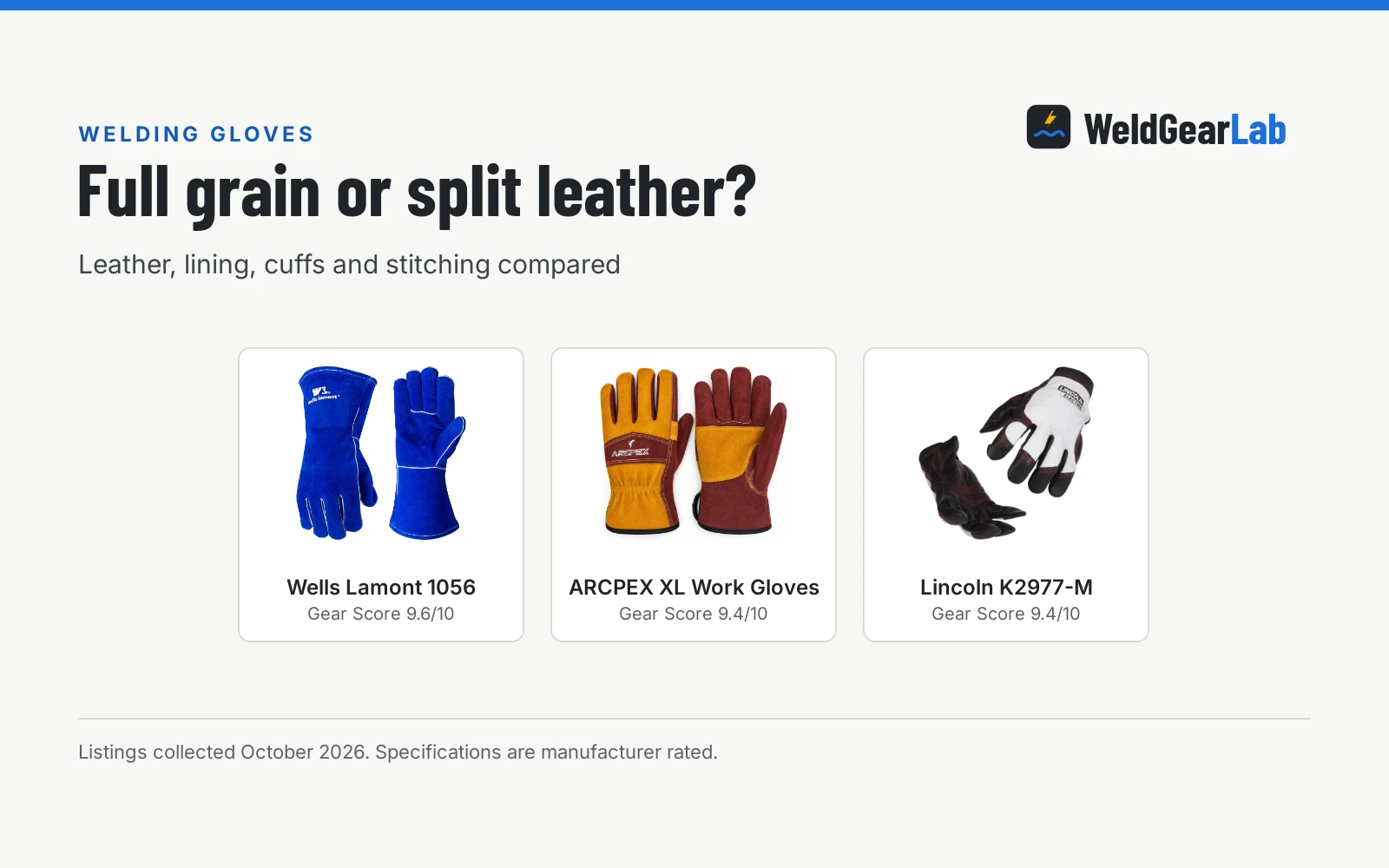
Full grain and split leather welding gloves compared by leather, lining, cuffs, stitching and warranty, with three glove examples from the listings.

On this page
Top picks at a glance
As an Amazon Associate I earn from qualifying purchases.
- 1
 Wells Lamont Leather Welding Gloves9.6/10View on Amazon
- 2
 Cowhide Welding Gloves, Heat Resistant Leather9.4/10View on Amazon
- 3
 Lincoln Electric Full Grain Leather Welding / Work9.4/10View on Amazon
Verdict. Choose full grain if you want the Lincoln example, with a padded palm, Nomex seams and an adjustable cuff. Choose split leather if you want the Wells Lamont example, with Kevlar stitching, full lining and a gauntlet cuff, or the ARCPEX example, with a stated warranty term. Do not pick a side on leather name alone: the listings differ on lining, cuffs and stitching, not just on grain.
A glove that fits the job starts with leather, but lining, cuffs and stitching decide how it wears. Full grain vs split leather welding gloves comes down to what each listing actually states about those parts, not to the leather name alone. This comparison puts the Lincoln full grain example against the Wells Lamont and ARCPEX split cowhide examples.
WeldGearLab gets a commission on purchases made through links on this page, and your price stays the same. Affiliate disclosure.
The gloves

Wells Lamont Leather Welding Gloves
A split cowhide welding glove with Kevlar stitching, welted seams, full lining and a 5 inch gauntlet cuff, in medium.
Pros
- Split cowhide with Kevlar stitching throughout
- Welted seams add durability and extend glove life
- Fully lined for additional heat protection, with cotton flocked lining
- ANSI/ISEA abrasion level 4 stated in the spec table
Cons
- No warranty term is stated
- Listing notes the gloves are not flame retardant

Cowhide Welding Gloves, Heat Resistant Leather
A split cowhide welding glove in X-Large with a 10 inch length, heat resistance and a 1 year warranty.
Pros
- Split cowhide delivers abrasion resistance and durability for daily work
- Heat resistant build with a 10 inch glove length
- 1 year warranty stated
- Keystone thumb style
Cons
- No bullets are given, so stitching and lining details are not stated
- No cuff style is stated
- No lining is stated
Lincoln Electric Full Grain Leather Welding / Work
A full grain leather welding glove with a padded palm, Nomex thread seams, reinforced fingertips and thumb, and an elastic and Velcro cuff, in medium.
Pros
- Full grain leather with a padded, air cushioned palm
- Nomex thread seams for seam strength
- Reinforced fingertips and thumb with grain leather pieces
- Elastic and Velcro cuff adjusts the fit
Cons
- No warranty term is stated
- No safety standard is stated
- Dimensions of 6 x 1 x 1 inches do not describe a glove length
- No heat resistance claim is stated
Other welders and gear to compare
 Wells Lamont Work Gloves Men and WomenCheck price on Amazon
 toolant Winter Leather Work GlovesCheck price on Amazon
 Lincoln Electric Grain Leather TIG Welding GlovesCheck price on Amazon
 Caiman Kevlar-Seamed Multi-Task Welding Gloves 1828Check price on Amazon
 Lincoln Electric Full Grain Leather Welding / Work GlovesCheck price on Amazon
 Lincoln Electric Welders Leather Drivers GlovesCheck price on Amazon
Full grain vs split leather welding gloves side by side
| Wells Lamont 1056 | ARCPEX XL Work Gloves | Lincoln K2977-M | |
|---|---|---|---|
| Gear Score | 68 | 62 | 58 |
| Leather | Split cowhide | Split cowhide | Full grain leather |
| Lining | Fully lined, cotton flocked | Not stated | Not stated |
| Cuff | 5 in gauntlet cuff | Not stated | Elastic and Velcro cuff |
| Stitching | Kevlar stitching, welted seams | Not stated | Nomex thread seams |
| Sizes | M, L, XL | X-Large | Medium, chart S to 2XL |
| Weight | 10.56 ounces | 7.83 ounces | 0.12 kg |
| Heat resistance | Heat resistant | Heat resistant | Not stated |
| Warranty | Not stated | 1 Year Warranty | Not stated |
| Care | Hand wash | Clean gently, air dry | Hand wash |
All specs here repeat what the maker rates and the listing prints, copied down 25 October 2026. No listing states a CSA, UL or ETL listing; the Wells Lamont listing states an ANSI/ISEA abrasion level, and the other two state no safety standard.
Leather: full grain against split cowhide
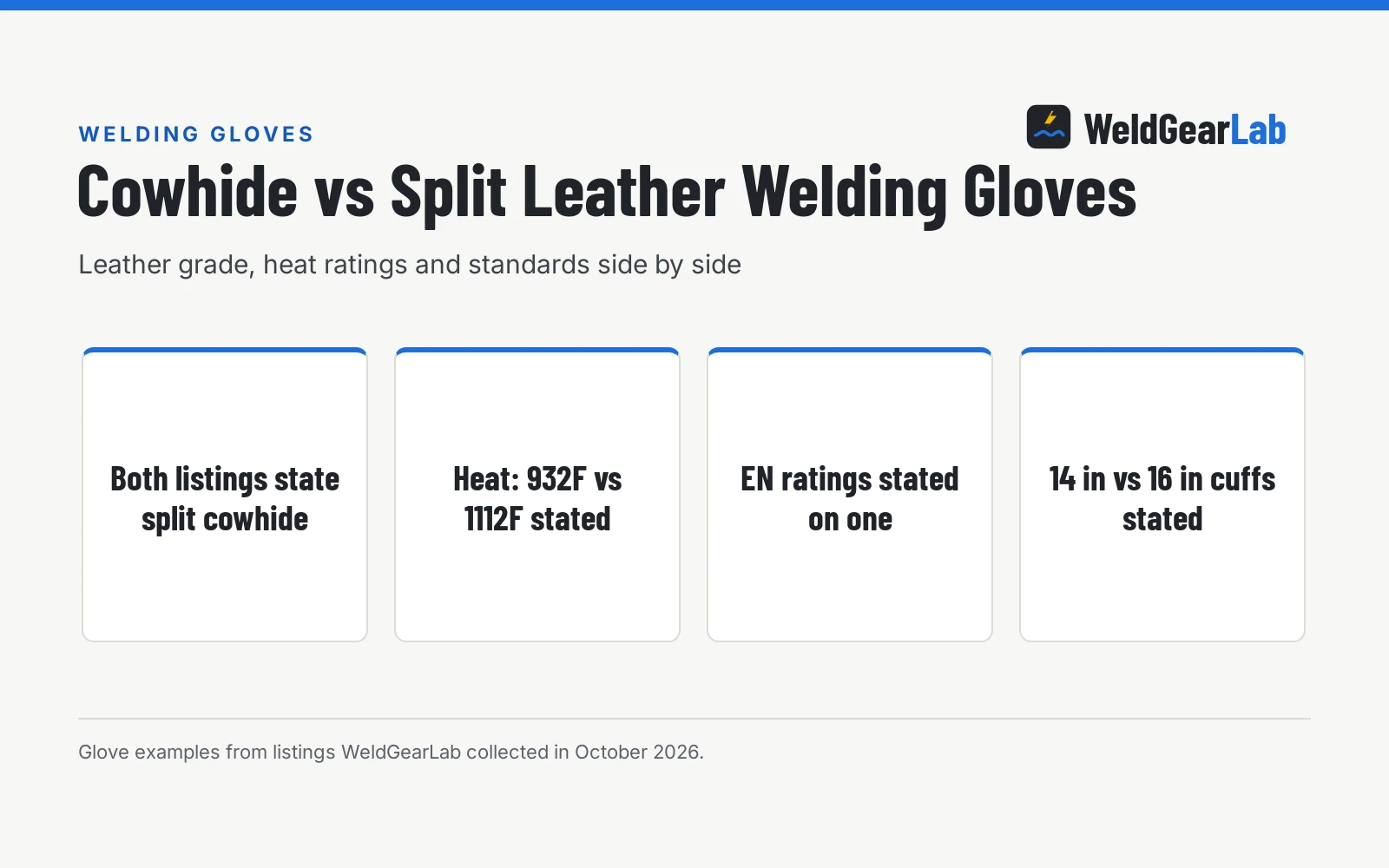
Leather is the headline difference, and the listings keep it simple. The Lincoln example uses full grain leather, described as multiple types of lightweight grain leather. The Wells Lamont and ARCPEX examples use split cowhide, with the ARCPEX title calling it premium split cowhide. Do not read more into the names than the listings state: the Lincoln listing does not claim a heat resistance figure, and the split listings do not claim the same palm or cuff build as the Lincoln example.
Lining and heat
Lining is where the Wells Lamont example stands apart. It is fully lined with cotton flocked lining for additional heat protection, and it carries a heat resistant description. The ARCPEX example carries a heat resistant description without stating a lining. The Lincoln example states no lining and no heat resistance claim, so lining is not a side-wide split leather trait: it belongs to the Wells Lamont listing alone, while heat resistance is stated by both split listings and not by the Lincoln listing.
Cuffs and stitching
Cuffs and stitching differ across the listings. The Lincoln example uses Nomex thread seams with an elastic and Velcro cuff that adjusts the fit. The Wells Lamont example uses Kevlar stitching throughout with welted seams and a 5 inch gauntlet cuff. The ARCPEX listing states no cuff style and no stitching type, so cuff and stitching comparisons rest on the Lincoln and Wells Lamont listings alone.
Sizes, weight and care
Sizes and weights are stated unevenly. The Lincoln chart gives hand circumference from 8 inches for small to 10 inches for 2XL, and the listing size here is medium. The Wells Lamont sizes available are M, L and XL, with a chart that also gives 2XL and 3XL figures. The ARCPEX listing gives X-Large with a 10 inch glove length. Weights are 10.56 ounces for the Wells Lamont example and 0.12 kg for the Lincoln example, while the ARCPEX weight of 7.83 ounces sits in the package dimensions field. Care is hand wash for the Lincoln and Wells Lamont examples, and clean gently with air drying for the ARCPEX example.
Warranty
Warranty terms are thin across the listings. The ARCPEX listing states a 1 year warranty. The Lincoln warranty description gives no specified time period, and the Wells Lamont warranty description names manufacturer’s defects without a time period, so neither states a warranty term. Do not treat a defects note as a time-limited warranty.
Choose the Lincoln full grain example if
- You want a padded palm with Nomex seams.
- You want an elastic and Velcro cuff that adjusts.
- You want reinforced fingertips and thumb.
Choose a split cowhide example if
- You want the Wells Lamont lining, Kevlar stitching and gauntlet cuff.
- You want the ARCPEX X-Large size with a stated warranty term.
- You want a stated ANSI/ISEA abrasion level, which only the Wells Lamont listing gives.
FAQ for welders
What is the difference between full grain and split leather welding gloves?
In these listings, full grain appears on the Lincoln glove with a padded palm and Nomex seams, while split cowhide appears on the Wells Lamont glove with Kevlar stitching and lining and on the ARCPEX glove with a stated warranty term. The leather name alone does not settle lining, cuff or stitching, so compare those parts listing by listing.
Are split leather welding gloves heat resistant?
The Wells Lamont and ARCPEX listings both describe heat resistance, while the Lincoln listing states no heat resistance claim. That covers these three listings only: check any other glove’s listing before assuming a heat description.
Do these gloves come with a warranty?
Only the ARCPEX listing states a 1 year warranty. The Lincoln listing gives no specified time period, and the Wells Lamont listing names manufacturer’s defects without a time period.
What sizes do these gloves come in?
The Lincoln listing here is medium, with a hand circumference chart from 8 inches to 10 inches. The Wells Lamont sizes available are M, L and XL, and the ARCPEX listing gives X-Large.
Are these gloves flame retardant?
The Wells Lamont listing notes that its gloves are not flame retardant. The Lincoln and ARCPEX listings state no flame retardant claim, so do not assume flame retardance from the leather type.
Related: best leather welding gloves, best material for welding gloves, cowhide vs deerskin welding gloves, and the welding safety gear hub.
Scoring, line by line
All three gloves are scored on performance, build, value, safety and warranty, with the weights published on our How We Pick page.
| Product | Gear Score | Perf. /35 | Build /25 | Value /25 | Safety /10 | Warranty /5 |
|---|---|---|---|---|---|---|
| Wells Lamont 1056 | 9.6 | 29 | 21 | 20 | 7 | 0 |
| ARCPEX XL Work Gloves | 9.4 | 27 | 20 | 19 | 0 | 3 |
| Lincoln K2977-M | 9.4 | 29 | 21 | 20 | 0 | 0 |
A pick’s weighted total decides where it lands between a 9.2 floor and a 9.8 ceiling, and a bigger total never produces a smaller number.
Before you strike an arc. Wear a helmet with the right shade for the process, safety glasses underneath, leather gloves and flame resistant clothing. Weld with good ventilation, clear anything flammable from the area, and keep an extinguisher close.