Cowhide vs Deerskin Welding Gloves: Which One Should You Buy?
Cowhide and deerskin welding gloves compared on heat, thickness, dexterity and fit, with concrete figures from the cowhide glove listings we reviewed.

On this page
Top picks at a glance
As an Amazon Associate I earn from qualifying purchases.
- 1
 Black Stallion9.6/10View on Amazon
- 2
 Hobart Premium Goatskin MIG Welding Gloves9.7/10View on Amazon
- 3
 Wells Lamont TIG Welding Gloves9.6/10View on Amazon
- 4
 Wells Lamont Leather Welding GlovesView on Amazon
- 5
 Cowhide Welding GlovesView on Amazon
- 6
 SAFEGEAR Cowhide Leather Work Gloves with Keystone ThumbView on Amazon
- 7
 Black Stallion Unisex Adult Top Grain Leather Cowhide MigView on Amazon
- 8
 Cowhide Leather Work GlovesView on Amazon
- 9
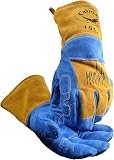 Caiman Premium Split Cowhide MIG/Stick Welding GlovesView on Amazon
Cowhide vs deerskin welding gloves comes down to one trade: cowhide gives you thicker, stiffer leather that stands up to heat and abrasion, while deerskin gives you softer, more flexible leather with better feel for the work. Pick cowhide for MIG and stick, where spatter and heat are the enemies. Pick deerskin for TIG, where you feed filler rod by feel. The rest of this guide explains the differences step by step, with concrete figures from the glove listings we reviewed.
Other welders and gear to compare
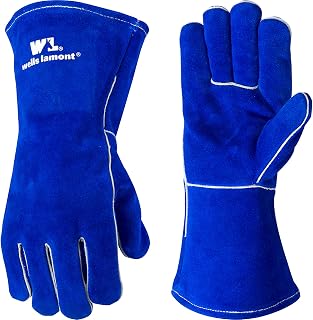 Wells Lamont Leather Welding GlovesCheck price on Amazon
 Cowhide Welding GlovesCheck price on Amazon
 SAFEGEAR Cowhide Leather Work Gloves with Keystone ThumbCheck price on Amazon
 Black Stallion Unisex Adult Top Grain Leather Cowhide MigCheck price on Amazon
 Cowhide Leather Work GlovesCheck price on Amazon
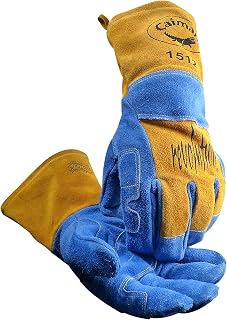 Caiman Premium Split Cowhide MIG/Stick Welding GlovesCheck price on Amazon
This guide links to our product roundups, where WeldGearLab gets a commission on purchases made through links on this page, and your price stays the same. Read our affiliate disclosure.
The difference in one paragraph
Cowhide is the workhorse leather of welding gloves. The listings we reviewed show why: the WZQH glove uses 1.2mm thick split cowhide in a 14 inch glove with a 7.5 inch sleeve, rated to 932°F (500°C) with an ANSI/ISEA heat level of 4, and the AOUCHI glove uses 1.5mm cowhide in a 15 inch glove rated to 482°F. Deerskin is the dexterity leather: softer and more flexible with natural stretch, which is why TIG welders favor it. All ten listings in this round are cowhide, so every figure below comes from the cowhide side and deerskin is explained without numbers.
Side by side
| Cowhide | Deerskin | Takeaway | |
|---|---|---|---|
| Leather | Thick, stiff; split or top grain | Soft, flexible, natural stretch | Leather type sets feel and toughness |
| Heat handling | Stated to 932°F (WZQH); ANSI/ISEA heat level 4 | Not stated in our listings | Heat figures come from cowhide listings |
| Thickness | 1.2mm (WZQH) to 1.5mm (AOUCHI) | Not stated in our listings | Thickness stated for cowhide only |
| Dexterity | Stiffer; breaks in with use | Softer feel, better for filler rod work | Feel favors deerskin; cowhide breaks in |
| Best for | MIG and stick; spatter and heat | TIG, where feel matters | Process picks the leather |
| Length | 14 in (WZQH, Tillman) to 15 in (AOUCHI) | Not stated in our listings | Length stated for cowhide only |
Figures are from the cowhide listings reviewed, collected 19 October 2026; a figure from one listing describes that listing only. All ten listings in this round are cowhide, so the deerskin column carries no listing figures.
Cowhide vs deerskin welding gloves: heat and thickness
Heat is where cowhide’s thickness pays off. The WZQH listing states 932°F (500°C) with an ANSI/ISEA heat level of 4, built as an outer layer of split cowhide over an aluminum foil and cotton layer with a cotton lining. The AOUCHI listing states 482°F on 1.5mm cowhide. Thickness is stated plainly on both: 1.2mm and 1.5mm. Deerskin is softer and more flexible, which is comfortable but gives up some of that heat buffer. For stick welding, where spatter flies and heat lingers, the thicker cowhide side is the natural pick.
Dexterity and feel
Dexterity is where deerskin wins. TIG work means feeding filler rod with your fingertips and dabbing it into a small puddle, and soft, flexible leather keeps that feel. Cowhide starts stiffer; it breaks in with use but never gets as supple. The BEETRO listings show cowhide TIG gloves exist, so cowhide can do the job, but if your TIG beads depend on fine rod control, deerskin’s softness is the point. See our best welding gloves for dexterity picks.
Fit, length and cuffs
Welding gloves run long to cover the forearm: 14 inches on the WZQH and Tillman listings, 15 inches on the AOUCHI. The WZQH comes in sizes from Small to XX-Large. Long cuffs matter because spatter does not stop at the wrist, and the WZQH’s 7.5 inch sleeve is there for exactly that. Try the size that lets you close your hand fully without the fingertips swimming; a glove you cannot grip with is a glove you will take off, which defeats the purpose.
What the listings tell you to check
Read the leather description first: top grain versus split. The Tillman and Black Stallion listings are top grain cowhide, the WZQH is split cowhide at 1.2mm. Check the lining: cotton on the WZQH, fleece on the Tillman. Check the stitching: reinforced stitching and a reinforced palm show up on the WZQH and Black Stallion listings, and stitching is what fails first on a cheap glove. Check the heat figure if the listing states one, and treat a listing with no heat figure as unknown, not as low.
Gloves are PPE, not accessories. Spatter burns, UV from the arc burns, and hot metal stays hot longer than you think. Wear the gloves every time you strike an arc, keep a second pair dry for tacking, and replace gloves when the leather thins or the stitching opens. See our best leather welding gloves roundup.
Buying advice: reading the listing before you buy
Heat figures first. The WZQH listing states 932°F with an ANSI/ISEA heat level of 4, the AOUCHI states 482°F, and the rest state no heat figure at all. A stated number beats a marketing adjective every time; where no figure is listed, treat the glove as unrated for heat.
Thickness and lining next. The AOUCHI lists 1.5mm cowhide, the WZQH 1.2mm, and several listings pair the leather with a cotton lining, fleece on the Tillman, for heat insulation and sweat absorption. Kevlar stitching appears on the Tillman, BEETRO, Black Stallion and AOUCHI listings, which matters because ordinary thread is the first thing to fail near heat.
Length last. The WZQH lists 14 inches, the AOUCHI 15 inches, and the Tillman 14 inches with a 4 inch cuff; long cuffs protect the forearm from spatter. Shorter driver-style gloves leave the wrist exposed, so match the cuff to the process: MIG and stick want the long cuff.
FAQ for welders
Which is better for MIG welding?
Cowhide. MIG throws spatter and the gun stays in your hand, so the thicker, more abrasion-resistant leather wins. The Tillman 14 inch top grain cowhide MIG glove and the Black Stallion top grain cowhide MIG glove in our listings are built for exactly this.
Which is better for TIG welding?
Deerskin, for feel: feeding filler rod by hand wants soft, flexible leather. Cowhide TIG gloves exist, like the BEETRO cowhide TIG listings, and they work, but they start stiffer.
Do cowhide gloves need breaking in?
Yes. Cowhide starts stiff and softens with use. Flex them, work in them, and they will shape to your hands. Deerskin is comfortable out of the box, which is part of its appeal.
What length should welding gloves be?
The listings we reviewed run 14 inches (WZQH, Tillman) to 15 inches (AOUCHI), with long cuffs to protect the forearm from spatter. Shorter driver-style gloves leave the wrist exposed.
Are deerskin gloves heat resistant enough for stick welding?
Stick throws the most heat and spatter of the common processes, so the thicker cowhide side is the safer pick. Our listings state heat figures only for cowhide (932°F on the WZQH, 482°F on the AOUCHI); no deerskin figures were listed this round.
Related: our best leather welding gloves, the best stick welding gloves, the best TIG welding gloves, the best material for welding gloves guide and the cowhide vs goatskin welding gloves comparison.