Cowhide vs Goatskin Welding Gloves: Which One Should You Buy?
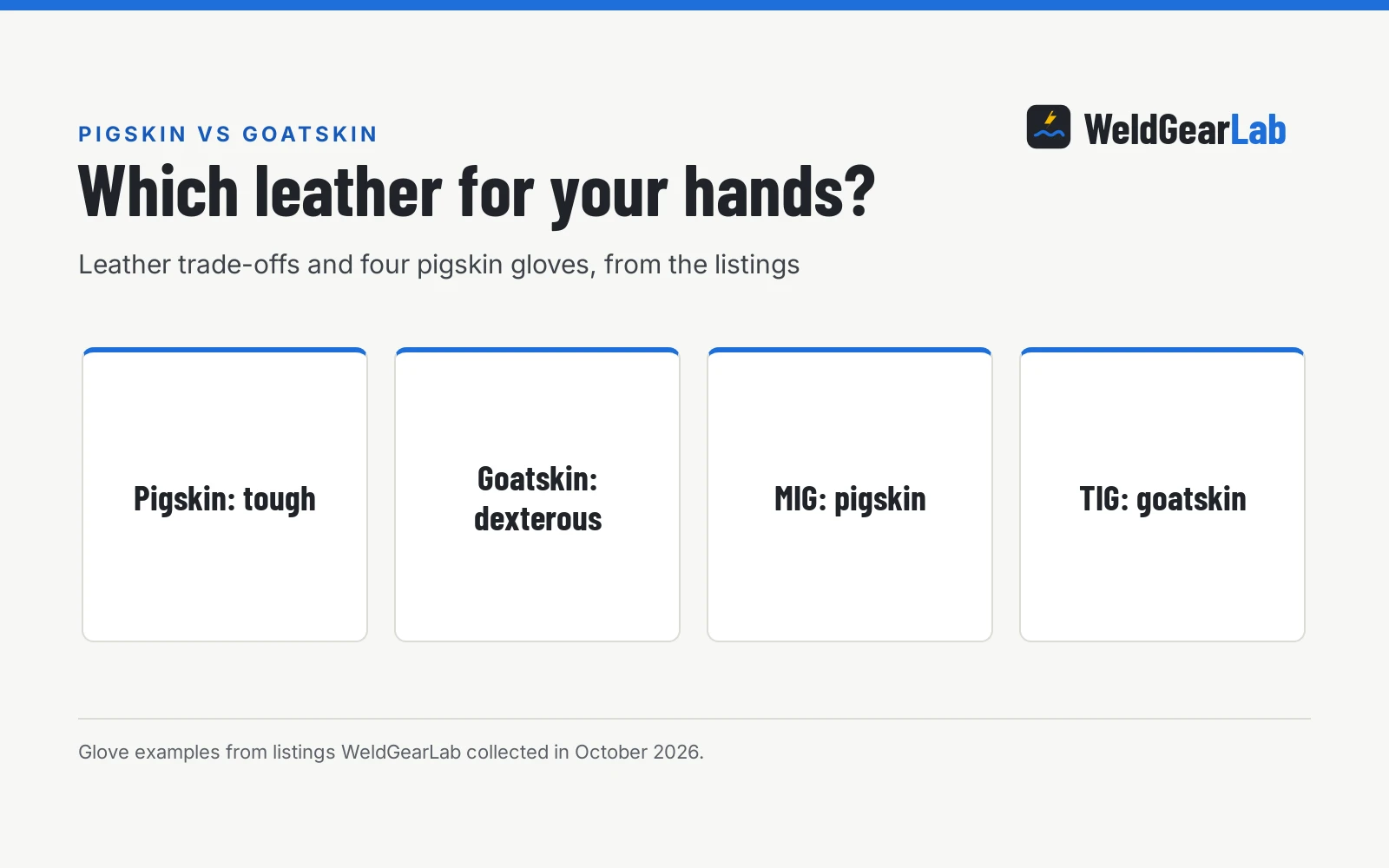
Cowhide and goatskin welding gloves protect your hands differently: cowhide shields against heavy heat and stick spatter, while supple goatskin gives the dexterity needed for TIG filler rod control.

On this page
Top picks at a glance
As an Amazon Associate I earn from qualifying purchases.
- 1
 Black Stallion9.6/10View on Amazon
- 2
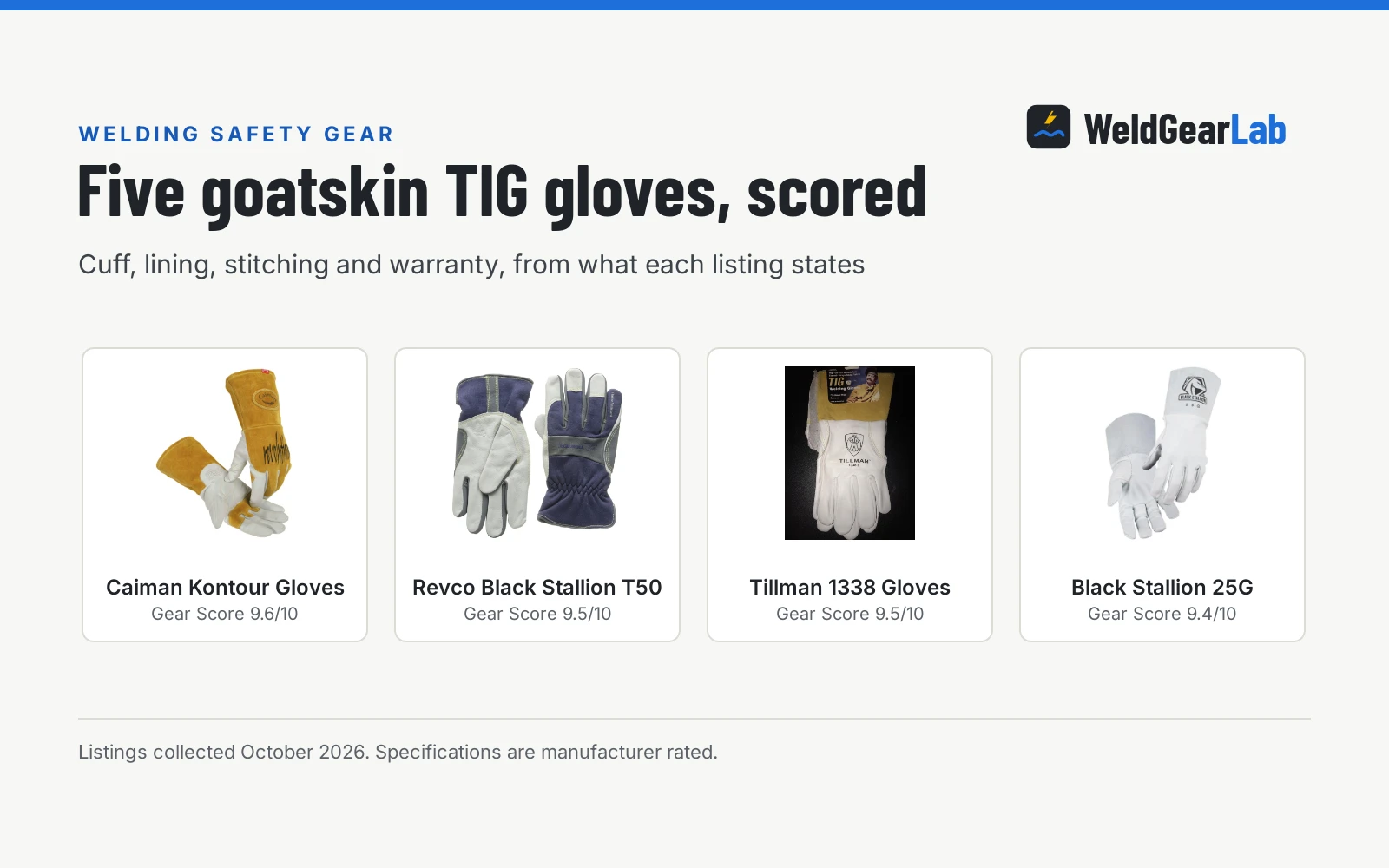
 Tillman 1338 Top Grain Goatskin TIG Welding Gloves with 4"9.5/10View on Amazon
- 3
 Cowhide Welding GlovesView on Amazon
- 4
 MOUNTAIN ESSENTIALS Leather Work GlovesView on Amazon
- 5
 Bear Knuckles W572 Leather Cowhide Stick & MIG Welding GlovesView on Amazon
- 6
 SAFEGEAR Cowhide Leather Work Gloves with Keystone ThumbView on Amazon
- 7
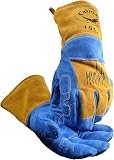 Caiman Premium Split Cowhide MIG/Stick Welding GlovesView on Amazon
- 8
 Tillman 1414 Top Grain/Split Cowhide Drivers GlovesView on Amazon
When clamping dirty farm iron for heavy stick repair or running delicate root passes on stainless tubing, your hands face completely different hazards. Choosing between cowhide vs goatskin welding gloves comes down to heat protection versus torch dexterity. Cowhide is the thick shield for high-heat stick, flux-cored, and heavy MIG welding where sparks fly and radiant heat can blister hands through thin leather. Goatskin is the supple skin built for precision TIG welding where you need fine finger feel to feed filler rod smoothly into the puddle. This guide compares both leathers side by side.
Other welders and gear to compare
 Cowhide Welding GlovesCheck price on Amazon
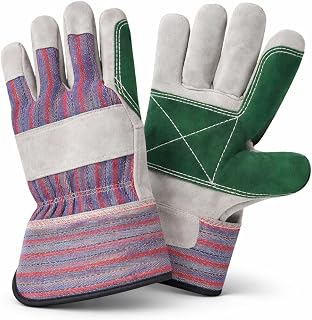 MOUNTAIN ESSENTIALS Leather Work GlovesCheck price on Amazon
 Bear Knuckles W572 Leather Cowhide Stick & MIG Welding GlovesCheck price on Amazon
 SAFEGEAR Cowhide Leather Work Gloves with Keystone ThumbCheck price on Amazon
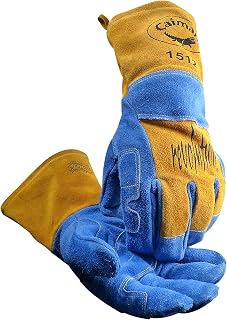 Caiman Premium Split Cowhide MIG/Stick Welding GlovesCheck price on Amazon
 Tillman 1414 Top Grain/Split Cowhide Drivers GlovesCheck price on Amazon
This guide links to our product roundups, where WeldGearLab gets a commission on purchases made through links on this page, and your price stays the same. Read our affiliate disclosure.
The difference in one paragraph
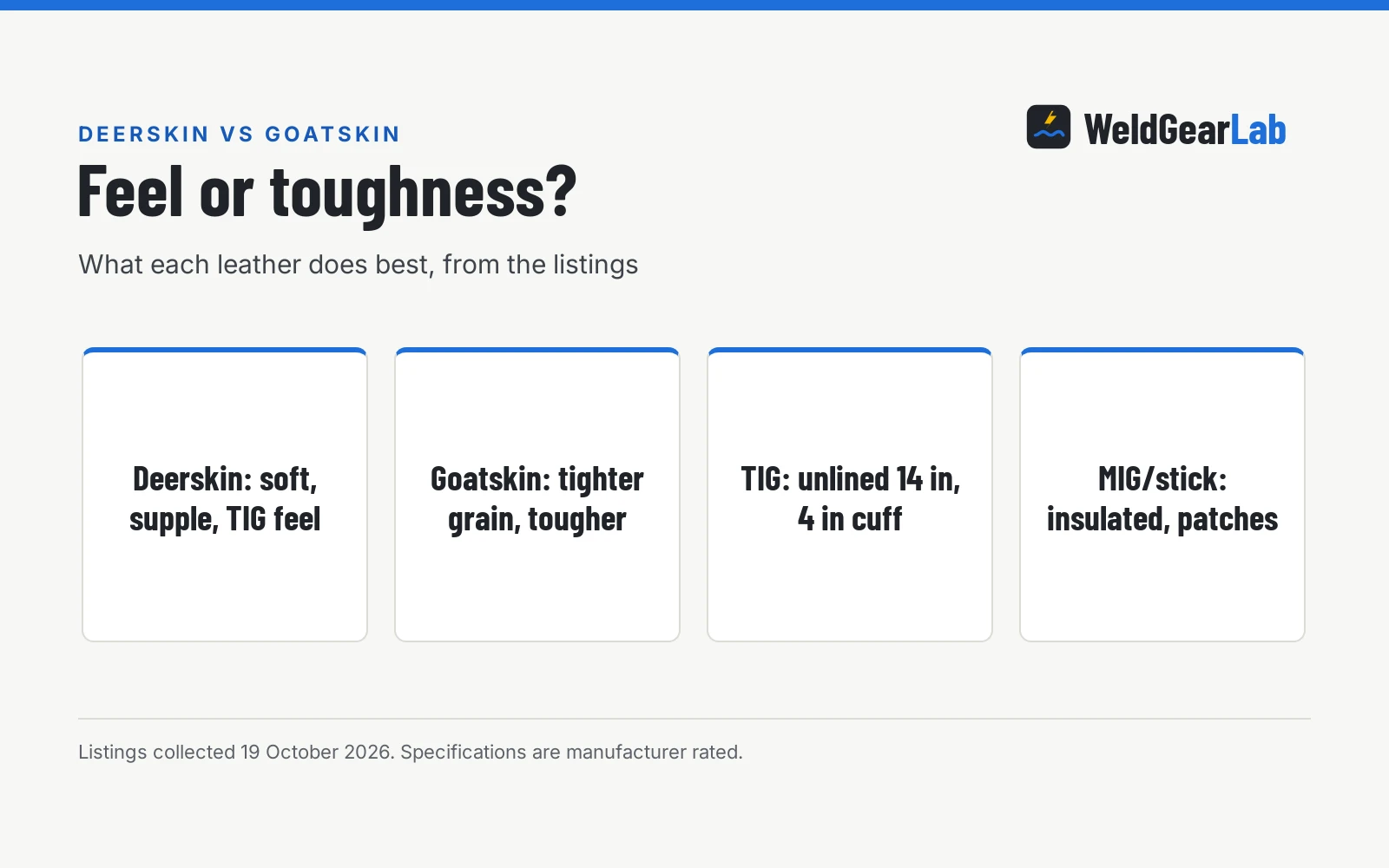
Leather blocks heat and ultraviolet arc radiation, but hide thickness dictates flexibility. Cowhide yields thick, fibrous leather split into heavy suede or finished as rugged top grain. That bulk absorbs thermal energy, deflects molten spatter, and resists abrasion on rough steel plates, though heavier cuts reduce finger dexterity. Goatskin features high tensile strength in a thin cross-section with natural lanolin. The tight grain stays pliable, letting fingers roll a torch handle and slide thin filler wire without removing PPE, but it offers minimal insulation against heavy sparks or sustained heat.
Cowhide vs goatskin welding gloves: side by side
| Split cowhide | Grain cowhide | Goatskin | |
|---|---|---|---|
| Primary welding processes | Stick, flux-cored, heavy gouging | MIG, general fabrication | Precision TIG, low-amp MIG |
| Heat resistance | High radiant heat and heavy slag | Moderate radiant heat | Low to moderate heat |
| Spatter and spark deflection | Thick split leather deflects heavy sparks | Good deflection, smooth surface | Vulnerable to heavy spatter burn-through |
| Dexterity and touch sensitivity | Lower dexterity, stiff grip | Moderate dexterity and flexibility | High tactile sensitivity, fine wire feed |
| Leather texture and grain | Coarse fibrous suede, rough texture | Smooth outer grain, dense fibers | Naturally oily, soft, supple grain |
| Typical lining | Cotton or fleece thermal lining | Often unlined or light lining | Usually unlined for maximum touch feel |
| Durability on rough steel | High abrasion resistance on plate | High puncture and tear resistance | Moderate abrasion resistance, built for feel |
| Cuff protection style | Long gauntlet for forearm coverage | Gauntlet or safety cuff | Safety cuff or light slip-on wrist |
| Fit and removal | Looser fit to flick off when hot | Regular fit for torch handling | Snug fit for precise filler rod control |
Glove fit and cuff style alter shop performance. Thick cowhide gloves feature a looser fit so you can fling them off quickly if hot spatter drops into the cuff or heat soak builds up. Goatskin gloves fit slim to hug fingers, providing the tactile feel needed to maintain arc length and avoid tungsten dips. Always match glove cut to your welding process.
When cowhide is the better choice
- Heavy stick welding. High-amperage stick electrodes shower sparks, flying slag, and intense heat that scorch light leather. Heavy split cowhide absorbs sparks and slows heat transfer.
- Flux-cored and outdoor welding. Gasless flux-cored wire spatters aggressively and leaves molten slag. Tough cowhide gauntlets protect forearms when working out of position on farm equipment or structural steel.
- Material handling and grinding prep. Handling sheared plate, beveling pipe, chipping slag, and brushing welds wear leather fast. Cowhide resists abrasion from sharp burrs and steel edges.
- Heavy-duty MIG fabrication. High-amperage MIG spray transfer on thick plate generates intense heat soak. Lined cowhide gloves insulate your torch hand along continuous seams.
Our best stick welding gloves guide covers heavy split leather options, while our best welding gloves for high heat roundup looks at reinforced insulation for heavy fabrication.
When goatskin is the better choice
- Precision TIG welding. TIG demands fine control to dab filler wire into a tiny molten puddle. Supple goatskin delivers tactile feedback through your thumb and index finger.
- Low-amperage sheet metal MIG. Running short-circuit MIG on thin sheet steel requires light torch manipulation without fighting heavy leather at your knuckles.
- Torch angle control. Walking the cup on pipe or holding a steady push angle on aluminum benefits from smooth wrist articulation that stiff gloves can hinder.
- Resistance to heat hardening. Natural oils inside goatskin keep leather soft across repeated thermal cycles, whereas sweat and radiant heat can leave cowhide stiff and crusty.
See our best TIG welding gloves roundup for supple pairs built for torch feel, and check our best welding gloves for dexterity guide for flexible shop picks.
How to tell glove leather in listings
Online listings often blur lines between leather grades or write conflicting specs. Look for these specific indicators when evaluating gloves:
- Split versus grain leather specifications. Split cowhide indicates a coarse, suede surface from lower hide layers, suited for rough stick welding. Top grain cowhide or grain goatskin indicates the smooth outer surface, offering tighter grain and better dexterity.
- Check published safety and abrasion standards. Standardized ratings confirm build quality. Intra-FIT lists EN388-2132X and EN407-413X4X Type A certification on its 537013 model, while J. J. Keller lists EN 388 3131 and ANSI Cut Level A6 on its SAFEGEAR line. Tillman specifies an ANSI Isea Abrasion Level 4 rating on its 1350L pearl cowhide glove.
- Examine stated glove dimensions and sizing data. Stated dimensions indicate coverage and fit across tasks. Tillman lists an 18 inches glove length on its 105018 split cowhide glove for extended forearm protection, while its 1350L pearl cowhide MIG glove lists a 12 inches length. Sizing charts also show variations across sizes; for example, J. J. Keller lists an 11.5 inches glove length for Medium on model 64321, alongside hand width measurements of 4.1 inches for Small, 4.3 inches for Medium, 4.6 inches for Large, 4.7 inches for X-Large, and 4.9 inches for XX-Large.
- Catch listing contradictions between titles and tables. Listings sometimes claim a specific hide in the headline and another in the spec sheet. For example, an Intra-FIT listing is titled cowhide MIG in its heading but lists grain goatskin palm and full grain goatskin back in its spec table. Similarly, J. J. Keller listings name cowhide in the title and state 100% cowhide leather in the fabric type, while listing goatskin leather in the material row.
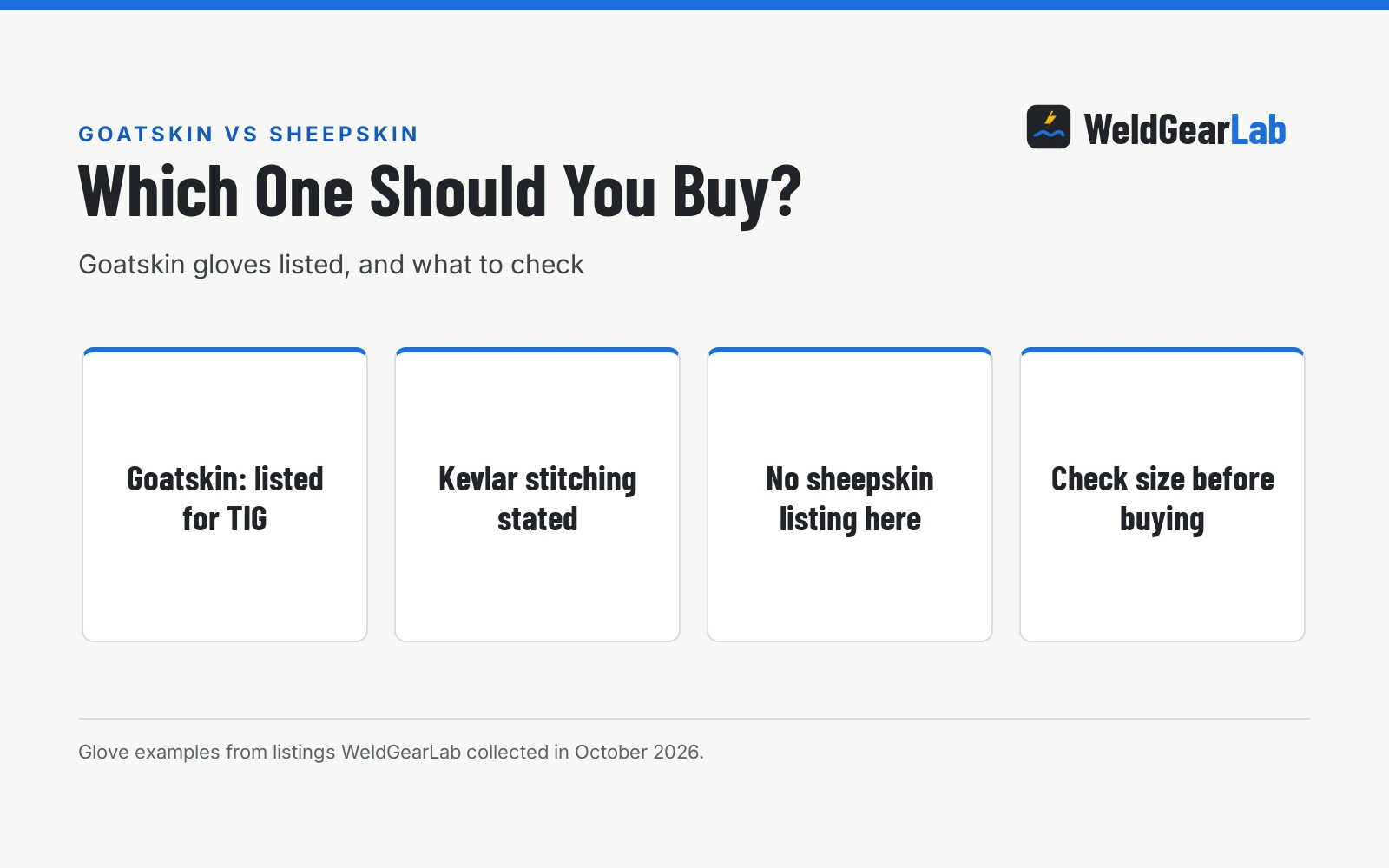
Look for Kevlar stitching on high-wear seams. Thread failure from heat causes gloves to split before leather wears out; listings like Tillman 1350L, Tillman 105018, and BEETRO TC0385 state Kevlar stitching throughout.
Which cuff and lining for shop work
The leather shell is only part of the glove build; inner lining and cuff patterns define everyday protection on the fab floor.
Lining decides thermal endurance. Unlined gloves, such as the Tillman 1350L pearl cowhide glove and BEETRO TC0385, maximize tactile contact and prevent bunching up inner fabric. However, radiant heat transfers directly through unlined hide during extended arc time. Heavy stick gloves use cotton insulation, like the cotton-lined Tillman 105018 split cowhide model, to slow heat transfer near the arc. For precision TIG, an unlined goatskin palm is preferred for feeding wire smoothly.
Cuff length protects wrists and sleeves from spatter ingress. Extended cuffs prevent stray sparks and slag from dropping into sleeves during out-of-position welds. Heavy split cowhide gloves often provide deep forearm coverage, such as Tillman listing an 18 inches glove length on its 105018 model, while MIG models may feature a dedicated cuff like the 4″ cuff stated on the Tillman 1350L pearl cowhide glove. Shorter slip-on cuffs or elastic wrists, such as BEETRO listing an elastic wrist on its TC0385-5 model, keep debris out while offering easy wrist flexion for benchwork. See our best welding gloves for MIG guide for balanced designs.
Can one pair do both?
Most welders who tackle heavy fabrication and fine detail work keep separate pairs on their cart: heavy lined cowhide for stick and flux-cored jobs, and unlined goatskin for TIG. Fine TIG joints with heavy split cowhide lead to clumsy handling, stubbed tungsten, and uneven filler dabs. Conversely, wearing thin goatskin while burning stick electrodes or running high-amperage MIG risks burns and destroys light leather.
Some makers build hybrid pairs with goatskin on the palm for dexterity and cowhide on the back or wrist for spatter defense, like BEETRO pairing white goatskin palms with brown cowhide wrist sections on its TC0385-5 work gloves. While hybrid designs work well for general shop fabrication, they cannot replace heavy stick gauntlets for high-amperage passes.
Burn prevention and PPE safety. Never use wet or oil-soaked gloves; moisture conducts heat rapidly causing steam burns, while grease creates a fire hazard under sparks. Replace gloves when stitching fails or leather chars. Ensure cuffs overlap sleeves completely to prevent ultraviolet burns or trapped spatter. Check our welding safety gear checklist for beginners for complete shop safety advice.
FAQ for welders
Can you use cowhide gloves for TIG welding?
You can hold a TIG torch wearing cowhide, but thick leather limits finger dexterity. Feeding thin filler wire smoothly requires fingertip sensitivity, while walking the cup requires free wrist movement that bulky cowhide can restrict. While unlined cowhide can work for high-amperage TIG on thick steel, goatskin remains standard for clean puddle control.
Can you use goatskin gloves for stick welding?
Goatskin is too thin to withstand the intense radiant heat and heavy spatter of stick welding. Molten slag balls and heavy sparks will scorch thin grain leather and cause burns almost immediately. Stick welding calls for thick insulated leather, typically heavy split cowhide with extended gauntlets.
What is the difference between split cowhide and top grain cowhide?
Top grain cowhide comes from the outer layer of the hide, providing a smooth finish, pliability, and puncture resistance. Split cowhide comes from the fibrous inner layer, yielding a coarse suede texture that excels at radiant heat absorption and rough abrasion resistance. Most heavy stick gloves use split cowhide, while light MIG gloves often use top grain.
Why does goatskin stay softer than cowhide after heat exposure?
Goatskin features a tighter fiber structure with higher natural lanolin content than cowhide. These natural oils help the leather resist drying out, cracking, and stiffening after repeated exposure to shop heat and hand sweat. Cowhide loses moisture faster under radiant heat, turning brittle over time.
Which leather is better for MIG welding?
The right leather depends on your MIG settings and wire type. For heavy steel, flux-cored wire, or spray transfer, heavy split cowhide blocks intense radiant heat and spatter. For short-circuit MIG on sheet metal and light fabrication, top grain cowhide or goatskin provides the dexterity needed for trigger and torch control.
Related: best leather welding gloves, welding gloves with grip, best welding gloves for men, and the welding safety gear hub. Also see our guide on best material for welding gloves.