Dial Bore Gauge vs Telescoping Gauge: Which One Should You Buy?
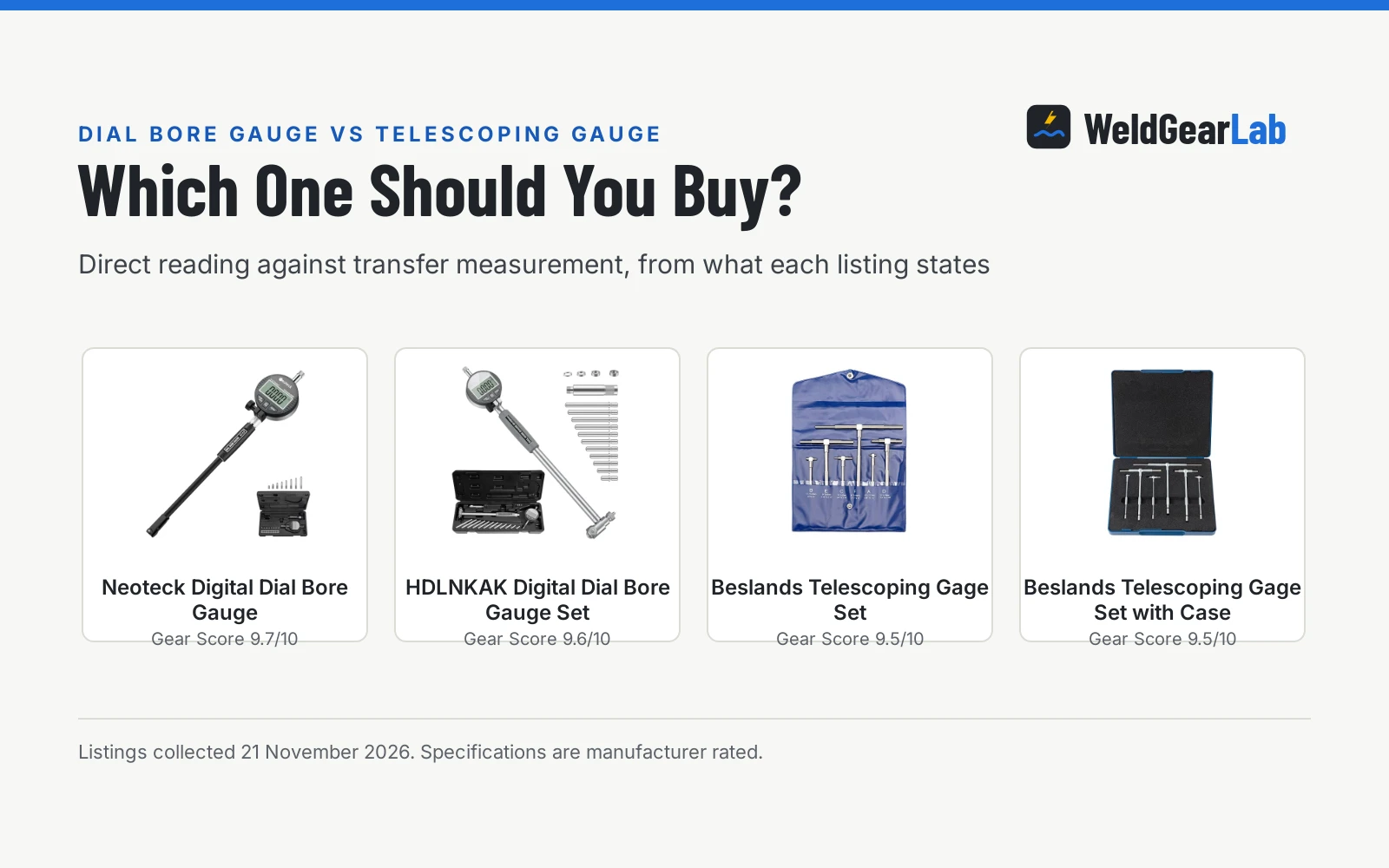
The Neoteck and HDLNKAK dial bore gauges show the reading on a digital indicator, while the two Beslands telescoping gauge sets transfer the bore to a micrometer or caliper.

On this page
Top picks at a glance
As an Amazon Associate I earn from qualifying purchases.
- 1
 Neoteck Digital Dial Bore Gauge9.7/10View on Amazon
- 2
 HDLNKAK Digital Dial Indicator Bore Gauges Set9.6/10View on Amazon
- 3
 Beslands 6 Pc Telescoping Gage Set, 5/16"9.5/10View on Amazon
- 4
 Beslands 6 Pc Telescoping Gage Set9.5/10View on Amazon
Verdict. Pick a dial bore gauge when you want the reading on the gauge itself: the Neoteck covers small bores and the HDLNKAK set covers larger ones, both with a digital indicator. Pick a telescoping gauge when you already own a micrometer or caliper and want a simple transfer tool: both Beslands sets cover the same wide range with no indicator to zero.
A cylinder bore wears out of round and tapers with use, and the only way to know is to measure it. That is the job behind dial bore gauge vs telescoping gauge: one side reads the bore directly, the other transfers the size to a micrometer. Both sides here measure engine cylinders, and the choice comes down to how you want the number.
WeldGearLab gets a commission on purchases made through links on this page, and your price stays the same. Read our affiliate disclosure.
The four gauges
Neoteck Digital Dial Bore Gauge
A digital dial bore gauge for 0.7 to 1.5 inch bores, with 8 gauge heads, a 0.5 inch digital indicator and an 18 month warranty.
Pros
- Reads bores from 0.7 to 1.5 inch with 0.0005 inch accuracy
- Digital indicator with 0 to 0.5 inch range and 0.0005 inch resolution
- 8 gauge heads in the set, plus a storage case
- 18 month warranty stated in the listing
Cons
- Covers only bores up to 1.5 inch
- Measures to 5 inch deep, less than the 2 to 6 inch set here
- Digital indicator covers only a 0 to 0.5 inch range
- Needs the right gauge head fitted before measuring
HDLNKAK Digital Dial Indicator Bore Gauges Set
A digital dial bore gauge set for 2 to 6 inch bores, with 12 anvils, carbide tips and a self-centering design.
Pros
- Covers 2 to 6 inch bores with 12 anvils
- Carbide anvils on the measuring plunger
- Self-centering design for engine cylinder work
- Deep bore measurement for checking cylinder out-of-roundness without removing the piston
Cons
- No warranty term in the listing
- Heaviest of the four at 2.58 lb
- 12 anvils plus 4 adjusting washers to keep track of
- Measures 15.4 by 6.0 by 2.44 inches
Beslands 6 Pc Telescoping Gage Set, 5/16"
A 6 piece telescoping gauge set for 5/16 to 6 inch bores, in stainless steel with a vinyl pouch.
Pros
- Covers 5/16 to 6 inch with 6 gauges
- Stainless steel construction with hardened tool steel contact points
- Knurled locking knob holds the setting for transfer
- Light at 1.0 lb with a vinyl case
Cons
- Needs a micrometer or caliper to read the result
- No direct reading; the setting must be transferred
- No warranty term in the listing
- One set of 6 gauges; a second set needed for bores over 6 inch
Beslands 6 Pc Telescoping Gage Set
A 6 piece telescoping gauge set for 5/16 to 6 inch bores, chrome plated with a portable storage box.
Pros
- Covers 5/16 to 6 inch with 6 gauges
- Chrome plated surface for a long service life
- Constant spring tension for uniform contact pressure
- Storage box included for the 6 gauges
Cons
- Needs a micrometer or caliper to read the result
- No direct reading; the setting must be transferred
- Chrome plated rather than stainless steel
- Same 5/16 to 6 inch range as the pouch set
Dial bore gauge vs telescoping gauge: side by side
| Neoteck Digital Dial Bore Gauge | HDLNKAK Digital Dial Bore Gauge Set | Beslands Telescoping Gage Set | Beslands Telescoping Gage Set with Case | |
|---|---|---|---|---|
| Gear Score | 69 | 58 | 54 | 53 |
| Range | 0.7 to 1.5 inch | 2 to 6 inch | 5/16 to 6 inch | 5/16 to 6 inch |
| Accuracy | 0.0005 inch | 0.01 mm (0.0003 inch) | Not stated | Not stated |
| Deep measurement | 5 inch | 150 mm (5.9 inch) | Not stated | Not stated |
| Reading | Digital indicator, direct | Digital indicator, direct | Transfer to micrometer or caliper | Transfer to micrometer or caliper |
| Weight | Not stated | 2.58 lb | 1.0 lb | Not stated |
| Warranty | 18 Months | Not stated | Not stated | Not stated |
Treat the specs as maker ratings pulled straight from the listings; we gathered them on 21 November 2026. No listing here states a CSA, UL or ETL listing.
How each side reads
The Neoteck and HDLNKAK gauges read directly. Each carries a digital indicator: the Neoteck reads 0 to 0.5 inch with 0.0005 inch resolution, and the HDLNKAK reads 0 to 12.7 mm with 0.01 mm resolution. Fit the right gauge head or anvil, set the indicator to zero against a known reference size, and the display shows how far the bore differs from that setting. The Beslands sets work the other way. Each telescoping gauge expands in the hole, locks in place, and comes out so a micrometer or caliper can read the final size. That transfer step is the whole difference between the sides: the dial bore gauge shows the reading on its own display, the telescoping gauge hands the setting to another tool. See the micrometer vs caliper guide for the tool that finishes the job.
Range and depth
The Neoteck covers 0.7 to 1.5 inch, the smallest range here, with 8 gauge heads stepping from 0.7-0.8 inch to 1.4-1.5 inch. The HDLNKAK set covers 2 to 6 inch with 12 anvils from 2 inch to 4 inch and 4 adjusting washers. Between the two dial bore gauges, the Neoteck starts at 0.7 inch and the HDLNKAK set reaches 6 inch. Both Beslands sets cover 5/16 to 6 inch with 6 gauges, the widest single range here. For depth, the Neoteck measures to 5 inch and the HDLNKAK set states 150 mm, or 5.9 inch, deep. The HDLNKAK listing also states 10 inch deep in another line, so check with the seller before ordering for a deep bore. Neither Beslands set states a depth.
Accuracy
The Neoteck maker rates accuracy at 0.0005 inch, matching its 0.0005 inch resolution. The HDLNKAK maker rates accuracy at 0.01 mm, or 0.0003 inch, against a 0.01 mm resolution on the indicator. Two-point contact on both gauges detects ovality and taper. Neither Beslands set states an accuracy figure, and the final number depends on the micrometer or caliper that reads the transferred setting, so compare the telescoping side on range and build rather than on a stated accuracy.
What is in the box
The Neoteck set includes a 0.5 inch digital indicator, a wrench, a measuring rod, 8 gauge heads and a storage case. The HDLNKAK set includes a digital dial indicator, measuring extended heads, a chrome plated handle, an ABS storage case, an instruction manual, 12 anvils and 4 adjusting washers. Each Beslands set includes 6 telescoping gauges: the pouch set comes with a vinyl case and the other with a portable storage box.
Weight and build
The HDLNKAK set weighs 2.58 lb, the heaviest here, and the set measures 15.4 by 6.0 by 2.44 inches. The pouch Beslands set weighs 1.0 lb. No weight is stated for the Neoteck gauge or the boxed Beslands set. On build, the Neoteck uses an all-metal clamping device, an aluminum housing and a sealed gauge head with a glass mirror cover. The HDLNKAK set uses carbide anvils and a chrome plated handle. The pouch Beslands set is stainless steel with hardened tool steel contact points, and the boxed set is chrome plated.
Warranty
The Neoteck is the only one of the four with a stated warranty term: 18 months. The other three listings state no warranty term, which is the main reason the Neoteck scores higher on warranty. Check the warranty terms with the seller before ordering if a written term matters to you.
Choose the dial bore gauge if
- You want the reading on the gauge itself, with no second tool.
- Your bores run from 0.7 inch to 6 inch across the two sets here.
- You measure engine cylinders and want to check ovality and taper.
- A stated warranty term matters to you.
Choose the telescoping gauge if
- You already own a micrometer or caliper to read the transfer.
- You want one set that covers 5/16 to 6 inch.
- You prefer a simple mechanical tool with no indicator to zero.
- You want the 1.0 lb pouch set for the toolbox.
Before You Strike an Arc
- Fit the gauge head that matches the bore, then set the dial indicator to zero against a known reference size before measuring.
- Check that the telescoping gauge locks firmly before you pull it from the bore.
- Confirm the depth the set reaches before measuring a deep cylinder.
- Keep the bore and the gauge contact points clean so grit does not change the reading.
FAQ for welders
What is a dial bore gauge?
A dial bore gauge measures the inside diameter of a bore, such as an engine cylinder. The Neoteck and HDLNKAK gauges here carry a digital indicator that shows the difference from the zero setting, and two-point contact detects ovality and taper. The gauge is self-centering, so it finds the bore center as you measure.
How do dial bore gauges work?
The gauge head fits the bore and the indicator shows how far the bore differs from the zero setting. The Neoteck covers 0.7 to 1.5 inch with 8 gauge heads, and the HDLNKAK set covers 2 to 6 inch with 12 anvils. Both use two-point contact to detect ovality and taper.
How do you read a dial bore gauge?
Fit the gauge head that matches the bore size, then set the indicator to zero against a known reference size. The Neoteck indicator reads 0 to 0.5 inch with 0.0005 inch resolution, and the HDLNKAK indicator reads 0 to 12.7 mm with 0.01 mm resolution. Read the difference from the zero setting on the digital display and add it to the reference size.
How do you set up a dial bore gauge for use?
Select the measuring head of the right size for the bore, then adjust the pointer of the dial indicator to the zero setting against a known reference size. The Neoteck set includes a wrench and a measuring rod for the setup, and the HDLNKAK set includes extended heads and adjusting washers. Check the fit before measuring.
How do you measure a bore with a dial bore gauge?
Fit the right gauge head, set the indicator to zero against a known reference size, and insert the gauge into the bore. The self-centering design finds the center, and two-point contact detects ovality and taper. For a telescoping gauge, expand it in the hole, lock it, remove it, and read the size with a micrometer or caliper.
Related: best bore gauge, best dial bore gauge for engine building, micrometer vs caliper, dial indicator setup, and the measuring and layout hub.
Scoring, line by line
Each gauge is scored on performance, build, value, safety listing and warranty. The Neoteck leads on the strength of its stated accuracy, its 8 gauge heads and its 18 month warranty. The HDLNKAK set follows on range and carbide anvils, held back by no stated warranty. The two Beslands sets score close together on the same range, separated by build and the case.
| Product | Gear Score | Perf. /35 | Build /25 | Value /25 | Safety /10 | Warranty /5 |
|---|---|---|---|---|---|---|
| Neoteck Digital Dial Bore Gauge | 9.7 | 30 | 21 | 20 | n/a | 3 |
| HDLNKAK Digital Dial Bore Gauge Set | 9.6 | 29 | 21 | 20 | n/a | 0 |
| Beslands Telescoping Gage Set | 9.5 | 26 | 20 | 20 | n/a | 0 |
| Beslands Telescoping Gage Set with Case | 9.5 | 26 | 19 | 20 | n/a | 0 |
Think of 9.2 as the bottom and 9.8 as the top. Totals are placed between them in proportion, which keeps the order intact: more points, higher score. Safety points apply to gear that runs on power or lists safety features. Without either, we score out of 90 instead of 100.