How to MIG Weld Thin Sheet Metal without Burning Through
How to MIG weld thin sheet metal without burning through by using small-diameter wire, low heat settings, tight joint fitup, and short stitch welds.
 By WeldGearLab Editorial
Updated October 9, 2026
By WeldGearLab Editorial
Updated October 9, 2026
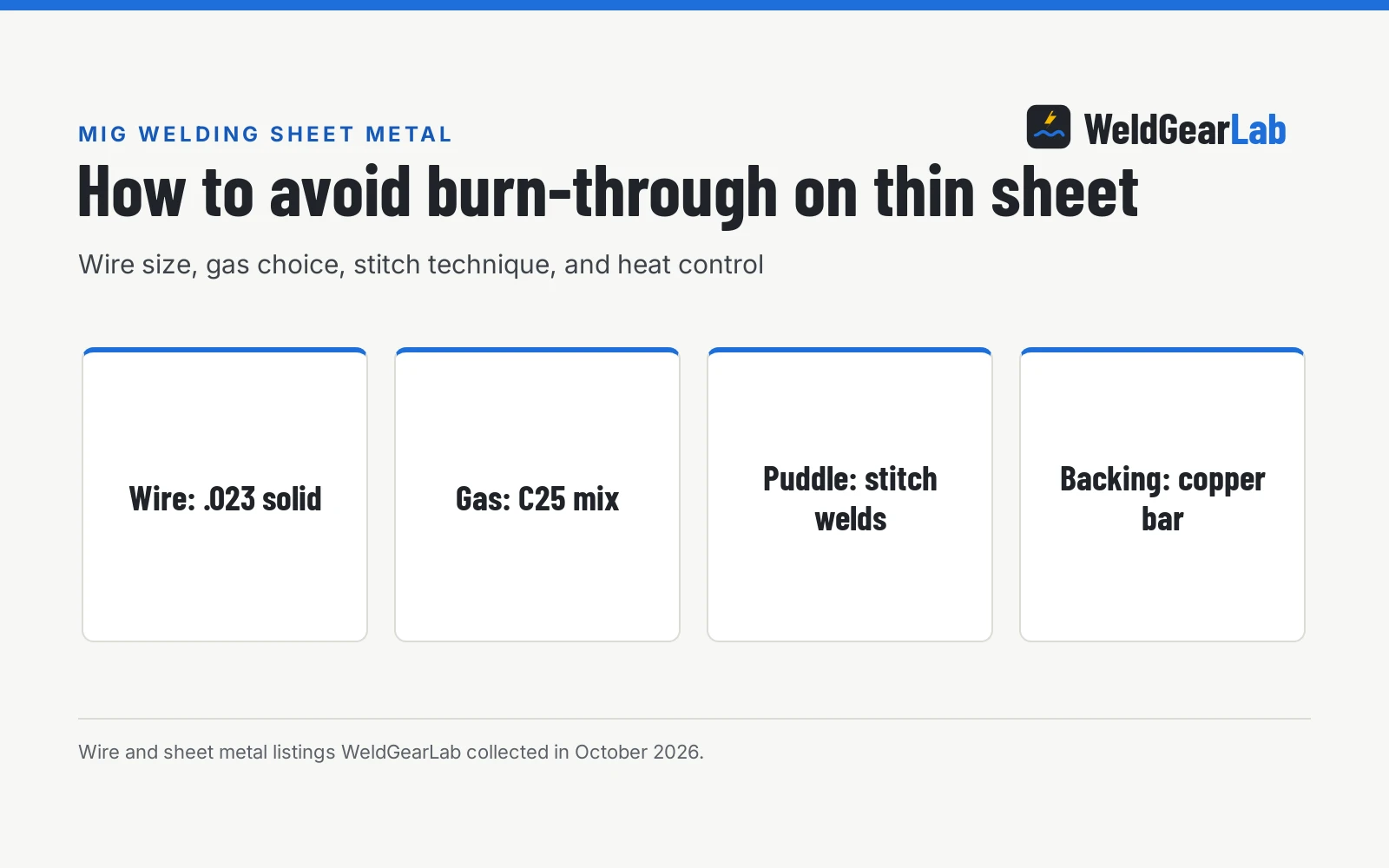
Knowing how to MIG weld thin sheet metal without burning through comes down to managing heat input. Thin steel melts rapidly under a sustained electric arc, turning a planned seam into a gaping hole. The solution is using .023 solid wire with C25 shielding gas, lowering machine voltage, keeping joint fitup tight, and replacing continuous passes with overlapping trigger pulses known as stitch welding. Backing the joint with a copper bar also pulls heat away before the metal blows out. This guide explains how to balance machine settings and torch technique to weld clean sheet metal joints without blowing holes.
As an Amazon Associate I earn from qualifying purchases. This guide links to our product roundups, where WeldGearLab earns a commission when you buy through links, at no extra cost to you. Read our affiliate disclosure.
How to MIG Weld Thin Sheet Metal without Burning Through
Thin sheet metal has minimal mass and a narrow cross-section, meaning it has little capacity to absorb and dissipate heat. When an arc stays concentrated in a localized spot, the base metal reaches melting temperature in an instant. Arc pressure and gravity then force the molten puddle downward, creating a blowout hole that is difficult to repair. Controlling this process requires matching wire diameter, machine voltage, and travel technique to the sheet thickness.
Makers define sheet metal gauges by specific decimal thicknesses. For example, Yudylg lists 20-gauge cold-rolled sheet steel at 0.039 inches (1 mm), while Metoro lists 16-gauge cold-rolled sheet at .060 inches. INE lists its ER70S-6 solid MIG wire in .023 inch diameter specifically for thin gauge metal from 20 gauge to 16 gauge (0.8 mm to 1.6 mm). Welding steel of this thickness requires a short electrical arc, minimal filler deposition, and brief arc duration so the puddle solidifies before base metal melts through.
Side by side
| Continuous bead | Stitch welding (trigger pulses) | Stitch welding with copper backer | |
|---|---|---|---|
| Heat accumulation | High and continuous, warps and blows holes | Low, heat dissipates between pulses | Lowest, copper rapidly draws heat away |
| Burn-through risk | Severe on thin steel like 20 gauge | Controlled by brief trigger bursts | Minimal, copper supports molten puddle |
| Distortion and warping | High across long seams | Low when skipping across sections | Very low due to rapid heat dissipation |
| Puddle control | Puddle expands quickly and sags | Each spot freezes before next trigger pull | Puddle freezes flat against backing bar |
| Wire size compatibility | Difficult to control even with fine wire | Optimized for .023 solid wire | Optimized for .023 solid wire |
| Fitup tolerance on thin sheet | Zero gap tolerance, any gap causes immediate blowout | Needs tight flush contact with no gap | Copper backer helps bridge minor fitup variations |
| Post-weld cleanup | Grinding blown holes and warped panels | Uniform overlapping spots with minimal grinding | Flat rear bead with minimal grinding |
| Operator technique | Continuous travel along the seam | Rhythmic pulse-and-cool trigger sequence | Pulse-and-cool sequence over clamped backer |
Trigger technique and thermal dissipation determine whether a sheet metal joint succeeds or blows through. Using brief trigger pulses gives each weld puddle a moment to freeze, while continuous beads trap rising heat until the metal gives way. Clamping metal tightly and keeping heat low allows clean fusion across delicate panels.
Why continuous beads burn through thin sheet
Running a continuous bead on thick plate creates a strong, uniform joint because heavy metal absorbs and distributes heat. On thin sheet steel, a continuous arc creates thermal saturation almost immediately. Because thin sheet has very little cross-sectional area, it cannot conduct thermal energy away from the weld zone fast enough to dissipate continuous heat input. Within moments, the base metal saturates with heat, the molten puddle expands, and arc pressure blows through the seam.
Continuous passes also create severe heat distortion. Uneven heating causes thin panels to buckle, warp, and lift away from the clamping surface. Once panels lift, gaps open between the sheets. Air gaps eliminate metal-to-metal contact, causing the arc to blow through the unsupported edges. For auto body panels and light sheet fabrication, dragging a long continuous puddle across a seam consistently fails. Choosing an appropriate machine from our budget MIG welder guide helps provide the low-end voltage control necessary to avoid blowing holes in delicate steel.
Why stitch welding sheet metal is the better technique
Stitch welding sheet metal replaces a continuous bead with a series of overlapping spot welds. Instead of dragging the torch along the seam, the operator pulls the trigger, establishes an arc just long enough to form a molten puddle, and immediately releases the trigger. The molten puddle freezes from liquid steel to solid metal in an instant. The operator then moves the gun nozzle slightly forward, overlapping the edge of the previous spot weld, and triggers another brief pulse.
Repeating this pulse-and-cool cycle creates a continuous, leak-free seam without saturating the base metal with heat. To keep distortion minimal, avoid placing stitch pulses consecutively along a single stretch of the seam. Place a pulse on a section of the panel, jump to the opposite end, and place another pulse. Moving across different areas gives each spot time to cool below glowing temperature before returning to fill in adjacent spots. This stitch technique keeps panels flat, reduces grinding time, and prevents blowouts.
How to set up wire, voltage, and joint fitup
Successful sheet metal welding depends heavily on careful preparation before pulling the trigger. Joint fitup must be tight, with flush contact and no gap between the mating edges. Gaps between sheet edges allow the arc to melt the exposed edge away before a shared puddle can form, resulting in blowouts and open keyholes. Clamp panels securely using flat clamps, locking pliers, or magnetic supports to keep seams aligned. KEILEOHO lists 8-inch MIG welding pliers with a sheet thickness gauge, which allows quick gauge checks and keeps gun nozzles clean of spatter.
Cleanliness is equally vital. Remove all paint, rust, primer, oil, and mill scale down to bare, shiny steel on both the front and back of the joint. Contaminants introduce resistance that disrupts arc stability and creates porosity. Both voltage and wire feed speed should be set to the lower end of the machine’s operating range. Keeping voltage low limits arc length, while keeping wire feed speed low limits amperage and heat input. The two settings must stay balanced: excessive wire feed speed causes the wire to stub into the puddle, while insufficient wire speed causes the arc to burn back toward the contact tip. Check our guide on what size MIG wire for sheet metal for detailed wire matching across light gauges.
Which shielding gas and wire size for sheet metal
Wire diameter directly governs how much heat is transferred into the workpiece. Heavier wire diameters require higher amperage to melt, which deposits excessive heat into thin sheet metal. By contrast, .023 inch solid wire melts cleanly at much lower amperage, keeping the puddle small and controllable. INE supplies .023 inch ER70S-6 wire on a 2 lb spool, rated for single and multi-pass welding on mild steel up to 510 MPa tensile.
Shielding gas choice is just as critical. INE specifies C25 gas, composed of 75% argon and 25% CO2, or 100% CO2 for solid wire welding. For thin sheet metal, C25 is the superior option. Argon creates a smooth, gentle arc with reduced penetration and low spatter, while the CO2 portion stabilizes arc energy. Running 100% CO2 produces deeper penetration and harsher arc characteristics, increasing the danger of burn-through on light gauges such as 20 gauge steel. Set machine polarity to DC positive (DC+) as specified on solid wire packaging, which provides a stable arc and smooth metal transfer for gas-shielded MIG welding.
Can a backing bar prevent blowouts?
A backing bar provides an effective physical heat sink behind thin sheet metal seams. Copper is the preferred backing material because molten steel does not fuse to copper under normal MIG welding temperatures. Clamping a flat copper bar or flattened piece of copper pipe directly against the back of the seam draws heat away from the steel panel rapidly, cooling the weld zone before base metal can melt away.
If an arc momentarily penetrates through the thin sheet, the solid copper backer supports the liquid puddle and prevents a gaping hole from opening. Once the stitch pulse ends, the steel puddle solidifies against the copper surface, leaving a flat, reinforced back bead that requires minimal cleanup.
Sheet metal welding safety requires standard protective precautions. Wear leather gloves, safety glasses under an auto-darkening hood, and fire-resistant clothing to protect against spatter and ultraviolet arc rays. Ensure adequate shop ventilation to disperse welding fumes, especially when cleaning solvents or protective oils are present. Secure compressed shielding gas cylinders upright with a chain, keep a working fire extinguisher accessible, and verify electrical ground connections before striking an arc.
Frequently Asked Questions
What is stitch welding sheet metal?
Stitch welding sheet metal is a technique where the operator triggers a series of brief, overlapping spot welds rather than running a continuous bead. Each trigger pulse lasts just long enough to form a puddle before the trigger is released to let the steel solidify. This cycle limits heat accumulation and prevents blowouts on thin panels.
Why does thin sheet metal burn through so easily?
Thin steel lacks the physical mass required to absorb and conduct heat away from the welding arc. A continuous arc concentrates thermal energy in a localized spot faster than heat can dissipate, causing the puddle to melt completely through the sheet. Gravity and shielding gas pressure then push the liquid metal out, leaving a blowout hole.
Can you weld thin sheet metal with flux core wire?
Gasless flux-cored wire is generally poorly suited for thin sheet metal because it burns hotter and produces more aggressive penetration than gas-shielded solid wire. Flux core wire also deposits a slag crust that can get trapped inside intermittent stitch welds, causing inclusions. Solid .023 wire with C25 shielding gas provides much better heat control on light gauges.
What wire diameter is best for thin sheet metal?
Solid MIG wire in .023 inch diameter is the standard choice for thin sheet metal because smaller wire melts at lower amperage, keeping the puddle small and heat input minimal. For example, INE rates its .023 inch ER70S-6 wire for metal thickness from 20 gauge to 16 gauge (0.8 mm to 1.6 mm). Heavier wires require higher current that easily overheats delicate edges.
How does a copper backing bar prevent burn-through?
A copper backing bar acts as a thermal heat sink clamped directly behind the sheet metal joint. Because copper conducts heat away rapidly and does not bond with molten mild steel, it chills the puddle quickly and supports liquid metal if the arc pierces the sheet. This prevents holes from opening and produces a flatter rear bead profile.
Related: what size MIG wire for sheet metal, best welder for body panels, how to choose a MIG welder, and the MIG welders hub. Also see our guide on why a MIG welder spatters.
About the author
WeldGearLab Editorial is the editorial team behind WeldGearLab. We research product listings, specifications, safety listings and warranty terms, score every pick with the published Gear Score method, and correct errors when readers report them. We do not run our own shop trials; see How We Pick for exactly how picks are made.