Harbor Freight Titanium vs Hobart MIG Welder: Which One Should You Buy?
Harbor Freight Titanium and Hobart MIG welders suit different priorities, comparing lightweight inverter portability against heavy duty transformer construction and long term parts support.
 By WeldGearLab Editorial
Updated October 9, 2026
By WeldGearLab Editorial
Updated October 9, 2026
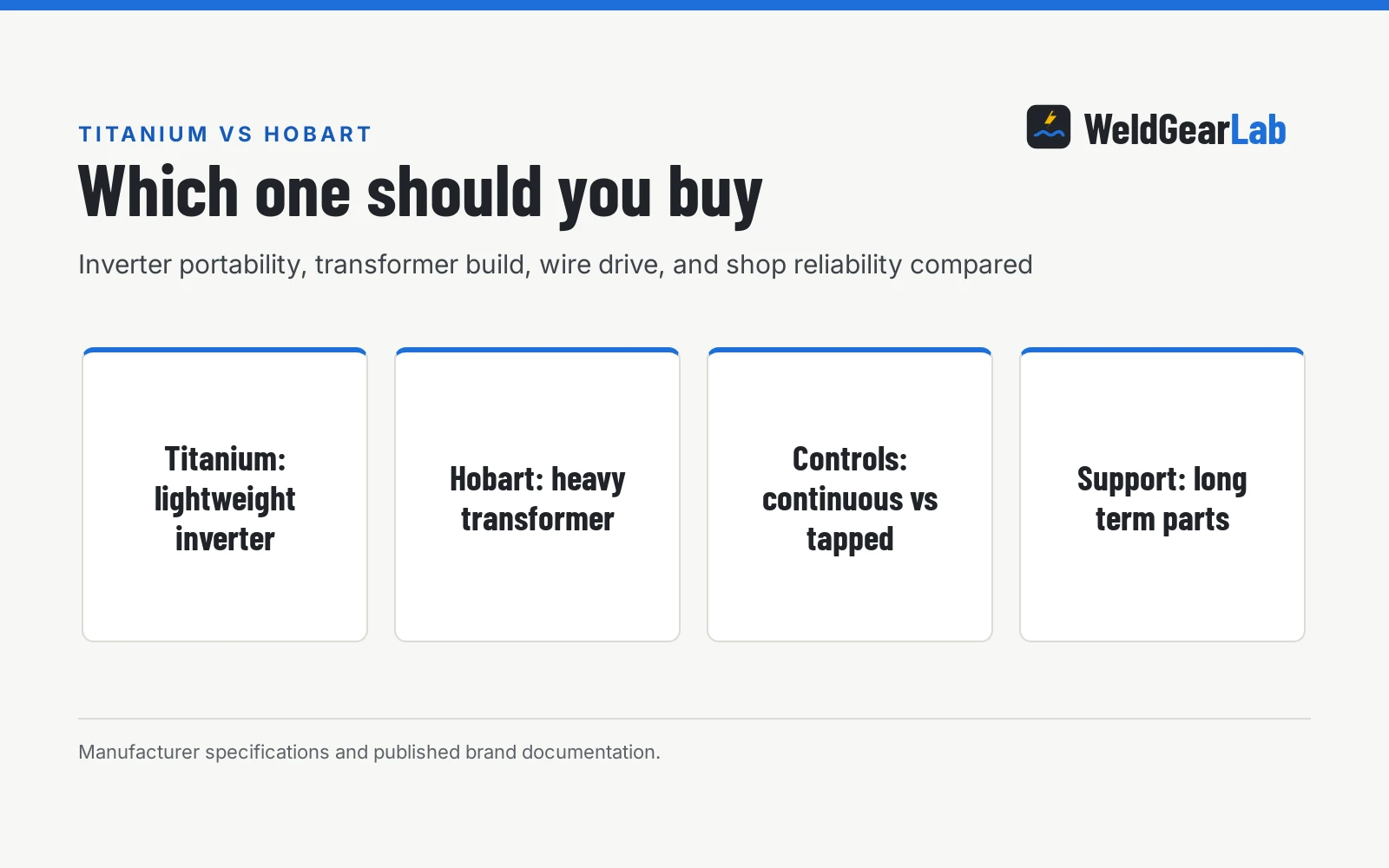
Deciding between a Harbor Freight Titanium vs Hobart MIG welder comes down to whether you prioritize lightweight portability and modern inverter features or heavy industrial durability with decades of proven reliability. For hobbyists who need a compact machine to move around the garage for light repairs without spending heavily upfront, the Titanium delivers accessible capability. For serious fabricators, farm maintenance, and anyone who wants a heavy iron core transformer with robust drive components that will run reliably for decades, the classic Hobart remains the superior long term investment. This guide compares their internal designs, arc performance, feeding systems, and shop usability to help you decide which brand fits your welding projects.
As an Amazon Associate I earn from qualifying purchases. This guide links to our product roundups, where WeldGearLab earns a commission when you buy through links, at no extra cost to you. Read our affiliate disclosure.
The difference in one paragraph
Harbor Freight Titanium wire feed welders use solid-state inverter electronics, making them compact, light enough to carry by their top handle around the shop, and capable of smooth variable voltage control across a broad working range. The classic, widely used Hobart Handler wire feed machines rely on traditional iron core transformers, resulting in heavy, rugged shop cabinets with stepped voltage taps, robust internal wiring, and industrial-grade aluminum drive mechanisms. Titanium gives you modern electronic adjustability at an accessible entry cost, while Hobart gives you long-established mechanical toughness, domestic component availability, and higher resale confidence.
Harbor Freight Titanium vs Hobart MIG Welder side by side
| Harbor Freight Titanium | Hobart Handler | Shop application | |
|---|---|---|---|
| Core architecture | Lightweight inverter technology | Heavy duty iron core transformer | Inverter saves weight while transformer tolerates dirty shop air |
| Portability | Easy to carry by top handle around the shop or yard | Heavy cabinet designed for a dedicated wheeled cart | Titanium suits mobile tasks while Hobart suits fixed stations |
| Wire drive system | Cast aluminum drive with standard duty motor | Heavy duty cast aluminum drive with calibrated tension | Both use metal drives while Hobart adds heavier motor gearing |
| Gun and torch connection | Standard gun connection with plastic strain relief | Direct connection with heavy brass contact points | Heavy brass connections dissipate heat more effectively |
| Voltage adjustment | Continuous variable knob control | Tapped stepped voltage selector switch | Continuous dial allows fine tuning while stepped taps ensure repeatability |
| Arc characteristics | Fast reacting inverter arc | Smooth, forgiving traditional transformer arc | Transformer arc bridges poor metal fitup smoothly |
| Spool gun readiness | Select models support optional spool gun | Direct plug in spool gun capability on select models | Direct connection simplifies switching between steel and aluminum |
| Power supply requirements | Requires clean generator power with low harmonic distortion | Tolerates rugged generator power without board damage | Transformers resist dirty power while inverters regulate arc voltage |
| Replacement parts and consumables | Retail store support with common Tweco style tips | Widespread commercial distributor and dealer network | Both use common contact tips while Hobart offers deeper internal parts support |
| Warranty coverage | Standard retail warranty with optional paid replacement plans | Extensive industrial warranty support | Hobart provides domestic warranty repair network |
| Best suited for | Hobbyists, home garages, and light portable repairs | Farm shops, serious fabricators, and production work | Choose Titanium for convenience and Hobart for longevity |
While both brands offer MIG-capable machines that weld mild steel, stainless steel, and aluminum under proper shielding gas and torch setups, their design philosophies reflect different priorities. Titanium emphasizes benchtop convenience and continuous dial adjustment, whereas Hobart focuses on heavy-duty mechanical assemblies that withstand punishing shop environments and demanding duty cycles.
When Harbor Freight Titanium is the better choice
- Portability around the shop or yard. Because inverter circuitry replaces heavy transformer iron, Titanium units weigh significantly less, allowing you to lift and carry the machine by hand onto truck beds, workbenches, or into tight field locations.
- Fine voltage tuning. Continuous infinite voltage control knobs let you dial in the exact heat balance between stepped levels, which helps on delicate sheet metal and automotive body repairs where small voltage shifts prevent burn-through.
- Accessible entry cost. For home crafters and beginners who want to learn wire welding without making a major capital commitment, Titanium provides functional capabilities straight from the box.
- Occasional garage maintenance. If your machine sits on a storage shelf for weeks between small bracket repairs or lawnmower deck patches, the compact footprint saves valuable bench space.
For operators who frequently tackle outdoor repair jobs on rusty fence iron, learning about welding without shielding gas provides a practical way to run self-shielded wire without hauling gas bottles.
When Hobart is the better choice
- Demanding workshop and farm use. Built around substantial transformer assemblies and heavy steel housings, classic Hobart welders handle vibration, metal grinding dust, and continuous shop abuse without delicate circuit board failures.
- Industrial drive assemblies. Hobart incorporates heavy-duty cast aluminum wire drive systems with calibrated tension scales, rigid wire guide tubes, and solid drive rolls that prevent slippage, wire shaving, and feed motor stalling.
- Repeatable tapped voltage settings. Click-detent voltage selector switches make setup straightforward, ensuring that proven machine settings never drift during long weld passes or transport.
- Decades of parts support. Because Hobart shares industrial parentage with Miller Electric, replacement drive rolls, guns, contact tips, and internal switches remain readily available through local welding supply distributors.
When structural security, equipment repair, or production fabrication matters, Hobart provides dependable arc consistency that gives experienced operators peace of mind.
Inverter portability versus transformer durability
The central mechanical distinction between these brands lies in their electrical architecture. Understanding the tradeoffs of an inverter welder vs transformer welder clarifies why each design excels in different conditions:
- Internal component sensitivity. Inverters pack dense electronic circuit boards, rectifiers, and microprocessors into a compact frame. While highly efficient and capable of active output regulation, these delicate circuits can fail if exposed to conductive grinding dust, moisture, or high-voltage surges from dirty generator power.
- Transformer ruggedness. Traditional Hobart transformers utilize heavy iron laminations and durable windings. They contain few complex electronic boards, meaning metal dust, shop humidity, and rough vehicle transit rarely compromise internal operation, even when powered by rugged utility generators.
- Arc start responsiveness. Inverter welders initiate an arc with rapid electronic switching, producing minimal initial stubbing on clean sheet. Classic transformers deliver a softer, highly forgiving arc with natural inductive smoothing that bridges small joint gaps smoothly.
Choosing between them requires balancing how often you need to transport the machine against the harshness of the environment where it will operate.
Wire drive and torch build quality
A wire feed welder is only as dependable as its feeding mechanism. Consistent wire feeding prevents erratic sputtering, arc burnback, and birdnesting inside the cabinet. Hobart equips its Handler machines with heavy-duty cast aluminum drive mechanisms featuring calibrated tension markings, rigid steel guide inserts, and dual-groove drive rolls. The robust feed motor maintains steady wire delivery even when feeding through extended gun cables or pulling from heavier wire spools.
Harbor Freight Titanium models also utilize cast aluminum drive assemblies, which represent a significant upgrade over entry-level plastic feed mechanisms. However, the Titanium drive uses a lighter motor and a simpler tension assembly that requires more careful manual adjustment to avoid slippage. Both brands use widely available contact tips, with Titanium adopting the common Tweco standard and Hobart utilizing Miller-compatible consumables. Additionally, Hobart connects its welding gun via heavy brass fittings that resist heat degradation, whereas budget inverter guns often feature lighter plastic strain reliefs and standard retail torches.
Long term support and shop reliability
Purchasing a welder involves considering what happens when consumables wear out or a component requires service. Hobart maintains a nationwide network of service depots, certified warranty repair shops, and commercial supply houses. Because consumables and gun components match standard industrial platforms, contact tips, gas nozzles, and drive rollers can be purchased at almost any commercial welding distributor or rural farm supply store. For beginners exploring their first wire machine, our guide to the best welder for beginners explores how support networks influence initial learning curves.
Titanium owners depend primarily on local retail storefronts for support. While standard contact tips and nozzles share common sizing available at most hardware stores, proprietary internal parts such as replacement switches, control potentiometers, or main circuit boards often require ordering directly through retail parts channels. While Harbor Freight offers optional store replacement plans, out-of-warranty repair support remains minimal once internal inverter boards fail.
Safety precautions during wire welding. Both inverter and transformer welders generate intense ultraviolet radiation, toxic metal fumes, and dangerous electrical currents. Always weld in well-ventilated areas, use appropriate respiratory protection, clear all flammable debris from the work zone, and verify that your circuit breaker and wall outlet meet manufacturer electrical specifications. Never operate welding equipment in wet conditions or bypass safety grounding conductors.
Frequently Asked Questions
Is a Harbor Freight Titanium welder good enough for a home garage?
Yes, Titanium welders are capable machines for general home garage maintenance, automotive body patch panels, and hobby fabrication. Their compact inverter design and infinite voltage dials make them easy to store and adjust for occasional repair work. However, they are not intended for continuous production welding or severe industrial duty.
Why are Hobart MIG welders significantly heavier than Titanium welders?
Classic Hobart Handler machines rely on solid iron core transformers and substantial laminated steel housings rather than electronic inverter boards. This internal iron construction adds substantial physical mass but delivers exceptional durability and heat tolerance. The extra weight makes them ideal for stationary cart setups in demanding workshops.
Can Titanium and Hobart welders run on household generator power?
Hobart transformer welders withstand rugged generator power without circuit board damage because their simple transformer windings contain no delicate microelectronics. In contrast, sensitive electronic inverter circuitry inside Titanium welders requires clean power with minimal harmonic distortion to prevent component failure, although the inverter actively stabilizes the arc during modest voltage drops. Always consult the operator manual for clean power recommendations before connecting either welder to a generator.
Can I weld aluminum with these MIG welders?
Both brands offer select models capable of welding aluminum when equipped with a compatible direct-connect spool gun and pure argon shielding gas. Because soft aluminum wire easily kinks inside standard gun liners, a spool gun feeds the wire directly at the torch head. Check the specific machine model specifications to confirm that internal spool gun circuitry and control switches are present.
Which brand offers better long term value?
Hobart provides superior long term value for serious fabricators due to its industrial-grade components, domestic parts availability, and strong resale value over decades of service. Titanium offers better short term economic value for casual hobbyists who need functional wire welding capability without spending heavily upfront. Your expected welding frequency and workshop environment should guide your final decision.
Related: how to choose a MIG welder, flux core vs MIG welding, and the MIG welders hub. Also see our guide on why a MIG welder spatters.
About the author
WeldGearLab Editorial is the editorial team behind WeldGearLab. We research product listings, specifications, safety listings and warranty terms, score every pick with the published Gear Score method, and correct errors when readers report them. We do not run our own shop trials; see How We Pick for exactly how picks are made.