Inverter Welder vs Transformer Welder: Which One Should You Buy?
Inverter welders and transformer welders convert electrical power differently, creating major differences in weight, electrical efficiency, duty cycle, arc stability and shop durability.
 By WeldGearLab Editorial
Updated October 9, 2026
By WeldGearLab Editorial
Updated October 9, 2026
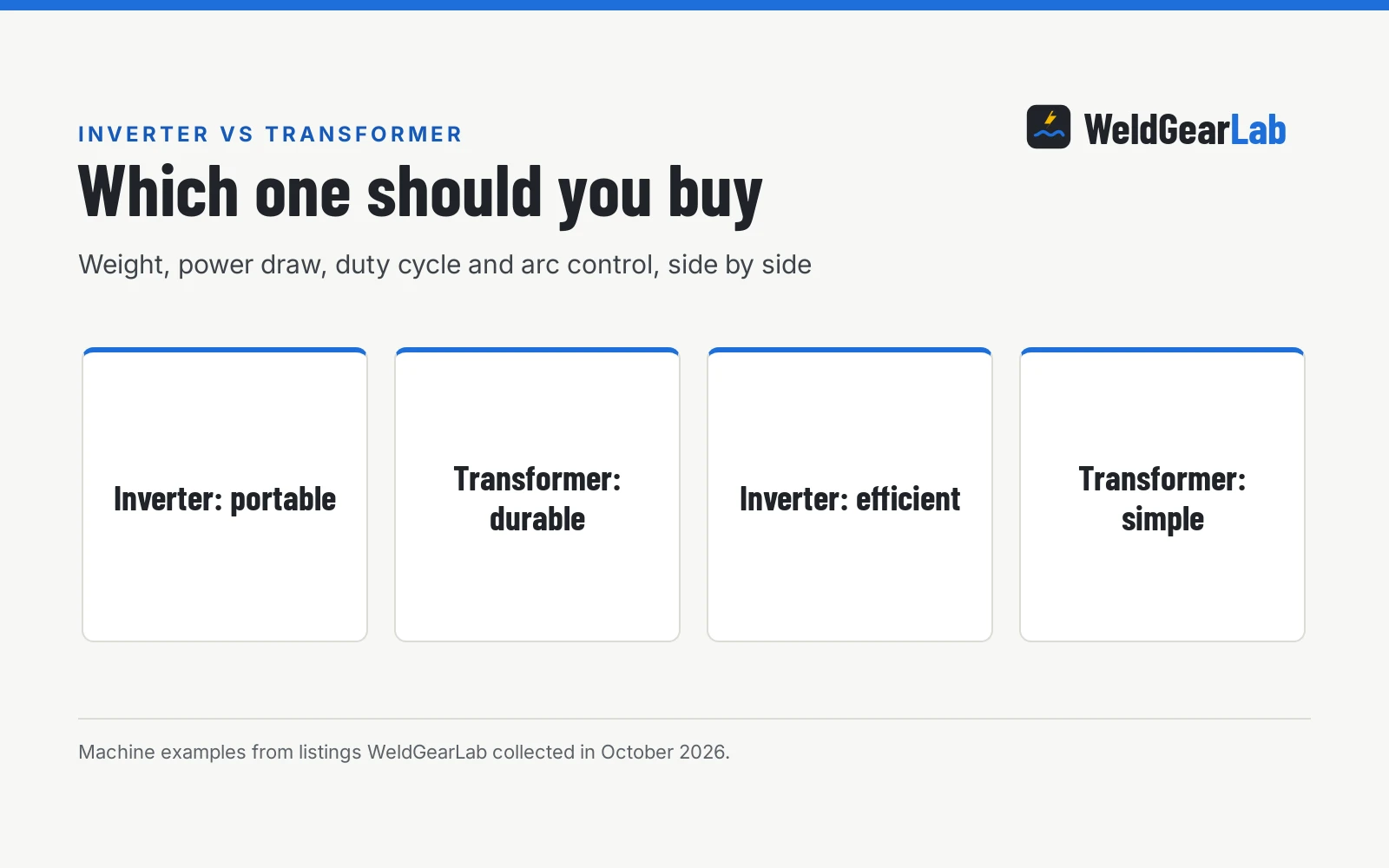
Choosing between an inverter welder vs transformer welder comes down to portability, power efficiency, and how you plan to use the machine. For most home garages, farm maintenance, and mobile repairs, an inverter welder is the better buy because it is lightweight, offers high electrical efficiency with dual-voltage flexibility, and delivers a smooth arc with helpful electronic assists. A traditional transformer welder remains a sensible choice if you want an indestructible, stationary machine for a dedicated workshop where weight does not matter and you want simple internals that can survive metal dust and rough handling for decades. This guide breaks down how both designs work, compares their strengths, and shows which one fits your shop.
As an Amazon Associate I earn from qualifying purchases. This guide links to our product roundups, where WeldGearLab earns a commission when you buy through links, at no extra cost to you. Read our affiliate disclosure.
Inverter welder vs transformer welder: The difference in one paragraph
A transformer welder uses a large iron core and copper windings to step down incoming AC line voltage into the low-voltage, high-amperage current needed for welding at utility line frequency. An inverter welder takes incoming alternating current, rectifies it to direct current, and uses solid-state electronic switches (IGBTs) to increase the frequency before stepping it down through a tiny transformer. That difference in frequency shrinks the transformer core from a heavy shop anchor to a component small enough to carry by a top handle, while giving electronic microprocessors microsecond control over the welding arc.
Side by side
| Inverter welder | Transformer welder | Best suited for | |
|---|---|---|---|
| Primary power conversion | High-frequency solid-state switching (IGBT) | Laminated iron core and copper windings | Compact electronic design |
| Weight and portability | Lightweight, easy to carry to field jobs | Heavy, stationary or requires a rolling cart | Mobile and field work |
| Power efficiency | Higher electrical efficiency, lower current draw | Lower electrical efficiency, draws more current | Standard household circuits |
| Duty cycle per footprint | Higher duty cycle for a given machine size | Requires large iron mass for high duty cycles | Lightweight shop setups |
| Arc control and stability | Smooth arc with hot start and anti-stick assists | Fixed arc response tied to utility power line | Beginners and out-of-position welds |
| Voltage flexibility | Frequently offers dual-voltage input | Typically dedicated single-voltage input | Shops with multiple outlet types |
| Generator operation | Requires clean power from an inverter generator | Tolerates voltage spikes and dirty power | Rough jobsite generator power |
| Internal complexity | Dense electronic circuit boards | Simple electrical wiring and few components | Straightforward long-term repair |
| Shop environment durability | Sensitive to moisture, metal grinding dust and drops | Resistant to dust, moisture and physical abuse | Grinding areas and unheated barns |
Power ratings and capabilities vary by model and input circuit; always check the data plate on the back of the welder and the owner manual before wiring a circuit. Multi-process units often add wire drive systems or high-frequency circuits that expand capability beyond standard stick welding.
When an inverter welder is the better choice
- Portability and field repair. Moving a machine around a farm, climbing onto a trailer, or carrying a welder up steps is simple with an inverter. While transformer units typically stay on rolling carts or shop benches, inverter machines are remarkably light. For instance, the Siasky stick welder lists a machine weight of 3.3 pounds, and TECWELD lists its 200A stick machine at 5 lbs. Even multi-process inverters remain portable, with the MJUM 160A unit listing at 20 pounds. When paired with utility power or clean generator output, this mobility makes out-of-position repairs practical.
- Standard household outlets and efficiency. Inverters draw far less power from the wall for the same welding output. A small inverter can run on a standard 110V household circuit for light maintenance and hobby fabrication on thinner steel plate. The TECWELD listing, for example, claims 30% higher efficiency than conventional welders, drawing less current from the branch circuit for a given welding amperage.
- Arc stability and stick arc assists. Electronic circuitry monitors arc voltage continuously. Features like hot start send an extra burst of current to strike the rod easily, arc force prevents the puddle from shorting out, and anti-stick drops current if the electrode freezes so you can snap it free without ruining the rod. Sefaspe lists these assists for running 6011, 6013, and 7018 rods on its 200A machine.
- Competitive duty cycles in compact packages. Because solid-state electronics waste less energy as heat, compact inverters can maintain usable run times without massive cooling assemblies. For example, both the MJUM 160A machine and the TECWELD 200A unit publish a 60% duty cycle supported by internal cooling fans. While heavy industrial transformers handle prolonged high-current shop welding without thermal shutdown, an inverter delivers a practical duty cycle for general repair in a fraction of the physical footprint.
Our best portable stick welder guide covers compact inverter models suited for mobile repair and home shop fabrication.
When a transformer welder is the better choice
- Harsh shop environments and metal dust. Transformer machines rely on heavy iron cores and varnished wire coils rather than dense computer boards. They tolerate airborne grinding dust, humidity, and shop dirt that can short out delicate surface-mount electronics.
- Simple repairs and longevity. When an inverter circuit board breaks down out of warranty, replacement parts are often proprietary or difficult to source. A transformer welder has very few components, primarily a transformer, switches, and heavy conductors, making troubleshooting and repairs straightforward for a qualified technician.
- No electronic board breakdown from voltage spikes. Older electrical lines and basic work environments can experience electrical surges. A transformer core naturally absorbs line spikes that could damage sensitive inverter semiconductors.
- Dedicated, stationary shop welding. If the welder will sit next to a heavy welding table and never leave the building, machine weight is an advantage rather than a handicap. The mass anchors the machine in place during heavy fabrication.
If you work primarily at a stationary table, see our guide on welding machine types to match the right power source to your fabrication needs.
How to tell which design a machine uses
Most modern welders sold online are inverters, but older shop machines and heavy industrial units use transformers. When evaluating a machine listing, look for these details:
- Machine weight. Weight is the clearest giveaway. When a machine advertised with ratings up to 200A or 250A is light enough to hold by a top handle or shoulder strap, it is an inverter. For example, Siasky lists an MMA-250A stick welder at 3.3 pounds, and Sefaspe lists its 200A unit at under 6 pounds. A transformer welder with comparable current output relies on heavy iron and copper that requires a substantial chassis or cart.
- Mentions of IGBT technology. Inverter listings explicitly highlight insulated-gate bipolar transistors. SOARFLY highlights advanced IGBT inverter technology on its 250A welder, and ACEWELDER lists an IGBT inverter for its 140A unit.
- Digital displays and synergic settings. Inverters use microprocessors that drive bright digital screens and automated setting helpers. Sefaspe and SOARFLY both include digital LED displays that show output current in real time, and Sefaspe provides synergic control to match amperage to rod diameter automatically.
- Dual-voltage input cords. Inverter power supplies adapt easily to multiple incoming voltages. Listings like the 160A MJUM and the 250A SOARFLY specify dual voltage 110V/220V operation, letting operators plug into household circuits or higher voltage shop receptacles.
Check our guide on 120V vs 240V welder outlets to understand how supply circuits affect welding output on both machine types.
Power supply and generator use
Running a welder from a generator or extension cord requires careful attention to electrical characteristics. Inverter welders rely on sensitive electronic semiconductors that can be damaged by dirty power, voltage spikes, or harmonic distortion from basic generator sets. When running an inverter in the field, use an inverter generator or a generator with clean sine-wave output. In contrast, a transformer welder is essentially a heavy coil of wire that absorbs voltage ripples and raw generator output without damage to control boards, though low voltage can still cause the arc to stutter. For field repairs away from grid power, review our guide to the best welder generator setups.
Can one machine do multiple processes?
Yes, multi-process versatility is one of the standout practical strengths of inverter design. Because an inverter uses digital controls to adjust voltage and current curves, a single unit can support stick, MIG, and TIG welding. For example, ACEWELDER lists a 3 in 1 unit combining flux core, stick, and lift TIG on 110V power. The MJUM 160A model offers a 4-in-1 setup covering flux core MIG, gas MIG, lift TIG, and stick. Even plasma cutting can be integrated, as seen in the TOOLIOM 5-in-1 kit that combines MIG, TIG, stick, flux core, and plasma cutting in a 47.8 pounds machine. Traditional transformer multi-process machines exist but are massive, heavy industrial units. For versatile home shop use, explore our best multi-process welder roundup.
Electrical and arc safety. Both inverter and transformer welders produce hazardous electrical currents, intense ultraviolet radiation, and toxic fumes. Always connect your machine to an electrical circuit with proper grounding and breaker protection sized according to the manufacturer data plate. Wear a certified auto-darkening welding helmet, flame-resistant leather gloves, and protective clothing to guard against arc flash and spatter. Weld only in well-ventilated areas with your head out of the fume plume, keep a fire extinguisher nearby, and consult your machine owner manual for specific electrical supply requirements.
Frequently Asked Questions
How does an inverter welder work?
An inverter welder takes incoming alternating current from the wall and rectifies it into direct current. High-speed solid-state transistors then switch that direct current back into high-frequency alternating current before a compact transformer steps it down to welding voltage. Finally, rectifiers and digital controls smooth the output, giving precise real-time control over arc characteristics.
Will an inverter welder run off a generator?
An inverter welder can run from a generator, but it requires clean electrical output with low harmonic distortion. Basic construction generators with unstable voltage regulation can generate voltage spikes that damage the welder electronic circuit boards. For portable field use, pair your welder with an inverter generator or a commercial generator rated for sensitive electronics.
Can you TIG weld with an inverter welder?
Yes, many inverter welders support TIG welding. Compact stick inverters often include a lift TIG mode for welding steel and stainless steel with a manual valve torch. Dedicated inverter TIG machines, such as the AHP Alpha-TIG225Xi, provide advanced AC/DC output and pulse frequency controls to weld thin aluminum as well as steel.
How do you use an inverter stick welder?
To use an inverter stick welder, connect your ground clamp to clean bare metal and insert an electrode into the holder. Set the machine amperage according to your rod diameter and the joint thickness, using synergic presets if your machine provides them. Scratch or tap the electrode tip against the workpiece to initiate the arc, then maintain a tight arc length as the rod consumes.
Why are transformer welders still used?
Transformer welders remain popular in dedicated fabrication shops and agricultural repair bays because of their rugged durability. With no delicate microprocessors or surface-mount circuit boards, a transformer welder can operate in dirty, humid, or dusty environments without electronic breakdown. For stationary shop work where the machine never needs to be moved, a transformer provides dependable performance year after year.
Related: stick welder AC vs DC, how to use stick welder, budget stick welders, welding duty cycle explained, and the welders hub.
About the author
WeldGearLab Editorial is the editorial team behind WeldGearLab. We research product listings, specifications, safety listings and warranty terms, score every pick with the published Gear Score method, and correct errors when readers report them. We do not run our own shop trials; see How We Pick for exactly how picks are made.