Best Welder Generator (2026): 5 Picks Scored for Shop and Field
Five portable generators for welding in the shop and field, compared on running watts, surge power, outlet types, fuel options, runtime, and warranty.
 By WeldGearLab Editorial
Updated October 9, 2026
By WeldGearLab Editorial
Updated October 9, 2026
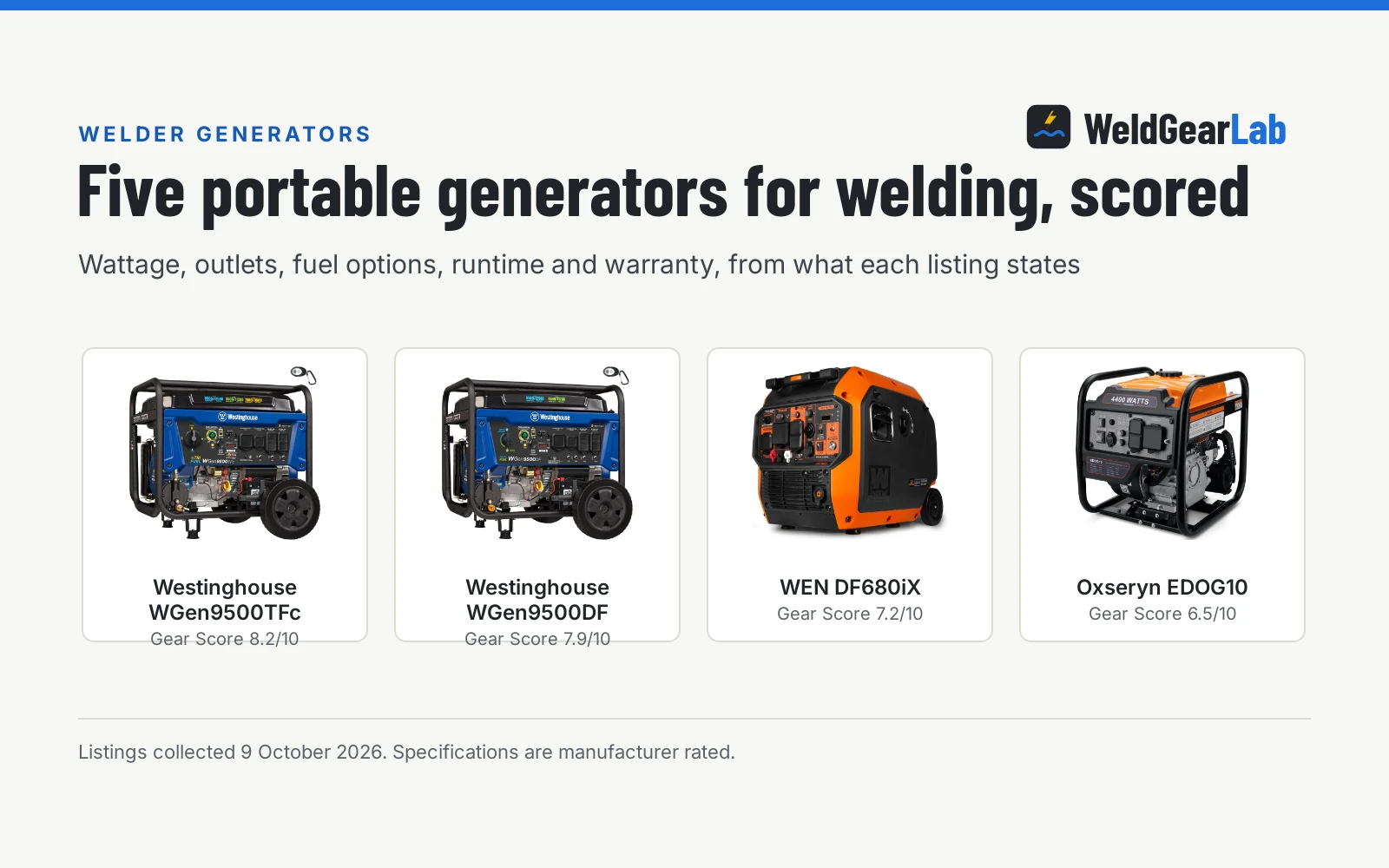
Finding the best welder generator means matching the generator running and starting wattage to the electrical demand of your welding machine. A portable generator supplies off-grid electricity for farm repairs, field fabrication, and emergency backup where utility lines do not reach. This guide compares five portable generators suitable for welding, scored on stated wattage, receptacle configurations, fuel options, runtime, and warranty coverage.
As an Amazon Associate I earn from qualifying purchases. WeldGearLab earns a commission when you buy through links on this page, at no extra cost to you. Read our affiliate disclosure.
Quick picks
- Best Overall Westinghouse WGen9500TFc: Tri-fuel capability with 9500 running watts, a 50A 120/240V outlet, carbon monoxide shutdown, remote electric start, and a 3-year warranty. Check price on Amazon
- Runner-Up Heavy Duty Westinghouse WGen9500DF: Dual-fuel power delivering 9500 running watts and 12500 peak watts, 50A 120/240V receptacle, remote start key fob, and a 3-year warranty. Check price on Amazon
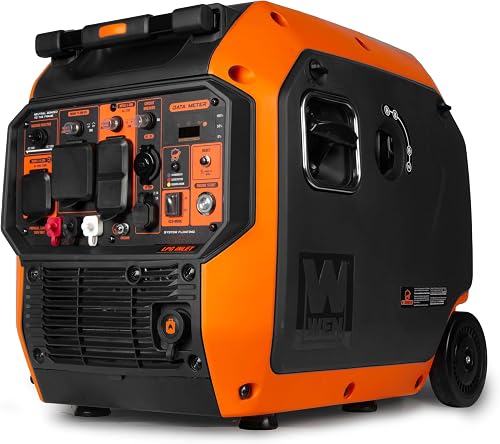
- Best Portable 240V Inverter WEN DF680iX: Dual-fuel inverter producing clean power with bonded-neutral 120V/240V output, 5100 running watts, CO shutdown, wheels, and telescoping handle. Check price on Amazon
- Best Lightweight 120V Pick Oxseryn EDOG10: A 56-pound inverter generator delivering 3400 running watts and 4400 peak watts, with a 30A RV port, ECO mode, and under 72 dBA sound rating. Check price on Amazon
Compare the picks
| Model | Gear Score | Running Watts | Peak Watts | Fuel Type | Voltage / Outlets | Weight | Warranty |
|---|---|---|---|---|---|---|---|
| Westinghouse WGen9500TFc | 8.2/10 | 9500 gas / 8500 LP / 7500 NG | 12500 gas / 11200 LP / 9500 NG | Tri-Fuel (Gas, Propane, Natural Gas) | 120V/240V (14-50R, L14-30R, GFCI 5-20R) | 215 lb | 3 years |
| Westinghouse WGen9500DF | 7.9/10 | 9500 gas / 8500 LP | 12500 gas / 11200 LP | Dual Fuel (Gas, Propane) | 120V/240V (14-50R, L14-30R, GFCI 5-20R) | Not stated | 3 years |
| WEN DF680iX | 7.2/10 | 5100 gas / 4500 LP | 6800 gas / 6000 LP | Dual Fuel (Gas, LPG) | 120V/240V (L14-30R, TT-30R, 5-20R) | 99.2 lb | Not stated |
| Oxseryn EDOG10 | 6.5/10 | 3400 | 4400 | Gasoline | 120V (2x 120V AC, 1x RV port) | 56 lb | 1 year |
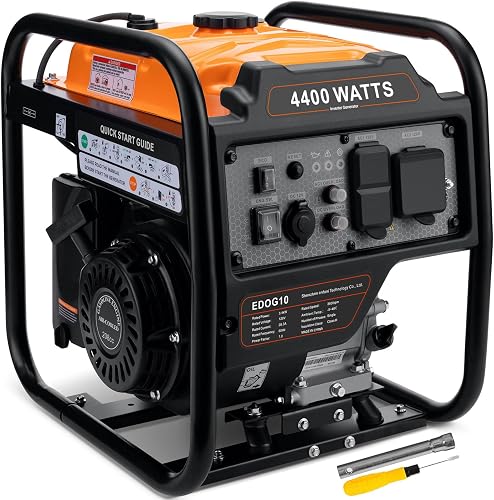
| Oxseryn OXOG10 | 6.2/10 | 3400 | 4400 | Gasoline | 120V (2x 120V AC, 1x 30A RV port) | 56 lb (bullets) / 57 lb (table) | 1 year |
Specifications are manufacturer rated, as published on each listing and collected 9 October 2026.
The picks
| Award | Product | Gear Score About the Gear ScoreThe Gear Score runs from 0 to 10 and weighs performance (35%), build (25%), value (25%), safety (10%, where it applies) and warranty (5%), using only what the manufacturer and the listing publish. How we pick › | |
|---|---|---|---|
 Westinghouse 12500 Peak Watt Tri-Fuel Home Backup
|
8.2/10 | Check price on Amazon | |
 Westinghouse 12500 Watt Dual Fuel Home Backup
|
7.9/10 | Check price on Amazon | |
 WEN 6800-Watt Dual Fuel RV-Ready Electric Start
|
7.2/10 | Check price on Amazon | |
 Oxseryn Power Equipment 4400 Watts Inverter
|
6.5/10 | Check price on Amazon | |
 Oxseryn 4400-Watts Inverter Generator
|
6.2/10 | Check price on Amazon |
Westinghouse 12500 Peak Watt Tri-Fuel Home Backup
A 9500 running watt tri-fuel generator with 12500 peak watts, a 50A 120/240V outlet, carbon monoxide shutdown, and a 3-year warranty.
Pros
- Tri-fuel engine runs on gasoline, propane, or natural gas for flexible fuel supply
- Heavy output of 9500 running watts and 12500 peak watts on gasoline
- Features a 120/240V 14-50R 50A outlet and 120V L14-30R transfer switch outlet
- Equipped with carbon monoxide shutdown sensor and 3-year limited warranty
Cons
- Heavy machine listed at 215 pounds requiring a solid surface to move
- Spec table only lists natural gas, omitting gasoline and propane from that field
- Spec table lists 240 volts only despite 120V household outlets being present
- No CSA, UL, or ETL safety listing stated on the Amazon listing
Westinghouse 12500 Watt Dual Fuel Home Backup
A dual-fuel 9500 running watt generator with 12500 peak watts on gasoline, a 50A 120/240V receptacle, and a 3-year warranty.
Pros
- Dual-fuel design produces 9500 running watts and 12500 peak watts on gasoline
- Includes a 50A 120/240V 14-50R receptacle alongside a 30A L14-30R outlet
- Remote electric start with key fob plus push button and recoil start
- Backed by a stated 3-year limited service, labor, and parts warranty
Cons
- Item weight is not stated anywhere in the listing specification table
- Spec table lists voltage as 120 volts despite dual voltage 120/240V outlets
- Spec table lists 6 total outlets while omitting some bullet details
- No CSA, UL, or ETL electrical certification stated in the listing
WEN 6800-Watt Dual Fuel RV-Ready Electric Start
A dual-fuel inverter generator delivering 5100 running watts with bonded-neutral 120V/240V power, CO shutdown, wheels, and a 3-year warranty.
Pros
- Dual-fuel inverter delivers clean power with bonded-neutral 120V/240V output
- Rated at 5100 running watts and 6800 surge watts on gasoline
- Features WEN Watchdog CO shutdown sensor and fuel shutoff carburetor drain
- Includes onboard wheels, pull handle, LPG quick connector, and 6-foot LPG hose
Cons
- Spec table lists running wattage as 4500 watts, reflecting propane rather than gas
- Stated runtime is 6 hours on a 2.9-gallon tank without specifying load level
- Output of 5100 running watts is lower than open-frame 9500W generators
- No CSA, UL, or ETL electrical safety standard is stated in the listing
Oxseryn Power Equipment 4400 Watts Inverter
A 56-pound open frame inverter generator providing 3400 running watts, 4400 peak watts, a 30A RV port, and a 1-year warranty.
Pros
- Lightweight open frame inverter design listed at only 56 pounds
- Rated at 3400 running watts and 4400 peak watts with inverter clean power
- States runtime up to 14 hours at 25% load with ECO mode on 2 gallons
- Noise rating published as under 72 dBA from 23 feet away
Cons
- Offers 120V output only with no 240V outlet for larger shop welders
- 1-year manufacturer warranty is shorter than the 3-year term on larger units
- Recoil or electronic start without remote control key fob
- No CSA, UL, or ETL electrical certification listed on the product page
Oxseryn 4400-Watts Inverter Generator
A compact 3400 running watt inverter generator with 4400 peak watts, a 30A RV port, 2-gallon fuel tank, and a 1-year warranty.
Pros
- Inverter generator producing 3400 running watts and 4400 peak watts
- Equipped with 30A RV outlet, two 120V AC ports, and 12V DC outlet
- Features cold start technology, low oil shutdown, and overload protection
- Compact open frame format with 2-gallon fuel tank and ECO mode
Cons
- Spec table lists starting wattage as 3400 watts, contradicting 4400 peak in title
- Listing contradicts itself on weight, stating 56 pounds in bullets and 57 pounds in table
- Engine displacement is omitted from the listing specification table
- Provides 120V output only, with no 240V receptacle and only a 1-year warranty
How we scored them
Each machine is scored out of 100 on performance, build, value, safety listing and warranty, with the criteria described on our How We Pick page. None of the generator listings examined here state an electrical safety listing such as CSA, UL, or ETL, so every unit scores zero on safety; rankings are determined by the remaining four criteria.
| Product | Gear Score | Perf. /35 | Build /25 | Value /25 | Safety /10 | Warranty /5 |
|---|---|---|---|---|---|---|
| Westinghouse WGen9500TFc | 8.2 | 33 | 22 | 22 | 0 | 4 |
| Westinghouse WGen9500DF | 7.9 | 32 | 21 | 22 | 0 | 4 |
| WEN DF680iX | 7.2 | 29 | 21 | 21 | 0 | 0 |
| Oxseryn EDOG10 | 6.5 | 24 | 19 | 20 | 0 | 2 |
| Oxseryn OXOG10 | 6.2 | 23 | 18 | 19 | 0 | 2 |
Buying guide: how to choose the best welder generator
Starting watts and running watts
Welding machines place a heavy demand on generator power, especially during arc ignition. Running wattage represents the continuous power the generator sustains during an active weld bead, while starting or surge wattage accommodates the momentary current spike when you strike an arc. The units in this comparison range from 3400 running watts and 4400 peak watts on the Oxseryn inverter generators up to 9500 running watts and 12500 peak watts on the Westinghouse open-frame units. Always confirm that your welding machine input draw does not exceed the generator continuous rating.
120V vs 240V receptacles
The receptacle layout dictates what equipment you can connect directly. Small portable welders often operate on standard 120V household circuits, which all five generators support through 120V duplexes or 30A RV receptacles. Larger fabrication units and farm welders require 240V power to reach their rated duty cycle and penetration. The Westinghouse WGen9500TFc and WGen9500DF provide a dedicated 120/240V 14-50R 50A outlet, while the WEN DF680iX features a 120V/240V L14-30R receptacle with a voltage selector switch. The Oxseryn units supply 120V power only.
Inverter clean power vs standard open frame
Modern welding equipment frequently incorporates sensitive solid-state inverter circuitry. Inverter generators, such as the WEN DF680iX and Oxseryn EDOG10, produce clean electrical output with minimal harmonic distortion that protects sensitive electronics. Traditional open-frame generators like the Westinghouse models utilize automatic voltage regulation to stabilize voltage across substantial power loads, making them effective workhorses for heavy transformer and inverter machines requiring high wattage.
Fuel options and runtime
Fuel availability often dictates field efficiency. Dual-fuel models like the Westinghouse WGen9500DF and WEN DF680iX run on gasoline or liquid propane, which stores indefinitely without gumming carburetors. The Westinghouse WGen9500TFc adds natural gas capability for uninterrupted shop operation. Tank capacities here span from 2 gallons on the Oxseryn models to 2.9 gallons on the WEN and 6.6 gallons on the Westinghouse units, with runtimes ranging from 6 hours on the WEN up to 12 hours on the Westinghouse units and up to 14 hours at 25% load on the Oxseryn models.
Safety features and ventilation
Generator engines emit carbon monoxide, an invisible, odorless, and lethal gas. Never operate an internal combustion generator indoors, inside a shop, in an enclosed garage, or near open doors and windows. The Westinghouse WGen9500TFc and WEN DF680iX include onboard carbon monoxide shutdown sensors that automatically shut off the engine if elevated gas concentrations are detected. Always position generators outdoors on a level surface with adequate ventilation and protect electrical connections from moisture.
Frequently Asked Questions
What is a welder generator?
In fabrication and field repair, the phrase welder generator describes either an engine-driven machine with an integrated welding power source or a portable generator dedicated to powering a separate welder off the electrical grid. The models compared in this guide are portable engine-driven generators that supply 120V and 240V electricity through standard receptacles to run standalone welders anywhere.
Can you use a regular generator for a welder?
Yes, you can run a welding machine on a standard portable generator provided the generator supplies the required voltage and sufficient wattage. The generator continuous running watts must meet or exceed the welder full-load input draw, and its surge capacity must handle arc strikes. Inverter generators are well suited for sensitive modern welders, while high-output open-frame units provide the 30A and 50A 240V receptacles required by larger shop machines.
How many watts do I need to run a welder on a generator?
The wattage required depends on the welder input specifications and operational settings. A compact 120V welder operating at moderate output can run on a generator supplying 3400 running watts and 4400 peak watts, such as the Oxseryn models. Heavier multi-process or farm stick welding on 240V requires between 5100 running watts from a unit like the WEN DF680iX and 9500 running watts from a high-output machine like the Westinghouse WGen9500DF.
How does a welder generator work?
A generator uses an internal combustion engine, fueled by gasoline, propane, or natural gas, to spin an alternator rotor. This electromagnetic mechanical process produces alternating current electricity at 60 hertz, which is regulated and routed to front-panel receptacles. Connecting your welding machine power cord to these outlets delivers the electricity needed to establish and maintain an electric welding arc in remote locations.
What size generator do I need for a 120V or 240V welder?
For a 120V welder, look for a generator offering at least 3400 running watts and a 30A receptacle to handle continuous welding without nuisance tripping. For a 240V welder, select a generator providing dual-voltage 120V/240V output with a 30A L14-30R or 50A 14-50R outlet, capable of delivering between 5100 and 9500 running watts with 6800 to 12500 surge watts for arc starts.
Related: welders hub, 120V vs 240V welder, best portable stick welder, best flux core welder, and best stick welder for farm use. Also see our best multi-process welder and our guide on welding duty cycle explained.
About the author
WeldGearLab Editorial is the editorial team behind WeldGearLab. We research product listings, specifications, safety listings and warranty terms, score every pick with the published Gear Score method, and correct errors when readers report them. We do not run our own shop trials; see How We Pick for exactly how picks are made.