MIG Welder for Auto Body Repair: What to Look For
A MIG welder for auto body repair needs gas shielding, thin wire and a machine that suits thin sheet, plus clean joints and a careful check of each weld.

On this page
Top picks at a glance
As an Amazon Associate I earn from qualifying purchases.
- 1
 VEVOR Stud Welder Dent Repair Kit9.5/10View on Amazon
- 2
 VEVOR Stud Welder Dent Repair Kit9.4/10View on Amazon
- 3
 Spot Welder Dent Puller Machine Body Repair Dent Removal9.5/10View on Amazon
A dented fender, a rusted floor pan or a patch panel that needs joining all call for the same thing: a clean weld on thin steel that will not burn through or warp the panel. A mig welder for auto body repair is the tool for that job, and this guide explains what to look for in the machine, the wire and the gas, then how to set up the joint and check the weld.
This guide links to our product roundups, where WeldGearLab gets a commission on purchases made through links on this page, and your price stays the same. Read our affiliate disclosure.
How to pick a mig welder for auto body repair
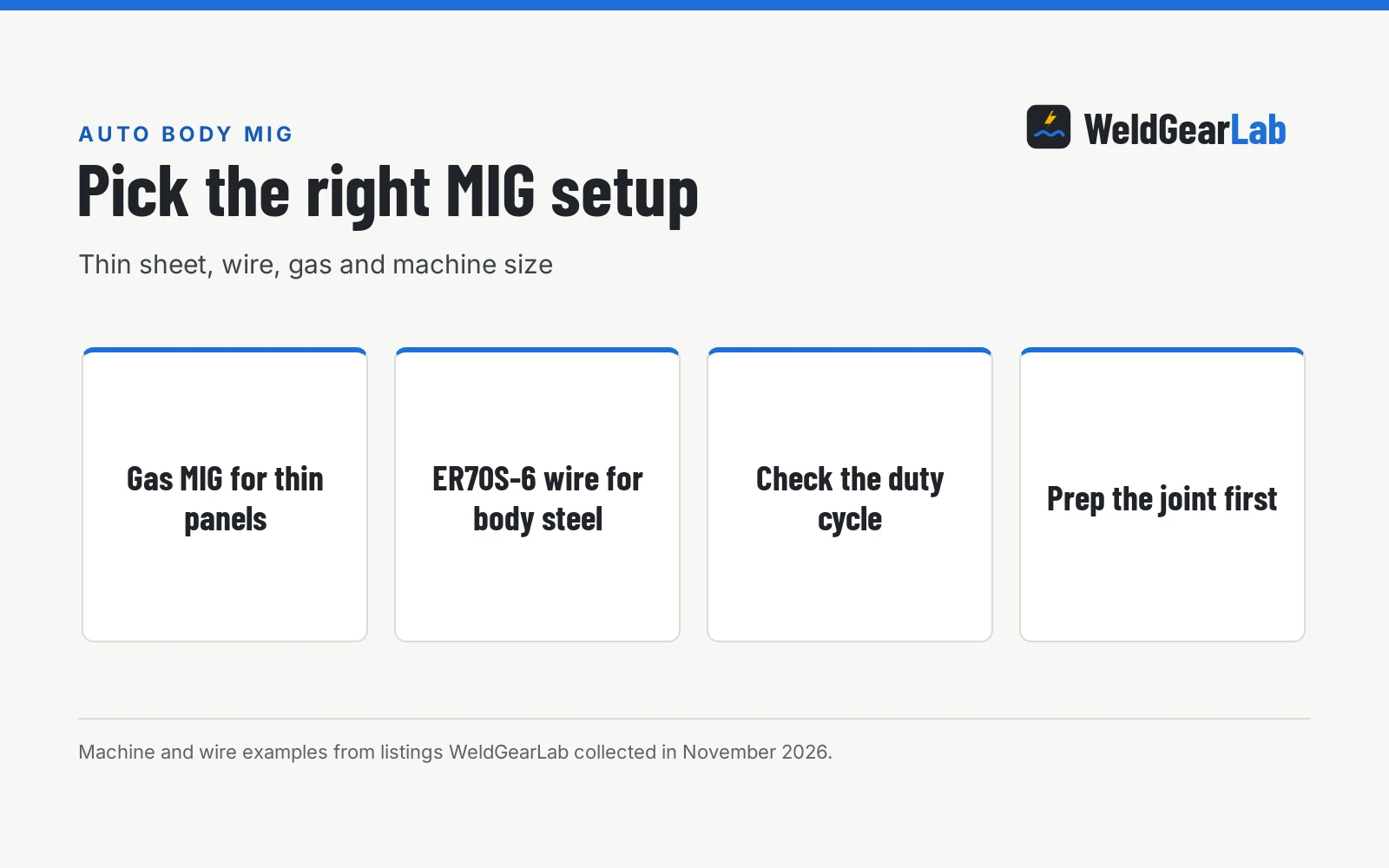
Body panels are thin, so the welder has to run cool enough for sheet steel and steady enough for short welds. Gas MIG with solid wire suits that work: the gas shields the puddle, the wire feeds smoothly, and the beads stay small and clean. Flux core can weld steel, but it runs hotter and leaves slag, which makes thin panels harder. Start with the machine, then match the wire and gas to it.
Side by side
| Gas MIG, solid wire | Flux core wire | Auto body note | |
|---|---|---|---|
| Shielding | Gas from a cylinder | Flux inside the wire | Gas shielding keeps thin panels cleaner |
| Wire | ER70S-6, .035 in, on a 10 lb spool | Flux core wire, no gas | The ARCPEX listing names .035 in ER70S-6 for auto body repair |
| Gas | 100% CO2 or 80% Argon / 20% CO2 | No cylinder or gas | The listing names both gas mixes for solid wire |
| Thin sheet | Lower heat, cleaner small beads | More heat and burn through | Gas MIG suits patch panels and thin steel |
| Cleanup | Low spatter, little grinding | Slag to chip, more spatter | Less cleanup matters on visible panels |
| Machine | 200 Amp MIG, dual voltage 110v/220v | The listing does not state flux core mode | The Everlast Storm 215C lists 200 Amp MIG and 110v/220v |
| Cutting | Plasma cut up to 1/2 in on a combo machine | Not stated | The Everlast listing rates plasma cutting to 1/2 in |
Check the polarity the wire calls for on its label and in the machine manual before welding. A machine that runs gas MIG and flux core usually has a polarity lead to swap when the wire changes.
What to look for in the machine
Look for a machine that lists gas MIG with solid wire, not flux core only. Dual voltage adds flexibility: the Everlast Storm 215C listing gives dual voltage 110v/220v, with 200 Amp MIG, 160 Amp Stick and 40 Amp Plasma. Duty cycle matters too: the same listing gives a 35% duty cycle at 200A MIG, which means the machine welds for part of each cycle at that output and rests for the rest. Check the duty cycle at the amps the body work will use, and follow the machine door chart or manual for settings. A large color display and a preset mode can help with setup, and the Everlast listing names both, but the figures that decide the purchase are the process, the voltage and the duty cycle.
Wire and gas for body panels
Solid wire and gas go together. The ARCPEX listing gives ER70S-6 solid wire in .035 in on a 10 lb spool, made for MIG welder auto body repair, exhaust pipes and garage metal work. The same listing states the wire needs either 100% CO2 or an 80% Argon / 20% CO2 mix for a cleaner finish. The wire is wound on a plastic reel and vacuum sealed in a moisture barrier bag with desiccant, and the listing states a 1 year warranty. Match the wire diameter to the machine drive rolls and the contact tip, and keep the wire dry and rust free.
Fit-up and prep
Fit-up decides more than settings do. Cut the patch to fit the opening with a small, even gap, clamp it in place and check the panel sits flush before welding. Clean the joint to bright metal on both sides, and grind off paint, rust and coatings near the weld. The ARCPEX listing notes its wire carries high levels of manganese and silicon deoxidizers for weld strength on rusty or dirty steel, but clean metal still welds better and needs less grinding after. Tack the panel in place around the joint, let each tack cool, and check the fit again before running the beads.
Run the bead
Run short beads and let the panel cool between passes so heat does not build up and warp thin steel. Keep the gun angle and stickout steady, watch the puddle, and stop if the bead starts to burn through. Chip and brush slag only on flux core welds; gas MIG beads need no slag removal. Check each bead for a smooth profile and full fusion at the edges before moving on.
Safety
Wear a welding helmet, safety glasses, gloves and flame resistant clothing, and keep the work area clear of flammable material. Weld with good ventilation or outdoors with the head out of the plume, and take care with fumes from galvanized steel or painted metal. Secure gas cylinders upright with a chain, and keep the machine manual close for the settings and the safety notes for the exact model.
For more options, see our welders guides.
FAQ for welders
What wire size suits auto body panels?
The ARCPEX listing gives ER70S-6 solid wire in .035 in on a 10 lb spool and names auto body repair among its uses. Match the wire to the drive rolls and contact tip on the machine, and use the gas the wire listing calls for.
Is gas needed for auto body MIG?
Yes, for solid wire. The ARCPEX listing states the wire needs either 100% CO2 or an 80% Argon / 20% CO2 mix. Flux core wire shields itself and needs no gas, but it runs hotter and leaves slag, which suits thick steel better than thin panels.
Can a multi-process machine weld auto body?
Yes, when it lists gas MIG. The Everlast Storm 215C listing gives 200 Amp MIG with dual voltage 110v/220v, plus 160 Amp Stick and 40 Amp Plasma cutting to 1/2 in. Use the MIG process for the body panels, and check the duty cycle at the amps the work will use.
What duty cycle suits body work?
Duty cycle is the share of a cycle the machine can weld at a given output before it must rest, and the Everlast listing gives 35% at 200A MIG. Body work runs at low output in short beads with cooling time between passes, so the rating at the working amps is the figure to check, not the headline amps alone. Follow the machine door chart or manual for settings.
Can rusty or dirty steel be welded?
The ARCPEX listing states its ER70S-6 wire carries high levels of manganese and silicon deoxidizers and is made for weld strength on rusty or dirty steel. Clean metal still gives a better weld, so grind the joint to bright metal and remove paint and coatings near the weld before striking an arc.
Related: how to choose a MIG welder, best MIG welder roundup, MIG welder set up, MIG vs TIG for auto body, and best MIG wire for auto body.