Spot Welder for Car Body Repair: What to Look For
A spot welder for car body repair either welds studs to pull dents or joins overlapping sheets, and power, modes, thickness and material decide which machine fits the job.

On this page
Top picks at a glance
As an Amazon Associate I earn from qualifying purchases.
- 1
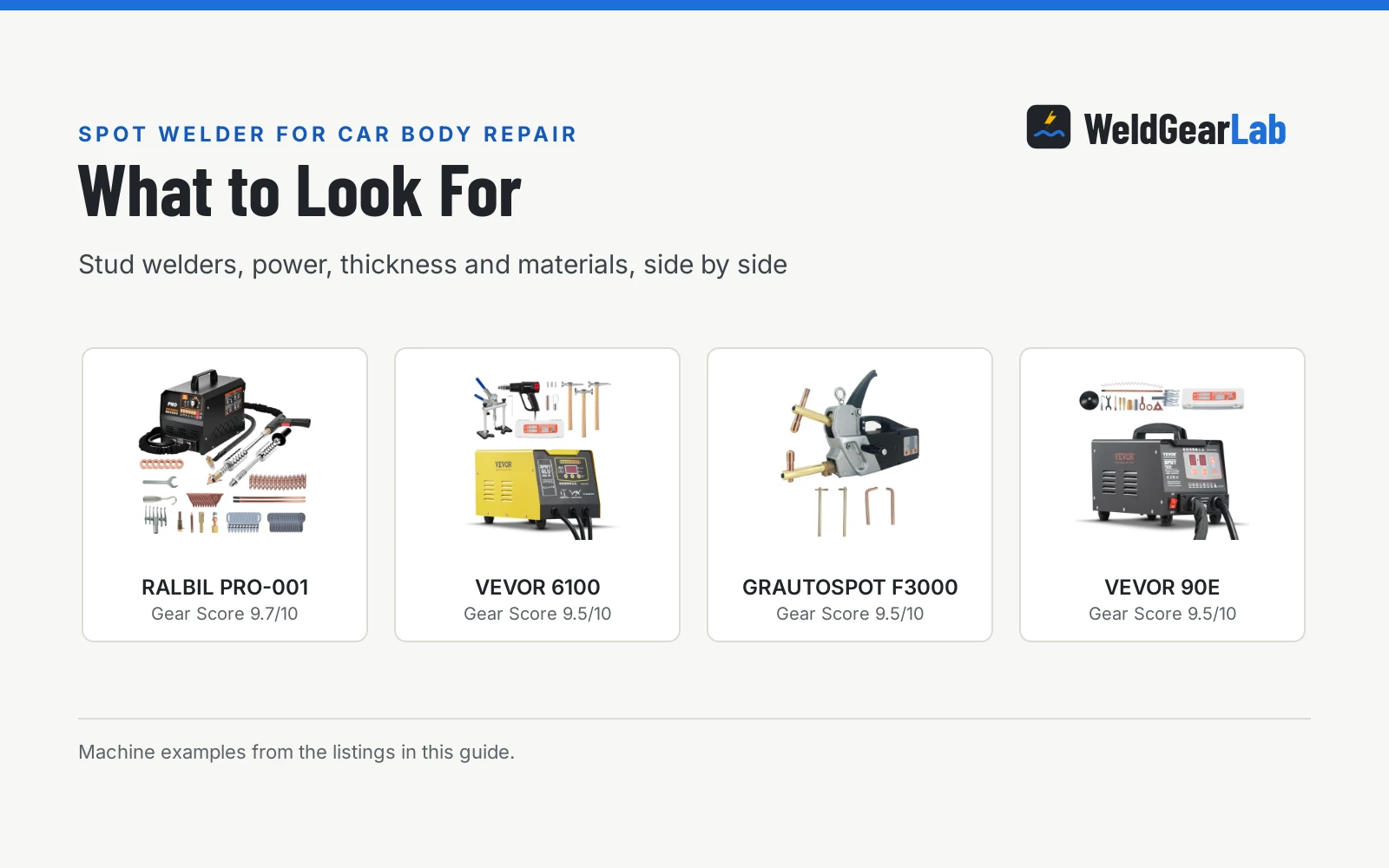
 RALBIL Dent Puller Welder 3.5KW Spot Welder Dent9.7/10View on Amazon
- 2
 VEVOR Spot Welder Dent Puller9.5/10View on Amazon
- 3
 Professional Portable Electric 110 Volt Spot9.5/10View on Amazon
- 4
 VEVOR Stud Welder Dent Repair Kit9.5/10View on Amazon
A dented door skin or a creased fender needs a weld that holds a pull without burning through thin sheet. A spot welder for car body repair answers that job in different ways: a stud welder welds studs to the panel so a puller can draw the dent out, and an electrode-arm spot welder joins overlapping sheets. The right machine depends on the panel material, the power supply in the shop, and the thickness the machine lists.
This guide links to our product roundups, where WeldGearLab gets a commission on purchases made through links on this page, and your price stays the same. Read our affiliate disclosure.
RALBIL Dent Puller Welder 3.5KW Spot Welder Dent
A 110V stud welder with 3500W output, 6 welding modes and a 3-year after-sales service, built for iron panels.
Pros
- 3500W output with 4200A for dent repair on iron
- 6 welding modes with auto and manual welding, including wave line welding and single-sided spot welding
- Overheat protection with an alarm at 158°F and a halt until it cools below 70°C
- 3-year after-sales service, the longest stated term here
Cons
- For iron only, and not suitable for galvanized sheet or aluminum
- Single-sided weld thickness is 0.6-1.6 mm, so thicker work is out of range
- Overheat alarm halts the machine at 158°F until it cools below 70°C
- 110V supply only, so a 220V shop supply gives no gain
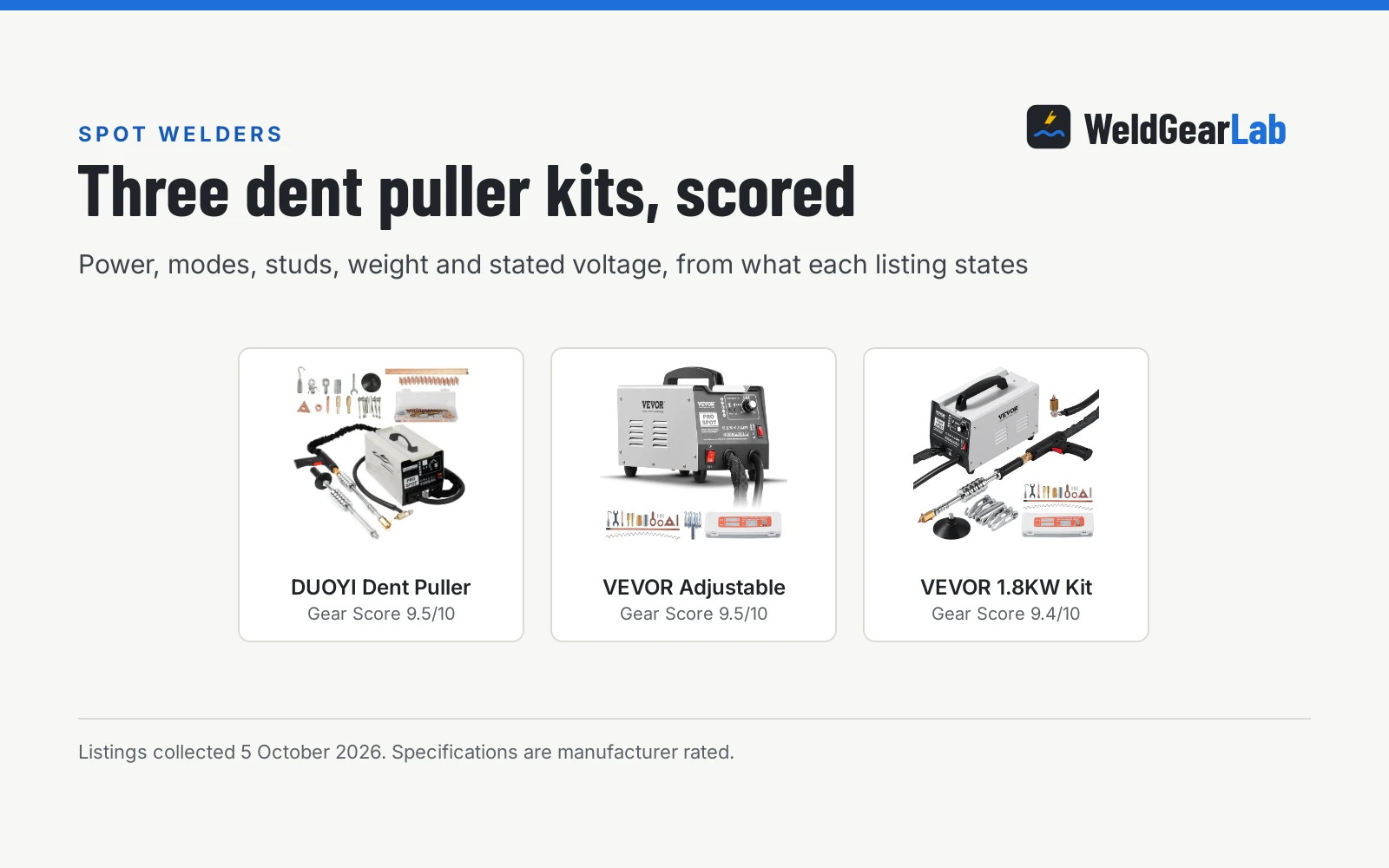
VEVOR Spot Welder Dent Puller
A 110V capacitor discharge stud welder for aluminum panels, with a heat gun, a bridge-style puller and 0.3 second energy storage.
Pros
- Built for aluminum car body panels, with a heat gun for heating before pulling
- Capacitor discharge welding that completes energy storage in 0.3 seconds
- Auto shutdown above 203°F, with ceramic insulation and side vents
- Bridge-style puller that precisely controls pulling force after heat treatment
Cons
- 300W, so it is low power next to the 3500W and 3KW picks
- Auto shutdown above 203°F stops work until the machine cools
- For aluminum panels, so steel work needs a different machine
- Heat gun and bridge puller add a second step to the repair
Professional Portable Electric 110 Volt Spot
A 110V electrode-arm spot welder for overlapping sheet, with Normal and Pulsed modes and replaceable electrode arms.
Pros
- Electrode arms weld overlapping sheet, which stud welders do not
- Welding thickness of 0.6+0.6 mm to 2+2 mm, up to 1/8 inch combined
- Two welding modes, Normal and Pulsed, with one-click mode, thickness and time choice
- Replaceable welding electrode arms, with 3 pairs of arms plus extra tips
Cons
- No warranty term is stated
- Welding thickness tops out at 2+2 mm, up to 1/8 inch
- 110V supply only, so a 220V shop supply gives no gain
- Two modes only, Normal and Pulsed, against 6 and 7 modes on the stud welders
VEVOR Stud Welder Dent Repair Kit
A 220V stud welder with 3KW output, 7 welding modes and 5 stud types, with accessories in a toolbox.
Pros
- 3KW output on a 220V supply
- 7 welding modes, with auto and manual modes
- 5 types of studs, suitable for various dent sizes and types
- Accessories in a toolbox, with a compact body and a handle
Cons
- 220V supply, so a 110V outlet will not run it
- For steel panels, so aluminum work needs a different machine
- 43.1 lb to carry, the heaviest weight stated here
- No warranty term is stated
What a spot welder for car body repair does
Car body panels are thin, so the welder must put heat in a small spot and stop before the sheet burns through. A stud welder makes a short weld that joins a stud to the outside of the panel. The stud gives a puller something to grip, and the dent comes out in small pulls. An electrode-arm spot welder works differently: two arms press overlapping sheets together and pass current through the joint, so the sheets fuse where the arms touch. That suits patch panels, not dent pulling.
Stud welder or spot welder
Start with the job. For a dent with the paint stripped back, a stud welder is the tool the repair is built around. For joining two sheets, such as a patch panel laid over a cut edge, an electrode-arm spot welder is the tool. The machines in this guide split along that line: the VEVOR and RALBIL picks are stud welders for dent repair, and the GRAUTOSPOT pick is an electrode-arm spot welder.
What to check before you buy
Power supply comes first. One pick here runs on 220V, and the rest run on 110V, so check the outlet the shop has before anything else. Next, match the machine to the metal. The VEVOR 6100 lists aluminum panels, the VEVOR 90E lists steel panels, and the RALBIL PRO-001 lists iron and states it is not for galvanized sheet or aluminum. Welding modes matter too: the RALBIL lists 6 modes, the VEVOR 90E lists 7 modes, and the GRAUTOSPOT F3000 lists Normal and Pulsed modes. Thickness limits close the list: the RALBIL lists a single-sided weld thickness of 0.6-1.6 mm, and the GRAUTOSPOT lists a welding thickness of 0.6+0.6 mm to 2+2 mm, up to a combined thickness of 1/8 inch.
Spot welders for car body repair
The machines below are the picks in this guide, ranked by Gear Score.
FAQ for welders
Can a spot welder fix a dent without a stud welder?
An electrode-arm spot welder joins overlapping sheets, so it does not pull dents. A stud welder welds studs to the outside of the panel, and a puller then draws the dent out using those studs. For dent repair, use a stud welder.
What power supply does a spot welder for car body repair need?
It depends on the machine. The VEVOR 90E lists 220V, while the RALBIL PRO-001, the VEVOR 6100 and the GRAUTOSPOT F3000 list 110V. Check the supply the listing states and the outlet the shop has.
Can I use a spot welder on aluminum body panels?
Some machines list aluminum and others do not. The VEVOR 6100 lists aluminum car body panels and pairs the welder with a heat gun and a bridge-style puller. The RALBIL PRO-001 states it is designed for iron and is not suitable for aluminum. The GRAUTOSPOT F3000 lists galvanized sheet, stainless steel sheet and metal sheet overlap, and does not name aluminum.
What thickness can these spot welders weld?
Stated thickness varies by machine. The RALBIL PRO-001 lists a single-sided weld thickness of 0.6-1.6 mm. The GRAUTOSPOT F3000 lists a welding thickness of 0.6+0.6 mm to 2+2 mm, up to a combined thickness of 1/8 inch of sheet steel. The VEVOR picks do not state a weld thickness.
Do I need a 220V outlet for car body spot welding?
Not for every machine here. The VEVOR 90E lists 220V and 3KW, so it needs a 220V supply. The other picks list 110V, so they run on a standard shop outlet. Match the machine to the supply the shop has.
Related: best spot welder for auto body, stud welder dent repair kit, uses for a spot welder, spot welder tips, and the Welders hub. Also see our MIG welder for auto body repair guide.