Spot Welder Tips: Electrodes, Settings and Technique
Spot welder tips set the size of each weld spot and the fit on the arms: match the contact face and thread, dress worn faces, and keep spares in the toolbox.

On this page
Top picks at a glance
As an Amazon Associate I earn from qualifying purchases.
- 1
 Battery Spot Welder9.5/10View on Amazon
- 2
 Spot Welder Dent Puller Machine Body Repair Dent Removal9.5/10View on Amazon
- 3
 VEVOR Stud Welder Dent Repair Kit9.5/10View on Amazon
Thin panels clamped in the tongs, the trigger pulled, and the spots come out weak and uneven from pull to pull. When the arms are sound and the metal is clean, the tips are the first place to look. Spot welder tips are the small copper electrodes that carry current into the joint, and the face size, the thread and the state of the face decide whether each spot lands the same way from pull to pull.
This guide links to our product roundups, where WeldGearLab gets a commission on purchases made through links on this page, and your price stays the same. Read our affiliate disclosure.
What spot welder tips do
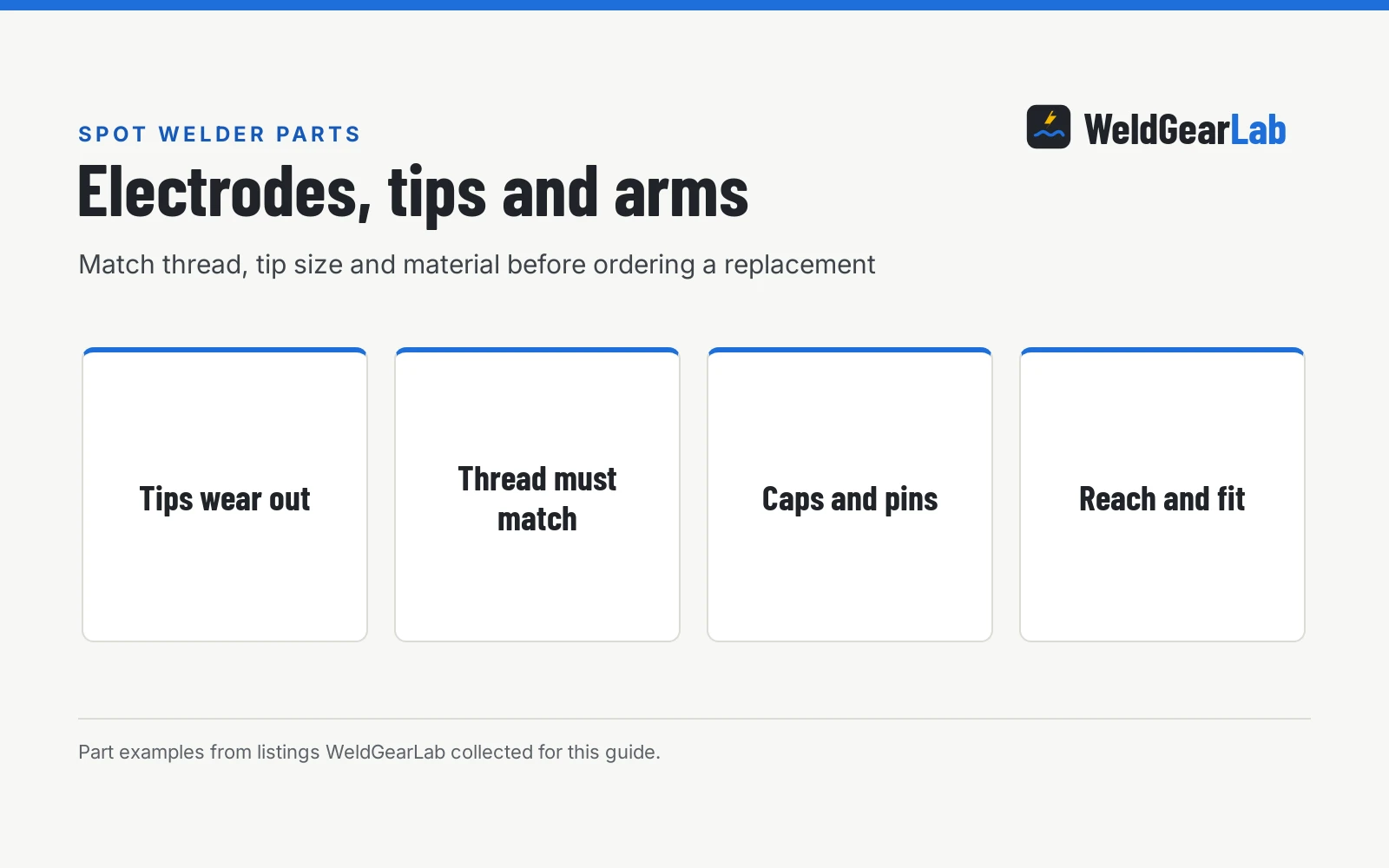
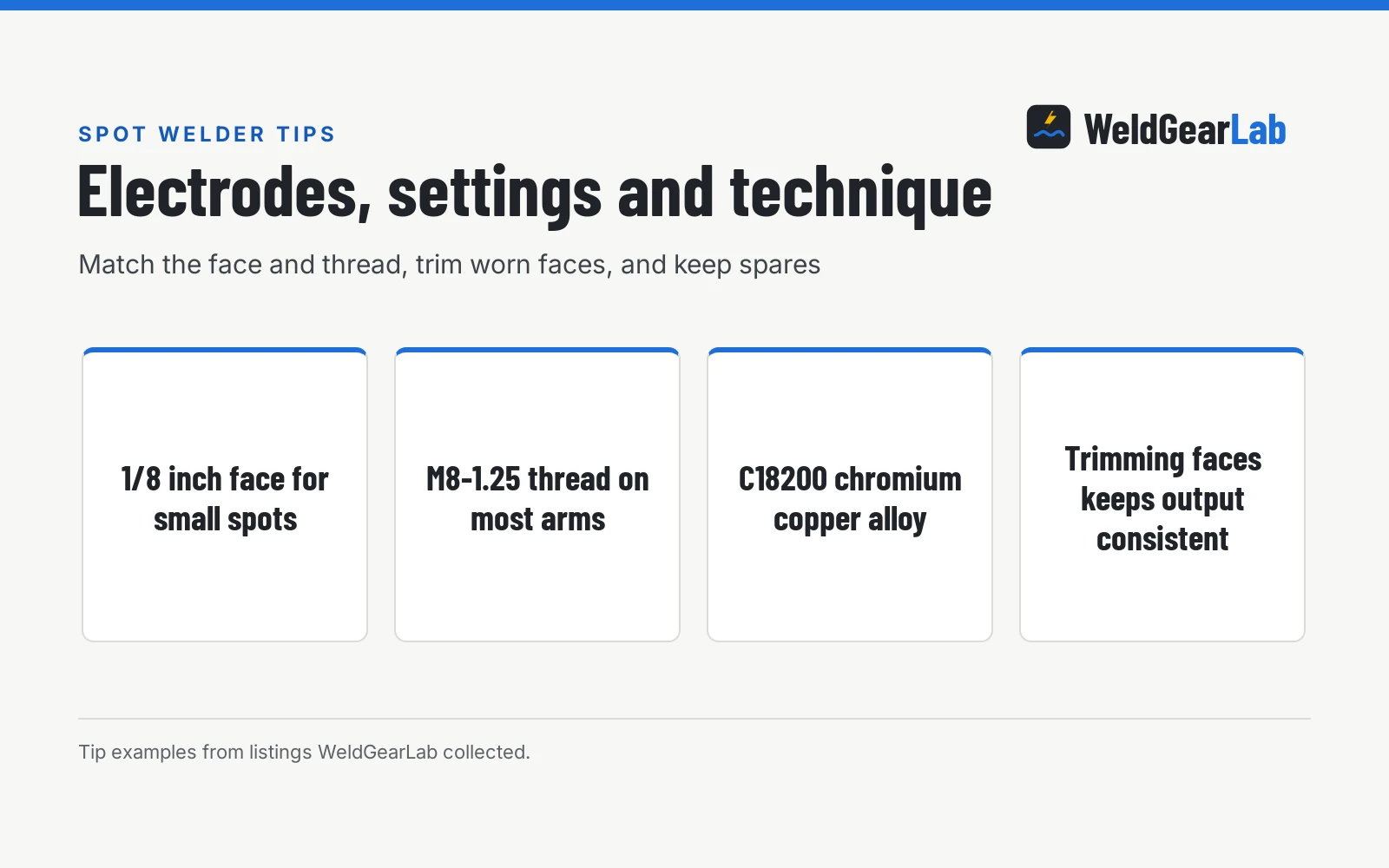
A spot welder tip is the electrode at the end of each arm. Current flows through the tip face into the sheets, the metal heats at the joint, and pressure from the arms holds the sheets together while the spot forms. The face is the flat circle that touches the metal: a 1/8 inch face makes a small spot on light-gauge material, while a 1/4 inch face spreads the current over a wider area. The listings here name faces of 1/8 inch, 3/16 inch, 1/4 inch and 5/32 inch, and each one suits a different size of spot.
Tips are wear parts. A face that has mushroomed spreads the current over a wider area, so spots turn weak and uneven. The Pidnsrozo listing puts it plainly: worn, mushroomed tip faces spread the welding current over a wider area, so spots turn weak and uneven, and threading in fresh tips renews the crisp 1/8 inch contact face. Chromium copper, chromium zirconium copper and solid copper are the materials the listings name, with C18200 chromium copper on the Thrasher Products tips, chromium zirconium copper on the Hicarer set and solid copper on the Pidnsrozo tips (on Amazon).
Match the thread before you order
The thread is the part that catches buyers out. Most arms in these listings carry an M8-1.25 metric thread, and the Hicarer, Pidnsrozo and Thrasher Products tips for Chicago Electric arms all use it. Miller style tongs use a 3/8-24 thread instead, and an imperial thread will not accept a metric tip. The Pidnsrozo listing gives the check in plain words: confirm the welder’s electrode arms carry an M8-1.25 metric thread before ordering, since arms vary between welder brands.
A ten-second check saves a round trip. Look at the arms, match the thread in the listing, and match the contact face to the spot size the job needs. The Thrasher 476-040211-125 tip fits Miller style welding tongs, and the Thrasher Products 476-040211 tip fits Miller-TT-6, TT-9 and G7 welding tongs. Where the listing names a fit, trust it over a guess: the Chicago Electric fit tips state M8-1.25, and the Miller style tips state 3/8-24.
Contact faces side by side
| Contact face | Thread | Fit notes | |
|---|---|---|---|
| 1/8 inch | 1/8 inch face | M8-1.25 or 3/8-24 | Small spots on light-gauge material |
| 3/16 inch | 3/16 inch face | M8-1.25 | Close clearance for tight areas |
| 1/4 inch | 1/4 inch face | M8-1.25 | Larger spots than the 1/8 inch face |
| 5/32 inch | 5/32 inch face | 3/8-24 | Miller style tongs: Miller-TT-6, TT-9 and G7 |
The 1/8 inch face is the common choice for small spots on light-gauge material, and it appears on tips for each thread: M8-1.25 on the Chicago Electric fit tips and 3/8-24 on the Miller style tips. The 3/16 inch close clearance tip is made for tight areas, and the 1/4 inch face suits a larger spot. The 5/32 inch Miller style tip sits between the 1/8 inch and 3/16 inch faces for Miller-TT-6, TT-9 and G7 tongs.
Spot welder tips for settings and technique
Tips do not set the weld on their own: pressure, time and current come from the machine, and the machine manual gives the starting point for the metal at hand. What the tips control is the contact: a clean, flat face puts the current where it belongs, and a mushroomed face spreads it. Dress the face when it starts to spread, and swap the tip when dressing no longer brings the crisp edge back. The Hicarer listing states the routine in plain words: turn off and cool the equipment fully before swapping old electrodes, tighten evenly to align the tips, adjust parameters and check with scrap metal, and trim the surface of the tips regularly to keep output consistent.
Fit-up matters as much as the tip. Sheets that touch along the joint need less current than sheets with a gap, and the arms must close square so each face meets the metal flat. Keep a spare pair in the toolbox: tips are wear parts, and a mushroomed face can stall a job at the worst moment. The listings here sell tips in 2-packs, 4-piece sets and 8-piece sets, and in 1-pair packs, so a backup pair in the toolbox keeps the work moving.
When a tip face is worn
The signs are plain: spots that vary from pull to pull and a face that looks rounded at the edge instead of flat. A worn face spreads the current, so the spot grows wide and weak. Trim the face back to flat and the spots tighten up; when trimming no longer restores the edge, thread in a fresh pair. The Pidnsrozo listing states the same sequence: worn faces spread the current and make spots weak and uneven, and fresh tips renew the crisp 1/8 inch face.
Keep the spares where they can be found. The Hicarer set ships 8 tips, the Pidnsrozo set ships 4, and the Thrasher Products tips ship as pairs, so a backup pair in the toolbox means the work never waits. Rotating pairs spaces out replacements on long projects, and a fresh pair threaded in at the start of a job beats a worn face later in it.
Sparks, fumes and fire. Spot welding throws sparks and hot metal, and coated or galvanized steel gives off fumes that need air moving past the work. Wear safety glasses and gloves, keep the head out of the plume, and clear dry grass and anything flammable from the area. See the OSHA welding overview.
FAQ for welders
What size spot welder tip should I use?
Match the face to the spot the job needs. A 1/8 inch face makes a small spot on light-gauge material, a 3/16 inch face suits tight areas, and a 1/4 inch face makes a larger spot. The 5/32 inch face fits Miller style tongs where the arms call for it.
How do I know which thread my spot welder arms use?
Check the arms before ordering. Most arms in these listings carry an M8-1.25 metric thread, while Miller style tongs use a 3/8-24 thread. An imperial thread will not accept a metric tip, so match the thread in the listing to the arms on the welder.
When should I replace spot welder tips?
Replace a tip when the face has mushroomed and trimming no longer brings the edge back. Worn faces spread the current, so spots turn weak and uneven from pull to pull. A backup pair in the toolbox means the work never waits while a fresh pair threads in.
Can I dress spot welder tips instead of replacing them?
Yes, while the face still has metal to trim. Trimming the surface of the tips regularly keeps output consistent, and a flat face puts the current where it belongs. When the face is too short or too worn to trim flat, thread in a fresh pair.
Do spot welder tips fit every spot welder?
No. The thread and the arm style must match: M8-1.25 fits Chicago Electric style arms, while 3/8-24 fits Miller style tongs. Check the thread and the fit the listing names before ordering, and keep the thread size with the spares so the next pair matches.
Related: best spot welder for hobbyists and best spot welder for auto body guides, the spot welder vs MIG welder comparison, and the welders hub. Also see the MIG welder replacement parts guide.