Uses for Spot Welder: Jobs It Handles Well
A spot welder joins nickel strip to battery cells with short pulses of heat, and this guide covers battery pack building, repair and thin metal work, with the gear that does each job.

On this page
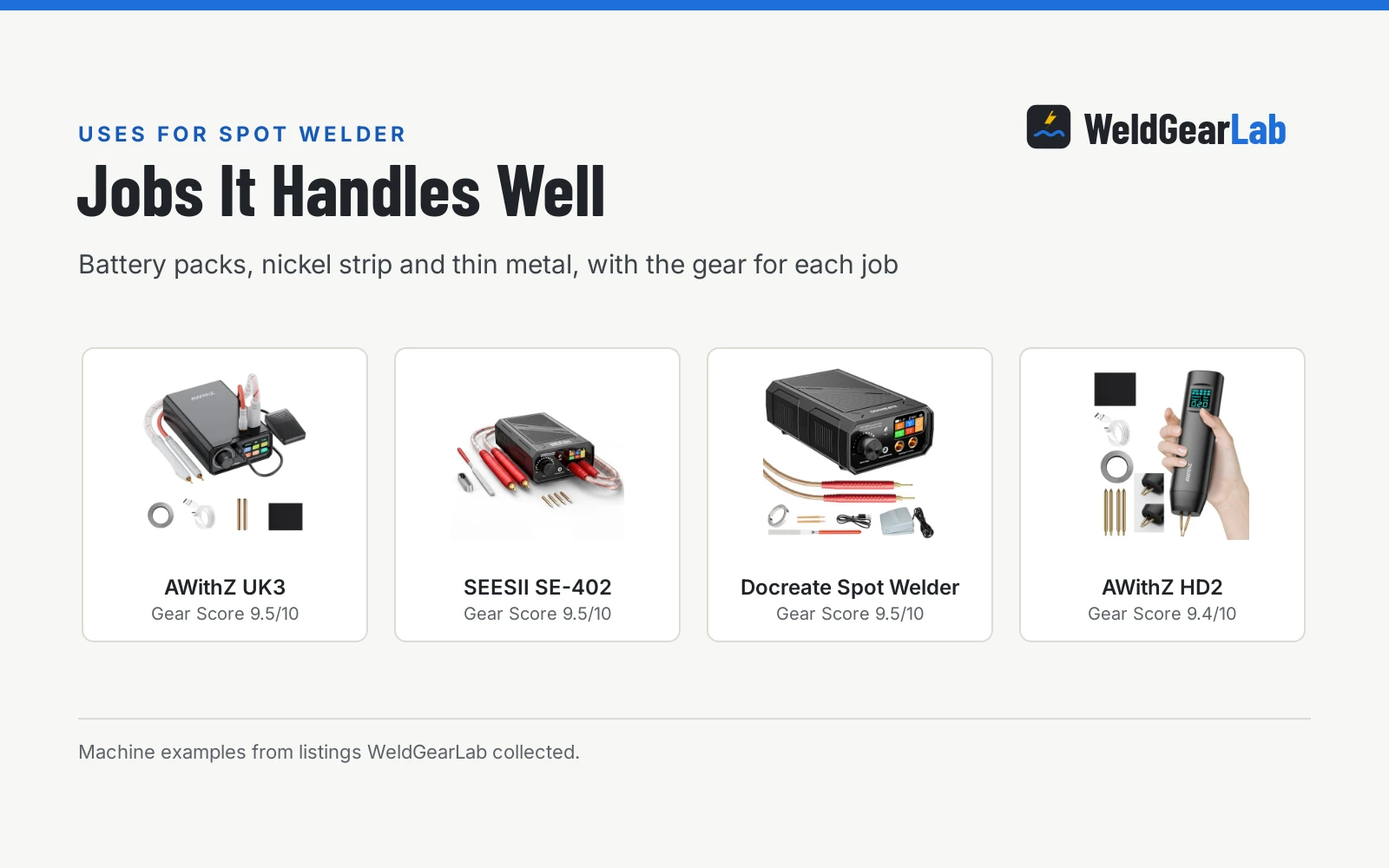
Top picks at a glance
As an Amazon Associate I earn from qualifying purchases.
- 1
 AWithZ 10000mAh Battery Spot Welder9.5/10View on Amazon
- 2
 SEESII 10KW Battery Spot Welder9.5/10View on Amazon
- 3
 Battery Spot Welder, 10000W Cordless Spot Welding9.5/10View on Amazon
- 4
 HD2 AWithZ Battery Spot Welder with Double-Ended9.4/10View on Amazon
A dead pack on the bench, a nickel strip waiting to join a cell terminal, a thin metal tab that needs a clean weld with no filler rod: these are the jobs a spot welder is built for. Uses for spot welder work center on joining thin metal with short pulses of current through electrodes pressed to the surface, and the battery powered units in this guide are made for that kind of bench work.
This guide links to our product roundups, where WeldGearLab gets a commission on purchases made through links on this page, and your price stays the same. Read our affiliate disclosure.
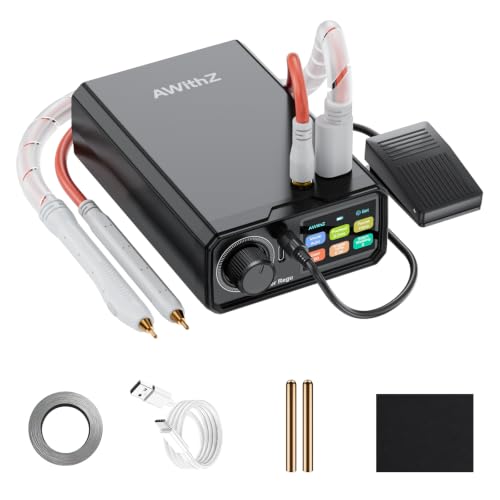
AWithZ 10000mAh Battery Spot Welder
A 13.8KW rotary-knob spot welder with 100 gears and a 10000mAh battery, built for pack building across cylindrical, phone and button cells.
Pros
- 13.8KW peak output, the highest rating in this guide
- 100 gears on a rotary knob for fine control from delicate phone cells to cylindrical power cells
- 10000mAh battery rated at over 300 welds at the highest gear
- Automatic, foot pedal and trigger modes, plus a Mode setting for button batteries
Cons
- Shuts down after 8 minutes with no operation, so a pause means starting the unit again
- Rotary knob adjustment means dialing through gears by hand for each change
- Foot pedal and pens add bench clutter on a small workspace
- Button batteries need the Mode setting, so the mode must be set before welding button cells
SEESII 10KW Battery Spot Welder
A 10KW cordless spot welder with 25 gears, a color LCD and a 10000mAh battery, made for battery pack assembly, maintenance and DIY repair.
Pros
- 10KW peak output for nickel-plated sheets under 0.3mm and pure nickel under 0.15mm
- 10000mAh battery rated at more than 300 welds at gear 25 on a full charge
- Color LCD shows voltage in real time, with a charge reminder below 7.3V
- Automatic and foot pedal modes, with a longest side of approx 6.5 inches for a small bench footprint
Cons
- Aluminum and copper are not recommended, per the maker
- Pure nickel limit of 0.15mm is thinner than the nickel-plated limit
- Weld quality follows voltage, so a low battery weakens welds until charged
- Needs a full charge before first use for best performance
Battery Spot Welder, 10000W Cordless Spot Welding
A 10000W cordless spot welder with 10–90 power levels and dual pulse output for nickel strip welding and battery pack repair.
Pros
- 10000W output with 10–90 adjustable power levels and dual pulse technology
- Welds 0.1–0.25mm nickel strips and battery tabs, suiting beginners and professionals alike
- LCD shows voltage and working status in real time
- Foot pedal control keeps hands free while welding
Cons
- Nickel strip range is listed as 0.1–0.25mm, below the thickest rating here
- No automatic mode is named; each weld needs the foot pedal
- Pins must not be touched during operation, so handling needs care around live tips
- No warranty term is stated
HD2 AWithZ Battery Spot Welder with Double-Ended
A 140g portable spot welder with 90 power levels and dual pulse output for 18650 and phone batteries on nickel sheet up to 0.2mm.
Pros
- 90 precise power levels with dual pulse output for nickel, steel and iron sheets up to 0.2mm
- Weighs only 140g, with USB-C charging for bench or travel use
- Double-ended, replaceable tips flip for extended use instead of single-use tips
- LCD shows Preheat, Gear, Trigger and Temp in real time
Cons
- Nickel sheet limit of 0.2mm, so thicker strip needs a different unit
- No foot pedal is named, so hands stay on the work during each weld
- Light 140g body needs a steady hand on the bench
- The box holds a charging cable with no mains adapter, so charging needs a USB-C source
What uses for spot welder covers
Between them, the units cover battery pack building, battery assembly, maintenance and DIY repair: SEESII names power tool, electric vehicle and drone packs, and AWithZ names cylindrical power batteries, mobile phone batteries and button batteries. Thin metal welding sits beside the battery work: nickel strip, nickel-plated sheet and thin steel tabs joined without filler rod or shielding gas.
The edge is clear. SEESII says aluminum and copper are not recommended for its unit because of high welding difficulty. That edge is part of the answer: a spot welder suits nickel strip and thin steel, and other metals call for a different process. See the spot welder vs MIG welder guide when the job needs a bead rather than a pulse weld.
Nickel strip thickness and power levels
Strip thickness and power levels decide whether a unit fits the job. The HD2 welds nickel, steel and iron sheets up to 0.2mm with 90 power levels. The SE-402 covers nickel-plated sheets under 0.3mm and pure nickel under 0.15mm with 25 power levels. The Docreate unit covers 0.1–0.25mm nickel strips with 10–90 power levels. The UK3 covers 0.4mm with 100 gears on a rotary knob.
Peak power follows the same spread: 10KW for the SE-402, 10000W for the Docreate unit, and 13.8KW for the UK3. Match the level to the strip, and run a practice weld on scrap before the real joint.
The gear that does the work
The picks below cover the job from dialing in the pulse for a thin strip to driving a full pack build on battery power alone.
Side by side
| AWithZ UK3 | SEESII SE-402 | Docreate Spot Welder | AWithZ HD2 | |
|---|---|---|---|---|
| Peak power | 13.8KW | 10KW | 10000W | Not stated |
| Battery | 10000mAh | 10000mAh | Rechargeable (capacity not stated) | Rechargeable (capacity not stated) |
| Power levels | 100 | 25 | 10–90 | 90 |
| Nickel thickness | 0.4mm | Under 0.3mm nickel-plated, under 0.15mm pure nickel | 0.1–0.25mm | 0.2mm |
| Control | Automatic, foot pedal, trigger | Automatic, foot pedal | Foot pedal | Not stated |
| Display | Not stated (control panel) | Color LCD | LCD | LCD |
| Welds per charge | Over 300 at highest gear | More than 300 at gear 25 | Not stated | Not stated |
| Auto shutoff | After 8 minutes with no operation | Not stated | Not stated | Not stated |
Power levels and nickel limits come from the makers; where a maker states no value, the table says so.
How to set the power level
Start low and work up on scrap. SEESII and Docreate advise a practice weld on scrap to find the right level before the real joint, and to charge fully before first use for best performance. Thinner strip needs less power, thicker strip needs more, and pure nickel behaves differently from nickel-plated strip.
Voltage matters too. SEESII notes that weld quality follows voltage, with higher voltage bringing firmer welds, and that the unit should be charged when it reads below 7.3V.
Spot welding safety in the shop
Keep fingers clear of the pins while welding: Docreate warns not to touch the welding pins during operation. The UK3 halts welding and alerts the user when thermal protection senses overheating, and shuts down after 8 minutes with no operation. The HD2 multi-protection system monitors temperature, voltage and battery health, stopping and alerting on a problem.
Work on a clear bench with the pack held steady and the strip flat under the tips before each pulse. When the setting is unknown, practice on scrap first rather than guessing on a live pack.
For more options, see our welders guides.
FAQ for welders
Can a spot welder weld aluminum or copper?
Not with the SE-402. SEESII says aluminum and copper are not recommended because of high welding difficulty, and the other makers in this guide state no position on aluminum or copper. These units are made for nickel strip, nickel-plated sheet and thin steel, and other metals call for a different process.
What thickness of nickel strip can a spot welder weld?
It depends on the unit. The Docreate unit covers 0.1–0.25mm, the HD2 covers up to 0.2mm, the SE-402 covers nickel-plated under 0.3mm and pure nickel under 0.15mm, and the UK3 covers 0.4mm. Match the strip to the unit before ordering, and run a practice weld on scrap to confirm the setting.
How many welds can a battery spot welder do per charge?
The counts that makers state agree on the scale: SEESII lists more than 300 welds on a full charge at gear 25, and AWithZ lists over 300 times at the highest gear for the UK3. Counts change with the gear setting, so treat the figure as a planning guide, not a promise.
Do I need a foot pedal to run a spot welder?
No. The SE-402 offers automatic mode, which fires when the pen touches the strip, and the UK3 offers automatic mode that outputs without a pedal or a button on the pen. Each also offers foot pedal control for work where hands stay on the pack. The Docreate unit offers foot pedal control. The HD2 names no control mode, so confirm the control type before ordering when pedal control matters for the job.
Can a spot welder fix a phone battery?
It can join the tabs on phone battery cells. The HD2 names 18650 and phone battery work, and the UK3 names mobile phone batteries and button batteries, with a Mode setting for button cells.
Related: best spot welder for hobbyists, spot welder vs MIG welder, laser welder for battery terminals, and how to choose a MIG welder.