Types of Gas Regulators for Welding
Single-stage, two-stage, flowmeter and preset regulators all drop cylinder pressure to working pressure, but they differ in steadiness, flow reading and fit, and the right choice depends on the gas and the job.

On this page
Top picks at a glance
As an Amazon Associate I earn from qualifying purchases.
- 1
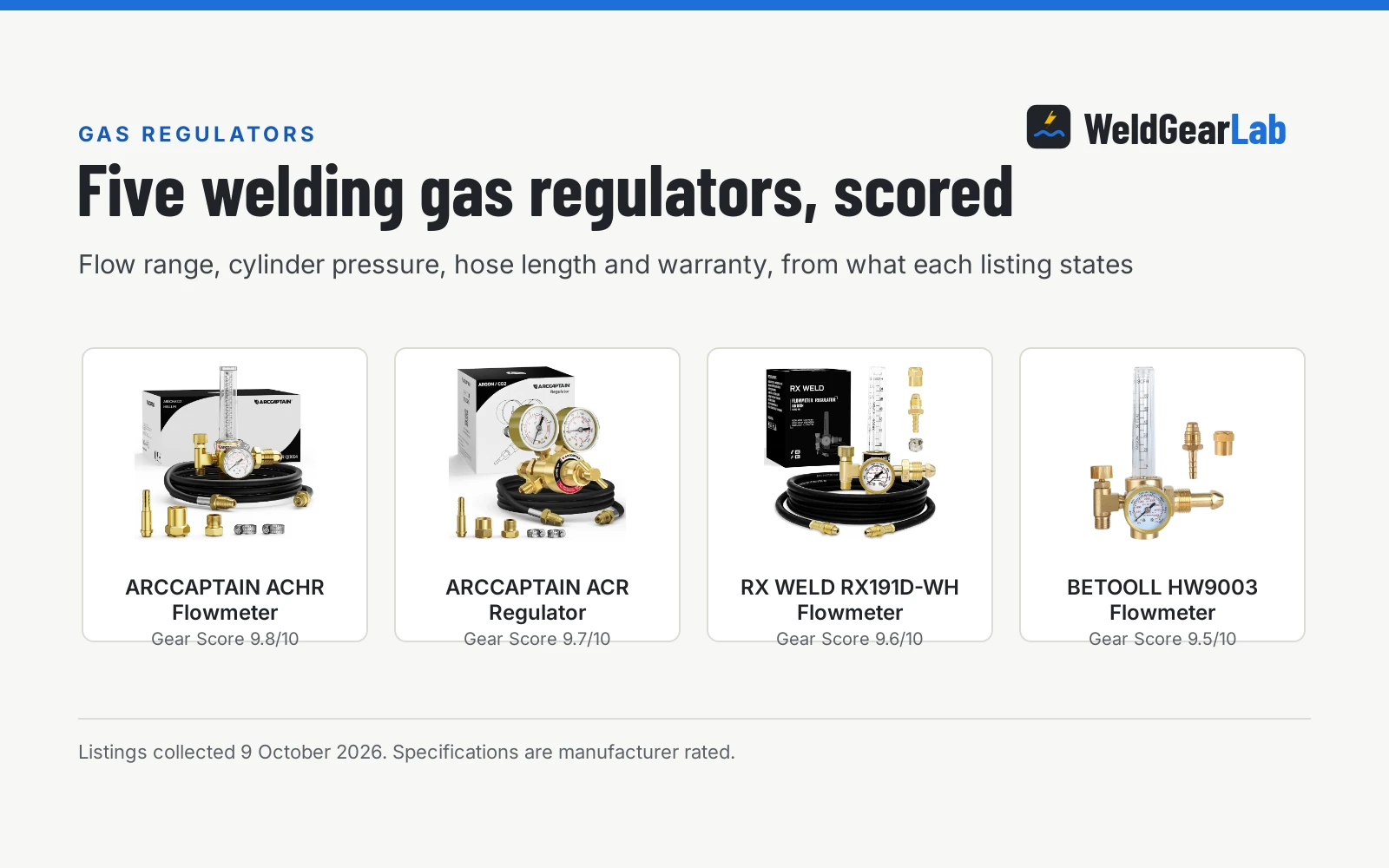
 ARCCAPTAIN Argon/CO2/Helium Regulator with 8.2FT Inert Gas9.8/10View on Amazon
- 2
 SPARC Premium Dual Argon Regulator for TIG/MIG Welding9.8/10View on Amazon
- 3
 ARCCAPTAIN Argon/CO2/Helium Regulator with 8.2FT Inert Gas9.7/10View on Amazon
A gas regulator drops the high pressure inside a cylinder down to a working pressure a torch or a MIG gun can use. Types of gas regulators differ in how they make that drop, how they show flow, and which gas they fit. This guide walks through the common types for MIG, TIG and oxy-fuel work, so the regulator on the bench matches the gas, the torch and the job.
This guide links to our product roundups, where WeldGearLab gets a commission on purchases made through links on this page, and your price stays the same. Read our affiliate disclosure.
Types of Gas Regulators at a Glance
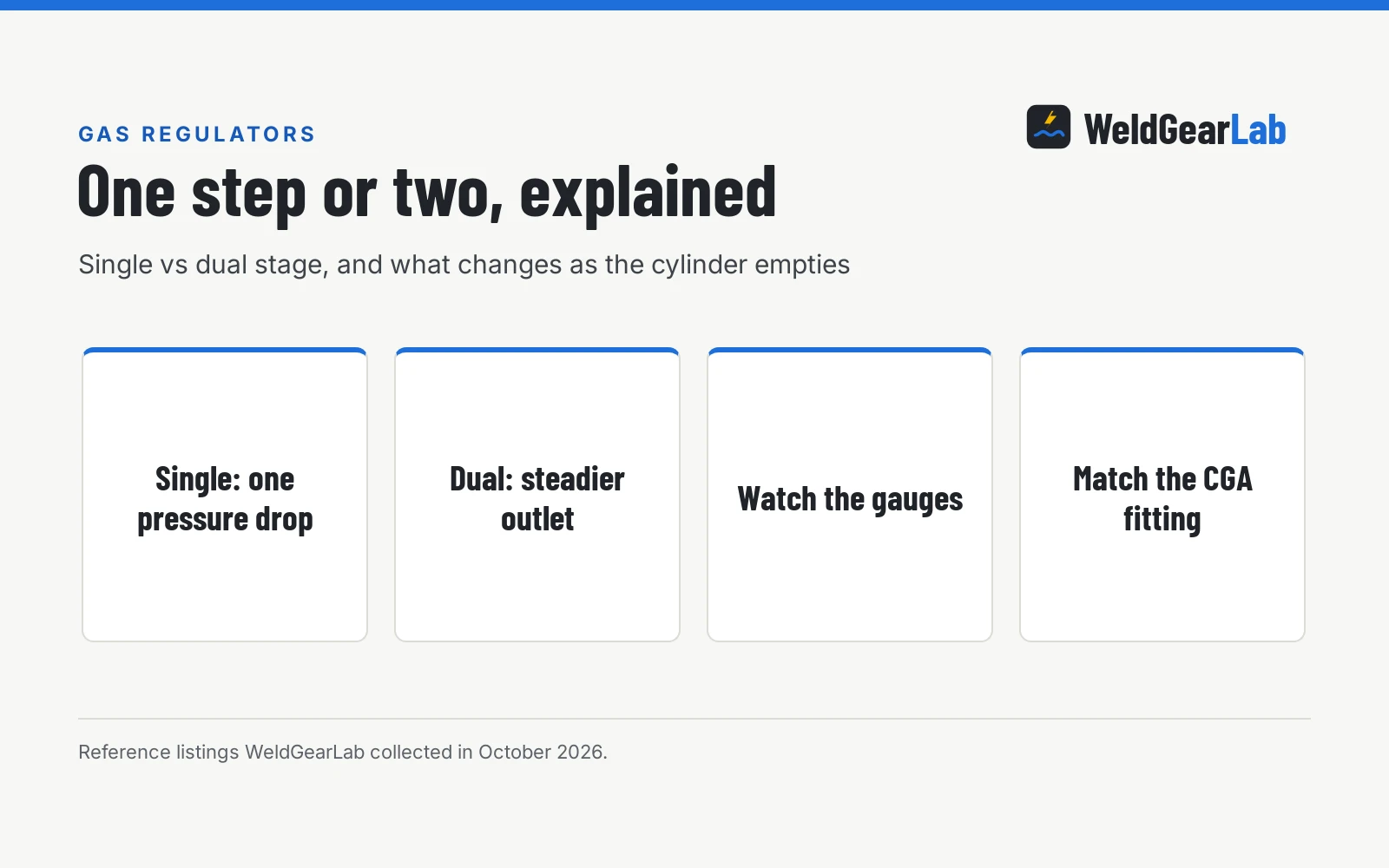
Most regulators for welding fall into a small set of types, and the differences come down to stages, flow reading and the gas they are built for. The table below lines them up side by side.
| Single-stage | Two-stage | Flowmeter | Preset | |
|---|---|---|---|---|
| How pressure is dropped | In a single step from cylinder pressure | Across stages in turn, then to working pressure | Set by the stages of the regulator | Fixed at the factory, with no adjustment knob |
| How flow is set | Turn the knob and read a gauge | Turn the knob and read a gauge | Turn the knob and read a glass tube with a floating ball | Mount it and weld, the flow is already set |
| Steadiness as the cylinder empties | Flow can drift as cylinder pressure falls | Holds working pressure steadier as the cylinder empties | Set by the stages; check the tube often | Drifts like a single-stage unit, with no knob to reset it |
| Common use | Short MIG and TIG jobs in a home shop | Long runs and work that needs steady flow | MIG and TIG where a clear flow reading helps | MIG work where the same flow suits every job |
| What to check | That the inlet fitting matches the cylinder valve | That the inlet fitting matches the cylinder valve | That the tube sits upright and the ball moves freely | That the fixed flow suits the wire and the metal |
Single-stage regulators
A single-stage regulator drops cylinder pressure to working pressure in a single step, through a diaphragm and a spring that the adjustment knob sets. It is the common regulator on home shop MIG and TIG setups, where the cylinder stays close to the bench and the welder checks the gauges often. The trade-off is steadiness: as the cylinder empties and its pressure falls, the working pressure can drift, so the flow at the torch drifts with it. Check the gauges during a long weld and reset the flow when it moves.
Two-stage regulators
A two-stage regulator drops pressure across stages in turn, with an added diaphragm that steadies the working pressure after the main drop. Flow at the torch stays closer to where it was set as the cylinder empties, which suits long runs and any job where stopping to reset flow breaks the rhythm of the weld. The cost is size and weight: a two-stage unit is larger and heavier than a single-stage unit. For short home shop jobs the extra steadiness may not matter.
Flowmeter and flow gauge regulators
Flowmeter and flow gauge describe how a regulator shows flow, not how many stages it has. A flow gauge regulator has a dial marked in flow units. A flowmeter regulator has a clear tube with a ball that floats at the flow rate, which is easy to read at a glance. Either style works when matched to the gas. A flowmeter must sit upright for the ball to read true, and a cracked tube leaks gas, so check the tube before each use.
Fuel gas regulators and oxy-fuel work
Fuel gas regulators serve a different job from shielding gas regulators. They feed acetylene or propane to a cutting or heating torch, where the gas burns with oxygen, and their fittings and pressure ranges are built for that fuel. A regulator made for a given fuel gas suits only that fuel gas, and fuel gas threads turn the opposite way from oxygen threads to stop a wrong connection. The guide to whether an acetylene regulator fits propane covers that mix-up in detail.
Oxy-fuel work also uses an oxygen regulator, which has its own fittings and must stay free of oil and grease. Keep oxygen equipment away from oil, open the cylinder valve slowly, and follow the setup steps in the torch manual. For the full setup, see how to set oxy-acetylene regulators for cutting and oxy-acetylene torch setup.
Matching a regulator to the gas and the job
Start with the gas. Argon, carbon dioxide and mixed shielding gases each need a regulator with fittings that match the cylinder valve, and a flow range that suits the torch. Check the cylinder valve type before the regulator inlet, since a mismatch means the regulator will not mount at all. The guides to types of gas cylinder, parts of a gas cylinder and gas cylinder valve types show what to look for.
Then match the regulator to the job. Short tack welds suit a single-stage regulator with a flow gauge, while long beads suit a two-stage unit, and a flowmeter makes the flow easy to check during the run. TIG work needs a steady, low flow, so a flowmeter earns its place there; see TIG welding gas types for the gases involved. MIG work on a farm or in a garage can run on a simpler setup; see MIG welder types and gasless vs gas MIG welder for the machine side.
Reading the gauges
Most regulators carry gauges, and each tells a different story. The cylinder gauge shows the pressure left in the cylinder. The working gauge shows the pressure going to the torch, which the adjustment knob sets. Learn which gauge is which before welding, since reading the wrong gauge leads to the wrong flow. A gauge that reads zero on a full cylinder, or a needle that sticks, means the regulator needs attention.
Compressed gas safety. Chain cylinders upright so they cannot fall, keep oil and grease away from oxygen fittings, and close the cylinder valve when the work is done. Weld with ventilation, clear anything flammable from the area, and keep a fire extinguisher within reach. See the OSHA welding overview.
FAQ for welders
Can I use the same regulator for argon and carbon dioxide?
Only when the regulator is built for the gas in the cylinder. Fittings differ by gas, and a regulator made for argon may not mount on a carbon dioxide cylinder at all. Check the inlet fitting and the maker guidance before mounting.
Why does my flow drift as the cylinder empties?
A single-stage regulator lets working pressure drift as cylinder pressure falls, so flow at the torch rises above where it was set. A two-stage regulator holds working pressure steadier. If flow moves fast on a fresh cylinder, check the fittings and hose for leaks.
Do I need a flowmeter, or is a flow gauge enough?
Either style sets flow well when matched to the gas. A flowmeter shows flow in a tube and is easy to read at a glance, while a flow gauge reads flow on a dial and has no glass to break. Pick the flowmeter for TIG work, and the flow gauge for a rough shop.
Can I use an acetylene regulator for propane?
No. Pressure ranges differ between fuel gases, and a regulator made for acetylene does not suit propane. Use a regulator made for the fuel gas in the cylinder, and read the guide to whether an acetylene regulator fits propane before swapping anything.
What should I check when a regulator arrives?
Check the inlet and outlet fittings for damage, the gauges for cracked glass or stuck needles, and the hose connection for a snug fit. Mount it on the cylinder, open the valve slowly, and watch for leaks. If anything is bent, cracked or leaking, send it back.
How do I know which regulator fits my cylinder?
Match the regulator inlet to the cylinder valve, and match the regulator to the gas. The valve type and the gas name are stamped on the cylinder, and the guides to gas cylinder valve types and types of gas cylinder show how to read them. When in doubt, ask the gas supplier before ordering.
Related: welding consumables, parts of a gas cylinder, how to set oxy-acetylene regulators for cutting, best flux core welder, and best welder for beginners. Also see the flux core welding setup guide.