Single Stage vs Dual Stage Gas Regulator: Which One Should You Buy?
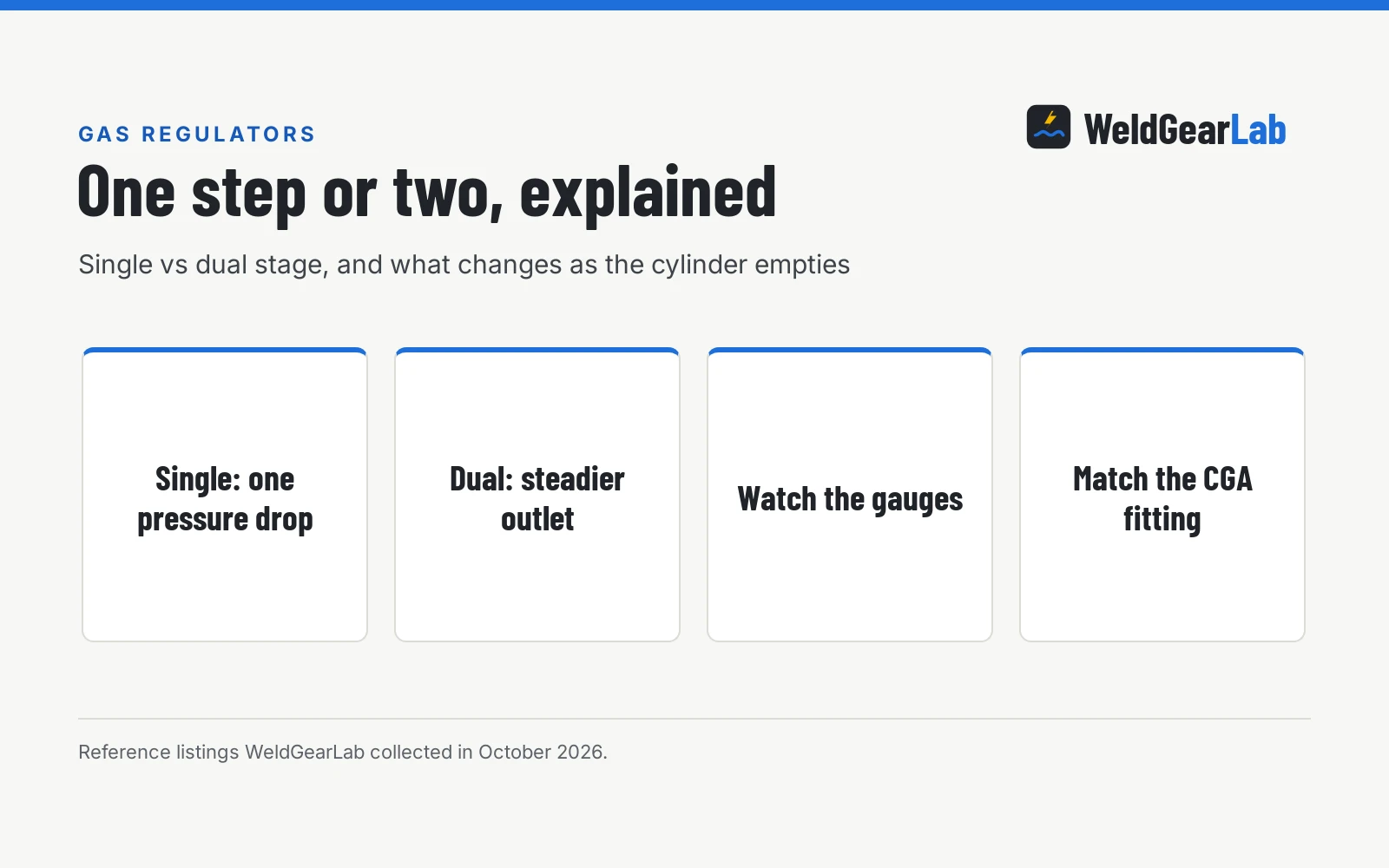
A single stage regulator drops cylinder pressure in one step; a dual stage does it in two, keeping outlet pressure steadier as the cylinder empties.

On this page
Top picks at a glance
As an Amazon Associate I earn from qualifying purchases.
- 1
 SPARC Premium Dual Argon Regulator for TIG/MIG Welding9.8/10View on Amazon
- 2
 Oxygen Single Stage RegulatorView on Amazon
- 3
 R622L 2nd Stage Propane RegulatorView on Amazon
A single stage vs dual stage gas regulator question comes down to one thing: how the regulator handles falling cylinder pressure. A single stage drops cylinder pressure to working pressure in one step, and the outlet pressure rises as the cylinder empties, so you reset it now and then. A dual stage drops it in two steps, which keeps the outlet pressure steadier all the way down. For short, intermittent jobs a single stage is enough; for long sessions where steady flow matters, pick a dual stage.
Other welders and gear to compare
 Oxygen Single Stage RegulatorCheck price on Amazon
 R622L 2nd Stage Propane RegulatorCheck price on Amazon
This guide links to our product roundups, where WeldGearLab gets a commission on purchases made through links on this page, and your price stays the same. Read our affiliate disclosure.
The difference in one paragraph
Both types sit between the cylinder and the torch and deliver a low, usable working pressure from a high cylinder pressure. A single stage regulator has one diaphragm and one spring doing all of that drop. A dual stage regulator has two in series: the first drops cylinder pressure to an intermediate pressure, and the second drops that to working pressure. Because the second stage sees a nearly constant inlet, its outlet barely moves as the cylinder empties.
Side by side
| Single stage | Dual stage | Notes | |
|---|---|---|---|
| Pressure drop | One step | Two steps | Dual has two diaphragms in series |
| Outlet as the cylinder empties | Rises; reset the working pressure | Stays steadier | Watch the delivery gauge on a single stage |
| Best for | Short, intermittent jobs | Long sessions and steady-flow work | Match the design to your session length |
The table compares the designs in general terms. The figures in the next section come from the reference listings we collected
How a single stage regulator behaves
With one stage, the outlet pressure follows the cylinder pressure upward as the cylinder drains: less pressure pushing on the inlet side means the spring pushes the valve a little further open. In practice you glance at the delivery gauge during a long job and nudge the adjusting knob back to your setting. For tacking, short repairs and intermittent use, that is a small chore, not a problem.
How a dual stage regulator behaves
The first stage of a dual stage regulator absorbs the swing of the falling cylinder pressure, so the second stage always works from a steady feed. You set the working pressure once and it holds nearly steady until the cylinder is nearly empty. That steadiness is what long TIG sessions and production-style work pay for: no mid-bead drift in gas flow.
What the reference listings show
The listings give concrete figures for the fittings and ranges you will actually shop. An RX WELD argon flow meter lists 0-60 CFH with a gauge range of 0-4500 PSI, a CGA580 inlet and a 5/8 inch UNF outlet with a 1/4 inch barb adapter, and its bullets name MIG and TIG applications. An RX WELD oxy-acetylene set lists oxygen delivery of 0-4000 PSI inlet and 0-100 PSI output, acetylene of 0-400 PSI inlet and 0-30 PSI output, with a 9/16 inch-18 outlet thread. An ESAB single stage acetylene regulator lists a 0.825 inch-14 inlet and 9/16 inch-18 outlet and carries a 3 year manufacturer warranty. A SÜA propane regulator lists a CGA-510 inlet, 9/16 inch-18 LH outlet, 300 psi maximum inlet and a 0-30 psi delivery range. A Victor flow meter lists 50 SCFH for argon and 38 SCFH for CO2 with a 25 psig preset outlet and 3000 psig maximum inlet.
Note what the listings also teach about fittings: CGA-580 appears on nitrogen, argon and helium, with the Victor listing also naming argon/CO2 mix service, while oxygen takes CGA-540, acetylene CGA200 and propane CGA-510. The threads differ on purpose, so a regulator built for one gas cannot be screwed onto the wrong cylinder.
Single stage vs dual stage gas regulator: which should you buy
Buy the single stage if your welding is short jobs with breaks in between: tacking, repairs, hobby projects where you can glance at the gauge and reset the pressure. The ESAB single stage acetylene regulator in the listings is that kind of tool, and its 3 year manufacturer warranty is stated in the spec table. Buy the dual stage if you run long beads, weld TIG for hours, or want to drain a cylinder to the bottom without touching the knob. Either way, match the CGA fitting to your gas: 580 for argon and inert gases, 540 for oxygen, 200 for acetylene, 510 for propane, per the listings above.
Compressed gas basics. Keep cylinders upright and chained so they cannot fall, and crack the cylinder valve briefly before attaching the regulator to blow out dust. Never use oil or grease on regulator fittings, especially on oxygen service. Close the cylinder valve when you are done, and bleed the hose. See the OSHA welding overview.
FAQ for welders
Can I use a single stage regulator for TIG welding?
Yes, for shorter work. TIG rewards steady gas flow, which is exactly what a dual stage holds better over a long session. The RX WELD argon flow meter in the listings names TIG among its applications, with a 0-60 CFH range and a CGA580 inlet. For long TIG sessions, a dual stage saves you from resetting the pressure mid-job.
Why does my working pressure rise as the cylinder empties?
That is normal single stage behavior. As cylinder pressure falls, the inlet pushes less against the diaphragm, and the spring opens the valve slightly more, so the delivery gauge creeps up. Check the delivery gauge during long jobs and reset it with the adjusting knob. A dual stage regulator barely does this because its second stage sees a nearly steady feed.
Do I need different regulators for different gases?
Yes. The CGA fittings differ by gas on purpose: the listings show CGA-580 for nitrogen, argon and helium with argon/CO2 mix service also named, CGA-540 for oxygen, CGA200 for acetylene and CGA-510 for propane. Never adapt a regulator to a cylinder it was not built for, and never use a fuel gas regulator on oxygen service.
What does a 0-30 psi delivery range mean?
It is the working pressure the regulator can deliver. The SÜA propane regulator in the listings takes up to 300 psi at the inlet and delivers 0-30 psi to the hose. Set the delivery pressure your torch or process calls for, within that range.
How do I read the two gauges on an oxy-fuel regulator?
One gauge reads cylinder pressure, the other reads delivery pressure. The RX WELD oxy-acetylene set in the listings shows the idea: the oxygen regulator reads 0-4000 PSI inlet with 0-100 PSI output, and the acetylene regulator reads 0-400 PSI inlet with 0-30 PSI output. Open the cylinder valve slowly, then set the delivery pressure with the adjusting knob.
Related: how to choose a MIG welder, best welder for beginners, CO2 vs argon for MIG welding, argon vs helium for TIG welding, and the welding consumables hub.