Parts of a Gas Cylinder and What They Do
The parts of a gas cylinder work as a chain, from the shell that holds the gas to the valve, regulator, gauges and cap that control and guard it.

On this page
Top picks at a glance
As an Amazon Associate I earn from qualifying purchases.
- 1
 Gas Cylinder Safety Cap9.7/10View on Amazon
- 2
 80 cu/ft 75% Argon 25% CO2 Welding Gas Cylinder Tank CGA 5809.6/10View on Amazon
- 3
 Pack of 29.5/10View on Amazon
A gas cylinder looks like a plain steel bottle until you need it to feed a torch or a MIG gun, and then every part on top of it has a job to do. The parts of a gas cylinder work as a chain: the shell holds the gas, the valve opens and shuts it off, the regulator drops the pressure down to something a torch can use, and the gauges show the pressure left in the cylinder and the pressure going to the torch. Know each part by name and you can spot a missing cap or a wrong fitting before it costs you a weld.
This guide links to our product roundups, where WeldGearLab gets a commission on purchases made through links on this page, and your price stays the same. Read our affiliate disclosure.
Parts of a Gas Cylinder, Piece by Piece
The table gives the short version, and the sections after it walk through each part with the figures the makers state.
| Part | What it does | Where it sits | What to check |
|---|---|---|---|
| Shell | Holds the gas under pressure | The bottle itself | Dents, rust, and a readable label |
| Collar | Threaded ring the cap screws onto | Top of the shell, around the valve | Thread size: 3-1/8 inch or 3-1/2 inch |
| Valve | Opens and shuts off the gas | Top of the cylinder, inside the collar | CGA number matches the regulator |
| Regulator | Drops cylinder pressure to working pressure | Screws onto the valve outlet | CGA inlet and delivery range suit the gas |
| Gauges | Show cylinder pressure and delivery pressure | On the regulator body | Needles move when the valve opens |
| Safety cap | Guards the valve and regulator in storage and transport | Threads onto the collar | Thread size matches the collar |
The shell and the collar
The shell is the bottle itself, a steel vessel that holds gas under pressure. At the top of the shell sits the collar, a threaded ring that the safety cap screws onto. Caps in the listings fit a 3-1/2 inch collar or a 3-1/8 inch collar, both with 11 threads per inch, so the thread size on the cap has to match the collar on the cylinder. A cap made for a 3-1/2 inch collar will not thread onto a 3-1/8 inch collar.
The valve
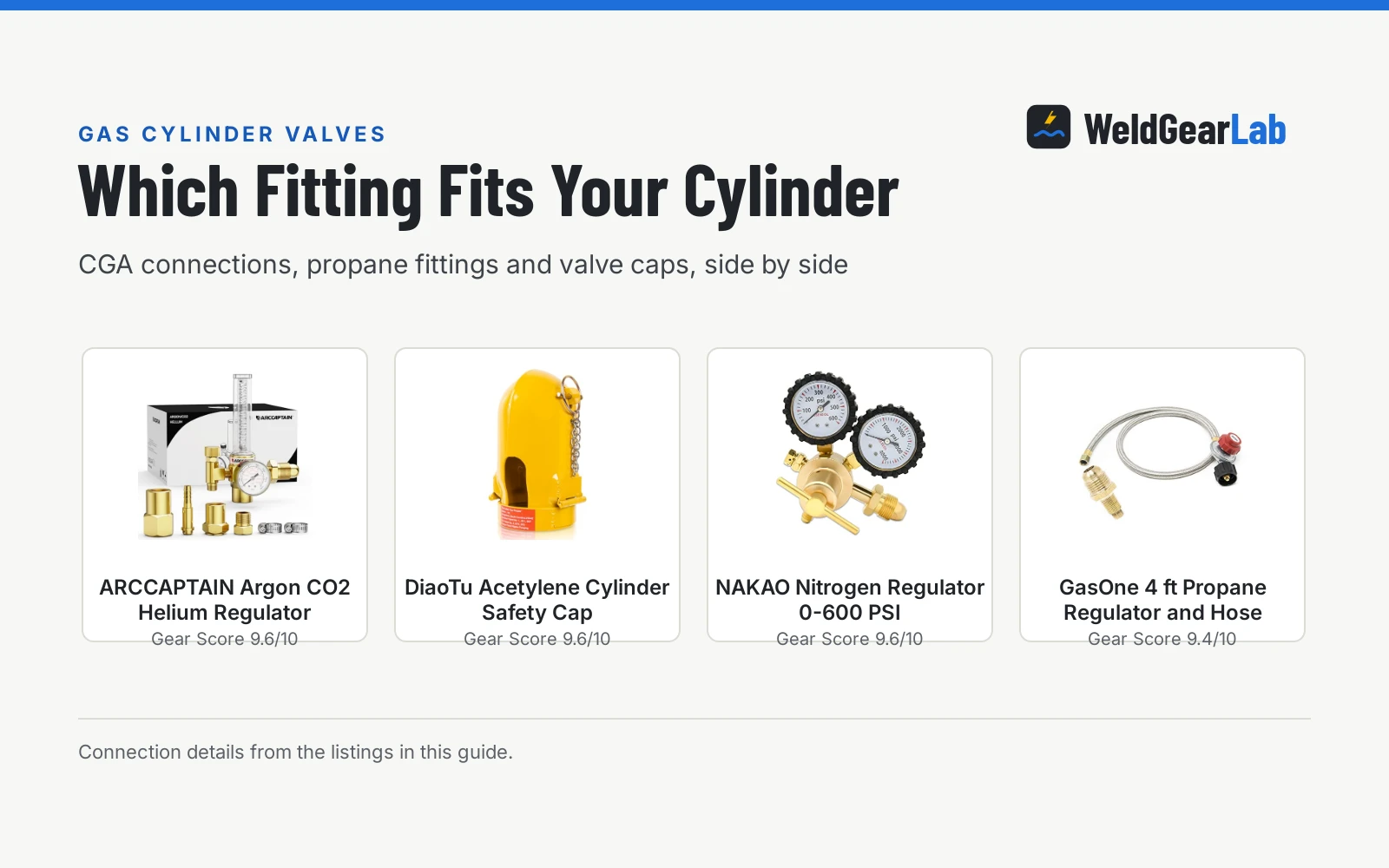
The valve sits at the top of the cylinder, inside the collar, and it is the part that opens and shuts off the gas. Turn the handwheel and gas flows from the shell into the regulator; shut it and the flow stops at the cylinder. The valve outlet carries a CGA number that names the fitting: CGA 580 covers nitrogen, argon and helium, while CGA 510 covers LP gas such as propane. That number has to match the regulator, because a regulator made for one CGA fitting will not seat on another. The gas cylinder valve types guide walks through the common valve styles.
The regulator
The regulator screws onto the valve and drops the pressure inside the cylinder down to a working pressure a torch or a MIG gun can use. Welding regulators are often single stage, which means the pressure drops in one step. The Preece Precision regulator (on Amazon) in the reference figures is a fixed flow model for nitrogen, argon and helium with a 150 PSI fixed flow outlet from a 1/4 inch NPT port and a CGA 580 inlet, plus a cylinder contents gauge that reads 0-3000 PSI. The Victor G250 regulator is a medium duty single stage model for LP gas with a 60 psig delivery range, a CGA 510 inlet, a 9/16”-18 outlet connection, and 2-inch gauges. Color coded knobs mark the gas on the Victor model.
Match the regulator to the gas and to the cylinder valve. A regulator rated for LP gas does not belong on an argon cylinder, and a fixed flow regulator gives a set flow instead of an adjustable range. See the can you use an acetylene regulator for propane guide before swapping a regulator between gases.
The gauges
The Preece Precision regulator lists a contents gauge that reads 0-3000 PSI, and the Victor G250 lists 2-inch gauges with high contrast faces. Read the contents gauge with the valve open and the torch shut to see what is left; where a delivery gauge is fitted, read it while gas is flowing to see the working pressure. A gauge that sits at zero with a full cylinder, or a needle that sticks, needs a swap before the next weld.
The safety cap
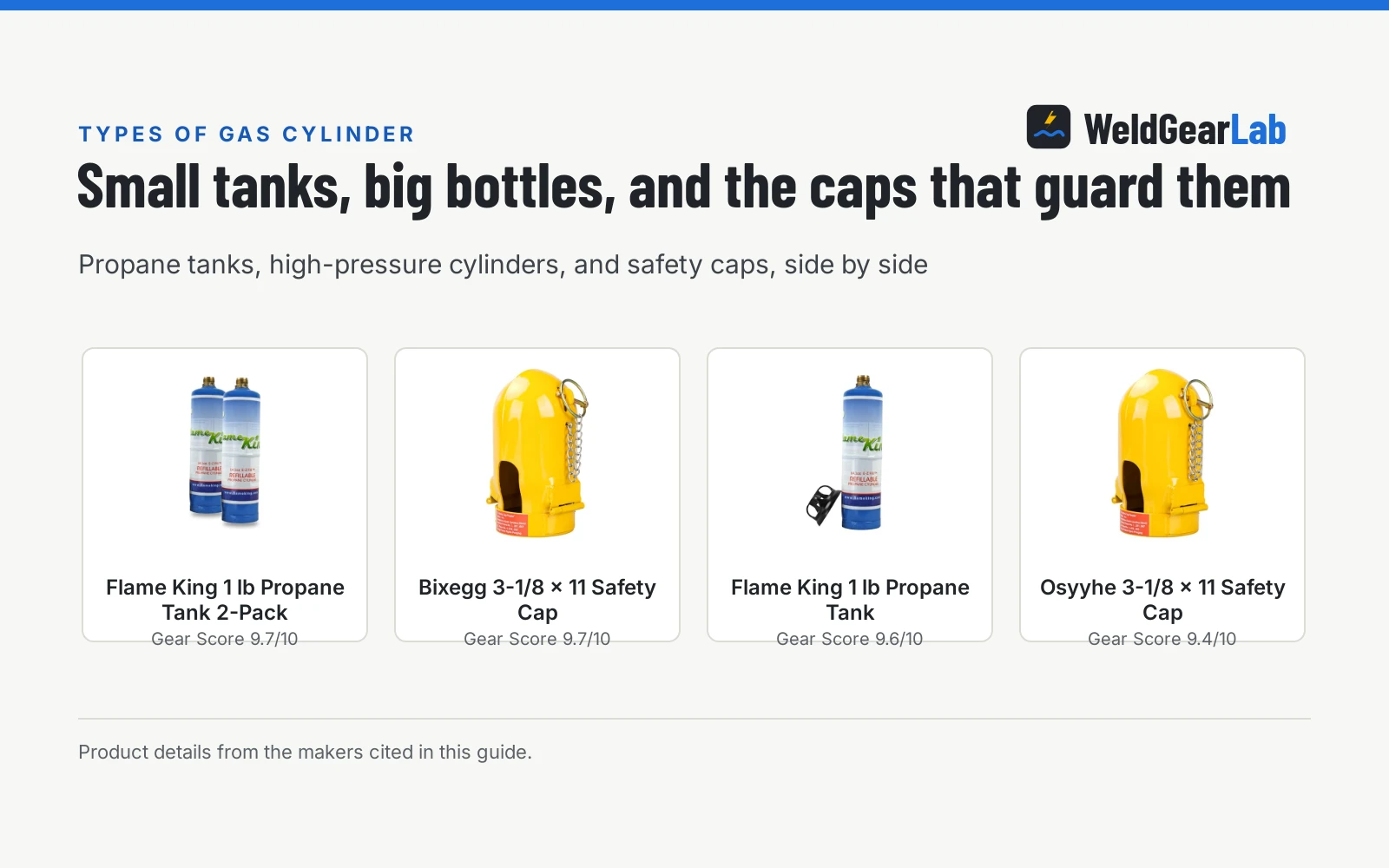
The safety cap threads onto the collar and guards the valve, the regulator and the threads when the cylinder is stored or moved. The yes dre cap (on Amazon) is cast iron, the Kinetry guard (on Amazon) is heavy-gauge steel, and the yes dre, Kinetry and Griftan caps come in a high visibility yellow finish. Some designs screw on and come off before the regulator goes on; the Kinetry GT-11 uses a 4-segment hinge that lets the cap stay open with the regulator and hoses still attached, compared with traditional 3-segment designs. The yes dre cap has a chain anchor that keeps the cap tied to the cylinder, and the Kinetry and Griftan caps take a #3 Master Lock through a slot or a lynch pin to lock the regulator against tampering.
Listed dimensions run from a compact 3.5 inches by 3.5 inches by 7.2 inches to a 6.0 inches by 6.0 inches by 11.0 inches cap, and the Griftan cap (on Amazon) lists 1.85 pounds. Warranties run from a 12-month replacement warranty to a 2-year warranty, with a one-year warranty on the DiaoTu cap (on Amazon).
Hoses and fittings
From the regulator outlet, a hose carries gas to the torch or the MIG gun. The Victor G250 lists a 9/16”-18 outlet connection, and the Preece Precision regulator lists a 1/4 inch NPT port. The fitting on the hose has to match the outlet on the regulator, and the hose has to suit the gas it carries. Check the thread before ordering a replacement hose.
How the parts fit together
Gas sits in the shell under pressure. The valve at the top opens the path out. The regulator screws onto the valve and steps the pressure down. The contents gauge shows the pressure left in the cylinder, and a delivery gauge, where the regulator has one, shows the working pressure. A hose from the regulator outlet feeds the torch or the gun. A screw-on safety cap threads onto the collar over the valve when the cylinder is stored or moved, and it comes off before the regulator goes on, while the hinged Kinetry guard stays on with the regulator and hoses still attached.
What to check before you weld
- Cap thread matches the collar. A 3-1/8 inch cap belongs on a 3-1/8 inch collar, and a 3-1/2 inch cap on a 3-1/2 inch collar, both at 11 threads per inch.
- Regulator CGA matches the valve. CGA 580 for nitrogen, argon and helium; CGA 510 for LP gas.
- Gauges read. The contents gauge should move when the valve opens.
- Cap back on for the move. The valve stays capped in storage and transport.
- Cylinder chained upright. A cylinder that tips can damage the valve, so keep it upright and chained to a cart or a wall.
FAQ for welders
What is the top part of a gas cylinder called?
The top of a cylinder holds the valve, the collar around it, and the safety cap that threads onto the collar. The valve opens and shuts off the gas, the collar gives the cap its thread, and the cap guards the valve in storage and transport. The regulator screws onto the valve outlet when the cylinder is in use.
What does a gas cylinder regulator do?
A regulator drops the pressure inside the cylinder down to a working pressure a torch or a MIG gun can use. A fixed flow model, like the Preece Precision regulator at 150 PSI, gives a set flow, while an adjustable model, like the Victor G250 with a 60 psig delivery range, lets the welder set the delivery pressure.
Do all gas cylinders use the same regulator?
No. The regulator has to match the gas and the valve fitting. CGA 580 covers nitrogen, argon and helium, and CGA 510 covers LP gas such as propane. A regulator made for one CGA fitting will not seat on another, so check the CGA number on the valve before buying a regulator.
What is a gas cylinder safety cap for?
The cap threads onto the collar and guards the valve, the regulator and the threads when the cylinder is stored or moved. Caps in the listings fit a 3-1/8 inch collar or a 3-1/2 inch collar with 11 threads per inch, and some add a chain anchor or a slot for a #3 Master Lock. Put the cap back on before the cylinder leaves the shop.
How do I know how much gas is left in a cylinder?
Read the cylinder contents gauge on the regulator with the valve open. The Preece Precision regulator lists a contents gauge that reads 0-3000 PSI, so a high reading means a full cylinder and a low reading means it is time to swap.
Related: types of gas cylinder used in welding, size K gas cylinder dimensions and storage, and the welding consumables hub.