Drill Press vs Hand Drill: Which One Should You Buy? (2026)
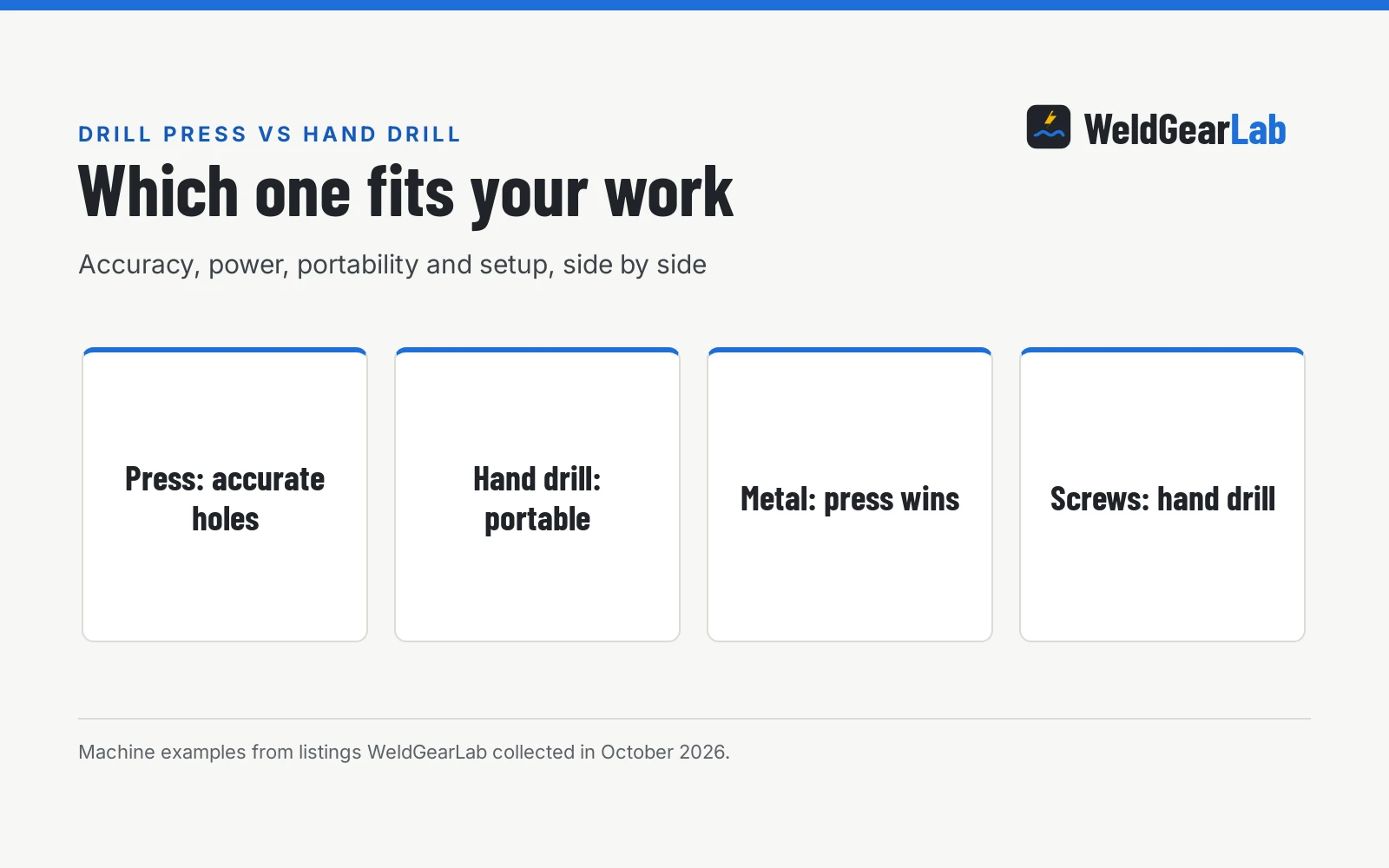
Drill press vs hand drill compared on accuracy, speed control, power, portability and depth, with three drills on the bench: a benchtop press, a cordless driver and a mini press.

On this page
Top picks at a glance
As an Amazon Associate I earn from qualifying purchases.
- 1
 BUCKTOOL 10-Inch Drill Press 6.2 Amp 3/4 HP Bench Drill Press9.7/10View on Amazon
- 2
 55-Piece Easy Out Screw Extractor Set with Broken Bolt9.5/10View on Amazon
- 3
 JET 12" Benchtop Drill PressView on Amazon
- 4
 VEVOR 12-Inch Benchtop Drill PressView on Amazon
- 5
 VEVOR 12 in Benchtop Drill PressView on Amazon
- 6
 VEVOR 10-Inch Benchtop Drill PressView on Amazon
- 7
 VEVOR 10 Inch Benchtop Drill Press 3.2 Amp Tabletop BenchView on Amazon
- 8
 VEVOR 10 in Benchtop Drill PressView on Amazon
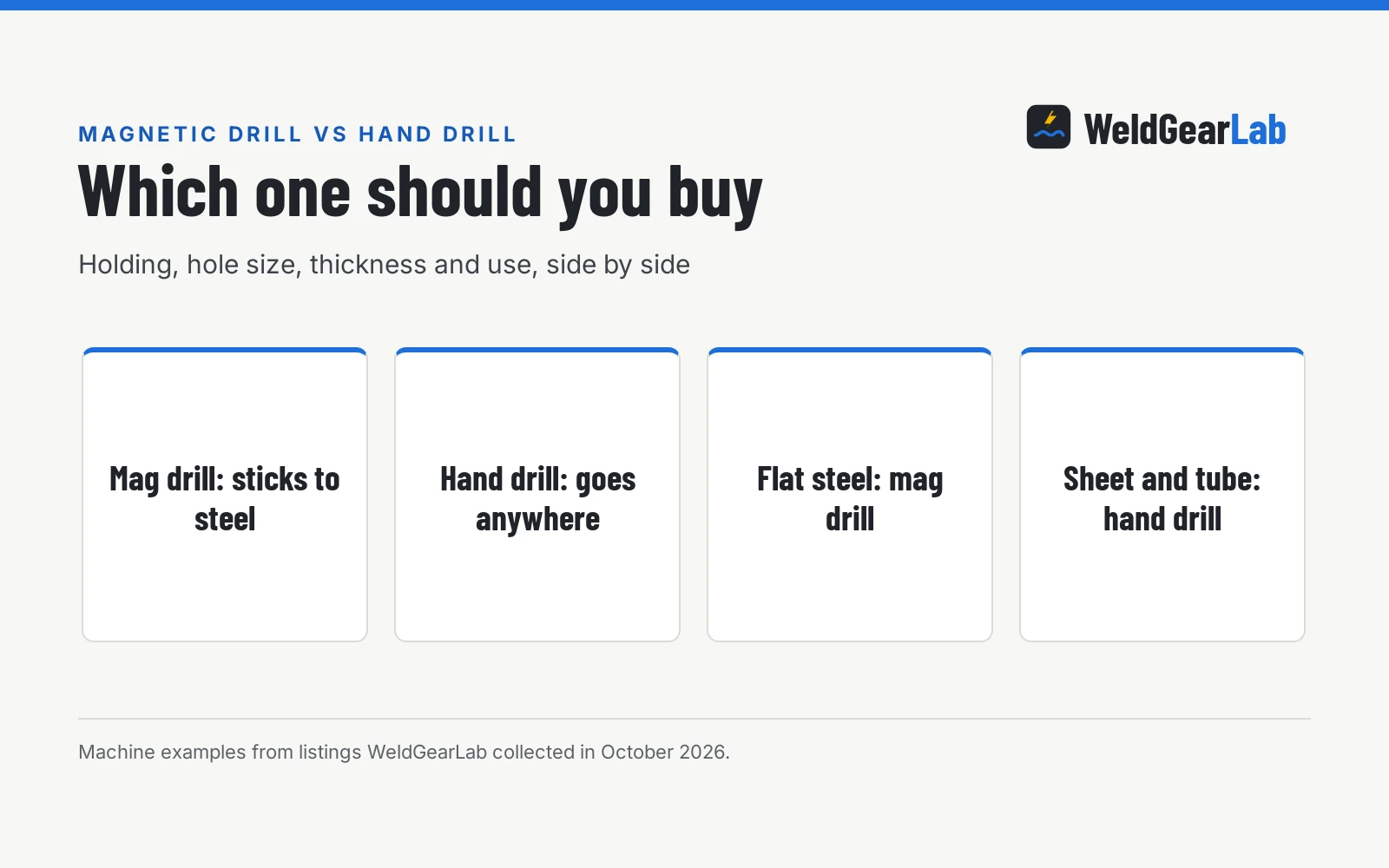
For drilling accurate, repeatable holes in metal, buy the drill press. For everything else, driving screws, quick holes on the job, work away from the bench, the hand drill wins. That split is the entire drill press vs hand drill decision: the press holds the bit square to the work and controls depth with a stop, while the hand drill goes where the work is and sets up in seconds. Most home shops end up with both, but the first purchase should match the work on the bench right now.
Other welders and gear to compare
 JET 12" Benchtop Drill PressCheck price on Amazon
 VEVOR 12-Inch Benchtop Drill PressCheck price on Amazon
 VEVOR 12 in Benchtop Drill PressCheck price on Amazon
 VEVOR 10-Inch Benchtop Drill PressCheck price on Amazon
 VEVOR 10 Inch Benchtop Drill Press 3.2 Amp Tabletop BenchCheck price on Amazon
 VEVOR 10 in Benchtop Drill PressCheck price on Amazon
This guide links to our product roundups, where WeldGearLab gets a commission on purchases made through links on this page, and your price stays the same. Read our affiliate disclosure.
Drill press vs hand drill in one paragraph
A drill press is a fixed spindle over a table: the motor, chuck and feed handle stay put while the positioned work rests on the table and the spindle feeds down into it. A hand drill is the same cutting action in a portable body: the operator aims the bit and supplies the feed pressure. That one difference, fixed versus freehand, decides hole accuracy, repeatable depth and whether the tool can leave the bench.
Side by side
| Drill press | Hand drill | Winner | |
|---|---|---|---|
| Hole accuracy | Table, fence and depth stop hold the bit square | Freehand; depends on the operator | Drill press |
| Speed control | Lever or belt, matched to bit and metal | Trigger plus two mechanical speeds | Drill press |
| Power | 1/2 HP corded on the JET; 710W on the mini press | 20V battery, 300 UWO on the DEWALT | Drill press |
| Portability | Bench-bound; 85 lb for the JET | 3.6 lb, goes anywhere | Hand drill |
| Chuck capacity | 5/8 in on the JET; 1.5 to 13 mm on the mini | 1/2 in on the DEWALT | Drill press |
| Depth control | Depth stop and linear scale | By feel or a tape flag | Drill press |
| Best for | Repeatable holes in metal and wood | Driving screws, quick holes anywhere | Depends on the job |
Speed, chuck and weight figures are the listings’ stated numbers. The JET’s spec table disagrees with its title and bullets on speed range, chuck size, travel and weight; go by the title and bullets. The DEWALT’s table lists two different torque figures; the review notes both.
When a drill press is the better choice
- Repeatable holes in metal. The table, fence and depth stop put every hole in the same place at the same depth. The JET adds a laser crosshair and a digital RPM readout for dialing in the cut.
- Correct speed for the bit. The JET shifts from 530 to 3,100 RPM without touching a belt, and the mini press runs 0 to 2,800 RPM in 6 speeds. Slow for big bits in steel, fast for small bits in wood.
- Depth control. A depth stop and linear scale beat a tape flag on the bit for blind holes and counterbores.
- Bigger bits. The JET’s 5/8 in chuck and 3-1/8 in travel handle bits a hand drill cannot feed straight.
When a hand drill is the better choice
- Portability. At 3.6 lb on a 20V battery, the DEWALT drills where the press cannot go: ladders, fences, engine bays.
- Driving fasteners. Two speeds, 0 to 450 and 1,500 RPM, cover driving and drilling without a bit change ritual.
- Speed of setup. No bench, no clamping, no speed change. Pick it up, drill, put it down.
- Tight spots. The compact body fits between studs and inside cabinets where a press cannot reach.
Pair either drill with the right bits: the best drill bits for steel covers the options, and titanium vs cobalt drill bits sorts the coatings.
Three drills on the bench
The three listings behind this comparison, ranked by their scores.
JET JWDP-12: the full-size press
A 12 in benchtop drill press with 530 to 3,100 RPM on a speed lever and digital readout, a 5/8 in keyed chuck, 3-1/8 in spindle travel and a 1/2 HP, 115V motor drawing 5A. The 10 by 16-1/8 in cast iron base and tilting table, laser crosshair and LED light suit bench metalwork, and the listing states a 5-year JET warranty. It weighs 85 lb and must be bolted to a bench. Note the spec table disagrees with the title on speed range, chuck size, travel and weight; the title wins.
DEWALT DCD771C2: the cordless hand drill
A 20V Max XR drill driver kit rated at 300 UWO, with a two-speed transmission at 0 to 450 and 1,500 RPM and a 1/2 in single-sleeve ratcheting chuck. It weighs 3.6 lb, the title includes the battery and charger, and the listing states a 3-year limited warranty. The table lists 650 in-lb maximum torque against a 530 in-lb torque field; both figures are in the listing.
BACHIN mini press: the light-duty press
A 710W benchtop mini press with 0 to 2,800 RPM across 6 speeds, a 1.5 to 13 mm chuck and a cast iron base, weighing 11.4 lb. Drilling capacity is stated at 30 mm in wood and 8 mm in metal. No warranty term or safety certification is stated. It suits light drilling in small shops, not serious metalwork.
Chips, sparks and clamping. A drill press throws hot chips; wear eye protection and clamp small parts instead of holding them by hand. A hand drill can grab and spin the work if the bit binds, so keep the auxiliary handle on and your body out of the spin path. Keep flammables clear of the bench either way.
FAQ for welders
Can a hand drill replace a drill press?
For rough holes and driving, yes. For accurate, square, repeatable holes in metal, no: the press holds the bit square to the work with a depth stop, and freehand drilling cannot repeat that. Most shops keep the hand drill for field work and the press for bench work.
What speed should I drill metal at?
Slower than wood, and slower for bigger bits. The JET’s 530 to 3,100 RPM range and the mini press’s 0 to 2,800 RPM exist so the speed can match the bit and the metal; the DEWALT’s two speeds, 0 to 450 and 1,500 RPM, cover the slow and fast ends. When in doubt, start slow and watch the chip color.
Do I need special bits for a drill press?
No, but the press rewards good bits. Standard twist bits work; the listings’ chuck capacities are 5/8 in on the JET, 1.5 to 13 mm on the mini press and 1/2 in on the DEWALT. A dull bit in a press just makes an accurate bad hole.
Is a benchtop drill press enough for a home shop?
For most home metalwork, yes. The JET’s 12 in swing and 3-1/8 in travel cover brackets, plates and hobby parts; it must be bolted to a bench. The mini press suits light drilling in small shops at 11.4 lb.
Can I use a drill press to drive screws?
It works but it is the wrong tool: no clutch, no reverse finesse, and the setup takes longer than the job. The hand drill’s low gear and trigger control are built for driving.
Related: best drill press for home garage, benchtop vs floor standing drill press, drill press vs mill and best drill press vise.