Best Drill Press Vise (2026): 5 Picks Scored for the Shop
Five cast iron drill press vises compared on jaw width, throat depth, jaw opening, clamping force, mounting slots, and stated manufacturer warranty.

On this page
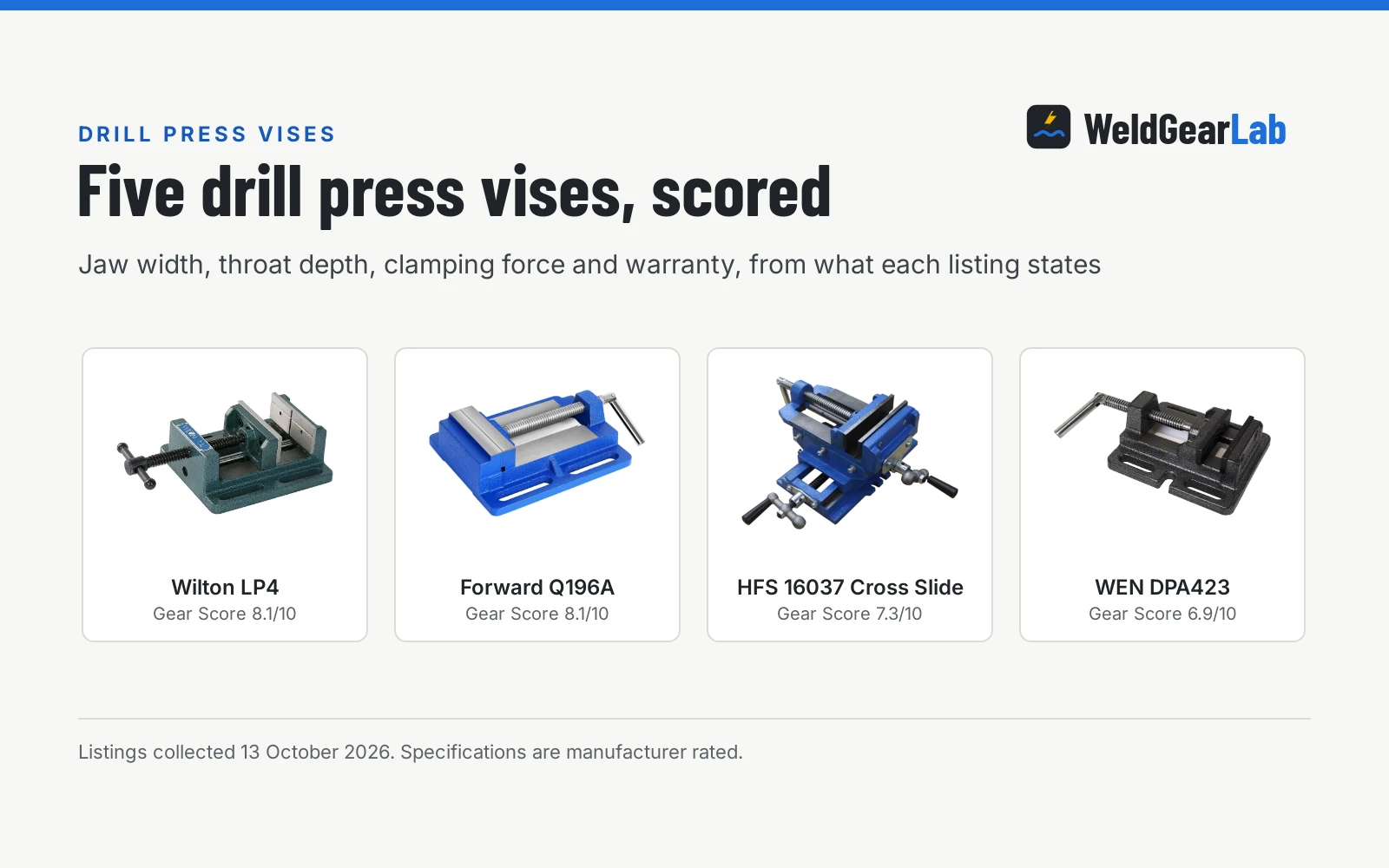
Top picks at a glance
As an Amazon Associate I earn from qualifying purchases.
- 1
 Best OverallWilton LP49.6/10View on Amazon
- 2
 Largest CapacityForward Q196A9.6/10View on Amazon
- 3
 Best Cross SlideHFS 16037 Cross Slide9.5/10View on Amazon
- 4
 Most CompactWEN DPA4239.4/10View on Amazon
When you need to drill clean, perpendicular holes in flat bar, angle iron, or round tubing before tack welding a project together, holding metal by hand on the drill press table invites dangerous catches and ragged holes. Clamping your stock in the best drill press vise keeps workpieces rigid, keeps your hands away from cutting flutes, and delivers repeatable hole alignment on every pass. This guide compares five cast iron vises across Amazon listings on jaw width, throat depth, clamping force, mounting slots, and stated manufacturer warranties to help you pick the right clamping tool for your metalworking bench.
WeldGearLab gets a commission on purchases made through links on this page, and your price stays the same. Read our affiliate disclosure.
Quick picks
- Best Overall Wilton LP4: A stated lifetime warranty, fine grain cast iron build, hardened V-grooved jaws for round stock, and 4-inch capacity. Check price on Amazon
- Largest Capacity Forward Q196A: A 6-inch jaw width with 5.43-inch opening, stated 30,000 PSI cast iron, and about 2640 lbs clamping force. Check price on Amazon
- Best Cross Slide HFS 16037 Cross Slide: Two crank handles offering 5 inches of longitudinal and 3.5 inches of cross travel for compound positioning on the drill press table. Check price on Amazon
- Most Compact WEN DPA423: A 3-inch jaw opening to 3-1/10 inches with 4 onboard mounting slots and a stated weight of 2.21 kg. Check price on Amazon
The machines
Wilton Low-Profile Drill Press Vise, 4" Jaw Width
A low-profile cast iron drill press vise with hardened V-grooved jaws, 4-inch jaw width, and a stated lifetime warranty.
Pros
- Backed by a stated manufacturer lifetime warranty
- Hardened V-grooved steel jaws hold round stock vertically and horizontally
- Low-profile casting leaves more vertical clearance under the drill chuck
- Fine grain cast iron body weighs 11.6 pounds for stability
Cons
- Tensile strength listed at only 1000 psi in the spec table
- Listing contradicts itself, showing 4-inch jaws in the title but 3-inch jaws in the spec table

Forward Q196A 6 Inch Drill Press Vise Portable
A 6-inch drill press vise featuring 30,000 PSI cast iron, a 5.43-inch jaw opening, and about 2640 lbs of clamping force.
Pros
- Largest jaw capacity here with a 6-inch width and 5.43-inch opening
- High-strength cast iron rated at 30,000 PSI tensile strength
- Serrated jaw plates generate a stated clamping force of about 2640 lbs
- Slotted base allows versatile bolt-down positioning across drill press tables
Cons
- No warranty term is stated in the listing
- Jaw height is relatively shallow at 1.06 inches
- At 11 pounds, the casting is lightweight for a 6-inch vise
- Listing designates it for light duty tasks despite the wide 6-inch jaws

HFS(R) 2 Way 4-Inch Drill Press X-Y Compound Vise
A 2-way cross-slide drill press vise with 4-inch jaws, offering 5 inches of longitudinal and 3.5 inches of cross travel.
Pros
- Dual-axis compound travel with 5-inch longitudinal and 3.5-inch cross adjustments
- Two swivel crank handles allow fine workpiece repositioning without unclamping
- Heaviest vise in the group at 15 pounds for stable tabletop mounting
- Serrated steel jaws and cold rolled steel lead screws
Cons
- No warranty term is stated in the listing
- Throat depth is not specified in the listing
- Tensile strength is listed at only 1000 psi in the spec table

WEN Drill Press Vise, 3-Inch (DPA423)
A compact 3-inch cast iron drill press vise with a 3-1/10-inch jaw opening, 1-inch throat depth, and 4 mounting slots.
Pros
- Compact footprint ideal for smaller drill press tables
- Four onboard mounting slots for flexible bolt-down alignment
- Jaws open up to 3-1/10 inches with a 1-inch throat depth
- Solid cast iron construction from a recognized power tool brand
Cons
- No warranty term is stated in the listing
- Lightest vise in the group at 2.21 kg
- Narrower 3-inch jaw width limits workpiece size
- Clamping force and tensile strength are not stated

PONY Drill Press Vise, 4-inch
A 4-inch cast iron drill press vise from Pony with basic mounting flanges and compact dimensions.
Pros
- Cast iron construction in high visibility orange finish
- 4-inch jaw width suitable for mid-sized drilling tasks
- Compact overall dimensions of 7 x 2.38 x 9.25 inches
- Includes a published manufacturer product information guide
Cons
- Jaw opening and throat depth are not stated in the listing
- Item weight is not stated in the specification table
- Bullet points provide no technical specifications or feature details
Other welders and gear to compare
 Wilton Low-Profile Drill Press ViseCheck price on Amazon
 WEN Drill Press ViseCheck price on Amazon
 MYTEC Drill Press ViseCheck price on Amazon
 VEVOR Drill Press ViseCheck price on Amazon
 Drill Press ViseCheck price on Amazon
Spec sheet comparison
| Model | Gear Score | Jaw width | Jaw opening | Throat depth | Material | Item weight | Warranty |
|---|---|---|---|---|---|---|---|
| Wilton LP4 | 9.6/10 | 4 in (title) / 3 in (table) | 4 in (title) / 3 in (table) | 1-1/2 in (title) / 1-1/8 in (table) | Cast iron, hardened steel | 11.6 lb | Lifetime |
| Forward Q196A | 9.6/10 | 6 in | 5.43 in | 1.06 in | Cast iron (30,000 psi) | 11 lb | Not stated |
| HFS 16037 Cross Slide | 9.5/10 | 4 in | 3.5 in | Not stated | Cast iron, steel jaws | 15 lb | Not stated |
| WEN DPA423 | 9.4/10 | 3 in | 3-1/10 in | 1 in | Cast iron | 2.21 kg | Not stated |
| PONY 29058 | 9.3/10 | 4 in | Not stated | Not stated | Cast iron | Not stated | Not stated |
Ratings in this table are the makers’ own claims taken from each product page (13 October 2026).
Buying guide: how to choose the best drill press vise
Jaw width and opening capacity
Jaw width determines the maximum contact area across your workpiece, while jaw opening dictates the thickest stock you can clamp. For general metalworking and fab work, a 4-inch jaw width handles most plate, angle iron, and brackets. If you frequently clamp larger weldments or wide structural pieces, a 6-inch vise like the Forward Q196A provides up to 5.43 inches of jaw opening. For compact benchtop drill presses, a 3-inch vise such as the WEN DPA423 saves space while offering 3-1/10 inches of opening capacity.
Cast iron build and tensile strength
Drill press vises rely on heavy cast iron bodies to dampen vibration and resist deflection under clamping pressure. Most standard shop vises use gray cast iron with modest tensile ratings. Forward publishes a 30,000 PSI tensile strength for its Q196A casting, giving it higher resistance to cracking under heavy screw pressure. Wilton uses fine grain cast iron castings with hardened steel jaw inserts. Heavier vises such as the 15-pound HFS cross slide also stay seated firmly on the table during drilling.
Base slots and tabletop mounting
Never operate a drill press with an unbolted vise when drilling metal. A drill bit catching on the exit side of a through-hole will spin an unsecured vise with tremendous rotational force. Look for wide mounting flanges with elongated slots that match the T-slots or through-slots on your machine table. The WEN DPA423 provides 4 onboard mounting slots for flexible bolt positioning, while the Wilton and Forward models feature generous side slots designed for standard hold-down clamps.
V-grooves versus serrated jaws
Standard drill press vises come with smooth or serrated steel jaw faces. Serrated jaws, such as those on the Forward and HFS models, dig into hot rolled steel and structural tubing for high friction grip under torque. If you frequently drill round bar, pipe, or tubing, Wilton’s LP4 includes precision-machined vertical and horizontal V-grooves in its hardened jaws. These V-grooves cradle round workpieces on multiple contact lines to keep them from rolling or twisting under the drill bit.
Standard vises versus cross-slide compound models
A standard drill press vise holds work at a fixed location, requiring you to loosen table clamps or slide the vise manually to center each new hole. A compound cross-slide vise like the HFS 16037 features two perpendicular lead screws with hand cranks, providing 5 inches of longitudinal travel and 3.5 inches of cross travel. This compound movement allows precise workpiece positioning along X and Y axes without releasing jaw clamping pressure, which helps when laying out hole patterns or stepping along a line.
Use as directed. Always clamp the vise securely to the drill press table slots using proper T-bolts or step clamps before starting the motor. Never hold a drill press vise by hand while drilling metal, as a catching bit can spin the tool violently and cause serious injury. Wear safety glasses or a face shield, clear metal chips with a brush rather than bare hands, and never exceed stated jaw capacity. See the OSHA welding overview and our Safety Disclaimer.
Before You Strike an Arc
Before you clamp your first workpiece and start drilling holes for your fabrication project, run through these quick setup and arrival checks:
- Inspect the casting on arrival for shipping cracks, rough parting lines, or burrs along the base and jaw faces before mounting it to your machine table.
- Wipe off factory shipping grease, check lead screw rotation for binding, and apply clean light machine oil along the screw threads and sliding ways.
- Align mounting bolts with your drill press table slots to confirm the vise base sits flat and level without rocking against table ribs or burs.
- Close the jaws completely and check that the jaw plates meet squarely across their full width before clamping critical metal parts.
FAQ for welders
What is a drill press vise?
A drill press vise is a specialized mechanical clamping tool engineered to secure workpieces firmly to the table of a drill press. Unlike a woodworking bench vise, it features a low, flat-bottomed base with side mounting slots that bolt down to machine table T-slots. Clamping work in a vise prevents metal stock from catching on the spinning bit and spinning out of control.
How do I use a drill press vise safely?
Always bolt the drill press vise directly to the machine table using T-slot bolts or step clamps before switching on the power. Never hold a vise with your hands while drilling, because drill bits frequently catch as they break through the bottom of the cut, which can whip the vise violently. Keep fingers clear of the cutting zone and remove swarf with a chip brush rather than bare fingers.
Can I use a drill press vise for milling?
Drill press vises and drill presses are engineered primarily for axial, downward thrust rather than lateral side loads. Most drill press spindles use Morse taper arbors that can loosen and fall out under the radial vibration of an end mill. While a cross-slide vise allows precise two-axis positioning for hole layouts, avoid heavy milling operations on a standard drill press.
How do I choose between a standard vise and a cross-slide vise?
A standard drill press vise is lighter, sits lower on the table, and offers rigid, straightforward clamping for drilling single holes or batch parts. A cross-slide compound vise adds two lead screws that move the vise along X and Y axes without loosening table clamps. Choose a cross-slide model if you need to drill precise hole patterns or line boring across a single plate setup.
Why do some drill press vises feature V-grooves in the jaws?
V-grooves machined horizontally and vertically into vise jaws allow round bar stock, pipe, and tubing to be clamped without slipping or rotating. Flat jaws contact round workpieces at only two tangent points, which can easily slip under high drill torque. The V-groove provides three-point contact that locks round materials securely in place.
Related: best drill press for metalworking, drill press vs mill, and the metal fab tools hub. Also see our types of welding clamps. Also see our angle clamps for welding. Also see our quick clamps for welding.
Scoring, line by line
Each vise is scored out of 10 on performance, build, value, safety listing, and warranty, with the weights published on our How We Pick page. Drill press vises are unpowered mechanical clamping tools with no electrical safety listings to publish, so every vise here scores zero on that criterion; the ranking comes from the other four categories.
| Product | Gear Score | Perf. /35 | Build /25 | Value /25 | Safety /10 | Warranty /5 |
|---|---|---|---|---|---|---|
| Wilton LP4 | 9.6 | 28 | 21 | 20 | n/a | 3 |
| Forward Q196A | 9.6 | 30 | 22 | 22 | n/a | 0 |
| HFS 16037 Cross Slide | 9.5 | 26 | 20 | 20 | n/a | 0 |
| WEN DPA423 | 9.4 | 23 | 19 | 20 | n/a | 0 |
| PONY 29058 | 9.3 | 20 | 18 | 18 | n/a | 0 |
The lowest score we show is 9.2 and the highest is 9.8; every point total is spread proportionally across that span, so extra points mean a higher figure. Safety points apply to gear that runs on power or lists safety features. Without either, we score out of 90 instead of 100.