Drill Press Vise vs Cross Slide Vise (2026)
Drill press vise vs cross slide vise: when each wins, plus four drill press vises compared by jaws, mounting and features.

On this page
Top picks at a glance
As an Amazon Associate I earn from qualifying purchases.
- 1
 Wilton Low-Profile Drill Press Vise9.6/10View on Amazon
- 2
 Wilton Low-Profile Drill Press ViseView on Amazon
- 3
 WEN Drill Press ViseView on Amazon
- 4
 MYTEC Drill Press ViseView on Amazon
- 5
 Wilton Industrial Drill Press ViseView on Amazon
- 6
 Wilton Cam-Action Drill Press ViseView on Amazon
- 7
 Drill Press ViseView on Amazon
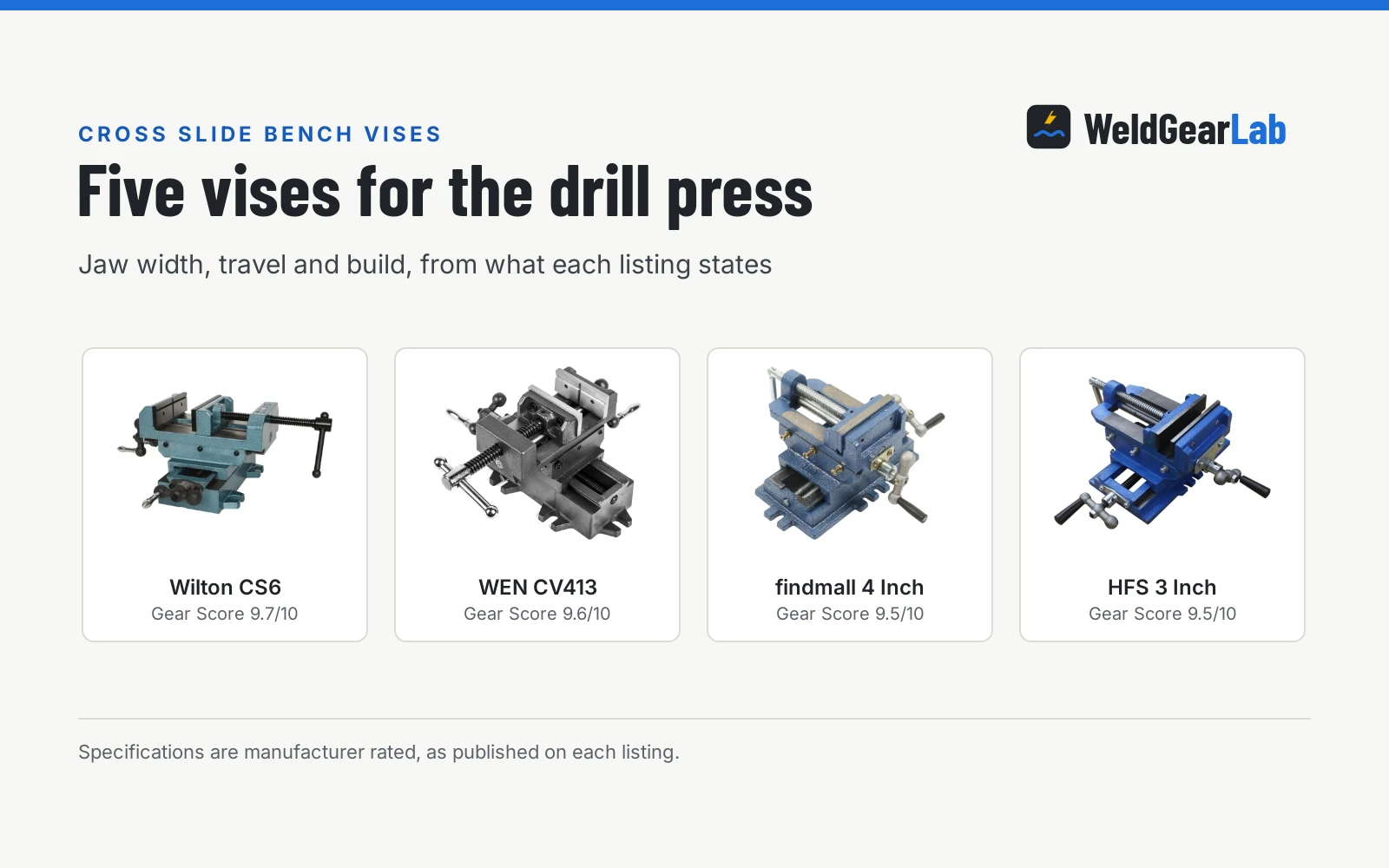
Drill press vise vs cross slide vise: a drill press vise clamps the workpiece in one fixed position for drilling, while a cross slide vise adds X-Y slides that move the workpiece under the bit for precise hole placement. For basic drilling, the drill press vise is enough; for repeated hole patterns or light milling, the cross slide vise earns its keep. This guide answers the question and shows four drill press vises, using only what each listing states.
Other welders and gear to compare
 Wilton Low-Profile Drill Press ViseCheck price on Amazon
 WEN Drill Press ViseCheck price on Amazon
 MYTEC Drill Press ViseCheck price on Amazon
 Wilton Industrial Drill Press ViseCheck price on Amazon
 Wilton Cam-Action Drill Press ViseCheck price on Amazon
 Drill Press ViseCheck price on Amazon
WeldGearLab gets a commission on purchases made through links on this page, and your price stays the same. As an Amazon Associate I earn from qualifying purchases. Affiliate disclosure.
What each vise does
A drill press vise bolts to the drill press table and holds the workpiece steady while the bit comes down. A cross slide vise does the same but adds two hand cranks that slide the jaws left-right and front-back, positioning the work precisely under the spindle. The cross slide is a drill press vise plus a positioning table.
When the drill press vise wins
Simple drilling: clamp once, drill, done. The Wilton’s low profile gives working room on the table; the Performance Tool’s etched jaws prevent slipping; the WEN’s mounting slots fasten to the table; the MYTEC’s quick-position button clamps in one second. For through-holes and tapping, the plain vise is faster and more rigid.
When the cross slide vise wins
Hole patterns: the X-Y cranks move the work between holes without unclamping. Light milling on a drill press: the slides position the cut. Any job where the bit must hit exact coordinates: the cross slide’s dials beat eyeballing. The trade is rigidity: slides add moving parts, so the cut is less rigid than a fixed vise.
Jaw size and opening
Stated jaw widths: 6 in (Wilton, per its title; its spec table lists 3 in, a contradiction we note), 4 in (WEN), 2-1/2 in (Performance Tool), 3.0 in (MYTEC). Jaw opening: 6 in (Wilton title), 4 in (WEN), 2-1/2 in (Performance Tool). Match the vise to the work: the jaw must open wider than the workpiece. Stated jaw openings here run from 2-1/2 in on the Performance Tool to 6 in on the Wilton title, so match the opening to the workpiece.
Jaw features
The Wilton states hardened V-grooved jaws that hold round stock vertically and horizontally. The Performance Tool states etched jaws to prevent slipping and a pivot handle for easier tightening. The MYTEC states a quick-position button with a locking function. V-grooves suit round stock; etched jaws suit flat stock.
Mounting
The WEN states four onboard mounting slots to fasten the vise to the drill press table. The other listings state no mounting details. A vise that is not bolted down can walk under load: mounting slots are the feature that keeps it put.
Weight and stability
Stated weights: 30 pounds (Wilton, per its spec table Item Weight), 2.75 lb (Performance Tool), 3.2 kg (WEN), 4.5 lb net per its bullets (MYTEC, whose spec table lists 2.33 kg, a contradiction we note). Heavier vises resist walking under load. Weight is a proxy for rigidity: more iron, less flex.
Materials
The Wilton states fine grain cast iron castings with hardened steel jaws; the Performance Tool states heavy-duty cast iron; the WEN states cast iron; the MYTEC states high-grade cast steel with 1120 lb tensile strength. Cast iron damps vibration; the hardened jaws resist wear. For a vise that lasts, the jaw hardness matters more than the body.
The drill press vise vs cross slide vise choice, side by side
| Vise | Jaw Width | Jaw Opening | Standout |
|---|---|---|---|
| Wilton LP6 | 6 in (title) | 6 in (title) | Limited lifetime warranty |
| WEN DPA424 | 4 in | 4 in | Four mounting slots |
| Performance Tool W3939 | 2-1/2 in | 2-1/2 in | Etched jaws, pivot handle |
| MYTEC quick-position | 3.0 in | Not stated | One-second quick button |
The gear: four drill press vises
Wilton LP6 low-profile vise
The Wilton LP6 states a low-profile design for working room, hardened V-grooved jaws, fine grain cast iron castings and hardened steel jaws, backed by Wilton’s limited lifetime warranty. Its title states 6 in jaw width, 6 in opening and 2 in depth, though its spec table lists 3 in figures, a contradiction we note. The warranty and the name make it the top pick.
WEN 4 in drill press vise
The WEN DPA424 states 4 in jaws opening to 4 in with a 1 in throat depth, cast iron construction, four mounting slots and universal drill press compatibility. The mounting slots are the standout: bolt it down and it stays.
Performance Tool W3939 vise
The Performance Tool W3939 states 2-1/2 in jaw width and opening, 1-1/16 in throat depth, etched jaws, a pivot handle and heavy-duty cast iron construction at 2.75 lb. The compact pick for small drill presses.
MYTEC quick-position vise
The MYTEC states a one-click quick-position button for one-second clamping and release, a locking function, high-grade cast steel, 4.5 lb net weight and 1120 lb tensile strength. The quick button is the feature: press and push the jaws, no cranking.
Safety
Bolt the vise to the table: an unbolted vise can spin with the bit if it grabs. The listings state no safety certifications. Keep hands clear of the bit, and clamp small parts: never hold work by hand under a drill press.
FAQ for welders
Do I need a cross slide vise?
Only for precise hole placement or light milling. For basic drilling, a drill press vise is enough and more rigid.
What size vise for my drill press?
Match the jaw opening to the work: stated openings here are 6 in on the Wilton title, 4 in on the WEN and 2-1/2 in on the Performance Tool. Check the table slots against the vise base.
Which has a warranty?
The Wilton states a limited lifetime warranty. The others state no warranty term.
How do I keep the vise from moving?
Bolt it down. The WEN’s four mounting slots are made for this; the other listings state no mounting details, so check the base against your table’s slots. A vise that walks ruins the work and risks the bit grabbing.
Can I mill with a drill press vise?
Lightly. A drill press is not a mill: side loads wear the spindle. The cross slide helps positioning but not rigidity.
Related: our metal fab tools hub and our safety notes.