Bench Vise vs Drill Press Vise: Which One Should You Buy?
A bench vise holds work on the bench for sawing, grinding and tapping, while a drill press vise mounts on the drill press table for drilling.

On this page
Top picks at a glance
As an Amazon Associate I earn from qualifying purchases.
- 1
 VEVOR Bench Vise 8 Inch Jaw Width Multipurpose with9.7/10View on Amazon
- 2
 VEVOR Drill Press ViseView on Amazon
- 3
 MYTEC Drill Press ViseView on Amazon
- 4
 Nagpew Drill Press ViseView on Amazon
- 5
 WhiteRhino Mini Vise ClampView on Amazon
- 6
 WEN Drill Press ViseView on Amazon
- 7
 VEVOR 6 Inch ACCU Lock Down Vise Precision Milling Vice 6View on Amazon
A part that needs a clean drilled hole wants a vise that mounts on the drill press table and holds the work steady under the bit, while a part that needs sawing, grinding or tapping wants a vise on the bench where you can work around it. That mounting difference is the heart of bench vise vs drill press vise: a drill press vise is a vise made to sit on the drill press table, and a bench vise is a general holding vise kept on a bench. This guide compares the two types and ranks three drill press vises from the listings by jaw width, opening, clamping force, material and mounting.
Other welders and gear to compare
 VEVOR Drill Press ViseCheck price on Amazon
 MYTEC Drill Press ViseCheck price on Amazon
 Nagpew Drill Press ViseCheck price on Amazon
 WhiteRhino Mini Vise ClampCheck price on Amazon
 WEN Drill Press ViseCheck price on Amazon
 VEVOR 6 Inch ACCU Lock Down Vise Precision Milling Vice 6Check price on Amazon
This guide links to our product roundups, where WeldGearLab gets a commission on purchases made through links on this page, and your price stays the same. Read our affiliate disclosure.
Bench vise vs drill press vise in one paragraph
A bench vise mounts to a bench and holds work for general shop tasks. The listed vises name sawing, grinding, cutting, tapping, reaming and machinery maintenance among their uses. A drill press vise mounts to the drill press table and holds the piece steady under the bit while you drill. Two of the three listings here state a slotted base for that mounting. The three listings here are all drill press vises, and each one also names bench and workbench use, which is why the two names get mixed up: the difference is where the vise mounts and what job it holds for, not the brand on the jaw.
Side by side
| MYTEC drill press vise | VEVOR drill press vise | Nagpew drill press vise | |
|---|---|---|---|
| Jaw width | 4.0 inch | 4 inch | Not stated |
| Jaw opening | 4.29 inch | Not stated | 4.3 inch |
| Jaw depth | 0.87 inch | Not stated | Not stated |
| Weight | 6.5 pounds | 5.29 pounds | Not stated |
| Material | Cast steel | Cast iron | Cast iron body, 45 steel jaw and pivot |
| Mounting | Workbench and drill press | Slotted base | Slotted base |
| Handle | Pivot handle | Labor-saving handle | Pivot handle |
| Stated holding strength | Supports up to 1500 lbs | Up to 7KN clamping force | Not stated |
Figures are as stated in each listing. Where a listing states nothing for a cell, the table says Not stated rather than borrowing a figure from another vise.
When a bench vise is the better choice
- General bench work. These listings name sawing, grinding, cutting, tapping, reaming and gluing as uses, and a bench vise holds the piece where you can work around it.
- Work that is not drilling. Cutting, gluing, tapping and reaming are bench jobs in these listings, and they do not need a drill press table under the vise.
- A fixed shop station. A vise kept mounted on the bench stays ready for the next job, instead of moving a vise on and off the drill press table.
See our clamp on vs bolt down bench vise guide for mounting styles.
When a drill press vise is the better choice
- Drilling on the drill press. The VEVOR and Nagpew vises mount through a slotted base to the drill press table and hold the piece steady under the bit.
- Milling and shaping machines. The VEVOR listing names milling machines, shaping machines and surface grinders as fits.
- Low clearance work. The Nagpew vise is a low profile vise, 2 inches high, for drill presses where headroom under the bit is tight.
- Quick changes. The MYTEC vise adds a quick positioning button that clamps and releases in one second, plus a locking function so the jaws do not slide off the spindle.
See our bench vise vs C clamp guide for another holding comparison.
Three vises from the listings, ranked
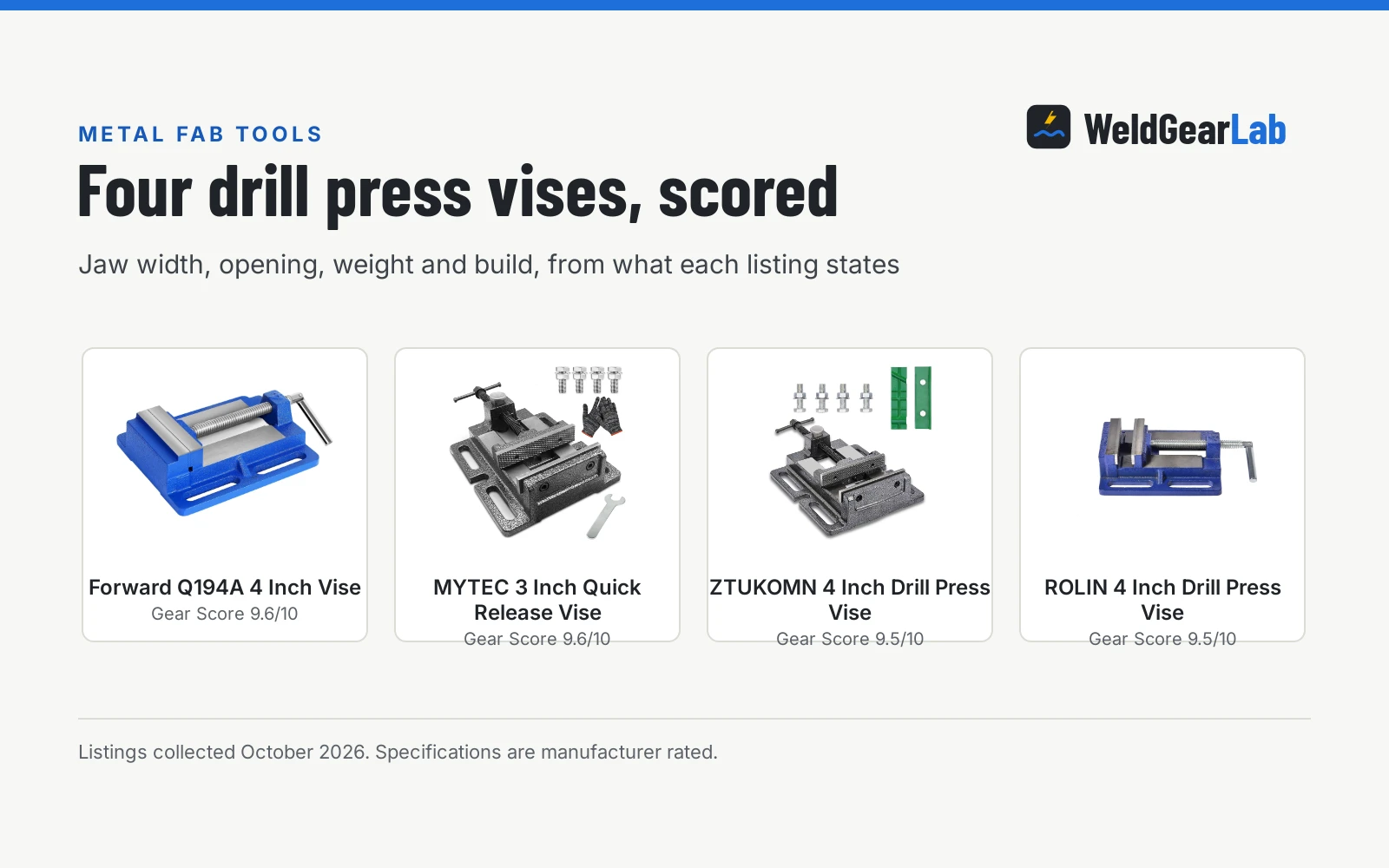
Top ranked: MYTEC drill press vise. The listing states a 4.0 inch jaw width, a 4.29 inch maximum opening, a 0.87 inch jaw depth, cast steel construction, hardened steel jaws, a pivot handle, a quick positioning button with a locking function, and support for up to 1500 lbs. It ranks first here because it states the widest set of usable details: opening, depth, locking and supported weight. One contradiction: the bullets list a net weight of 6.5 pounds while the spec table lists a different figure, so this guide uses the bullet figure, trusting the bullets over the spec table.
Next: VEVOR drill press vise. The listing states a 4 inch jaw width, cast iron construction, anti-slip textured jaws, up to 7KN of clamping force, dual long slots on both sides for mounting, and a labor-saving handle, with a listed weight of 5.29 pounds and dimensions of 8.66 inches by 6.5 inches by 2.28 inches. It ranks second because the clamping force and slotted base are stated clearly, but no jaw opening is stated.
Last: Nagpew drill press vise. The listing states a 4.3 inch widest jaw opening, a size of 8 inches long by 6.5 inches wide by 2 inches high, a cast iron body with jaw and pivot in 45 steel, a pivot handle, a slotted base and a blue oil-painted surface. It ranks third because it states no weight and no clamping force, so two of the comparison points stay unstated.
Clamping and drilling safety. Clamp the work fully before the bit spins, keep hands clear of the bit and the jaws, and check that the vise itself is fixed to the table before drilling. A vise that slides under drilling load can throw the work or break the bit. Wear eye protection when drilling metal, and clear chips with a brush, not your hands.
FAQ for welders
Can a drill press vise work as a bench vise?
Yes, within limits. All three listings name bench or workbench use alongside drill press use, and the MYTEC vise is sold as a workbench clamp. These vises suit bench jobs the listings name, like gluing, tapping and reaming. For heavy holding, a dedicated bench vise is the stronger choice.
What jaw width do these vises list?
The MYTEC lists a 4.0 inch jaw width and the VEVOR lists a 4 inch jaw width. The Nagpew lists a 4.3 inch widest jaw opening instead of a jaw width, so the table keeps those two figures separate. Jaw width and jaw opening are different measurements: width is across the jaw face, opening is how far the jaws part.
How do you mount a drill press vise?
The VEVOR and Nagpew vises use a slotted base, so they bolt to the drill press table through the slots. The MYTEC vise is sold as a workbench clamp for drill presses and bench use. Check the slot spacing against your table before ordering, since no listing here states a slot measurement.
What clamping force do these vises state?
The VEVOR states up to 7KN of clamping force with anti-slip textured jaws. The MYTEC states hardened steel jaws and support for up to 1500 lbs, which is a supported weight rather than a clamping force. The Nagpew states no clamping force, only that its jaw grips strongly.
Which vise ranks first among the three?
The MYTEC ranks first because it states the fullest set of details: jaw width, opening, depth, locking, supported weight and cast steel construction. The VEVOR ranks next on its stated clamping force and slotted base. The Nagpew ranks last because it states no weight and no clamping force.
Related: clamp on vs bolt down bench vise, bench vise vs C clamp, best drill press locking clamp, and toggle clamp vs spring clamp.