Bench Vise vs C Clamp: Which One Should You Buy?
A bench vise holds work at a fixed bench, while a C clamp carries to the part; how they differ, and two bench vises for fabrication work.

On this page
Top picks at a glance
As an Amazon Associate I earn from qualifying purchases.
- 1
 VEVOR Bench Vise 8 Inch Jaw Width Multipurpose with9.7/10View on Amazon
- 2
 BESSEY KREK2440 K Body REVO Clamp Kit9.8/10View on Amazon
- 3
 MYTEC 2-In-1 Bench Vise Heavy Duty for Workbench9.6/10View on Amazon
- 4
 MYTEC 2-In-1 Bench Vise Heavy Duty for WorkbenchView on Amazon
- 5
 Forward CR80A 8 Inch Bench Vise Heavy Duty with Anvil andView on Amazon
- 6
 Real Avid ViseView on Amazon
- 7
 Wilton Utility Bench ViseView on Amazon
- 8
 Wilton Utility 6-1/2" Bench & Pipe ViseView on Amazon
- 9
 Forward 1750B 5 Inch Bench Vise Heavy Duty with Anvil andView on Amazon
A part that moves while grinding or welding is a problem, and the answer to bench vise vs c clamp depends on where the work sits. A bench vise wins when the work comes to a fixed bench, because a bolted-down vise stays put while the work is ground, cut, tapped or filed. A C clamp wins when the work cannot come to the bench, because the clamp travels to the table or part and holds it there. This guide compares the holding styles, then ranks bench vises from listings for fabrication work.
Other welders and gear to compare
 MYTEC 2-In-1 Bench Vise Heavy Duty for WorkbenchCheck price on Amazon
 Forward CR80A 8 Inch Bench Vise Heavy Duty with Anvil andCheck price on Amazon
 Real Avid ViseCheck price on Amazon
 Wilton Utility Bench ViseCheck price on Amazon
 Wilton Utility 6-1/2" Bench & Pipe ViseCheck price on Amazon
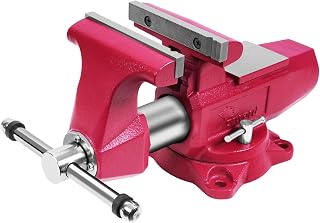 Forward 1750B 5 Inch Bench Vise Heavy Duty with Anvil andCheck price on Amazon
This guide links to our product roundups, where WeldGearLab gets a commission on purchases made through links on this page, and your price stays the same. Read our affiliate disclosure.
The difference in one paragraph
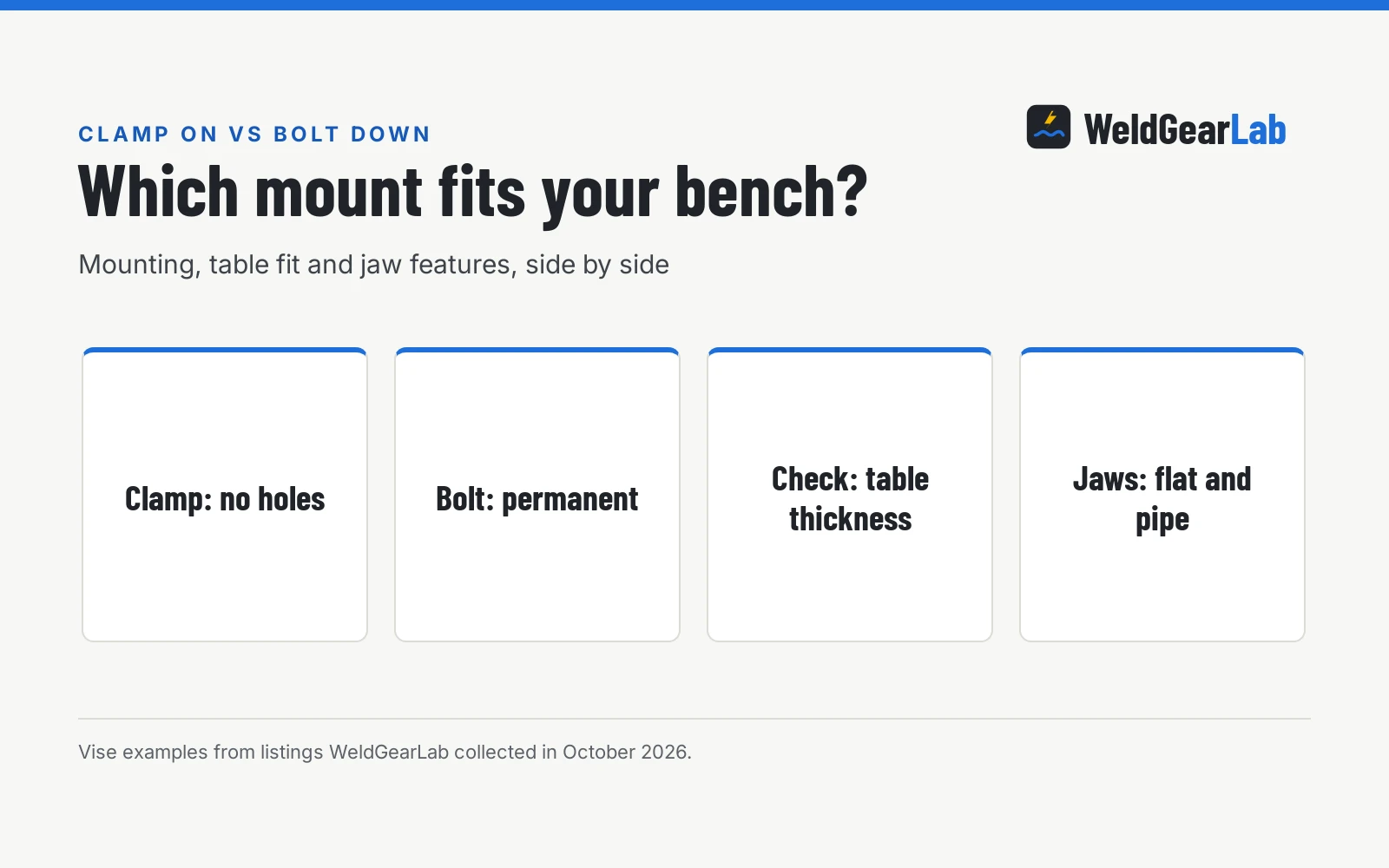
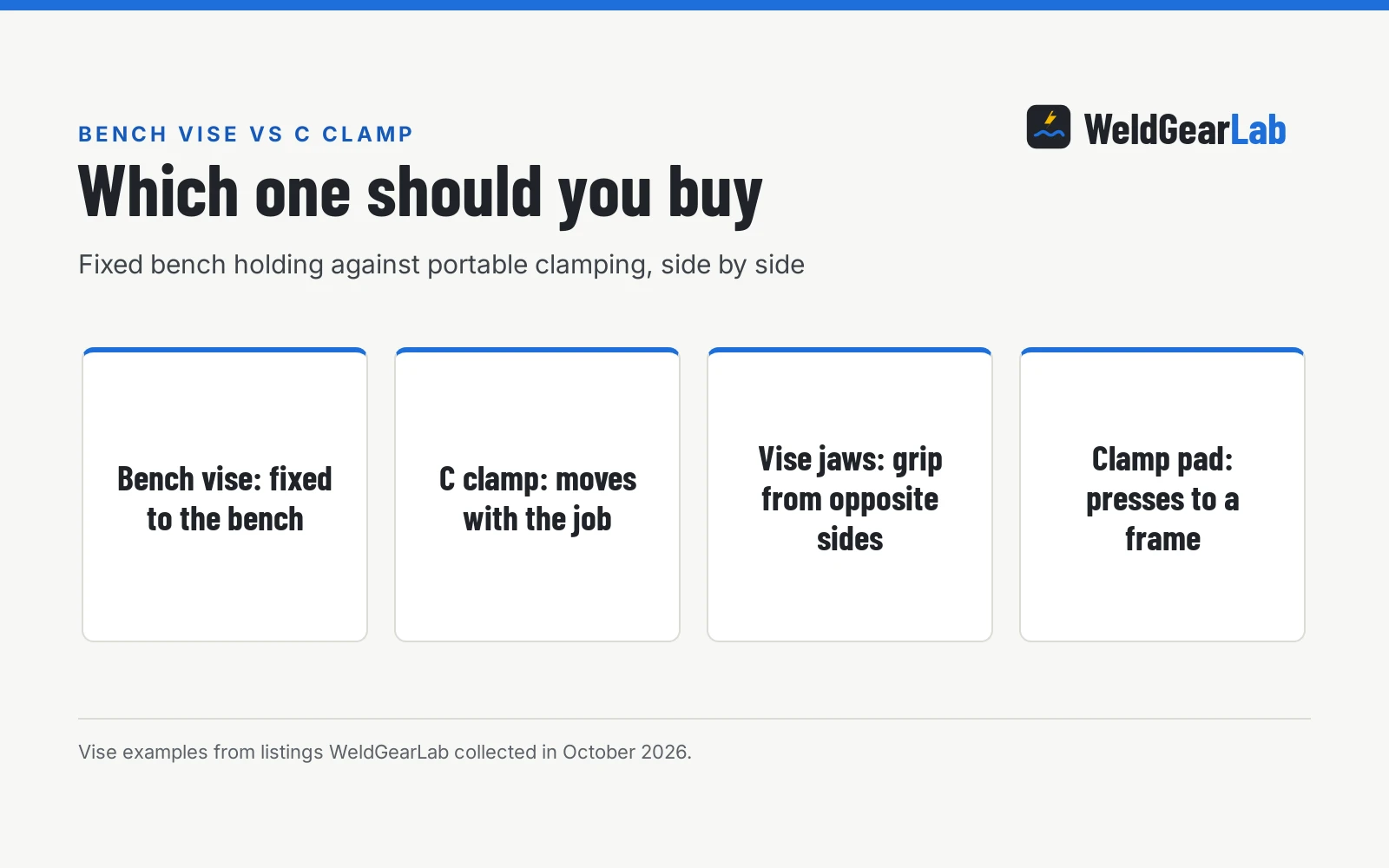
A bench vise is a bench holding tool. Most bolt to a bench, though the MYTEC vise in the gear section also offers a clamp base, and its jaws close on the workpiece from opposite sides, so the part stays still while grinding, cutting, tapping or filing. A C clamp is a portable holding tool. Its frame reaches over an edge and a screw pad presses the part against a table, a frame or another part, so the hold travels with the job. The bench vise suits work that comes to the bench; the C clamp suits work that stays where it sits.
Side by side
| Bench vise | C clamp | Note | |
|---|---|---|---|
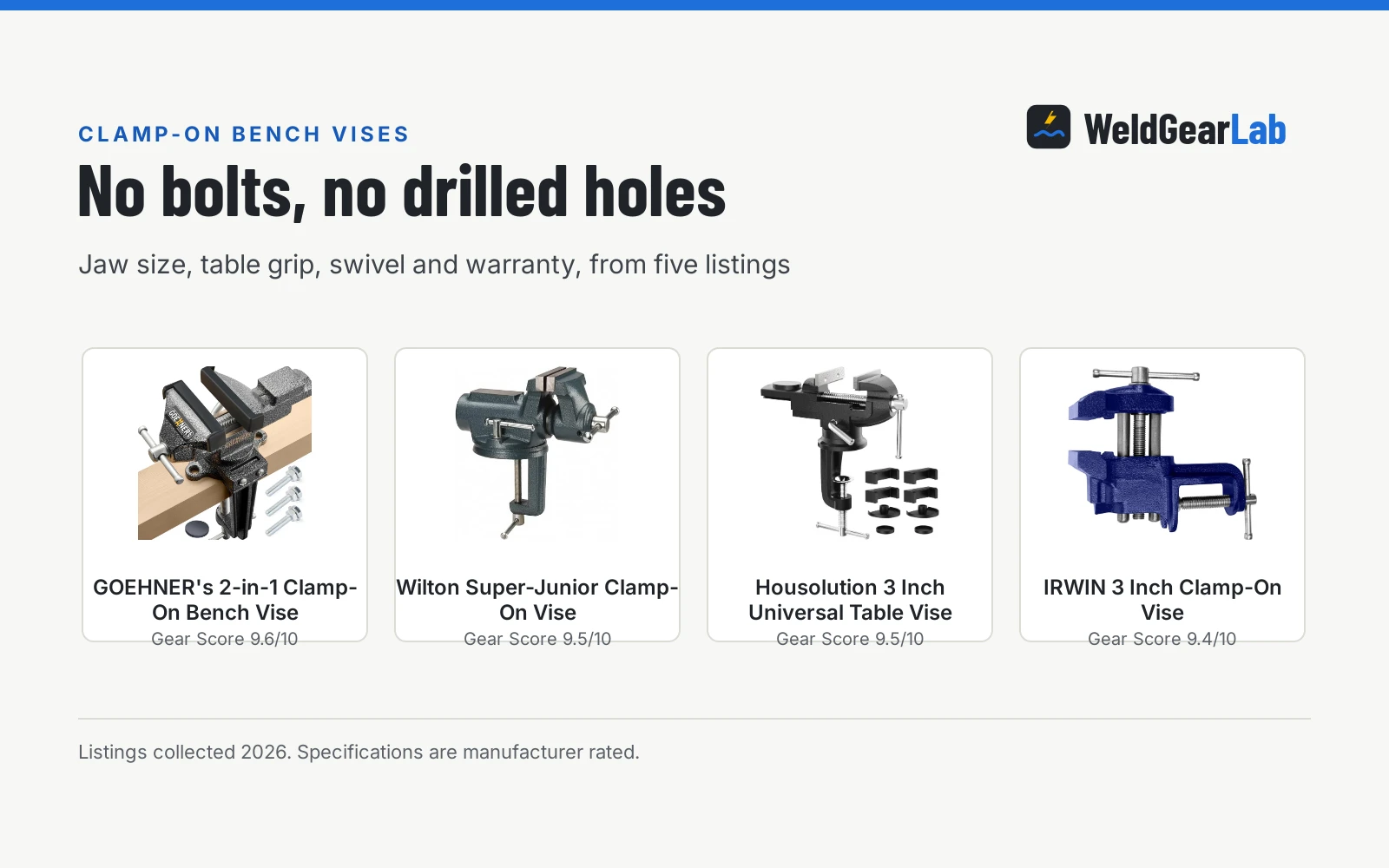
| Mounting | Usually bolts to the bench and stays put; some clamp on | Clamps onto a bench edge, table or workpiece and moves with the job | Fix the vise once; move the clamp often |
| Holding | Jaws grip the workpiece from opposite sides | A screw pad presses the workpiece against the clamp frame or the part it clamps to | Jaws must match the stock shape |
| Operator freedom | Operator stays free once the jaws close | Operator stays free once the clamp is tightened | Both leave the operator free once closed; the difference is fixed versus portable |
| Work size | Limited by jaw width, opening and throat depth | Limited by frame depth and screw opening | Check jaw figures against the stock |
| Moving between jobs | Usually stays on one bench; a clamp-on vise can move | Carries to the next table or part | A bolted-down vise takes time to move |
| Typical shop use | Grinding, cutting, tapping and filing at the bench | Holding parts to a table or to each other for welding and assembly | Match the hold to the task |
| Anvil | Many bench vises include a flat anvil | No anvil included | An anvil is a vise feature, not a clamp feature |
Jaw and force figures in the gear section come from each listing; check the listing before buying, since jaw width and opening differ by model.
When a bench vise is the better choice
- Bench work. Grinding, cutting, tapping and filing on a part that fits between the jaws.
- Repeated parts. The vise stays set on the bench while parts come and go.
- Pipe and round stock. Pipe jaws grip tubes and conduit more securely than flat jaws alone.
- Anvil work. A built-in anvil gives a flat face for straightening small parts.
When a C clamp is the better choice
- Work away from the bench. Clamp a part to a table, sawhorse or frame where it sits.
- Fit-up. Hold parts together for tacking without moving them to a vise.
- Edge clamping. A frame that reaches over an edge can clamp a part to a table edge where a bench vise cannot reach.
- Temporary holding. Clamp, weld, release, and carry the clamp to the next joint.
How to choose: bench vise vs c clamp
Start from the work, not the tool. If the part fits on a bench and the job repeats, a bench vise earns its place. If the part stays on a table or frame, a C clamp does the holding. Jaw width, jaw opening and throat depth decide whether a given vise fits the part, so compare those figures on the listing against the stock on hand. For more holding options, see a swivel vs fixed welding vise guide and a heavy duty C clamp roundup.
Clamping safety. Keep hands clear of the jaws while closing them, check that the workpiece sits securely in the jaws before grinding or cutting, and clear flammable material from the area before welding near a clamped part.
The gear: bench vises ranked
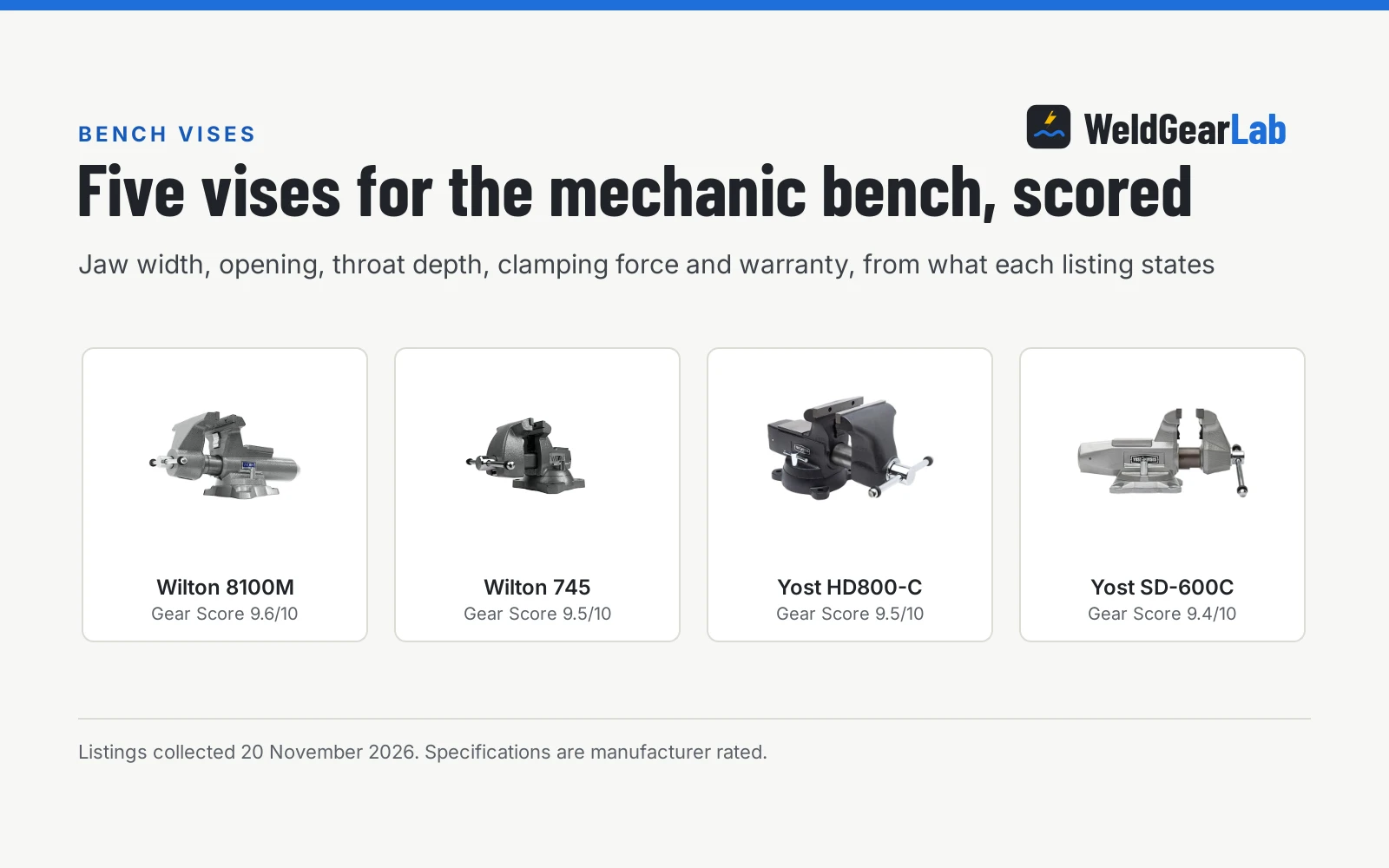
The gear section below ranks the bench vises in this guide’s listings, in rank order, by performance, build and value.
Forward CR80A
The Forward CR80A lists an 8 inch jaw width, a 9 inch max jaw opening, a 4.1 inch throat depth and 12,000 lbs of clamping force, with a 210 degree swivel base. The listing states ductile iron at PSI 60,000, replaceable flat jaws with slot jaws, built-in pipe jaws for 1/2 inch to 3 1/2 inch pipe, and a large reinforced anvil for grinding, cutting and tapping. That combination suits tough workshop and garage jobs where the vise holds heavy stock and the anvil sees regular use. Limits: the listing states no weight and no warranty term, so check the listing for mounting and handling details before buying.
MYTEC 2-In-1 Bench Vise
The MYTEC 2-In-1 Bench Vise lists a 6 inch jaw width, a 4.3 inch max jaw opening, a 2.2 inch throat depth and 3300 lbs of recommended working maximum clamping force, with a 270 degree swivel base. The listing states high-strength cast steel, a chrome-plated spindle, serrated pipe jaws plus general flat jaws, a polished flat anvil, and 2 installation options: bolted down, or clamped to the bench with a clamp base that fits workbenches with a clamping range of 2.1 inches. Net weight is 17 pounds, which keeps the vise portable enough to carry to the spot where it is needed. Limits: the listing states no warranty term, so check the opening against the stock on hand.
FAQ for welders
Can a bench vise replace a C clamp?
Not for every job. A bench vise holds work at a fixed bench, while a C clamp carries to the part or table where the work sits, so shops that weld both at the bench and on larger parts use both.
What jaw width should a bench vise have for fabrication work?
Check the jaw opening against the thickest stock the vise must hold, and the jaw width for how much jaw contacts the part. The Forward CR80A lists an 8 inch jaw width and a 9 inch max jaw opening, while the MYTEC lists a 6 inch jaw width and a 4.3 inch max opening.
Does a swivel base matter?
A swivel base lets the vise turn to the angle the work needs without moving the base. The MYTEC lists a 270 degree swivel base, and the Forward CR80A lists a 210 degree swivel base.
Do these vises include a warranty?
The MYTEC and Forward listings state no warranty term.
Can a C clamp hold a workpiece for welding?
A C clamp can hold parts to a table or to each other for fit-up and tacking. Check that the frame clears the joint and that the screw pad sits flat on the part before welding.
Related: large bench vise picks, heavy duty C clamps for metal work, quick clamps for metal, and the metal fab tools hub.