Best Bench Vise Large (2026): 4 Large Vises Compared
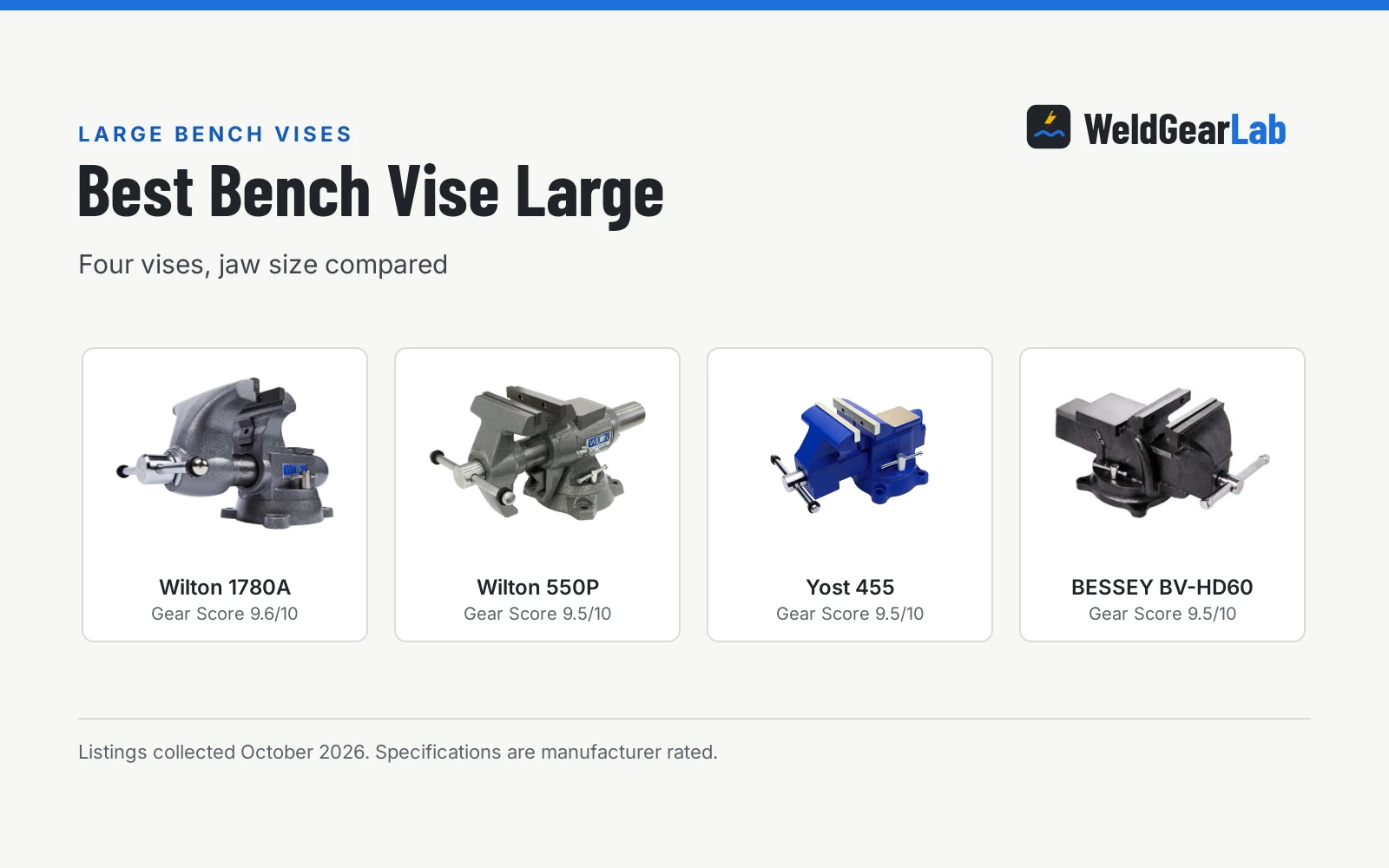
Four large bench vises compared by jaw width, opening, throat depth, iron grade and warranty, with every number taken from the listings.

On this page
Top picks at a glance
As an Amazon Associate I earn from qualifying purchases.
- 1
 Best OverallWilton 1780A9.6/10View on Amazon
- 2
 Best RotatingWilton 550P9.5/10View on Amazon
- 3
 Best Pipe ViseYost 4559.5/10View on Amazon
- 4
 Best 6-InchBESSEY BV-HD609.5/10View on Amazon
The best bench vise large enough for real work holds the part still while you beat on it. A vise that flexes or walks across the bench is worse than no vise at all. We compared four large bench vises by jaw width, opening, throat depth, iron grade, swivel and warranty, using only what each listing publishes.
WeldGearLab gets a commission on purchases made through links on this page, and your price stays the same. Read our affiliate disclosure.
Quick picks
- Best Overall Wilton 1780A: 8-inch jaw, 60,000 PSI ductile iron, lifetime warranty Check price on Amazon
- Best Rotating Wilton 550P: 360-degree head indexed at 30 degrees, lifetime warranty Check price on Amazon
- Best Pipe Vise Yost 455: Pipe jaws to 2.5 in, 360-degree swivel base, 1-year warranty Check price on Amazon
- Best 6-Inch BESSEY BV-HD60: 6-inch jaw and opening, hardened jaws, 29 lb Check price on Amazon
The machines
Wilton Tradesman Bench Vise, 8" Jaw Width
An 8-inch tradesman bench vise in 60,000 PSI ductile iron with a 6-3/4 inch opening, reversible jaw inserts and a lifetime warranty.
Pros
- 8-inch jaw is the widest here
- 60,000 PSI ductile iron body
- Reversible jaw inserts, serrated and smooth
- Lifetime warranty against manufacturing defects
Cons
- No safety certification is stated
- 20 by 8.8 by 11 inch size needs a deep bench
- No anvil dimensions are stated
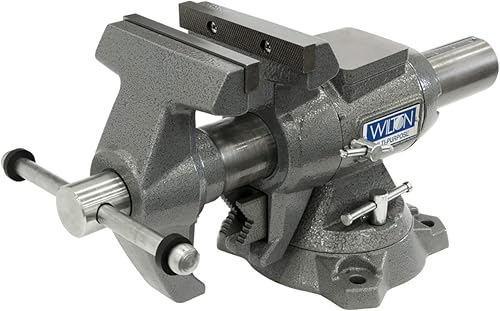
Wilton Multi-Purpose Bench Vise, 5-1/2" Jaw Width
A 5-1/2 inch multi-purpose bench vise with a 360-degree rotating head indexed at 30 degrees, replaceable jaws and a lifetime warranty.
Pros
- 360-degree rotating head indexed at 30 degrees
- Replaceable hardened steel serrated jaws
- V-jaws hold round stock vertically
- Lifetime warranty against manufacturing defects
Cons
- Net weight 21.3 lb against 40 lb item weight
- Pipe jaw capacity of 1/4 to 1-11/16 in is narrower than the Yost
Yost Vises 455 Combination Vise
A 5.5-inch combination pipe and bench vise in 30,000 PSI cast iron with a 360-degree swivel base, pipe jaws and a 1-year warranty.
Pros
- Pipe jaws from .125 to 2.5 inches
- 360-degree swivel base with two lockdowns
- Replaceable hardened steel serrated top jaws
- Large anvil work surface included
Cons
- 30,000 PSI gray iron trails ductile iron
- 11.36 kg weight with no pound figure
- 1-year limited warranty against lifetime warranties here
- Pipe jaws add width some benches lack
BESSEY BV-HD60 Heavy Duty Bench Vise, 6 In.
A 6-inch heavy-duty bench vise with hardened steel serrated jaws, a 6-inch max opening, a large anvil and a 1-year warranty.
Pros
- 6-inch jaw with 6-inch max opening
- Hardened steel serrated jaws
- Large built-in anvil
- Three mounting holes for stability
Cons
- Material lines state 30,000 psi and 5,000 psi
- Swivel stated as 36 degrees, not full rotation
- No throat depth is stated
- No pipe jaw capacity is stated
Spec sheet comparison
| Vise | Gear Score | Jaw width | Max opening | Throat | Material | Warranty |
|---|---|---|---|---|---|---|
| Wilton 1780A | 9.6/10 | 8 in | 6-3/4 in | 4-3/4 in | 60,000 PSI ductile iron | Lifetime |
| Wilton 550P | 9.5/10 | 5-1/2 in | 5 in | 2-3/4 in | Cast iron, ductile iron | Lifetime |
| Yost 455 | 9.5/10 | 5.5 in | 5 in | 3.25 in | 30,000 PSI cast iron | 1-year |
| BESSEY BV-HD60 | 9.5/10 | 6 in | 6 in | Not stated | 30,000 PSI cast iron | 1-year |
These numbers are the manufacturer’s ratings exactly as each listing gives them, recorded on 22 October 2026.
Buying guide: the best bench vise large
Jaw width sets the work size
The Wilton 1780A is the widest here at an 8-inch jaw, followed by the BESSEY BV-HD60 at 6 inches and the Yost 455 and Wilton 550P at 5.5 inches each. Max opening runs 6-3/4 inches on the 1780A, 6 inches on the BESSEY, and 5 inches on the Yost and 550P. Throat depth is 4-3/4 inches on the 1780A, 3.25 inches on the Yost and 2-3/4 inches on the 550P; the BESSEY states none. Read the title figures, not the spec tables: both Wilton tables list 4-1/2 inch jaws against the 8-inch and 5-1/2-inch titles. Size the vise to the biggest part you clamp, not the average one. The 1780A table also lists a 1/4 to 2-1/2 inch pipe capacity, and the 550P table lists 1/4 to 1-11/16 inches, but the titles govern the headline dimensions. Item dimensions run 20 by 8.8 by 11 inches on the 1780A and 20.9 by 9.8 by 9.4 inches on the 550P, so both need a deep bench. The Yost measures 14 by 7 by 9 inches and the BESSEY 16 by 7.38 by 8 inches.
Ductile iron vs cast iron
The 1780A body is 60,000 PSI ductile iron, which the listing calls twice the strength of gray cast iron. The 550P mixes cast iron with ductile iron at 30,000 PSI. The Yost 455 is 30,000 PSI cast grey iron with a steel U-channel bar, and the BESSEY is a 30,000 psi cast iron alloy, though its tensile strength line reads 5,000 psi against that figure. Ductile iron resists cracking under hammer work better than gray iron, which is why the 1780A leads on build. The Yost backs its iron with a steel U-channel bar, and the 550P pairs cast iron with ductile iron in the same body. Tensile figures tell the same story: 60,000 PSI on the 1780A against 30,000 PSI on the Yost and 550P. The BESSEY tensile line reads 5,000 psi, which conflicts with its own 30,000 psi alloy claim and cannot be resolved from the listing. See ductile iron vs cast iron bench vise for the full breakdown.
Swivel base or fixed
The 550P rotates a full 360 degrees on its head, indexed at 30-degree increments for quick setup at any angle. The Yost 455 swivels 360 degrees on its base with two lockdowns. The 1780A is listed in a 360-degree swivel style. The BESSEY states a 36-degree rotation, which reads like a partial swivel rather than a full turn. A swivel base earns its keep when you weld at odd angles; a fixed vise is fine if the work always faces you. The Yost lockdowns matter: two of them clamp the 360-degree base once the angle is set. The 550P indexes every 30 degrees, so repeat angles come back fast. The BESSEY 36-degree figure means limited rotation, closer to a fixed vise with some give. None of the four lists a fixed-only option, so every pick here moves. For the trade-offs, see swivel vs fixed welding vise.
Pipe jaws and anvils
All four carry an anvil for forming and shaping. The Yost 455 is the pipe specialist: permanent serrated pipe jaws from .125 to 2.5 inches plus replaceable serrated top jaws. The 550P has replaceable steel pipe jaws and V-jaws that hold round stock vertically. The 1780A uses reversible jaw inserts, serrated on one side and smooth on the other, with machined steel and a phosphate coating. The BESSEY keeps it simple with hardened steel serrated jaws. If pipe work is the job, the Yost pipe jaw range is the deciding spec. The Yost anvil is called out as a large work surface, and the 550P anvil is built in for forming and shaping. The 1780A anvil is described as designed to take a beating. Jaw replacement matters long-term: the 550P and Yost jaws swap out, and the 1780A inserts flip from serrated to smooth for finished work.
Warranty tells you who stands behind it
Both Wiltons carry a lifetime warranty against manufacturing defects, the strongest terms here. The Yost 455 comes with a 1-year limited warranty and 90-day return, plus lifetime tech support. The BESSEY BV-HD60 states 1 year against manufacturing defects. A lifetime term on a vise you will hammer on for decades is worth real money. The Yost pairs its 1-year limited warranty with a 90-day return and lifetime tech support, a decent package for a mid-range vise. Wilton’s lifetime term covers manufacturing defects on both models, which is the standard the others are judged against. Read the warranty text before the vise ships, not after it breaks. For more heavy options, see the best heavy duty bench vise roundup.
Before You Strike an Arc
- Bolt the vise down before the first weld: the BESSEY ships three mounting holes, and the Yost needs its swivel base locked with both lockdowns.
- Check the jaws on arrival: the 1780A inserts reverse from serrated to smooth, and the 550P and Yost jaws are replaceable.
- Mind the spec table conflicts on the two Wiltons: the titles state 8-inch and 5-1/2-inch jaws while the tables list 4-1/2 inches.
- Do not over-tighten: the Yost instructions warn that over-tightening can damage the vise or the work.
FAQ for welders
What is a bench vise?
A bench vise is a clamping tool bolted to a workbench, with a cast iron or ductile iron body, serrated steel jaws, an anvil and usually a swivel base. These four range from 5.5-inch to 8-inch jaws for holding metalwork while you weld, grind or fit parts.
How does a bench vise work?
Mount the vise to the bench and lock the swivel base. Turn the handle counterclockwise to open the jaws, set the work between them, then turn clockwise until snug and tighten until the part cannot move. The Yost instructions add the warning: do not over-tighten.
What size bench vise do I need?
Match jaw width and max opening to the biggest stock you clamp. These four offer 5.5-inch to 8-inch jaws with openings from 5 inches to 6-3/4 inches. A home shop doing general repair is well served by the 5.5-inch class; structural work wants the 8-inch Wilton.
What size bench vise should I get for a home shop?
The 6-inch BESSEY and 8-inch Wilton 1780A cover larger work, while the 5.5-inch Yost 455 and Wilton 550P handle everyday tasks. Check throat depth too: 4-3/4 inches on the 1780A against 2-3/4 on the 550P decides how deep a part can reach.
Do these vises hold pipe?
The Yost 455 is built for it, with pipe jaws from .125 to 2.5 inches. The Wilton 550P has replaceable pipe jaws and V-jaws for round stock, and the 1780A table lists a 1/4 to 2-1/2 inch pipe capacity. The BESSEY states no pipe capacity.
Scoring, line by line
The Gear Score weighs performance, build, value, safety and warranty. For bench vises, safety means stated certifications; none of these listings states one, so safety scores zero across the board. All four state a warranty term: lifetime on both Wiltons, 1-year on the Yost and the BESSEY. Performance covers jaw size, opening and throat; build covers iron grade and construction; value weighs what the listing delivers against its class. The 60,000 PSI ductile iron of the 1780A sets the build bar here. How we pick explains the weights.
| Product | Gear Score | Perf. /35 | Build /25 | Value /25 | Safety /10 | Warranty /5 |
|---|---|---|---|---|---|---|
| Wilton 1780A | 9.6 | 32 | 22 | 20 | 0 | 5 |
| Wilton 550P | 9.5 | 29 | 21 | 20 | 0 | 5 |
| Yost 455 | 9.5 | 29 | 20 | 21 | 0 | 3 |
| BESSEY BV-HD60 | 9.5 | 28 | 20 | 20 | 0 | 3 |
Displayed scores fall between 9.2 and 9.8: the weighted point total is mapped onto that band in a straight line, so earning more points always lifts the score.
More welding guides
Related: welding tables and carts. Also see our best bench vise for farm shop. Also see our bench vise vs welding vise. Also see our best heavy duty bench vise.