Ductile Iron vs Cast Iron Bench Vise: Which One Should You Buy? (2026)
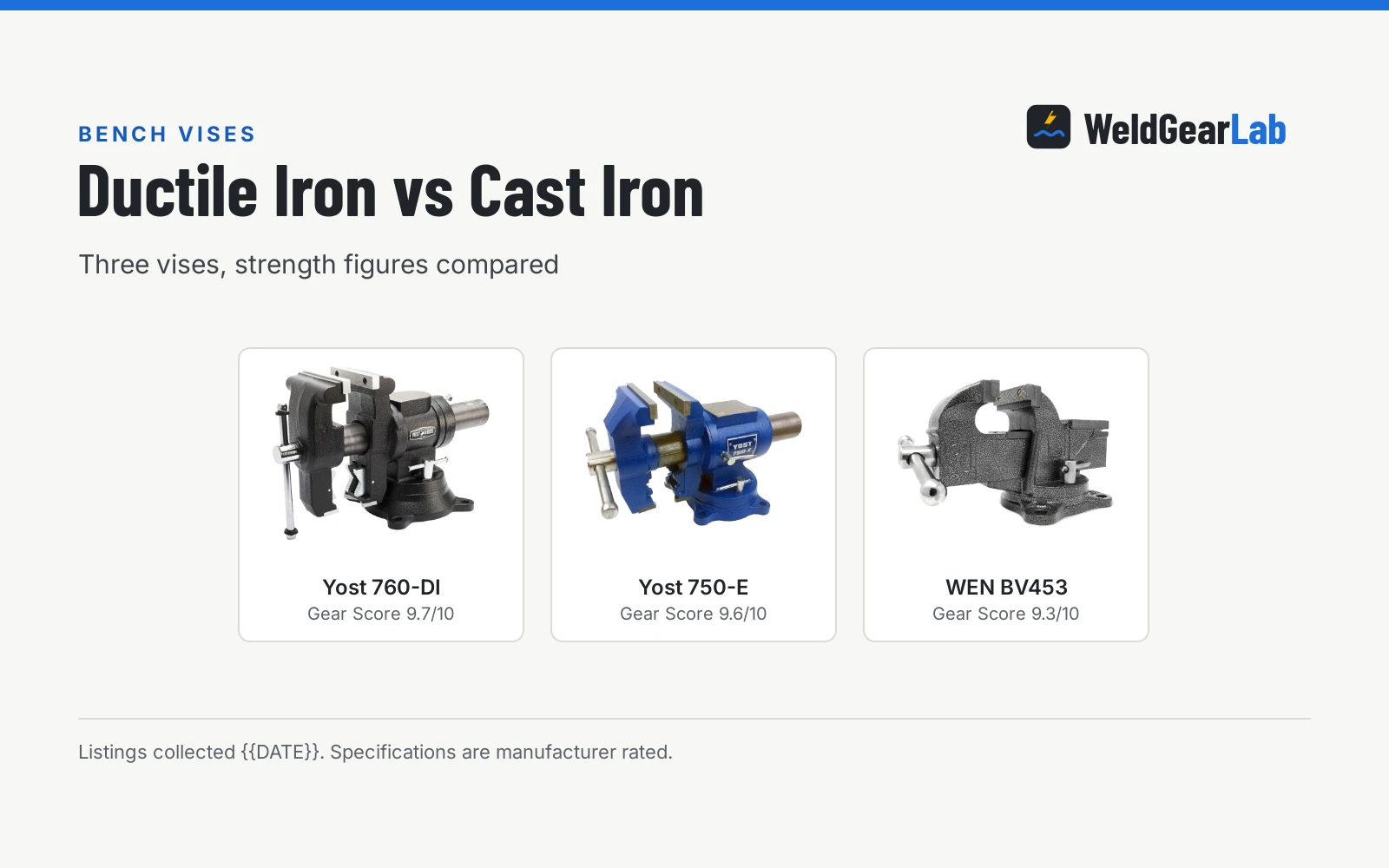
Two 60,000 PSI ductile iron bench vises and one 36,000 PSI cast iron vise, compared on jaw size, pipe capacity, swivel, weight and warranty.

On this page
Top picks at a glance
As an Amazon Associate I earn from qualifying purchases.
- 1
 Yost Vises 760-DI Multi-Jaw Rotating Vise 6 Inch9.7/10View on Amazon
- 2
 Yost Vises 750-E Multi-Jaw Rotating Vise System9.6/10View on Amazon
- 3
 WEN Bench Vise, 3-Inch, Cast Iron with Swivel Base9.3/10View on Amazon
Verdict. Pick ductile iron if the vise will take hammering, heavy clamping and pipe work; both ductile examples here are listed at 60,000 PSI against the cast iron example’s 36,000 PSI. Pick cast iron if the work is light and a compact 3-inch bench vise covers it.
The job is holding a piece of angle iron steady while you cut or drill it, and the vise is the third hand. A vise that flexes or walks across the bench turns fit-up into a fight. That is what the ductile iron vs cast iron bench vise question is really about: how much abuse the vise body can take before it gives.
WeldGearLab gets a commission on purchases made through links on this page, and your price stays the same. Read our affiliate disclosure.
The three vises

Yost Vises 760-DI Multi-Jaw Rotating Vise 6 Inch
A 75.8 lb heavy-duty 6-inch bench and pipe vise in 60,000 PSI ductile iron, with three replaceable hardened steel jaw sets, 360-degree swivel and a 3-year limited warranty.
Pros
- 60,000 PSI ductile iron, 6 in jaw
- Three replaceable hardened steel jaw sets
- Pipe capacity .63 to 4.33 in
- 3-year limited warranty and 90-day return
Cons
- 75.8 lb is the heaviest here
- No clamping force stated
- Anvil size not stated
- 6-inch size needs solid bench space

Yost Vises 750-E Multi-Jaw Rotating Vise System
A 5-inch bench and pipe vise in 60,000 PSI ductile iron with a dual jaw system, 360-degree swivel base and head, and a 1-year limited warranty.
Pros
- 60,000 PSI ductile iron
- Dual jaw: bench jaw plus pipe jaw
- 360-degree swivel base and head with dual lockdowns
- 1-year limited warranty and 90-day return
Cons
- 15.45 kg listed; no pound figure
- No clamping force stated
- 5 in jaw is smaller than the 760-DI
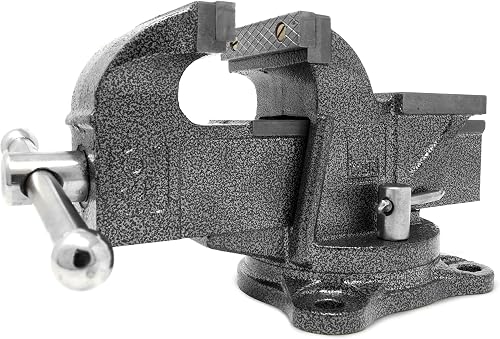
WEN Bench Vise, 3-Inch, Cast Iron with Swivel Base
A 3-inch cast iron bench vise rated 36,000 PSI, with over 1,850 lb of clamping force, a swivel base and a 2-3/4 in anvil.
Pros
- 36,000 PSI cast iron stated
- Over 1,850 lb clamping force
- Compact 3-inch size
- 2-3/4 by 2-3/4 in anvil
Cons
- No pipe capacity stated
- No warranty term stated
- 3-inch jaw limits workpiece size
Other welders and gear to compare
 Forward 30404 4 Inch Bench Vise Heavy Duty with Anvil andCheck price on Amazon
 Wilton Multi-Purpose Bench ViseCheck price on Amazon
 Yost Vises ADI-6 Heavy Duty ViseCheck price on Amazon
 findmall 5" Table Top Heavy Duty Bench ViseCheck price on Amazon
 AV Steel 4-1/2" Bench Vise with 240° Flexible Swivel LockingCheck price on Amazon
 VEVOR Bench ViseCheck price on Amazon
Side by side
| Yost 760-DI | Yost 750-E | WEN BV453 | |
|---|---|---|---|
| Side | Ductile iron | Ductile iron | Cast iron |
| Jaw width | 6 in | 5 in | 3 in |
| Material strength | 60,000 PSI ductile iron | 60,000 PSI ductile iron | 36,000 PSI cast iron |
| Jaw opening | 5.90 in | 5 in | 3-1/2 in |
| Pipe capacity | .63 to 4.33 in | .375 to 2.5 in | Not stated |
| Clamping force | Not stated | Not stated | Over 1,850 lb |
| Swivel | 360 degrees, 12 locking positions | 360-degree base and head, dual lockdowns | Over 130 degrees |
| Anvil | Large anvil work surface | Large anvil work surface | 2-3/4 by 2-3/4 in anvil |
| Weight | 75.8 lb | 15.45 kg | 5.33 kg |
| Warranty | 3-year limited | 1-year limited | Not stated |
All specs here repeat what the maker rates and the listing prints, copied down 22 October 2026. Both Yost listings include safety instructions; the WEN listing states no warranty term.
Ductile iron vs cast iron bench vise: the material difference
This is the whole comparison in one row of the table. Both Yost vises state 60,000 PSI ductile iron; the WEN states 36,000 PSI cast iron. Those are the makers’ own figures, and on the stated figures the ductile iron examples sit well above the cast iron one. Do not read more into it than the listings say: neither listing publishes impact or fatigue figures, so the comparison rests on the stated PSI figures alone.
Size and clamping
The 760-DI is the big one: a 6 in jaw opening to 5.90 in, at 75.8 lb. The 750-E steps down to a 5 in jaw and 5 in opening, listed at 15.45 kg with no pound figure. The WEN is the small one: a 3 in jaw opening to 3-1/2 in at 5.33 kg, but it is the only one of the three to state a clamping force, over 1,850 lb. Neither Yost states a clamping force, so the WEN wins a spec the others leave blank; that is a gap in the listings, not a win for cast iron.
Jaws, pipe capacity and anvils
The 760-DI brings three sets of replaceable hardened steel jaws: bench jaws, pipe jaws and V-jaws for round and flat stock, with .63 to 4.33 in pipe capacity. The 750-E has a dual jaw system, a bench jaw plus a pipe jaw, with .375 to 2.5 in pipe capacity and serrated jaws. The WEN lists 3 by 3/4 in grated jaws and no pipe capacity at all. Both Yosts list a large anvil work surface without dimensions; the WEN gives its anvil as 2-3/4 by 2-3/4 in.
Swivel bases
The 750-E swivels the most on paper: a 360-degree base with dual lockdowns plus a head that rotates a full 360 degrees. The 760-DI swivels 360 degrees on an interlocking V-grooved base with two lockdowns, and its head locks every 30 degrees for twelve positions. The WEN base pivots over 130 degrees with no lock count stated. If you reposition the work often, the Yosts’ lockdowns matter; a vise that drifts mid-weld is worse than one that never moved.
Warranty
The 760-DI carries a 3-year limited warranty with a 90-day return, the longest term here. The 750-E carries a 1-year limited warranty with a 90-day return. Both Yosts also promise lifetime tech support, which is support, not a warranty term. The WEN states no warranty at all.
Pick ductile iron if
- Your vise takes hammering, heavy clamping and pipe work.
- You want the 60,000 PSI figure both Yosts state.
- Replaceable hardened steel jaws appeal to you, on the 760-DI.
- A written warranty of one to three years matters to you.
Pick cast iron if
- Your work is light: small parts, drilling and filing.
- A compact 3-inch vise fits your bench.
- You want a stated clamping force, over 1,850 lb on the WEN.
- Pipe jaws and a long warranty are not on your list.
FAQ for welders
What does 60,000 PSI vs 36,000 PSI mean on a vise?
Those are the makers’ stated strength figures: both Yost vises list 60,000 PSI ductile iron, and the WEN lists 36,000 PSI cast iron. On the stated figures the ductile iron examples sit higher. Neither listing publishes impact or fatigue figures, so that is as far as the comparison goes.
Which vise here holds pipe?
Both Yosts: the 750-E lists .375 to 2.5 in pipe capacity with its pipe jaw, and the 760-DI lists .63 to 4.33 in with pipe and V-jaws. The WEN lists no pipe capacity.
Why does the Yost 750-E spec table say cast iron?
The table disagrees with its own listing. The title and bullets say 60,000 PSI ductile iron; the spec table says cast iron with 1,500 psi tensile strength. Trust the title and bullets, as the table is clearly wrong on both points.
Do any of these vises state a warranty?
Both Yosts do: the 760-DI states a 3-year limited warranty and the 750-E a 1-year limited warranty, each with a 90-day return. The WEN states no warranty term.
Can I bolt these to any bench?
The Yost listings say to make sure the vise is securely mounted to the workbench before use. The 760-DI weighs 75.8 lb, so it needs a bench that can carry it; the WEN listing gives no mounting guidance.
Related: bench vise vs welding vise, best 6 inch bench vise, 4×4 vs 4×8 welding table, and the welding tables and carts hub.
Scoring, line by line
All three vises are scored out of 10 on performance, build, value, safety listing and warranty, with the weights published on our How We Pick page.
| Product | Gear Score | Perf. /35 | Build /25 | Value /25 | Safety /10 | Warranty /5 |
|---|---|---|---|---|---|---|
| Yost 760-DI | 9.7 | 30 | 22 | 20 | 5 | 3 |
| Yost 750-E | 9.6 | 28 | 21 | 20 | 5 | 3 |
| WEN BV453 | 9.3 | 23 | 19 | 21 | 0 | 0 |
A pick’s weighted total decides where it lands between a 9.2 floor and a 9.8 ceiling, and a bigger total never produces a smaller number.
Before you strike an arc. Mount the vise to a solid bench before use, and do not over-tighten the handle; both Yost listings warn that over-tightening can damage the work or the vise. Wear eye protection, since the listings warn that misuse can injure eyes and hands. Keep the swivel locks snug before you lean into the work.