Best 6 Bench Vise (2026): 4 Picks for the Bench
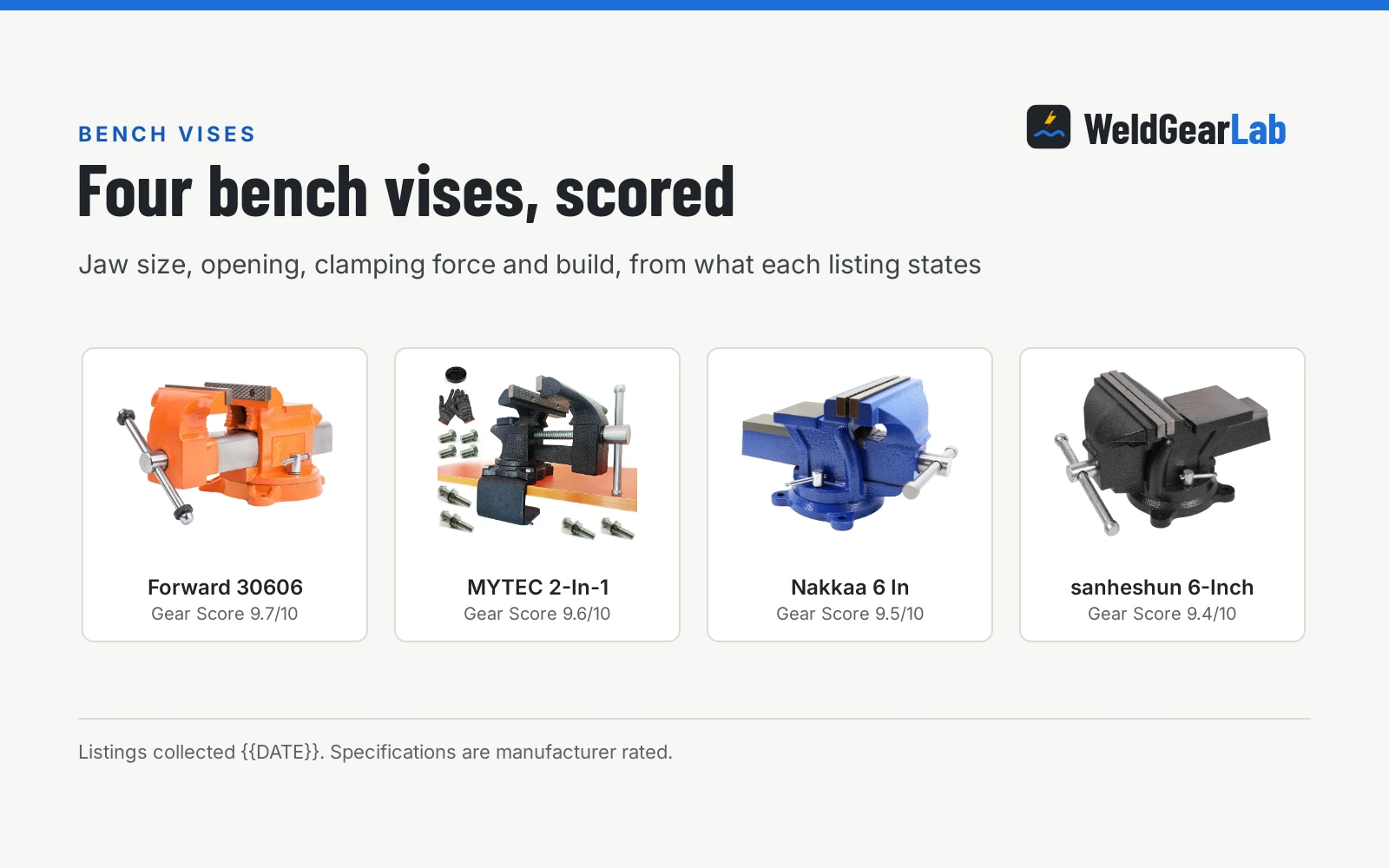
Four 6-inch vises for the shop bench, compared by jaw width, max opening, throat depth, clamping force and what each listing states.

On this page
Top picks at a glance
As an Amazon Associate I earn from qualifying purchases.
- 1
 Best OverallForward 306069.7/10View on Amazon
- 2
 Best Portable MountMYTEC 2-In-19.6/10View on Amazon
- 3
 Best Replacement JawsNakkaa 6 In9.5/10View on Amazon
Fit-up is where the weld gets made or ruined. You are holding two pieces of angle iron together, the tack is cooling, and you need a third hand that does not move. That third hand is a bench vise, and the listings do not all describe the same tool. This guide covers the best 6 bench vise options: four 6-inch vises compared by jaw width, max opening, throat depth, clamping force and what each listing states about its build.
WeldGearLab gets a commission on purchases made through links on this page, and your price stays the same. Read our affiliate disclosure.
Quick picks
- Best Overall Forward 30606: 6 in jaw with 6 in opening, 6,600 lb force and replaceable jaws on a 360-degree base. Check price on Amazon
- Best Portable Mount MYTEC 2-In-1: Bolts down or clamps on with a 2.1 in base clamp, 270-degree swivel and 4.3 in opening. Check price on Amazon
- Best Replacement Jaws Nakkaa 6 In: 6 in jaw, 5.5 in opening and replaceable microgroove jaws on a 360-degree base. Check price on Amazon
The machines


Forward 30606 6 Inch Bench Vise Heavy Duty
A 6-inch ductile iron bench vise with a 6 in jaw opening, 6,600 lb clamping force, replaceable flat jaws, built-in pipe jaws and a 360-degree swivel base with dual locking nuts.
Pros
- 6 in jaw width with a 6 in max opening, the widest here
- 6,600 lb clamping force from 60,000 PSI ductile iron
- Replaceable flat jaws plus built-in pipe jaws for 3/4 to 2 1/2 in pipe
- 360-degree swivel base with dual locking nuts and a 3.4 x 2.8 in anvil
Cons
- No warranty term is stated
- No safety listing is stated
- 33.9 lb item weight, per the listing
- Pipe jaw range tops out at 2 1/2 in

MYTEC 2-In-1 Bench Vise Heavy Duty for Workbench
A 6-inch cast steel bench vise that bolts down or clamps to the bench, with a 4.3 in max opening, 3,300 lb clamping force, pipe and flat jaws, and a 270-degree swivel base.
Pros
- 2-in-1 mount: bolt it down or clamp it to the bench
- 6 in jaw with 4.3 in max opening and 3,300 lb clamping force
- Serrated pipe jaws plus flat jaws in hardened steel
- 270-degree swivel base and a polished flat anvil
Cons
- No warranty term is stated
- No safety listing is stated
- 270-degree swivel is the least here

Nakkaa 6 Inch Heavy Duty Cast Iron Bench Vise
A 6-inch ductile iron bench vise with a 5.5 in max opening, replaceable microgroove steel jaws, a built-in anvil and a 360-degree swivel base with 3 mounting holes.
Pros
- 6 in jaw with 5.5 in max opening
- Replaceable microgroove tooth steel jaws
- 360-degree swivel base with 3 mounting holes
- Built-in anvil for hammer work
Cons
- No clamping force is stated
- No warranty term is stated
- No safety listing is stated

Bench Vise Heavy Duty 6-Inch
A 6-inch cast iron and steel bench vise with a 360-degree double locking swivel base and an oversized striking anvil, on a thin listing.
Pros
- 360-degree double locking swivel base
- Oversized striking anvil
- Forged jaws with heat treatment stated
- Cast iron and steel build
Cons
- No jaw opening is stated
- No clamping force is stated
- No throat depth is stated
- No warranty term is stated
Other welders and gear to compare
 Bench Vise Heavy Duty 6-InchCheck price on Amazon
 6" Bench Vise Heavy DutyCheck price on Amazon
 Wilton Utility Bench ViseCheck price on Amazon
 6" Heavy Duty Bench Vise with 360° Swivel Locking BaseCheck price on Amazon
 MYTEC Bench Vise or Table ViseCheck price on Amazon
Spec sheet comparison
| Model | Gear Score | Jaw width | Max opening | Throat depth | Clamping force | Swivel | Warranty |
|---|---|---|---|---|---|---|---|
| Forward 30606 | 9.7/10 | 6 in | 6 in | 3 3/8 in | 6,600 lb | 360 degrees | Not stated |
| MYTEC 2-In-1 | 9.6/10 | 6 in | 4.3 in | 2.2 in | 3,300 lb | 270 degrees | Not stated |
| Nakkaa 6 In | 9.5/10 | 6 in | 5.5 in | 2.16 in | Not stated | 360 degrees | Not stated |
| sanheshun 6-Inch | 9.4/10 | 6 in | Not stated | Not stated | Not stated | 360 degrees | Not stated |
These numbers are the manufacturer’s ratings exactly as each listing gives them, recorded on 22 October 2026.
How we picked the best 6 bench vise
Four vises went head to head on the figures that hold work still: jaw width, max opening, throat depth and clamping force. The Forward 30606 leads on paper with a 6-inch jaw, a full 6-inch opening, a 3 3/8-inch throat and 6,600 pounds of clamping force from 60,000 PSI ductile iron. The MYTEC trades some opening for a 2-in-1 mount that bolts down or clamps to the bench, and the Nakkaa brings replaceable microgroove jaws to a 5.5-inch opening. Weights run from 17 pounds on the MYTEC to 33.9 pounds on the Forward, and materials run from cast steel on the MYTEC to ductile iron on the Forward.
One listing disagrees with itself, and that costs it. The Nakkaa bullets say a 5.5-inch opening while its spec table says 4.72 inches. The sanheshun listing states almost nothing beyond the 6-inch size and the 360-degree base. Every figure in this guide comes straight from the listings, and the tables keep the gaps visible.
Buying guide: bench vises
Jaw width and opening
Jaw width sets the footprint of the grip; max opening sets the biggest stock the vise takes. Four listings state a 6-inch jaw width. Openings run from 4.3 inches on the MYTEC to a full 6 inches on the Forward, with the Nakkaa at 5.5 inches. The sanheshun states no opening at all.
Clamping force
Force is the number that holds the work. Stated figures here are 6,600 pounds on the Forward and 3,300 pounds as the recommended working maximum on the MYTEC. The Nakkaa and sanheshun state no clamping force, so their grip cannot be compared from the listings.
Throat depth
Throat depth decides how far into the work the jaws reach. The Forward states 3 3/8 inches, the MYTEC 2.2 inches, and the Nakkaa 2.16 inches in the bullets against 2.17 inches in the spec table. The sanheshun states none.
Swivel base
Three vises state a 360-degree swivel base; the MYTEC states 270 degrees. The Forward adds dual locking nuts and the sanheshun a double locking design. A locking base matters when the work pulls sideways during filing or sawing.
Anvil and extra jaws
Four listings state an anvil: polished flat on the MYTEC, 3.4 by 2.8 inches on the Forward, oversized striking on the sanheshun and built in on the Nakkaa. The Forward and MYTEC add pipe jaws for round stock; the Forward pipe jaws take 3/4 to 2 1/2-inch pipe.
Mounting
The vise has to stay put when you lean on the handle. The Nakkaa lists 3 mounting holes for bolting down, the MYTEC clamps to the bench with a 2.1-inch base clamp or bolts down, and the other two rely on bolt patterns the listings do not detail. Whatever the mount, the bench underneath has to be as solid as the vise.
Use as directed. Bolt the vise down or clamp it to a bench that will not tip before you lean on the handle. Keep hands clear of the jaws and the anvil face when hammering, wear eye protection when striking or cutting, and never extend the handle with a pipe. Clamp the work, then check it is seated before you weld near it.
Before You Strike an Arc
- Check the mounting first: 3 mounting holes on the Nakkaa, a 2.1-inch base clamp on the MYTEC, or a bolt pattern you drill yourself on the others.
- Open and close the jaws on arrival and check the swivel locks hold before the first weld.
- Confirm the anvil face is flat and the replaceable jaws seat fully where the listing includes them.
- No listing here states a warranty term, so inspect the casting for cracks or voids on day one.
FAQ for welders
What size bench vise do I need for welding?
A 6-inch jaw is the common shop size, and all four vises here state a 6-inch jaw width. Match the max opening to your stock: 4.3 inches on the MYTEC up to 6 inches on the Forward. Check the throat depth too, since it sets how far the jaws reach into the work.
How much clamping force is enough?
It depends on the work, but the stated figures here give a scale: 6,600 pounds on the Forward and 3,300 pounds as the recommended working maximum on the MYTEC. Two listings state no clamping force, so compare only what is stated. Never exceed the listing’s stated maximum.
Should the vise swivel?
A swivel base sets the work at the angle your torch or file needs. Three vises here state a 360-degree swivel and the MYTEC states 270 degrees. Look for a locking base, like the dual locking nuts on the Forward, so the vise stays put under load.
What is the anvil for?
The flat anvil behind the jaws is for light hammer work: straightening small parts, flattening tabs and backing up rivets. Four listings here state an anvil. It is not a substitute for a real anvil on heavy forging.
Why does one listing contradict itself?
The Nakkaa bullets say a 5.5-inch opening while its spec table says 4.72 inches. This guide reports both figures and scores the listing lower for it. When a listing disagrees with itself, trust the more specific field and measure on arrival.
Related: the best welding vise for table, the bench vise vs welding vise comparison, the best bench vise for metal work, the best heavy duty bench vise, the best welding vise under 100 and the welding tables and carts hub.
Scoring, line by line
Each vise is scored on performance, build, value, safety and warranty, with the weights published on our How We Pick page. Bench vises state no electrical safety listing, so every vise here scores zero on that criterion; the ranking comes from the other four.
| Product | Gear Score | Perf. /35 | Build /25 | Value /25 | Safety /10 | Warranty /5 |
|---|---|---|---|---|---|---|
| Forward 30606 | 9.7 | 32 | 22 | 21 | n/a | 0 |
| MYTEC 2-In-1 | 9.6 | 28 | 20 | 21 | n/a | 0 |
| Nakkaa 6 In | 9.5 | 28 | 20 | 19 | n/a | 0 |
| sanheshun 6-Inch | 9.4 | 22 | 18 | 18 | n/a | 0 |
Displayed scores fall between 9.2 and 9.8: the weighted point total is mapped onto that band in a straight line, so earning more points always lifts the score. Safety points apply to gear that runs on power or lists safety features. Without either, we score out of 90 instead of 100.