Bench Vise Parts: Names and What Each Does
Bench vise parts are the jaws, screw, handle, slide and base that hold work still, and this guide names each one and shows how to measure a replacement jaw.

On this page
Top picks at a glance
As an Amazon Associate I earn from qualifying purchases.
- 1
 VEVOR Bench Vise 8 Inch Jaw Width Multipurpose with9.7/10View on Amazon
- 2
 Forward 30606 6 Inch Bench Vise Heavy Duty with Anvil and9.7/10View on Amazon
- 3
 Forward 1304 4 Inch Bench Vise Workbench Vise with Anvil and9.7/10View on Amazon
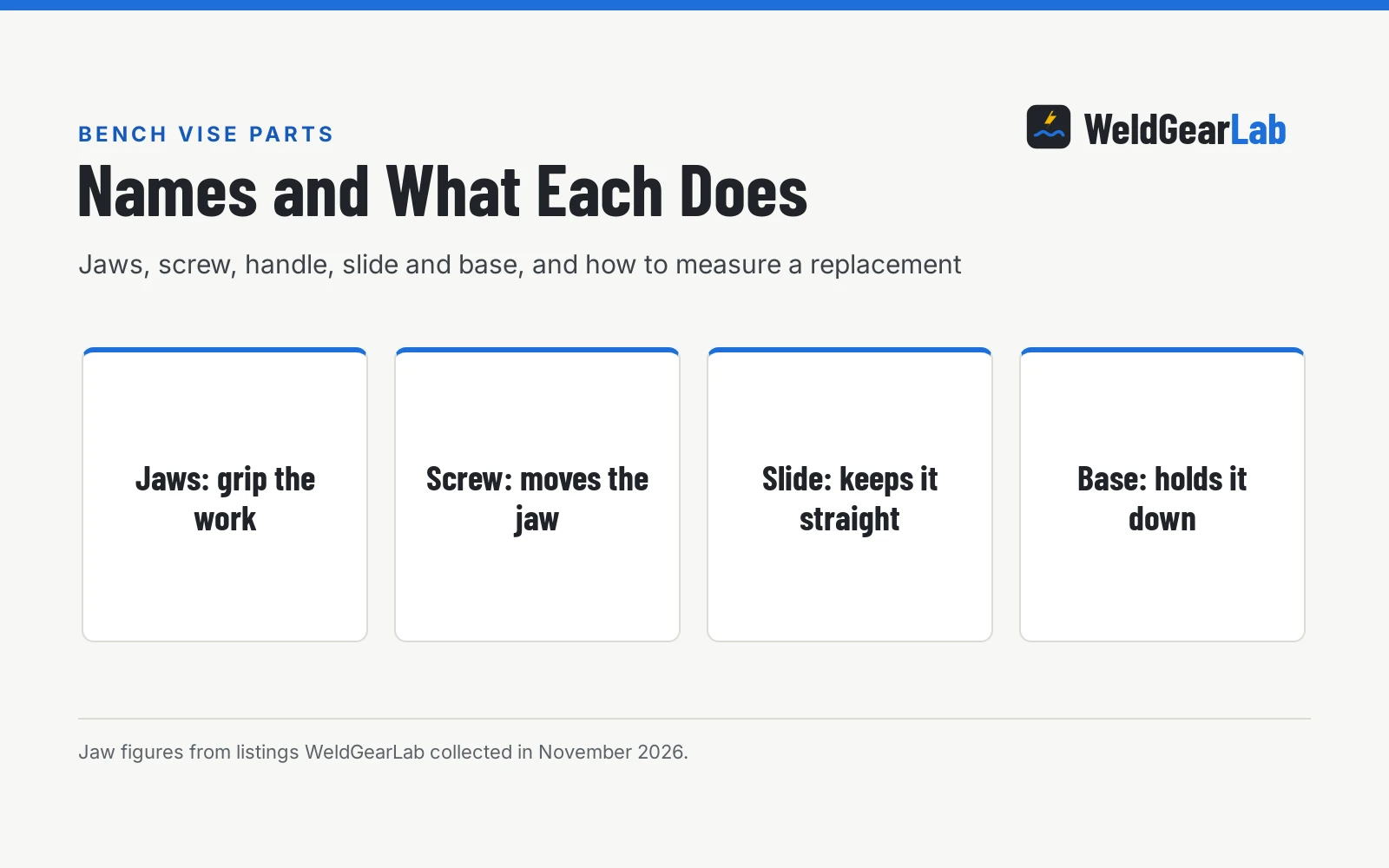
A bench vise holds metal still while the work is sawn, filed, drilled or welded, and bench vise parts are the pieces that do that job together. The fixed jaw and the moving jaw grip the work, the screw and handle move the moving jaw, the slide keeps it running straight, and the base holds the whole vise to the bench. When a piece wears out or breaks, the vise slips, racks or will not close square, and knowing the name of the failed part is the way to start fixing it. This guide names each part and shows how to measure a replacement jaw.
This guide links to our product roundups, where WeldGearLab gets a commission on purchases made through links on this page, and your price stays the same. Read our affiliate disclosure.
Bench vise parts in one paragraph
A bench vise is a clamp with a fixed half and a moving half. The fixed jaw sits on the body and does not move, while the moving jaw rides on the slide and closes against it when the handle turns the screw. The screw runs through a nut in the body, the handle gives the leverage to turn it, and the slide keeps the moving jaw square as it travels. Each part does a plain job and fails in its own way, so it helps to know them by name before ordering a spare.
Bench vise parts side by side
| Fixed jaw | Moving jaw | Screw and handle | Slide and base | |
|---|---|---|---|---|
| Job | Grips one side of the work | Grips the other side and moves | Drives the moving jaw in and out | Guides the jaw and anchors the vise |
| Wear point | Serrations smooth with use | Serrations smooth with use | Threads wear and the handle bends | Slide binds and the base loosens |
| Replacement | Bolt-on jaw plates | Bolt-on jaw plates | A new screw or handle | Clean, oil and refit, or replace the vise |
| Measure before ordering | Jaw width, height and thickness | Jaw width, height and thickness | Screw length and thread | Base bolt pattern |
The table above lines up the main bench vise parts by job, wear point and replacement. Jaws are the wear item most readers will replace, while the screw, slide and base last longer. Measure before ordering, because jaw plates fit a named vise size and hole spacing, not every vise on the bench.
The jaws
The jaws are the gripping faces of the vise, and they take all the wear. Steel jaws are usually serrated, and the serrations bite into the work so it does not slip. When the serrations smooth out, the vise still closes but the work creeps, and that is the sign to fit new jaw plates.
Replacement jaw plates are sold by vise size and model. Forward lists 6.5 inch steel jaw plates for the CR60A industry vise, heat treated to 45-56HRC, and 5 inch plates for the DT08125A multipurpose vise with the same hardness. K Tool International lists replacement jaws in 5 inch and 8 inch sizes as a pair, and Yost lists serrated jaws for bench vise model 445 and the MV-5 homeowners vise. Viprh lists reversible aluminum jaws 6 1/2 inch wide, 3/4 inch high and 7/16 inch thick, with 2 1/2 inch centre to centre holes, for older American-made reversible gray vises. A generic listing for the same vises uses alloy steel hardened to HRC 60, with a non-slip pattern and a V groove at each end for round work.
Soft jaws fit over the steel jaws to protect finished work. JMIATRY lists 3 pair of 4 inch magnetic jaw pads, 6 pieces in the pack, made from aluminum alloy with soft rubber inserts, with a V-shaped surface and a ledge for round, hex and flat parts. AUTOVIC lists aluminum offset jaws 5 1/2 inch wide, 3/4 inch high and 1/2 inch thick, with 3 inch centre to centre holes, for Craftsman, Columbian and Fuller vises, and the pack includes 4 screws sized 1/4 inch by 5.8 inch. For a new vise rather than new jaws, see the best bench vise for metal work guide.
The screw, handle and slide
The screw turns handle effort into clamping force. Turn the handle one way and the moving jaw closes, turn it back and the jaw opens. A bent screw or handle makes the jaw run stiff or wobble, and worn threads will not hold pressure. Keep the screw and slide clean and lightly oiled.
The base and swivel
The base is the foot of the vise, and it bolts to the bench through holes in the flange. A swivel base lets the vise turn to face the work, then locks in place. Check the base bolts before a heavy job, because a vise that rocks on its base will not hold work square.
How to measure replacement jaws
Measure the old jaws before ordering, because plates are made for a named vise and hole spacing. Measure the width, height and thickness, then the mounting holes centre to centre. The Forward 6.5 inch plates measure 6.5 inches by 0.75 inches by 0.43 inches, while the Forward 5 inch plates measure 4.92 inches by 0.75 inches by 0.37 inches. Viprh uses 2 1/2 inch centre to centre holes, AUTOVIC uses 3 inch holes, and the generic listing gives a range of 2-1/2 inch to 3-1/2 inch.
When to replace a part
- Jaws. The serrations are smooth, the work slips, or the plates are chipped.
- Screw and handle. The handle is bent, the screw turns stiff, or the jaw will not hold pressure.
- Slide. The moving jaw racks, binds or runs out of square.
- Base. The base is cracked, or the vise rocks on the bench even with the bolts tight.
Replace jaws first, because they are the most common wear item and the simplest fix. A screw or a base takes more fitting, so weigh the part against a new vise before ordering. See the best bench vise under 100 guide when a repair no longer makes sense.
For more options, see our welding tables carts guides.
FAQ for welders
What are the main parts of a bench vise?
The main bench vise parts are the fixed jaw, the moving jaw, the screw, the handle, the slide and the base. The jaws grip the work, the screw and handle close the moving jaw, the slide keeps the jaw square, and the base bolts the vise to the bench.
Can I replace just the jaws on a bench vise?
Yes, in most cases the jaws bolt on and come off with the mounting screws. Replacement plates are sold by vise size and model, so match the width, height, thickness and hole spacing to the listing.
What size replacement jaws do I need?
Measure the old jaws across the face, top to bottom and through the thickness, then measure the mounting holes centre to centre. Listings state these figures, such as 6.5 inch plates for the Forward CR60A and 5 inch plates for the Forward DT08125A (on Amazon).
Are soft jaws worth using on a bench vise?
Soft jaws are worth using when the work is finished or soft and steel serrations would mark it. The JMIATRY pads (on Amazon) use a soft rubber contact surface with a V-shaped surface and a ledge, so they hold round, hex and flat parts while protecting the surface.
Why does my bench vise not grip the work?
The usual cause is worn jaws, with the serrations smoothed out so the work creeps under pressure. A bent screw, a worn thread or a binding slide can cause the same fault, and a loose base lets the whole vise rock.
Related: best bench vise under 100, best clamp on bench vise, clamp on vs bolt down bench vise, and the bench vise vs welding vise guide. Also see the how we pick method.