Best Bench Vise for Metal Work (2026): 5 Picks
Five bench vises for metal work compared by jaw width, max opening, clamping force, material, mounting and weight, from 3 in to 8 in.

On this page
Top picks at a glance
As an Amazon Associate I earn from qualifying purchases.
- 1
 Best OverallVEVOR Bench Vise9.7/10View on Amazon
- 2
 Best 5 in ViseForward DT08125A9.6/10View on Amazon
- 3
 Best 3 in SwivelMAXMAN Bench Vise9.5/10View on Amazon
- 4
 Best Compact Clamp-OnZHRMJZG Table Vise9.4/10View on Amazon
- 5
 Best PortableCMOOD Table Vise9.4/10View on Amazon
The job is a length of angle iron that needs a straight cut, and holding it by hand is how crooked cuts and burned gloves happen. A bench vise locks the work to the bench so both hands are free for the grinder or the torch. The best bench vise for metal work pairs a wide jaw with serious clamping force, a swivel base for odd angles, and jaws that grip flat stock and pipe alike. This guide compares five by what their listings publish: jaw width, max opening, clamping force, material, mounting and weight. Two are heavy bolt-down fabrication vises in ductile iron; three are lighter clamp-on vises for smaller benches and temporary setups, so the right pick depends on the bench as much as on the work.
WeldGearLab gets a commission on purchases made through links on this page, and your price stays the same. Read our affiliate disclosure.
Quick picks
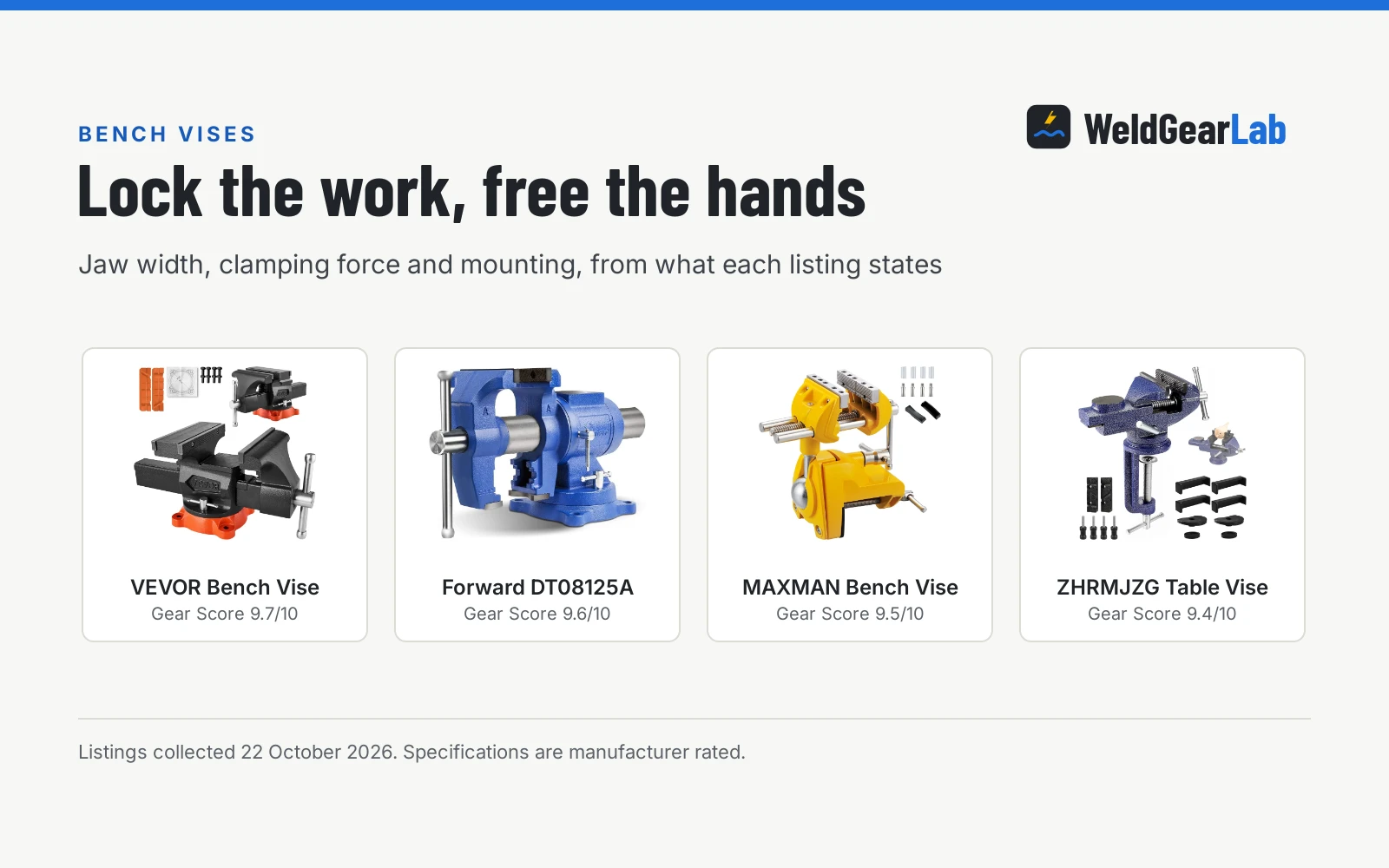
- Best Overall VEVOR Bench Vise: 8 in jaw, 6,744 lb clamping force and two-way jaws in ductile iron. Check price on Amazon
- Best 5 in Vise Forward DT08125A: 5 in ductile iron vise with 5,500 lb clamping force and 3 jaw sets. Check price on Amazon
- Best 3 in Swivel MAXMAN Bench Vise: 3 in cast steel vise with a 360 deg head that tilts to 45 deg. Check price on Amazon
- Best Compact Clamp-On ZHRMJZG Table Vise: 3.2 in clamp-on vise with soft jaws and 360 deg rotation. Check price on Amazon
- Best Portable CMOOD Table Vise: 3 in clamp-on table vise in cast steel for light duty work. Check price on Amazon
The machines

VEVOR Bench Vise 8 Inch Jaw Width Multipurpose
An 8 in ductile iron vise with 6,744 lb clamping force, two-way jaws and a 4-bolt mount.
Pros
- Widest jaw here at 8 in, 11.5 in reverse opening
- Highest stated clamping force: 6,744 lb
- Ductile cast iron with a large anvil area
- Pipe jaw with 0.59 to 2.36 in clamping range
Cons
- Heaviest here at 44.3 lb, needs a stout bench
- No warranty term is stated
- 8 in size is overkill for small parts
- Two-way jaw design takes learning
Forward DT08125A 5 Inch Heavy Duty Bench Vise
A 5 in ductile iron vise with 5,500 lb clamping force, 3 jaw sets and a 360 deg rotating head.
Pros
- 5,500 lb clamping force in 60,000 PSI ductile iron
- 3 jaw sets: microgroove top, pipe jaws and V-jaws
- 360 deg rotating head plus swivel base
- Large reinforced anvil for hammering
Cons
- No warranty term is stated
- 33 lb needs a solid bench
- 5 in jaw is mid-size, not the widest here
- Blue finish is industrial, not pretty

MAXMAN Bench Vise, 360° Cast Steel Swivel Base
A 3 in cast steel clamp-on vise with a 360 deg head that tilts to 45 deg.
Pros
- Head rotates 360 deg and tilts to 45 deg
- Quenched jaws for hardness and strength
- Clamp-on mount, no drilling needed
- Rubber pads protect bench and workpieces
Cons
- No clamping force figure stated
- No warranty term is stated
- Weight not stated on the listing
- 3 in jaw suits small work only

Table Vise, 3.2 Inch Bench Vise Universal Rotate
A 3.2 in clamp-on cast iron vise with soft jaws and 360 deg rotation.
Pros
- Clamp-on install, no drilling required
- Soft jaws included for delicate workpieces
- 360 deg rotating base
- Compact 3.8 lb for small workspaces
Cons
- No clamping force figure stated
- No warranty term is stated
- Cast iron, not ductile iron
- 3.2 in size suits small work only

Universal Table Vise 3 Inch
A 3 in clamp-on portable vise in cast steel for light duty metalworking.
Pros
- Portable clamp-on design fits most tables
- Quenched jaws for added hardness
- Rubber blanket protects fragile items
- 360 deg swivel base
Cons
- No clamping force figure stated
- No warranty term is stated
- Light duty: not for heavy fabrication
- 2.8 in jaw width is the narrowest here
Other welders and gear to compare
 AV Steel 4-1/2" Bench Vise with 240° Flexible Swivel LockingCheck price on Amazon
 6" Bench Vise Heavy DutyCheck price on Amazon
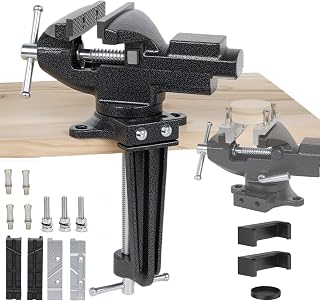 Table ViseCheck price on Amazon
 2 PCS 3 Inches Bench ViseCheck price on Amazon
 MYTEC 2-In-1 Bench Vise Heavy Duty for WorkbenchCheck price on Amazon
Spec sheet comparison
| Model | Jaw width | Max opening | Clamp force | Material | Mount | Weight |
|---|---|---|---|---|---|---|
| VEVOR Bench Vise | 8 in | 11.5 in (reverse) | 6,744 lb | Ductile iron | 4-bolt, 360 deg swivel | 44.3 lb |
| Forward DT08125A | 5 in | 5 in | 5,500 lb | Ductile iron | Bolt-down, 360 deg swivel | 33 lb |
| MAXMAN Bench Vise | 3 in | 3.2 in | Not stated | Cast steel | Clamp-on, 360 deg head | Not stated |
| ZHRMJZG Table Vise | 3.2 in | 3.2 in | Not stated | Cast iron | Clamp-on, 360 deg | 3.8 lb |
| CMOOD Table Vise | 2.8 in | 3 in | Not stated | Cast steel | Clamp-on, 360 deg swivel | 1.88 kg |
These numbers are the manufacturer’s ratings exactly as each listing gives them, recorded on 21 October 2026. Clamping force is stated for two of the five vises.
Buying guide: the best bench vise for metal work
Jaw width and opening
Jaw width decides how much of the workpiece the vise grips at once. A vise that only nips the edge of a wide plate lets the plate flex and chatter under the grinder.
The VEVOR lists an 8 in jaw with an 11.5 in max opening in reverse and 8 in forward; the Forward lists a 5 in jaw with a 5 in max opening. The three smaller picks list 3 to 3.2 in jaws with 3 to 3.2 in openings. For flat bar and angle iron, a wider jaw holds straighter; for small brackets and bolts, 3 in is plenty. See welding vise vs welding clamp if you are deciding between the two.
Clamping force
Only two listings state clamping force: the VEVOR at 6,744 lb (29.96 kN) and the Forward at 5,500 lb (24 kN). The other three listings state no figure, so there is no honest way to rank them on force. If your work is grinding, drilling and tapping, favor the two that publish a number; if it is light holding and fitting, the unstated picks are still vises, just unrated ones.
Ductile iron, cast iron or cast steel
The Forward and VEVOR are ductile iron, with the Forward listing 60,000 PSI ductile iron. The ZHRMJZG is cast iron, and the CMOOD and MAXMAN list cast steel or alloy steel. Ductile iron bends before it breaks, which is what you want when a vise takes a beating. Cast iron is rigid but can crack under shock; cast steel sits between. All five will hold work, but the ductile iron picks are the ones to hammer near.
Swivel base and pipe jaws
All five rotate: 360 degree swivel bases on the Forward, CMOOD, ZHRMJZG and VEVOR, and a 360 degree head on the MAXMAN that also tilts to 45 degrees on the oblique side. For round stock, the Forward lists built-in pipe jaws from 3/5 in to 2 1/2 in plus V-jaws, and the VEVOR lists a pipe jaw with a 0.59 to 2.36 in clamping range. If you bend or cut pipe and tube, pipe jaws are worth more than raw jaw width.
Mounting
The Forward bolts down with included bolts and the VEVOR uses a 4-bolt mounting design; both suit a permanent bench spot. The CMOOD, ZHRMJZG and MAXMAN are clamp-on vises that grip the bench edge with no drilling, which suits renters and temporary setups. The MAXMAN lists 10 mounting holes for different fixings. A vise that walks across the bench is worse than no vise, so match the mount to how permanent your bench is. For the bench itself, see the welding tables and carts hub.
Anvil and extras
The Forward and VEVOR both list a reinforced anvil, which turns the vise into a small forming and straightening station. None of the three smaller picks lists an anvil, so plan a separate striking surface if you buy one of those. Extras worth noting: the Forward includes mounting bolts, the VEVOR includes bolts and nuts, the MAXMAN includes soft rubber jaw covers and bench pads, the ZHRMJZG includes soft jaws, and the CMOOD includes a rubber blanket for fragile workpieces. None of the five listings states a warranty term, so the extras are part of the value calculation.
Use as directed. Bolt or clamp the vise solidly before use, since a shifting vise throws work. Keep hands clear of the jaws when tightening, do not use a cheater bar on the handle beyond what the listing allows, and wear eye protection when grinding or cutting in the vise. Follow standard shop safety practice for welding, cutting and grinding.
FAQ for welders
What size bench vise do I need for metal work?
For general fabrication, the 5 in Forward or the 8 in VEVOR cover flat bar, angle and pipe. The 3 to 3.2 in picks suit small parts, brackets and light drilling. Bigger is not always better: an 8 in vise at 44.3 lb needs a stout bench.
How do I mount a bench vise?
The Forward includes bolts for a bolt-down mount and the VEVOR lists a 4-bolt mounting design. The CMOOD, ZHRMJZG and MAXMAN clamp onto the bench edge with no drilling. Whichever you choose, the vise must not move under load.
What are pipe jaws for?
Holding round stock. The Forward lists built-in pipe jaws from 3/5 in to 2 1/2 in, and the VEVOR lists a pipe jaw with a 0.59 to 2.36 in range. Flat jaws alone let pipe roll; pipe jaws cradle it.
Can I hammer on a bench vise?
Both the Forward and the VEVOR list a reinforced anvil for hammering and forming work. The smaller picks do not list an anvil, so treat them as clamping tools, not striking surfaces.
Is ductile iron better than cast iron for a vise?
The listings suggest it: the Forward lists 60,000 PSI ductile iron and the VEVOR lists ductile cast iron, while the ZHRMJZG lists cast iron. Ductile iron resists cracking under shock loads better than plain cast iron.
Related: the best welding vise for home shop, the best welding vise for mechanics, welding vise vs welding clamp and the welding tables and carts hub.
Scoring, line by line
Each vise is scored on performance, build, value, safety listing and warranty, with the weights published on our How We Pick page. Bench vises have no electrical safety listing to state and none of these listings states a warranty term, so every vise here scores zero on those two criteria; the ranking comes from the other three.
| Product | Gear Score | Perf. /35 | Build /25 | Value /25 | Safety /10 | Warranty /5 |
|---|---|---|---|---|---|---|
| VEVOR Bench Vise | 9.7 | 33 | 21 | 20 | n/a | 0 |
| Forward DT08125A | 9.6 | 32 | 21 | 20 | n/a | 0 |
| MAXMAN Bench Vise | 9.5 | 26 | 19 | 20 | n/a | 0 |
| ZHRMJZG Table Vise | 9.4 | 24 | 18 | 20 | n/a | 0 |
| CMOOD Table Vise | 9.4 | 23 | 18 | 19 | n/a | 0 |
Displayed scores fall between 9.2 and 9.8: the weighted point total is mapped onto that band in a straight line, so earning more points always lifts the score. Safety points apply to gear that runs on power or lists safety features. Without either, we score out of 90 instead of 100.