Cast Iron vs Forged Steel Bench Vise: Which One Should You Buy?
Cast iron and forged steel bench vises hold work differently, and the right material depends on how much striking, bending and heavy clamping the bench sees.

On this page
Top picks at a glance
As an Amazon Associate I earn from qualifying purchases.
- 1
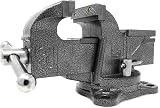 WEN Bench Vise9.3/10View on Amazon
- 2
 Yost Vises 760-DI Multi-Jaw Rotating Vise 6 Inch Jaw Width9.7/10View on Amazon
- 3
 Yost Vises 750-E Multi-Jaw Rotating Vise System9.6/10View on Amazon
- 4
 COGNATIVE 2” Gray Cast Iron Mini Table Clamp Bench ViseView on Amazon
- 5
 Nakkaa 10 Inch Heavy Duty Cast Iron Bench Vise 360° SwivelView on Amazon
- 6
 PONY 6 Inch Heavy Duty Bench ViseView on Amazon
- 7
 VEVOR Heavy Duty Bench ViseView on Amazon
- 8
 PONY 5 Inch Heavy Duty Bench Vise with 360-Degree Swivel BaseView on Amazon
- 9
 Yost Vises 445 Combination ViseView on Amazon
A vise earns its place when it holds a frame steady for a weld, grips a bar for filing, or clamps a bracket while holes are drilled. When the work also involves hammering, prying or heavy striking, the body material starts to matter as much as jaw size. This guide answers the cast iron vs forged steel bench vise question directly: cast iron, in the ductile form the listings below state, suits steady clamping and ordinary shop work, while forged steel suits benches where the vise also absorbs blows and shock loads.
Other welders and gear to compare
 COGNATIVE 2” Gray Cast Iron Mini Table Clamp Bench ViseCheck price on Amazon
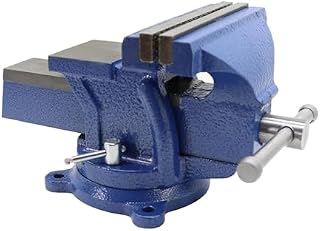 Nakkaa 10 Inch Heavy Duty Cast Iron Bench Vise 360° SwivelCheck price on Amazon
 PONY 6 Inch Heavy Duty Bench ViseCheck price on Amazon
 VEVOR Heavy Duty Bench ViseCheck price on Amazon
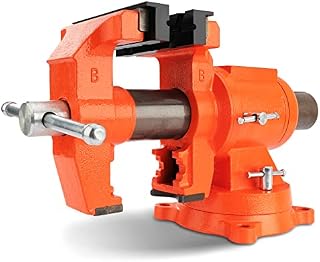 PONY 5 Inch Heavy Duty Bench Vise with 360-Degree Swivel BaseCheck price on Amazon
 Yost Vises 445 Combination ViseCheck price on Amazon
This guide links to our product roundups, where WeldGearLab gets a commission on purchases made through links on this page, and your price stays the same. Read our affiliate disclosure.
Cast iron vs forged steel bench vise: the difference in one paragraph
Cast iron is poured into a mold and cooled into shape, which gives a stiff body with good vibration damping. Forged steel is shaped under pressure, which lines up the grain of the metal and gives a body that bends before it breaks. Ductile iron, the material the three listings below state, is a cast iron with a nodular grain structure that adds toughness over plain gray cast iron, but it is still a casting, not a forging. The practical split is simple: castings are stiff and steady, forgings are tougher under blows.
Side by side
| Cast iron | Forged steel | What it means on the bench | |
|---|---|---|---|
| How it handles overload | Stiff, and it can crack rather than bend when pushed past its limit | More give before failure, and it tends to bend rather than crack | A cracked body ends the vise; a bent body may still grip, but it may no longer close squarely |
| Hammering and striking | Light peening on the anvil is normal work, but heavy blows risk the casting | Suited to heavier striking work on the anvil | Match the anvil work to the body, not just the jaw size |
| Jaw grip over time | Jaw teeth grip well when the slide stays clean and the jaws stay free of grit | Jaw teeth and slide wear in a similar way, with the body more forgiving under shock loads | Keep the slide and screw clean either way; grit wears both materials |
| Weight and bench load | Heavy for its size, which steadies the work during filing and sawing | Heavy as well, with the mass spread through a forged body | Either material needs a solid bench and firm mounting |
| Shop fit | A sound pick for clamping, filing, drilling and light fabrication | A sound pick where the vise also takes hammering and prying | Pick by the hardest job the vise will see, not the average job |
The table states general material behavior, not a promise about any single vise. A well made casting can outlast a poor forging, and a listing that states little about its body tells the reader little about either. Read the jaw size, opening, throat depth and clamping force the listing states, and weigh those against the hardest job planned for the bench.
When cast iron is the better choice
- Steady clamping work. Filing, sawing, drilling and fit-up all reward a stiff body that does not flex while the work is held.
- Welding and fabrication. Holding frames, brackets and tube for tacking and assembly needs grip and stability more than shock resistance.
- A bench that stays indoors. A casting kept clean and dry, with the slide wiped down, stays in good working order for ordinary work.
- Wide size range. The listings here show ductile iron bodies from a 6 inch jaw to a 10 inch jaw, so size, not material alone, decides the fit.
When forged steel is the better choice
- Heavy striking. Work that involves hammering on the anvil or driving parts into place favors a body that bends rather than cracks.
- Prying and shock loads. Bending a bar in the jaws or levering a stuck part puts sudden loads on the body that forgings absorb better.
- Rough shop conditions. A vise that gets knocked, dropped or worked outdoors faces the kind of abuse a forging handles better.
- One vise for every job. When a single vise must cover clamping and striking alike, the tougher body is the safer pick.
Three vises from the listings, ranked
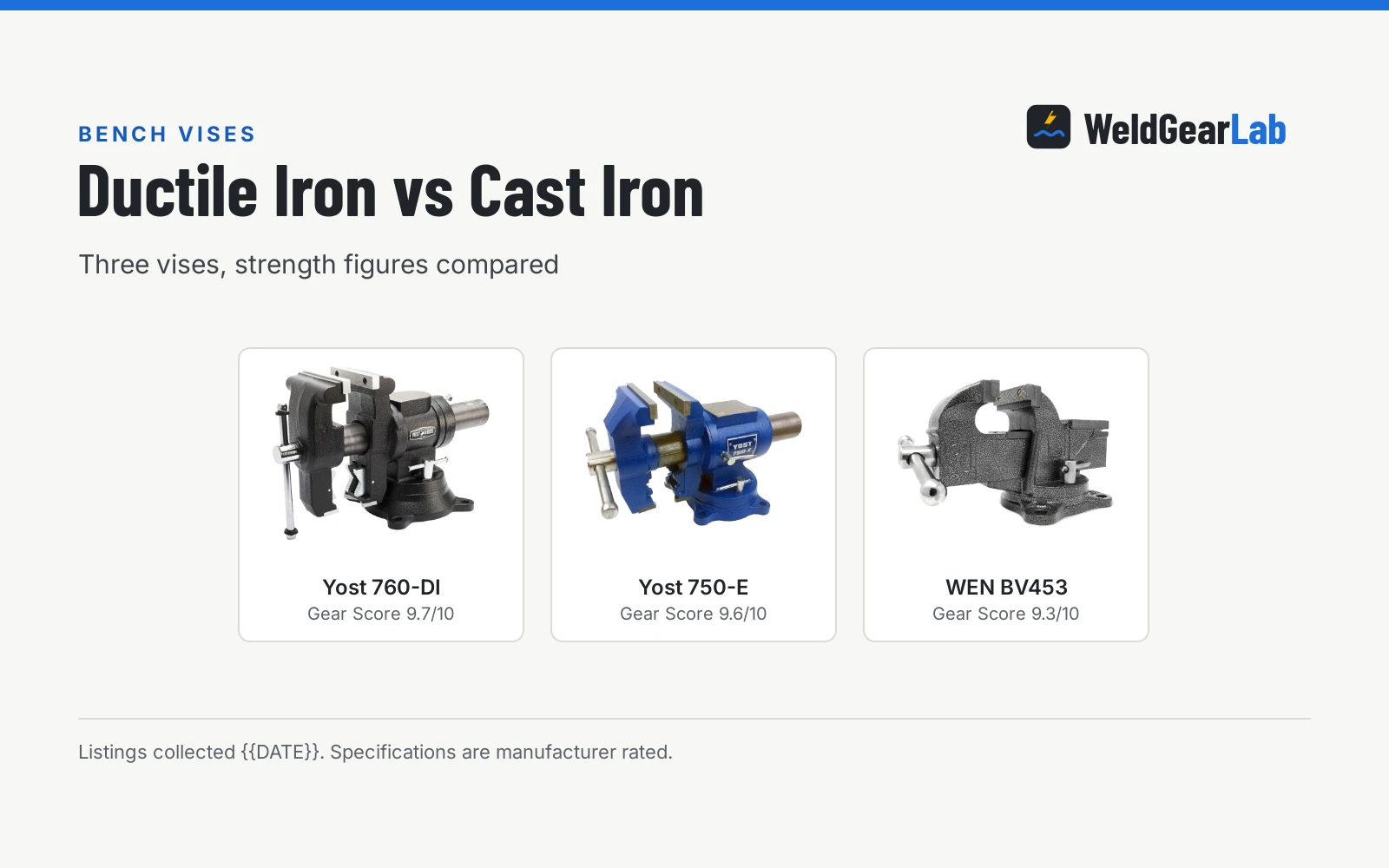
Every listing below states a ductile iron body, so this section ranks them on the specs their listings state, not on material alone. First is the Yost HD650-C Heavy Duty 6-1/2 Inch Mechanics Work Bench Vise. The listing states 60,000 PSI ductile iron, a 6.50 inch jaw width, a 5.90 inch maximum jaw opening, a 4.29 inch throat depth and a maximum jaw clamping force of 10,116 lbs. It also lists replaceable pipe jaws, an interlocking swivel base and a large anvil surface. The stated clamping force is the highest figure any of the three listings states, and the spec set is the most complete, which puts it first.
Second is the Nakkaa 10 Inch Heavy Duty Cast Iron Bench Vise. The listing states a 10 inch jaw width, a maximum jaw opening of 7.87 inch and a throat depth of 3.55 inch, with a lockable 360 degree swivel base and 3 mounting holes. It lists replaceable microgroove tooth steel jaws and an integrated anvil. The jaw width and opening are the widest of the three, which suits wide stock and large brackets, though the listing states no clamping force figure.
Third is the PONY 6 Inch Heavy Duty Bench Vise. The listing states a 6 inch jaw width, a clamping force of 8800 lbs, ductile iron with a tensile strength of 6000 PSI, a 360 degree rotatable base, replaceable pipe jaws and a built-in anvil. It also lists a fully enclosed rear to keep dust and debris out of the vise body. The stated force is solid for a vise of this jaw width, and the enclosed rear is a practical touch for a dusty shop.
One note on the numbers: the PONY listing states 6000 PSI while the Yost listing states 60,000 PSI, and the two figures describe different listings, not a shared standard. Compare each vise on its own stated figures, and treat a missing figure, such as the Nakkaa clamping force, as unstated rather than as a weakness the listing disproves.
How to pick the material for your bench
Start with the hardest job, not the most common one. When the vise will mostly clamp, file, drill and hold work for welding, a ductile iron body of the right jaw size does the job well. When the vise will also take hammering, bending and prying, look for a forged steel body, and check that the anvil and jaws are rated by the maker for that work. Then check fit: jaw width against the widest stock, opening against the thickest part, throat depth against how far into the jaws the work must reach, and the swivel base against the angles the bench layout demands. A vise that fits the work and the bench beats a larger vise that does not.
Mounting matters as much as material. A thin bench top will flex under load no matter what the vise body is made of, and a swivel base left unlocked will drift under load. Bolt the base down solidly, lock the swivel before clamping, and keep the slide and screw clear of swarf and grinding dust.
FAQ for welders
Is ductile iron the same as cast iron?
Ductile iron is a form of cast iron with a nodular grain structure that makes it tougher than plain gray cast iron. It is still poured into a mold, so it shares the stiffness of a casting, but it resists cracking better than gray iron. When a listing states ductile iron, read it as a tougher casting, not as a forging.
Can a cast iron vise handle hammering?
Light peening and tapping on the anvil are normal vise work, but heavy striking risks cracking a casting, while a forging is more likely to bend than crack. When hammering is a regular part of the job, a forged steel body is the better pick. Keep heavy blows off the jaws themselves on either material, since jaw teeth chip under direct hammer strikes.
What jaw size does a home shop need?
Jaw width should cover the widest stock the bench sees, and the opening should clear the thickest part. The listings here range from a 6 inch jaw to a 10 inch jaw, with openings from 5.90 inch to 7.87 inch. Measure the largest bracket, frame rail or bar the shop handles, then pick a vise whose stated opening clears it.
Does clamping force matter more than jaw size?
Both matter, and neither replaces the other. Clamping force holds the work still under filing and drilling, while jaw size and opening decide whether the work fits at all. A vise with a high stated force but too small an opening cannot hold a wide part, and a wide vise with a low stated force may let work shift under a file.
Should the base swivel or stay fixed?
A swivel base helps when work must be turned to a comfortable angle for filing, welding or drilling, and two of the three listings here state a 360 degree swivel base, while the third lists an interlocking swivel base. A fixed base suits a bench where the vise always faces one way. Either way, lock the base before working, since an unlocked swivel drifts under load.
Related: heavy duty bench vise, ductile iron vs cast iron bench vise, and bench vise vs welding vise.