Best 7018 Welding Rod for Beginners (2026): 5 Stick Electrodes Scored
Five 7018 stick welding electrodes for beginner fabricators, compared on rod diameter, pack weight, arc characteristics, polarity, and stated warranty terms.

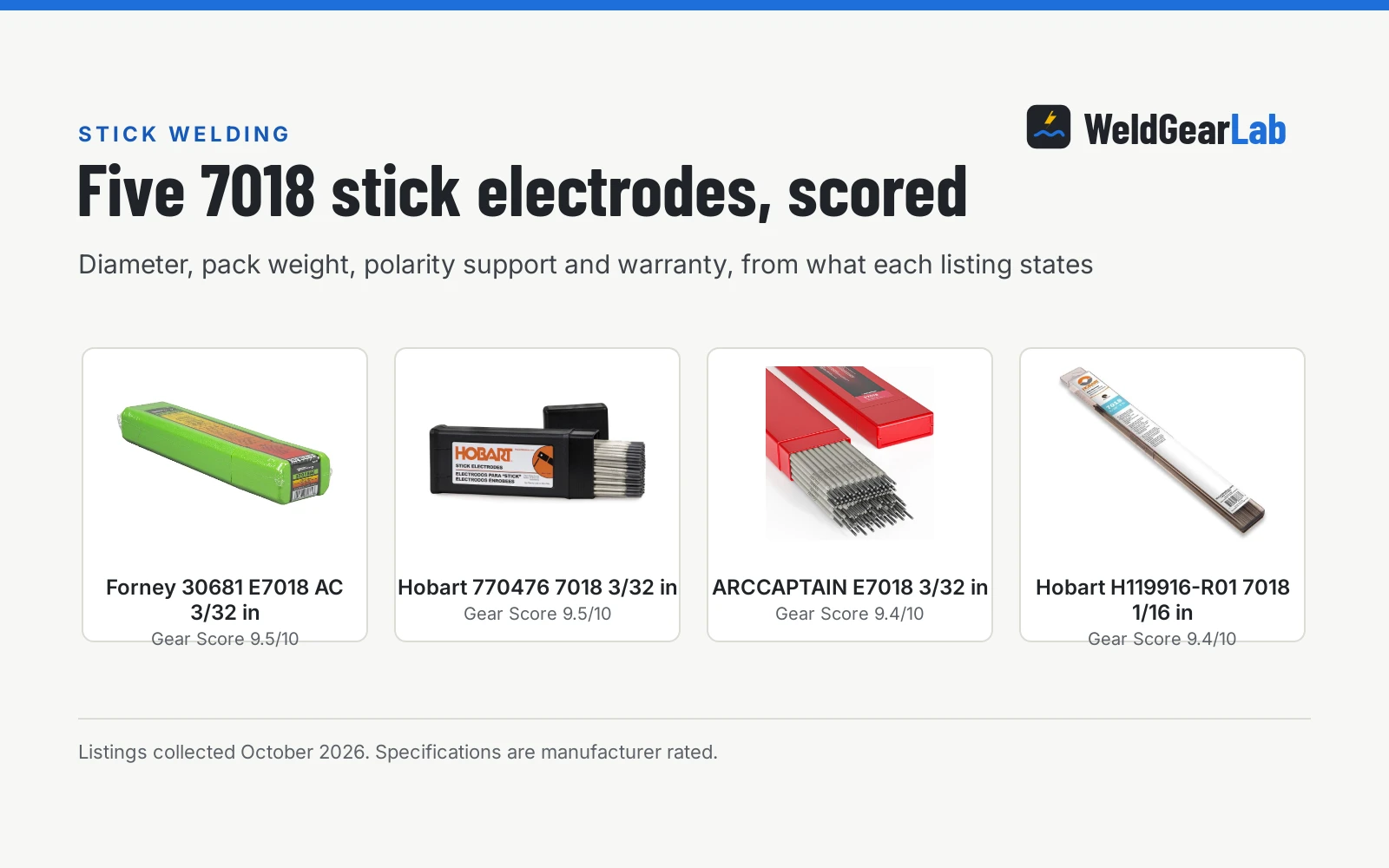
On this page
Top picks at a glance
As an Amazon Associate I earn from qualifying purchases.
- 1
 Best OverallForney 30681 E7018 AC 3/32 in9.5/10View on Amazon
- 2
 Best Bulk PackHobart 770476 7018 3/32 in9.5/10View on Amazon
- 3
 Best for Thin MetalHobart H119916-R01 7018 1/16 in9.4/10View on Amazon
- 4
 Best 1/8-Inch PackSunstac E7018 1/8 in9.3/10View on Amazon
When you have structural carbon steel clamped on the bench and need strong, ductile beads without cracking, finding the best 7018 welding rod for beginners comes down to arc stability, rod diameter, and how easily the electrode strikes on your machine. The ARCCAPTAIN listing describes its E7018 as delivering high-quality x-ray welds. For beginners running basic power sources, choosing an electrode with arc-stabilizing additives or a manageable 3/32-inch diameter makes all the difference between frustration and smooth progress.
WeldGearLab gets a commission on purchases made through links on this page, and your price stays the same. Read our affiliate disclosure.
Quick picks
- Best Overall Forney 30681 E7018 AC 3/32 in: A 5 lb pack in 3/32 inch diameter formulated for low-OCV AC and DC+ power sources, with easy restriking and a 90 day warranty. Check price on Amazon
- Best Bulk Pack Hobart 770476 7018 3/32 in: A 10 lb carton in 3/32 inch diameter rated at 70,000 PSI tensile strength for all-position carbon steel welding on DC. Check price on Amazon
- Best for Thin Metal Hobart H119916-R01 7018 1/16 in: A 1 lb plastic pack in 1/16 inch diameter rated at 70,000 PSI that operates at very low amperage on smaller machines. Check price on Amazon
- Best 1/8-Inch Pack Sunstac E7018 1/8 in: A 5 lb pack in 1/8 inch diameter featuring added yttrium oxide, LiF and MgO arc stabilizers for heavier steel joints. Check price on Amazon
The machines

Forney 30681 E7018 AC Welding Rod, 3/32-Inch
A 5 lb pack of 3/32 inch 7018 AC rods designed for low open circuit voltage power sources, with easy restriking and a 90 day warranty.
Pros
- Designed for low open circuit voltage power sources and AC or DC+ operation
- Formulated for easy re-striking on tack and skip welds
- Stated 90 day warranty against manufacturer defects
- Self cleaning slag and light spatter per the listing
Cons
- Short 90 day warranty coverage compared to longer equipment warranties
- Spec table contradicts title by listing E6010 type and 1/8 inch diameter

Hobart 7018 Stick Welding Electrode 3/32
A 10 lb bulk pack of 3/32 inch carbon steel 7018 electrodes rated at 70,000 PSI for all-position welding on DC or high-OCV AC machines.
Pros
- Large 10 lb pack gives ample rod volume for beginner practice
- Rated at 70,000 PSI tensile strength on carbon steel
- Rated for all welding positions
- Low-hydrogen 7018 stick for carbon steel, as listed
Cons
- Listing explicitly notes not for low-voltage AC welders
- No warranty term is stated
- 10 lb pack requires dry storage to avoid moisture contamination

ARCCAPTAIN E7018 Welding Rod 3/32" 5 LB Low
A 5 lb pack of 14 inch long 3/32 inch iron powder electrodes designed for smooth arc action and AC or DC reverse polarity welding.
Pros
- Iron powder coating formula promotes smooth arc action and low spatter
- Runs on both AC and DC reverse polarity in all positions
- Full 14 inch length in a convenient 5 lb pack
- Stated high melting efficiency and crack-resistant weld metal
Cons
- No warranty term is stated
- No exact tensile strength figure is published in the text
- No amperage range is stated in the listing
Hobart H119916-R01 1-Pound Plastic 7018 Stick
A 1 lb pack of 1/16 inch 7018 electrodes rated at 70,000 PSI, ideal for low-amperage welding on thinner carbon steel sections.
Pros
- Thin 1/16 inch diameter operates at very low amperage
- Convenient 1 lb plastic pack prevents wasting unused rods
- Rated at 70,000 PSI tensile strength on carbon steel
- All-position welding on low, medium, and high-carbon steels
Cons
- Listing explicitly notes not recommended for low-voltage AC welders
- No warranty term is stated
- Slender 1/16 inch rods burn quickly and flex easily during starts
- Small 1 lb pack is unsuitable for larger fabrication projects

Sunstac E7018 Low-Hydrogen Welding Rod
A 5 lb pack of 1/8 inch 7018 rods formulated with yttrium oxide, LiF and MgO arc stabilizers for AC and DC all-position welding.
Pros
- Thicker 1/8 inch core handles heavier joint build-up and thicker plate
- Flux includes yttrium oxide, LiF and MgO arc stabilizing additives
- Full 14 inch length in a 5 lb pack
- All-position capability for AC and DC operation
Cons
- 1/8 inch diameter demands higher amperage that can exceed small home welders
- No warranty term is stated
- No exact tensile strength figure is published in the listing
- 1/8 inch diameter is the largest diameter in this comparison
Other welders and gear to compare
 Victory Welding Alloys 7018 Welding Rod 5/32" E7018 5/32" 5Check price on Amazon
 Bestarc E7018 3/32 Inch Welding Rod 5LBCheck price on Amazon
 E7018 3/32" 10LB Welding Rod Stick Electrodes Low HydrogenCheck price on Amazon
 FEIFANKE 250A Stick Welder MachineCheck price on Amazon
 E6013 Welding Rod 1/8" 4.4LB Carbon Steel Stick ElectrodesCheck price on Amazon
Spec sheet comparison
| Model | Gear Score | Diameter | Pack weight | Current and polarity | Tensile strength | Positions | Warranty |
|---|---|---|---|---|---|---|---|
| Forney 30681 E7018 AC 3/32 in | 9.5/10 | 3/32 in | 5 lb | AC or DC+ | 70,000 PSI | All positions | 90 days |
| Hobart 770476 7018 3/32 in | 9.5/10 | 3/32 in | 10 lb | AC or DC (not low-voltage AC) | 70,000 PSI | All positions | None stated |
| ARCCAPTAIN E7018 3/32 in | 9.4/10 | 3/32 in | 5 lb | AC or DCEP | Not stated | All positions | None stated |
| Hobart H119916-R01 7018 1/16 in | 9.4/10 | 1/16 in | 1 lb | AC or DCEP (not low-voltage AC) | 70,000 PSI | All positions | None stated |
| Sunstac E7018 1/8 in | 9.3/10 | 1/8 in | 5 lb | AC or DC | Not stated | All positions | None stated |
Ratings in this table are the makers’ own claims taken from each product page (15 October 2026).
Buying guide: best 7018 welding rod for beginners
Electrode diameter and machine output
Selecting the right core wire diameter is critical when learning stick welding. A 3/32-inch diameter rod is widely regarded as the sweet spot for beginners because it runs smoothly on lower amperage output without overheating small home welders. Slender 1/16-inch electrodes allow delicate work on thinner sheet metal where excess heat causes burn-through. In contrast, 1/8-inch electrodes deposit heavy fill passes on thick steel plate, but they demand higher amperage that can quickly hit the thermal duty cycle limit of compact hobby welders.
AC buzz boxes versus DC inverter welders
The type of welding current you run dictates how 7018 performs. Low-hydrogen electrodes run smoothest on direct current electrode positive (DCEP), which provides steady arc transfer, deep penetration, and minimal spatter. Running 7018 on alternating current (AC) requires sufficient open circuit voltage (OCV) to reignite the arc every time the electrical wave alternates. As Hobart notes in its listings, standard 7018 rods are not recommended for low-voltage AC welders. If you weld with an entry-level AC transformer machine, look specifically for 7018 AC formulations that incorporate potassium and other arc stabilizers in the flux coating.
Moisture control and package size
The flux coating on 7018 electrodes is formulated to be low-hydrogen, which prevents hydrogen-induced cracking in high-strength carbon steel. However, that flux coating readily absorbs moisture from ambient air if left exposed on a shop bench. While structural code welding mandates holding ovens, hobbyists can manage moisture by purchasing smaller 1 lb or 5 lb cartons rather than massive bulk containers. Once opened, keep your unused rods sealed in an airtight storage tube to preserve clean arc performance.
Arc striking and restriking
Striking an arc with a fresh 7018 rod is straightforward, but restriking a partially burned rod presents a common hurdle for novices. When the arc extinguishes, the flux coating forms a non-conductive glassy slag cap over the steel core wire. Tapping the rod directly onto the plate can chip away flux rather than establishing an arc. Experienced shop welders quickly scratch the tip on a scrap piece or pinch the cooled slag cap off with a gloved hand before attempting to strike an arc in the joint.
Joint fit-up and surface cleanliness
Unlike fast-freezing cellulosic electrodes that can blast through surface contaminants, 7018 requires clean metal. Rust, mill scale, oil, and paint introduce moisture and impurities directly into the molten puddle, resulting in wormholes and porosity. Take the time to grind your weld joint to bright, bare steel before fitting up your parts. Clean fit-up with uniform root gaps ensures predictable puddle control and dependable joint strength.
Safety on the bench. Always wear a proper auto-darkening welding helmet, heavy split-cowhide welding gloves, and flame-resistant leather sleeves before striking an arc. Low-hydrogen stick electrodes generate intense ultraviolet radiation, hot slag chips, and concentrated welding fumes. Keep your head out of the fume plume, work in a well-ventilated shop area, and clear all combustible materials from the vicinity of your welding bench.
Before You Strike an Arc
- Check your power source: Hobart listings explicitly state their 7018 rods are not for low-voltage AC welders, so verify your machine open circuit voltage or switch your welding leads to DC reverse polarity (DCEP).
- Inspect packaging upon arrival: verify that plastic containers or cardboard cartons arrived completely intact, with no crushed flux coatings or evidence of moisture absorption.
- Grind joint edges to bare metal: remove all paint, grease, oil, and heavy mill scale from the weld zone to prevent porosity in the low-hydrogen deposit.
- Keep slag tools within arm’s reach: 7018 produces a heavy slag crust that must be thoroughly chipped and wire-brushed between weld passes.
FAQ for welders
Can a beginner weld with 7018 rods?
Yes, beginners can weld with 7018 once they learn how to manage arc strikes and maintain a tight arc length. The rod produces a smooth puddle with low spatter and high tensile strength that resists cracking on carbon steel. Choosing a 3/32-inch diameter or a specialized AC formulation makes the arc significantly easier to control on hobby welders.
What is the difference between standard 7018 and 7018 AC rods?
Standard 7018 electrodes require higher open circuit voltage and run best on DC reverse polarity, often sticking when used on entry-level AC transformers. Formulations labeled 7018 AC include arc stabilizers in the flux that allow the arc to stay lit as alternating current passes through zero. They also restrike much more readily for tack welds and short passes.
What diameter 7018 welding rod should a beginner choose?
A 3/32-inch diameter is the most versatile starting choice for home and farm fabricators. It runs comfortably within the output range of smaller machines and handles common steel thicknesses without blowing through. Slender 1/16-inch rods suit sheet metal repairs, while 1/8-inch rods demand more machine power than many beginner welders can supply.
Can I run 7018 electrodes on an AC stick welder?
You can run 7018 on an AC welder if the electrode specifically supports AC operation and your machine delivers adequate open circuit voltage. Standard 7018 rods frequently stutter or extinguish on low-voltage AC buzz boxes, as noted on Hobart listings. For consistent performance on basic AC welders, select an AC-specific rod like the Forney 30681.
Do beginners need a rod oven for 7018 electrodes?
Home hobbyists welding general repairs and farm equipment do not need a commercial rod oven. Code-certified structural welds require moisture-free low-hydrogen storage, but everyday hobby projects work well with fresh, dry rods from small sealed packages. Storing 1 lb or 5 lb packs in airtight containers keeps ambient humidity away from the flux.
Related: welding equipment for beginners, how to use stick welder, how to strike an arc with a stick welder, and the welding consumables hub. Also see our best welder for beginners. Also see our why does my welding rod keep sticking. Also see our what does 7018 mean on a welding rod. Also see our how to store 7018 rods without a rod oven. Also see our welding rod amperage chart. Also see our welding duty cycle explained, and the stick welders hub.
More related guides (16)
- dc vs ac stick welding
- stick welder ac vs dc
- best portable stick welder
- best small inverter stick welders
- best stick welder with hot start
- best welding rods for ac welder
- best welding rods for mild steel
- best stick welding gloves
- best stick welding helmet
- welding safety gear checklist for beginners
- can you stick weld thin metal
- how to stick weld rusty metal
- stick welder vs mig welder for farm repairs
- stick welder vs wire welder
- inverter welder vs transformer welder
- inverter welder pros and cons
Scoring, line by line
Each electrode is scored out of 10 on performance, build, value, safety listing and warranty, with the weights published on our How We Pick page. Stick welding electrodes have no electrical safety listing or PPE standard to state, so every electrode here scores zero on that criterion; the ranking comes from the other four.
| Product | Gear Score | Perf. /35 | Build /25 | Value /25 | Safety /10 | Warranty /5 |
|---|---|---|---|---|---|---|
| Forney 30681 E7018 AC 3/32 in | 9.5 | 28 | 19 | 21 | 0 | 2 |
| Hobart 770476 7018 3/32 in | 9.5 | 28 | 21 | 21 | 0 | 0 |
| ARCCAPTAIN E7018 3/32 in | 9.4 | 28 | 19 | 20 | 0 | 0 |
| Hobart H119916-R01 7018 1/16 in | 9.4 | 26 | 20 | 19 | 0 | 0 |
| Sunstac E7018 1/8 in | 9.3 | 26 | 19 | 19 | 0 | 0 |
The lowest score we show is 9.2 and the highest is 9.8; every point total is spread proportionally across that span, so extra points mean a higher figure.