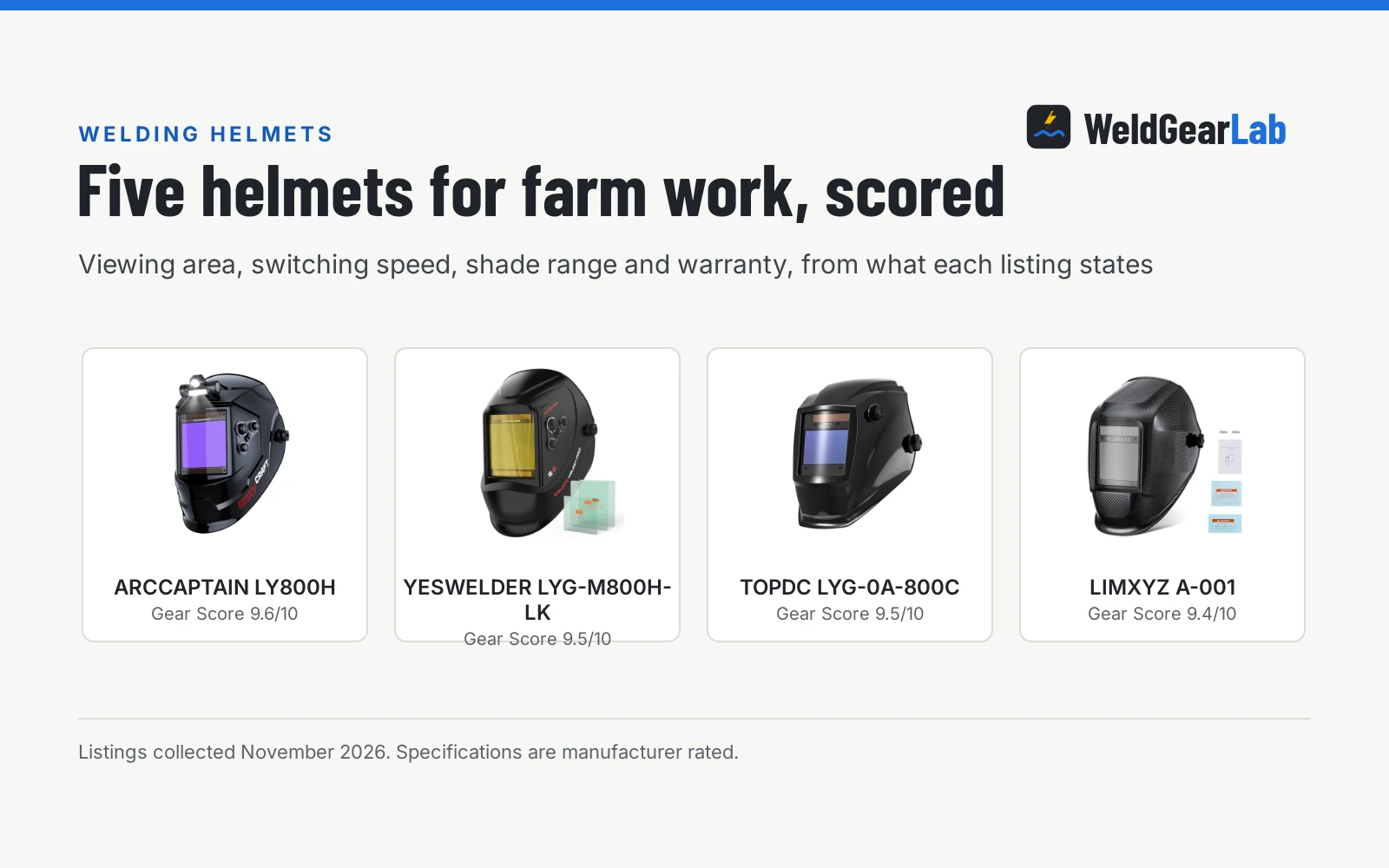
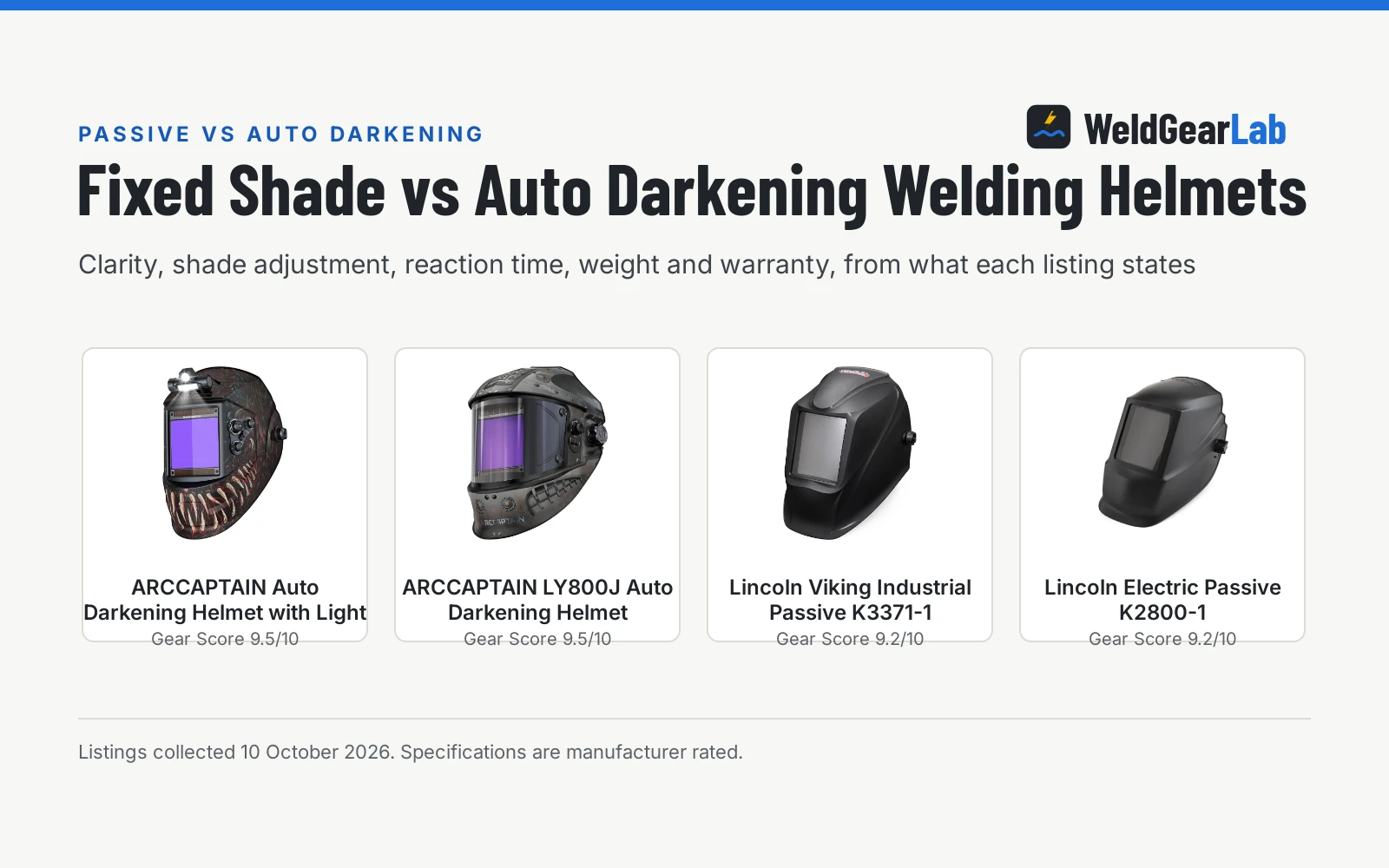
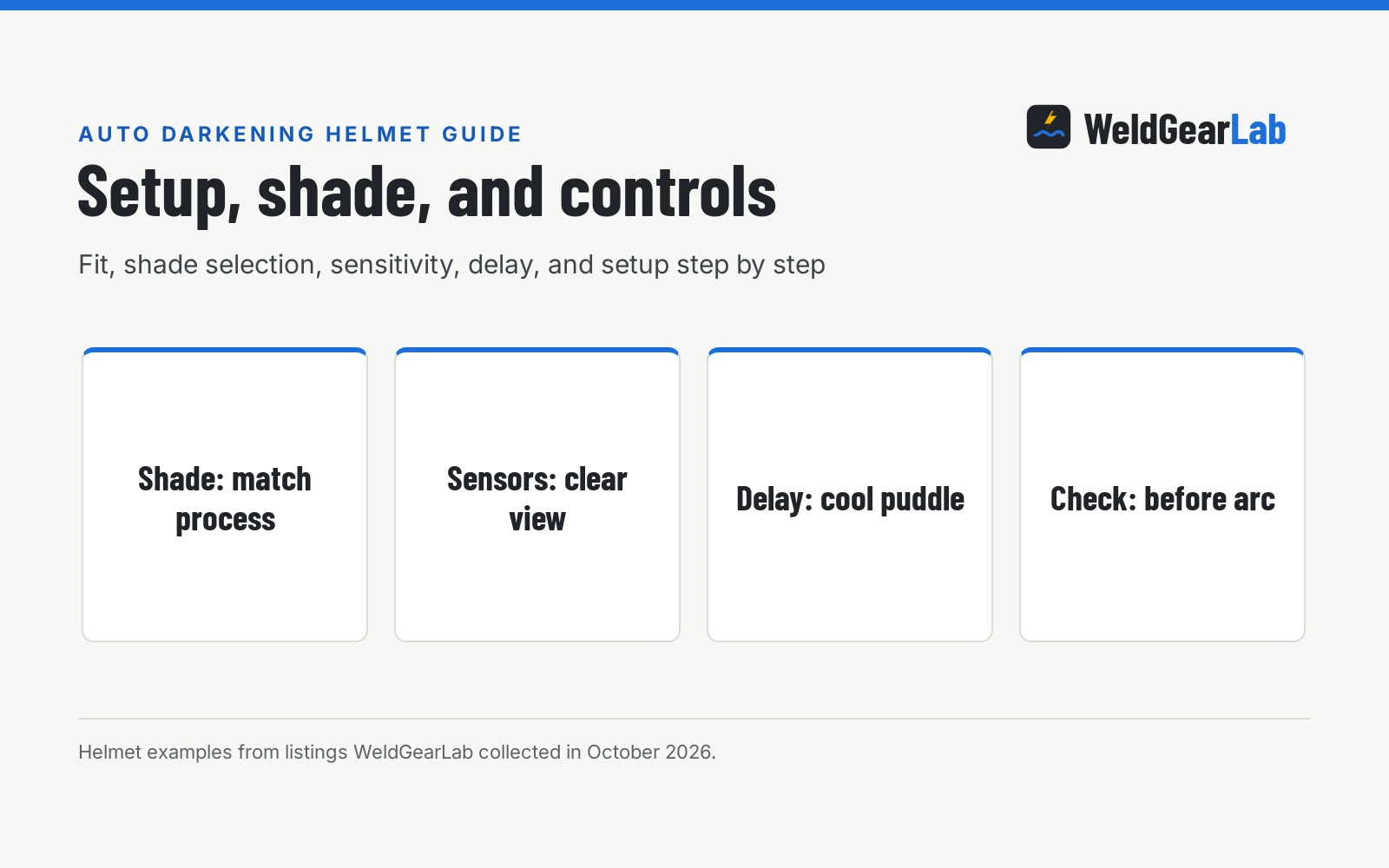
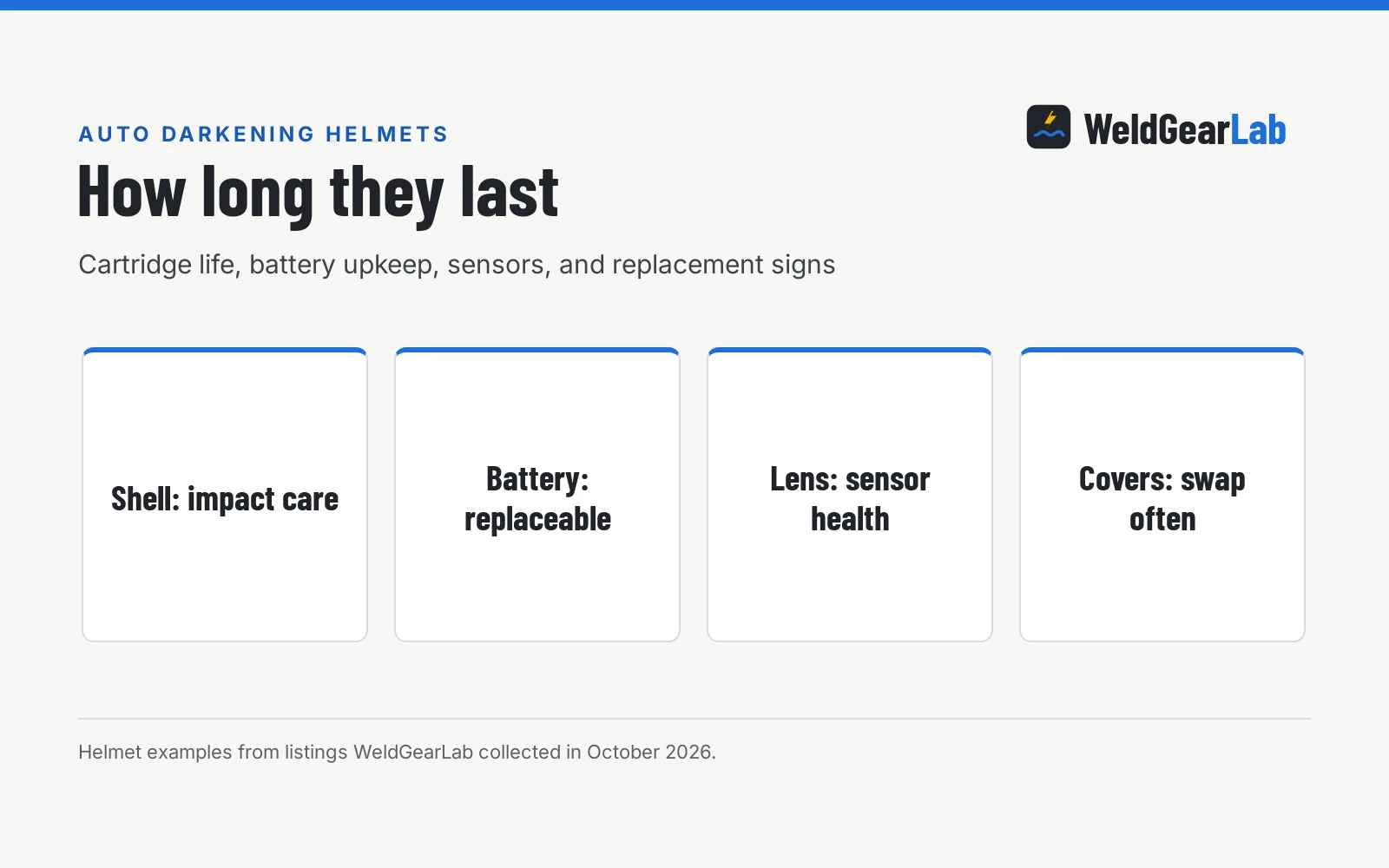
Auto Darkening Welding Helmet for Beginners
An auto darkening welding helmet for beginners keeps the view clear until the arc strikes, then darkens the lens so the puddle stays in sight while the bead runs.

On this page
Top picks at a glance
As an Amazon Associate I earn from qualifying purchases.
- 1
 Jackson Safety Insight Auto Darkening Welding Helmet9.7/10View on Amazon
- 2
 ARCCAPTAIN Auto Darkening Welding Helmet with Light9.6/10View on Amazon
- 3
 ESAB® Sentinel™ A60 Auto-Darkening Welding Helmet- Havoc9.5/10View on Amazon
A cracked bracket on a trailer, a gate hinge that needs a fresh bead, a patch on a mower deck: the job sits on the bench, the torch is ready, and the arc is about to light. An auto darkening welding helmet for beginners keeps the view clear before the arc starts, then darkens the lens the moment the arc strikes, so the puddle stays in sight without a nod or a hand flip. This guide explains shade, view, response, fit and power in plain shop terms, with figures from helmet listings to show what each setting means on a real hood.
This guide links to our product roundups, where WeldGearLab gets a commission on purchases made through links on this page, and your price stays the same. Read our affiliate disclosure.
What an auto darkening welding helmet for beginners does
An auto darkening welding helmet for beginners holds a clear lens while the welder sets up the joint, lines up the torch and checks fit-up. Sensors on the front of the hood watch for the arc, and the lens darkens when the arc strikes, then clears again when the arc stops. That change lets a new welder watch the puddle form and keep the bead on line, instead of flipping a fixed lens up and down between passes.
The shade range matters because the lens has to suit the process and the arc. ICONIC WELD lists a fixed shade at Shade #3/11, and a variable cartridge at Shade #4/9-13. MIGVAN lists Shade 4/5-9/9-13, with a light state of DIN 4, and modes for GRIND, 5-9 and 9-13. A guide on auto darkening vs fixed shade helmet sets out the trade between a fixed lens and a lens that adjusts, and welding helmet types shows where an auto darkening hood sits among the other styles.
Side by side
| Feature | ICONIC WELD helmet | MIGVAN helmet | What to look for |
|---|---|---|---|
| Shade | Shade #3/11, or #4/9-13 with VS8000 | Shade 4/5-9/9-13 | A range that covers the work planned |
| View | Not stated | 100x82mm front, 90x58mm side | A clear view of the puddle and joint |
| Response | Not stated | 1/10000s, 0.1ms | Fast darkening when the arc strikes |
| Sensors | Not stated | 4 arc sensors | Sensors that see the arc from the work angle |
| Weight | 12-13 oz | about 585g | A weight that stays comfortable through a session |
| Power | Not stated | Solar and CR2450 battery, 600mAh | Power that stays ready between sessions |
| Grind mode | Flip-up lens | GRIND, 5-9 and 9-13 | A grind setting or a way to lift the lens |
| Warranty | Not stated | 1 year | A stated warranty term in writing |
The table uses figures from the reference listings, and leaves a cell as Not stated where a listing gives no figure for that point. A fixed shade and a variable shade are not separate helmets here: ICONIC WELD offers the VS6000 fixed cartridge and the VS8000 variable cartridge for the same shell, so the shade choice is a cartridge choice.
How to read shade, view and response
Shade is the dark level of the lens while the arc burns. A light state is the shade before the arc strikes, and a dark state is the shade while the arc burns. The welding helmet shade chart maps shade to process in a way that is easy to check before striking an arc, and the hood manual gives the shade range the maker states for each mode.
View area is the size of the window through which the welder sees the puddle. MIGVAN lists a front viewing area of 100x82mm and a side viewing area of 90x58mm, with a 180 degree panoramic view that widens the field to the sides. A wide view helps a beginner see the joint edge, the torch angle and the puddle in the same glance.
Response is how fast the lens darkens when the arc strikes. MIGVAN lists a response of 1/10000s, stated as 0.1ms, with 4 arc sensors watching for the arc. Sensors matter because an arc the sensors cannot see can leave the lens light when the arc strikes. True color clarity is the claim ICONIC WELD makes for its VS6000 and VS8000 cartridges, and it means the puddle keeps a natural color through the lens.
Fit, weight and comfort
Weight shows up in the neck before it shows up anywhere else. ICONIC WELD lists a weight of 12-13 oz for its shell, with a flame-resistant leather head cover and a cooling sweatband, and a vulcanized fiber shell that the maker states as heat and water resistant. MIGVAN lists a weight of about 585g, with a PA shell, an adjustable headband and a sweat pad. The weights use different units, so a buyer should compare them in the same unit before judging which shell is lighter.
Fit is the headband, the sweatband and the way the shell sits on the head. An adjustable headband lets the hood sit level, with the lens square to the eyes. Parts of a welding helmet names the parts that wear out and the parts that can be swapped.
Power, sensors and grind mode
Power is what keeps the lens darkening when the arc strikes. MIGVAN lists solar power with a CR2450 battery, a capacity of 600mAh, and a low battery LED indicator that shows when the battery needs attention. Welding helmet battery size explains the CR2450 cell, and welding helmet maintenance covers cleaning and lens care so the view stays clear.
Grind mode keeps the lens light while the grinder runs, so the welder can see the work without the lens darkening from sparks. MIGVAN lists a mode switch with GRIND, 5-9 and 9-13. ICONIC WELD takes a different path, with a flip-up lens that lets the welder switch between welding and grinding without removing the helmet. Either path works if the welder remembers to switch back before striking an arc: the mode switch back to a weld shade, or the flip-up lens back down.
How to set up a new helmet
Set the shade to the range the manual states for the process at hand, then check the headband until the hood sits level and the lens sits square to the eyes. Wipe the lens cover clean so the puddle stays sharp. Clear dry grass and anything flammable from the area, keep ventilation moving, and wear safety glasses under the hood when chipping slag or grinding. What welding helmets provide protection from sets out what a hood shields and what it does not, and the best welder for beginners guide pairs a machine with the hood and gear that go with it.
FAQ for welders
What shade should a beginner use?
Use the shade range the manual states for the process at hand. ICONIC WELD lists Shade #3/11 for a fixed cartridge and Shade #4/9-13 for a variable cartridge, while MIGVAN lists Shade 4/5-9/9-13 with a light state of DIN 4.
Do auto darkening helmets work for MIG, TIG and stick?
MIGVAN lists its hood for Stick, MIG, TIG, plasma cutting and grinding, so those processes are covered by that listing. Check the manual for the shade range and mode the maker states for each process.
How long does the battery last?
MIGVAN is the only hood here that states a power source and a capacity, and it gives no run time. MIGVAN lists solar power with a CR2450 battery at 600mAh, and a low battery LED indicator that shows when the battery needs attention. Watch the indicator and keep a spare CR2450 cell on hand for that hood.
Is a wide view worth it for a beginner?
A wide view helps a beginner track the puddle, the joint edge and the torch angle in the same glance. MIGVAN lists a front viewing area of 100x82mm and a side viewing area of 90x58mm, with a 180 degree panoramic view.
What should a beginner check before buying a helmet?
Check the shade range, the view area, the weight, the grind mode and the warranty term the maker states. ICONIC WELD lists a weight of 12-13 oz and a flip-up lens, while MIGVAN lists a weight of about 585g, a view of 100x82mm at the front, and a warranty term of 1 year. Compare those figures in the same units.
Related: welding helmets, best welder for beginners, best auto darkening welding helmet for farm use, and the welding helmet shade chart.